The Ultimate Checklist for Choosing an SEO Company in the AI Era

The playbook for organic growth has been completely rewritten. If you are currently choosing an SEO company, you are likely realizing that the old rules of search engine optimization no longer apply. Traditional search engines are rapidly transforming into answers engines, powered by generative AI.
To win in this new landscape, your approach to selecting an SEO vendor must evolve beyond simply looking for someone who can build backlinks or write basic, repetitive blog posts. You need a partner—or a platform—built for the future of search. This comprehensive guide provides a modern agency evaluation framework to help you navigate this transition, ask the right questions, and avoid costly, outdated retainers.
Key Takeaways
| Metric / Feature | Legacy SEO Agencies | Modern AI-Era SEO (Platform + Hybrid) |
|---|---|---|
| Primary Focus | Keyword rankings, manual backlink outreach | Generative Engine Optimization (GEO), LLM visibility, entity authority |
| Content Velocity | Low (4–8 articles per month due to manual bottlenecks) | High (Continuous publishing pipelines with human-in-the-loop QA) |
| Pricing Model | Expensive monthly retainers ($2,500–$10,000+) | Value-based, performance-driven, or predictable SaaS pricing |
| Reporting Metrics | Static PDF ranking reports, keyword positions | Real-time keyword momentum, share of voice in AI Overviews |
| Tech Stack | Fragmented tools (Ahrefs, SEMrush, Google Docs) | Integrated autonomous pipelines, schema generation, real-time tracking |
Why Choosing an SEO Company Has Changed in the AI Era
Organic search is undergoing its most significant disruption since its inception. If you base your decision on criteria from five years ago, you will likely hire a team that is optimizing for a version of Google that no longer exists.
The Evolution from Traditional Search to Generative AI Search
For decades, search was simple: a user typed a query, and Google returned a list of ten blue links. Today, search engines are conversational interfaces. With Google's AI Overviews, SearchGPT, and Perplexity, users often get their questions answered directly on the search results page without ever clicking through to a website.
According to technology research firm Gartner, search engine volume is projected to drop 25% by 2026 due to AI chatbots and answer engines. This shift does not mean organic search is dying; rather, it is evolving.
To remain visible, your brand must be cited as a trusted source within these AI-generated answers. This requires a shift from traditional SEO to Generative Engine Optimization (GEO). When selecting an SEO vendor, you must ensure they understand how large language models (LLMs) retrieve and synthesize information.
Why Legacy SEO Tactics Fail in the Modern Search Landscape
Many legacy agencies still rely on tactics that are actively penalized or ignored by modern algorithms. Keyword stuffing, low-quality guest posting on private blog networks (PBNs), and thin content creation no longer work.
Industry publications like Search Engine Land frequently highlight how Google’s helpful content updates target sites that publish low-effort, outsourced articles designed solely for search engines rather than human readers.
At the same time, search remains the lifeblood of digital acquisition. Data from BrightEdge shows that organic and paid search combine to drive over 68% of all trackable web traffic across B2B and B2C industries. To capture your share of that 68%, your content must demonstrate deep topical authority, semantic richness, and flawless technical optimization. If an agency cannot explain how they optimize for entities and semantic search, they are using an outdated playbook.
What Is the Agency Evaluation Framework for Choosing an SEO Company Today?
To cut through the sales pitches, you need a structured agency evaluation framework. This framework should assess a provider’s capabilities across three core pillars: technical mastery, content strategy, and reporting transparency.

Technical Mastery & Generative Engine Preparedness
Technical SEO is no longer just about page speed and XML sitemaps. While those elements remain fundamental, modern technical SEO requires preparing your site for AI crawlers.
When evaluating a provider, look for deep expertise in:
- Schema Markup and Structured Data: This is the language AI engines use to understand the context of your content. Your provider should implement advanced schema (such as Product, Article, Organization, and FAQ markup) to make your data easily digestible for LLMs.
- Entity Optimization: Search engines now understand the world in terms of "entities" (people, places, concepts, and things) rather than just strings of text. Your SEO partner must know how to build topical authority by linking related concepts across your site.
- Crawler Accessibility: Ensuring your site can be crawled by both traditional search bots (like Googlebot) and AI bots (like GPTbot or PerplexityBot) without sacrificing security or performance.
Content Strategy: Humans, AI, and Hybrid Workflows
The debate is no longer about whether to use AI in content creation; it is about how to use it responsibly to scale output without sacrificing quality.
A modern SEO company must have a clear AI content quality assurance workflow. If they claim they write 100% of their content completely manually with zero AI assistance, they are likely either lying or operating at a speed and cost that will put you at a competitive disadvantage. Conversely, if they simply copy-paste raw outputs from ChatGPT, your site will eventually suffer from Google's quality algorithms.
The sweet spot is a hybrid workflow: using sophisticated AI pipelines to handle data gathering, structuring, and initial drafting, paired with expert editors who inject real-world experience, original insights, and brand voice.
Before signing any contracts, ask to see their quality control checklist. For a deeper look at how automated pipelines compare to traditional writing services, read our analysis on evaluating SEO content writing services vs automated AI publishing pipelines.
Reporting Transparency and Keyword Momentum Tracking
If an agency sends you a monthly PDF report showing only a few vanity keyword rankings and a vague summary of "work completed," run the other way.
Modern reporting must be dynamic and real-time. You need to track:
- Keyword Momentum: How your target keywords are climbing through the search tiers over time.
- Share of Voice in LLMs: How often your brand is cited in Google AI Overviews, Perplexity answers, and other generative engines.
- Actual Business Outcomes: Conversions, pipeline value, and revenue generated from organic traffic—not just raw clicks.
Pro Tip: Never accept static reports. Demand access to a live dashboard where you can verify keyword momentum and traffic data whenever you want.
For insights on how to transition away from static reports to actionable, developer-ready roadmaps, check out our guide on how to choose SEO audit companies that deliver actionable automation roadmaps.
What Critical Questions Should You Ask Potential SEO Providers?
When you begin interviewing candidates, you need to move past generic questions. Use these specific questions for seo providers to separate the true experts from the smooth-talking salespeople.
Questions for SEO Providers Regarding Strategy and Execution
- “How do you optimize our content to be cited in Google's AI Overviews and conversational search engines like Perplexity?”
- What to look for: They should talk about structured data, answering user intent directly in concise paragraphs, building strong digital PR citations, and establishing topical authority.
- “What is your process for ensuring AI-assisted content meets Google’s E-E-A-T (Experience, Expertise, Authoritativeness, Trustworthiness) guidelines?”
- What to look for: A clear explanation of their human-in-the-loop editing process, fact-checking protocols, and how they source unique insights that cannot be generated by an LLM alone.
- “Can you show us a live example of a client site where you successfully built topical authority from scratch in a competitive niche?”
- What to look for: Real, unmasked data showing sustained organic growth, not just cherry-picked screenshots of temporary traffic spikes.
Evaluating Pricing Models: Retainers vs. Autonomous Software
The financial structure of your partnership is just as important as the strategy. According to industry pricing benchmarks published by Moz, traditional SEO agency retainers typically range from $1,500 to $5,000+ per month, depending on the scope of work.
However, much of that retainer goes toward paying for agency overhead, account managers, and manual, slow-moving processes.
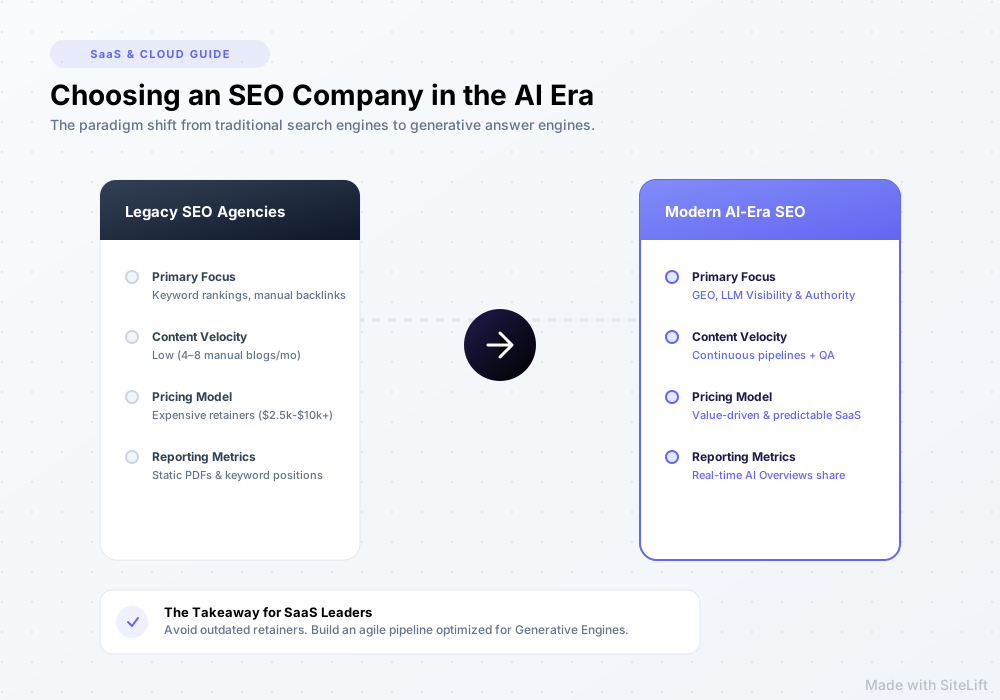
Infographic by SiteLift
When selecting an SEO vendor, compare these legacy pricing models against modern, autonomous publishing platforms. Ask yourself: Are you paying for hours billed, or are you paying for actual output and organic visibility?
To break down these costs further, explore our comprehensive guide on decoding SEO agency fees, hourly rates, and automated alternatives.
Red Flags to Watch For During the Vetting Process
Avoid providers that exhibit any of the following warning signs:
- Guaranteed Rankings: No one can guarantee a #1 spot on Google. The search algorithms change daily, and AI Overviews have introduced even more volatility. If an agency promises guaranteed rankings, they are likely using high-risk, short-term tactics that could get your site penalized. For more on this, read our expose on the truth about guaranteed SEO services and real ranking predictability.
- "Secret Sauce" Methodology: True SEO is not magic; it is engineering, high-quality content, and data. If a provider refuses to explain their process because it is a proprietary secret, they are likely hiding outdated or black-hat practices.
- Low-Quality Link Networks: Ask where they acquire backlinks. If they own or frequently use private blog networks (PBNs) or low-quality directory sites, your domain authority is at serious risk.
My Editorial Opinion: Why the Hourly Retainer Model Is Dead (and What Underrated Metric You Should Track Instead)
If you are still paying an agency $5,000 a month to write four blog posts and perform a basic "technical audit" every quarter, you are losing money.
The traditional agency model is structurally broken for the AI era. It incentivizes slow execution. Agencies bill by the hour, which means they have no financial incentive to scale your content velocity or automate manual tasks.
In my view, the most underrated metric in organic growth today is Content Velocity—the speed at which you can publish high-quality, architecturally sound pages that cover every angle of your industry's search intent.
In the AI era, you cannot build topical authority by publishing once a week. Your competitors are using automated publishing pipelines to cover entire topical clusters in days.
If your SEO vendor is held back by manual bottlenecks, you will be left behind. The future belongs to those who pair deep technical SEO with autonomous, scalable publishing systems.
Should You Hire a Traditional SEO Agency or Opt for an AI vs Agency Hybrid Model?
When deciding on the best path forward, you generally have three options: a traditional managed service agency, a pure AI tool, or an autonomous SEO and AI visibility platform.
Pros and Cons of Traditional Managed Service Agencies
- Pros: High touch, dedicated account managers, customized strategic consulting for complex, enterprise-level site migrations.
- Cons: Extremely expensive, slow execution, high risk of human error, and misaligned incentives based on billable hours rather than performance.
The Rise of Autonomous SEO and AI Visibility Platforms
Autonomous SEO platforms represent a paradigm shift. Instead of waiting weeks for an agency to perform keyword research, write an article, get it approved, and manually publish it, these platforms automate the entire pipeline.
They identify keyword opportunities, generate highly optimized content, structure the internal linking, publish directly to your CMS, and track performance—all on autopilot.
This model is particularly effective for businesses looking to scale rapidly without hiring a massive in-house team or paying exorbitant agency fees. If you are trying to decide between these paths, read our detailed comparison on choosing a local SEO agency vs autonomous local publishing to scale faster.
Cost-Benefit Matrix: Time, Scalability, and ROI
| Evaluation Criteria | Traditional Agency | Autonomous Platform |
|---|---|---|
| Time to Launch | 4–6 weeks of onboarding | Less than 24 hours |
| Publishing Capacity | Limited by human hours | Virtually unlimited scaling |
| Cost per Published Page | High ($150–$500+ per page) | Low (Fraction of the cost of manual writing) |
| Risk of Human Bottlenecks | High (Sick days, turnover, slow approvals) | None |
How Do You Implement the Ultimate SEO Checklist Before Signing a Contract?
Before you sign any agreement with an SEO provider, use this step-by-step checklist to ensure your investment is protected and structured for success.
Step-by-Step Vetting Process
- Run a Technical Baseline Audit: Request a preliminary audit of your site. If they return a generic, automated PDF report from a tool like SEMrush without any custom analysis, they are not putting in the effort.
- Request Proof of AI Quality Control: Ask for their specific editorial guidelines for AI-assisted content. Ensure they have human editors fact-checking and refining every piece of content.
- Validate Backlink Acquisition Strategies: Ask for examples of links they have built for other clients. Check the quality of those linking domains yourself using independent tools.
- Confirm CMS Integration Capabilities: Ensure they can seamlessly integrate with your existing CMS (WordPress, Webflow, Shopify, etc.) to publish and update content without requiring constant developer resources.
Key Contract Terms and Deliverables to Require
Never sign a contract that locks you into long-term commitments without clear escape clauses. Ensure your agreement includes:
- Full Content Ownership: You must retain 100% ownership of all content, metadata, and code generated during the campaign, even if you cancel the service.
- No Proprietary CMS Lock-in: Ensure they do not host your content on a proprietary platform that will break or disappear if you terminate your contract.
- Flexible Cancellation Terms: Avoid 12-month lock-ins. Look for month-to-month agreements or contracts with a 30-day cancellation clause based on performance milestones.
Dominate Modern Search Autonomously with SiteLift
If you are tired of the slow timelines, high retainers, and underwhelming results of traditional agencies, there is a better way.
SiteLift is an autonomous SEO and AI visibility growth platform designed to help businesses dominate both traditional search engines and AI answer engines on autopilot.
Instead of paying thousands of dollars a month for manual labor, SiteLift automates your entire organic growth pipeline:
- Autonomous Content Generation: Automatically creates high-quality, semantically rich content tailored to your target audience.
- Premium Network Distribution: Distributes your content across a curated network to build natural authority and backlink momentum.
- Seamless CMS Integration: Plugs directly into your WordPress, Webflow, or Shopify store to publish content automatically.
- Real-Time Tracking: Monitors your keyword momentum and search engine visibility in real-time, giving you total transparency.
Why pay for slow agency hours when you can compound your organic authority on autopilot?
— sitelift.io
FAQ
What is the average cost of hiring an SEO company in 2025?
The cost varies wildly depending on the model you choose. Traditional agencies typically charge monthly retainers between $1,500 and $5,000+, with high-end enterprise agencies charging upwards of $10,000 per month. In contrast, autonomous SEO platforms and hybrid software solutions can deliver significantly higher content velocity and technical optimization at a fraction of that cost, often ranging from a few hundred to a couple of thousand dollars per month.
How does choosing an SEO vendor differ now compared to five years ago?
Five years ago, the focus was almost entirely on keyword rankings, basic on-page optimization, and manual backlink building. Today, you must evaluate a vendor's ability to optimize for Generative Engine Optimization (GEO). This means assessing how they handle structured schema markup, entity relationships, and content quality control in an era where AI Overviews and conversational search engines (like ChatGPT and Perplexity) dominate search results.
What are the biggest red flags when interviewing an SEO provider?
The major red flags include guarantees of #1 rankings, vague explanations of their strategy (claiming they have a "secret sauce"), reliance on private blog networks (PBNs) for link building, and static, non-interactive reporting. Additionally, if they claim they do not use AI at all in their processes, they are likely either falling behind in efficiency or not being entirely transparent with you.
Can an AI platform replace a traditional SEO agency?
For many businesses, yes. An autonomous SEO platform like SiteLift can handle keyword research, content production, publishing, internal linking, and performance tracking faster and more cost-effectively than a traditional agency. However, for highly complex tasks like major enterprise site migrations or custom international SEO setups, a hybrid model—using an autonomous platform paired with specialized technical consulting—often yields the best results.
How long does it take to see results from a new SEO company or platform?
Organic search is a compounding channel, so results are rarely instantaneous. Generally, you can expect to see early signs of progress—such as improved technical health scores and crawl rates—within the first 30 to 60 days. Significant ranking momentum, traffic increases, and citations in AI Overviews typically begin to manifest between 3 and 6 months, depending on your industry's competitiveness and your publishing velocity.
Topics Covered:
- choosing seo company
- selecting seo vendor
- agency evaluation framework
- questions for seo providers
- ai vs agency
More from SiteLift

AI for SEO: How to Automate Research, Content Creation and Distribution
Learn how to use AI for SEO to automate keyword research, generative content creation, CMS publishing, and search engine visibility.

SEO Tools in 2026: How to Build an Autonomous Stack That Grows Traffic on Autopilot
Discover how to build an autonomous stack with modern AI SEO tools, automated publishing workflows, and real-time rank tracking to grow organic traffic.

Repurposing Content for SEO: How to Multiply Organic Reach Across Channels
Learn how repurposing content for SEO multiplies organic reach. Discover step-by-step strategies for syndication, AI visibility, and automation.