Ecommerce Link Building: Scale Product Authority and Revenue on Autopilot

Driving organic revenue to an online store is vastly different from ranking an informational blog. If you manage an online shop, you have likely discovered the hard truth: executing effective ecommerce link building is one of the most frustrating challenges in search engine optimization. Webmasters and journalists love linking to original research, free tools, and opinion essays, but getting them to link directly to a commercial product page feels like pulling teeth.
According to research by BrightEdge, organic search accounts for 44% of revenue on average across retail and ecommerce websites. Yet, winning top visibility for competitive search terms requires serious algorithmic muscle. According to Backlinko's search engine ranking factor study, the #1 result in Google has an average of 3.8 times more backlinks than positions 2 through 10. Without a systematic framework to build search authority, your store risks remaining invisible to ready-to-buy consumers.
Below, we break down how to overcome the commercial intent barrier, build high-equity links that move the needle, and automate the process so your store compounds authority while you focus on fulfillment.
Key Takeaways
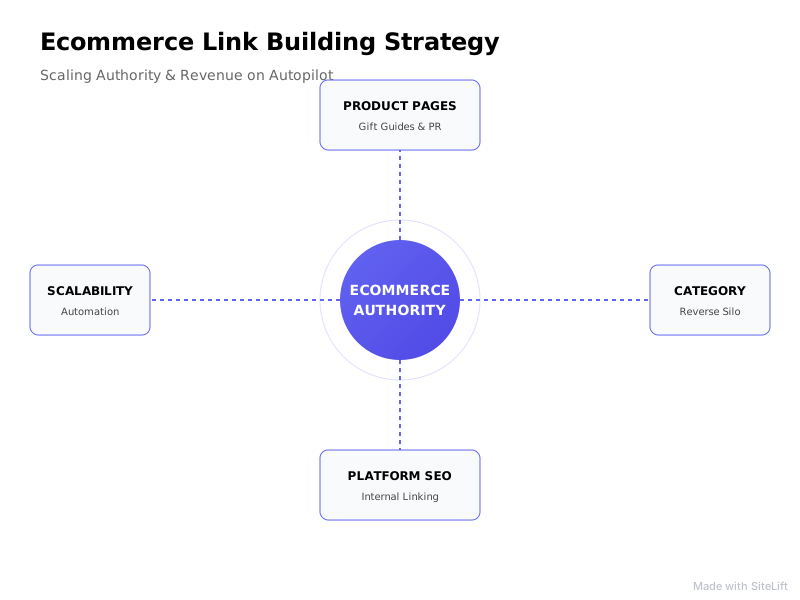
| Core Focus Area | Primary Challenge | High-Impact Solution |
|---|---|---|
| Product Pages | High commercial intent makes third parties hesitate to link directly. | Gift guides, product-led PR campaigns, and unlinked brand reclamation. |
| Category Pages | High-volume keywords with fierce competition from retail giants. | The Reverse Silo Method: funnelling link equity from top-funnel research assets. |
| Platform SEO | Inventory churn and platform URL constraints (e.g., Shopify /products/). |
Strategic internal linking and 301 redirect management for out-of-stock items. |
| Scalability | Manual email outreach is labor-intensive with low conversion rates. | Programmatic link assets, autonomous PR workflows, and data-driven indexing. |
What Is Ecommerce Link Building and Why Is It Uniquely Challenging?
Ecommerce link building is the strategic practice of acquiring inbound hyperlinks from authoritative external websites to your category pages, product pages, and supporting content assets. In search algorithms, backlinks act as external votes of confidence. As defined in Moz's foundational guide to link building, inbound links transfer crawl equity and PageRank, signalling to search engines that a specific domain is trustworthy enough to serve to active searchers.
For an online retailer, those links directly correlate with category rankings, keyword visibility, and bottom-line checkout revenue. However, traditional link outreach playbooks built for SaaS or B2B blogs fall flat when applied to commercial storefronts.
Infographic by SiteLift
The Commercial Intent Barrier: Why Websites Hesitate to Link to Products
When an editor or blogger writes an article, they want to provide value to their readership. Linking out to a comprehensive guide, a scientific study, or a free calculator adds editorial value to their text.
Linking out to a $95 pair of running shoes, however, looks like an endorsement or an affiliate relationship.
Editorial gatekeepers are protective of their audiences. They know that a link pointing directly to an "Add to Cart" button carries overt commercial intent. Unless you are offering an affiliate commission or providing an exclusive product sample for a hands-on review, webmasters will routinely ignore standard cold emails asking them to link to your individual product listings.
Category Page Link Building vs. Product Page Backlinks
To structure an ecommerce campaign effectively, you must distinguish between building links to individual products versus high-level product categories:
- Category Page Link Building: Category pages (e.g., "Men's Leather Boots") target short-tail, high-volume search queries. These pages account for the lion's share of commercial organic discovery. However, category pages are notoriously dry and difficult to build direct links to, requiring creative authority funnels.
- Product Page Backlinks: Product pages (e.g., "Handcrafted Waterproof Chelsea Boot - Size 10") target transactional, long-tail queries. While conversion rates on these pages are higher, individual products eventually run out of stock, change URLs, or get discontinued.
Pouring your entire outreach budget into building direct links to seasonal or fast-moving SKUs creates a fragile SEO foundation. The real challenge is establishing a steady stream of equity that strengthens the entire site architecture over time.
The Direct Impact of External Authority on Shopify and Headless Stores
Modern ecommerce platforms—whether Shopify, Magento, BigCommerce, or custom headless builds—often introduce structural SEO hurdles. Shopify, for instance, nests product URLs within collections (/collections/footwear/products/boot-name) while maintaining a canonical version at the root (/products/boot-name).
If your external backlink profile is weak, search crawlers struggle to crawl, render, and index these complex directory setups. According to Ahrefs, 90.63% of all web pages receive zero organic traffic from Google, largely due to a complete lack of referring domains. External authority acts as crawl fuel: it elevates your entire crawl budget, prompting Google to discover new product variations, process index updates, and rank your collections above competing stores.
What Are the Most Scalable Strategies for Ecommerce Link Acquisition?
Generating consistent inbound links to an online store requires tactics that bypass the commercial intent barrier. You cannot simply ask for links; you must manufacture compelling editorial reasons for publications to cite your store.
Ecommerce Digital PR and Proprietary Consumer Data Reports
Ecommerce digital PR is arguably the most scalable way to generate mainstream press coverage at scale. Instead of pitching your actual merchandise, you turn your transactional backend into proprietary data stories.
Consider the aggregated data an online store sits on:
- Average spend trends across different geographic markets.
- Sudden spikes in demand for specific aesthetics, materials, or lifestyle goods.
- Seasonal inflation fluctuations on everyday products.
Publishing these findings as a quarterly "Consumer Shopping Trend Index" turns your brand into a primary research source. Lifestyle journalists, consumer-interest writers, and financial reporters routinely pull quotes and statistics from original data reports, linking back to your domain as the primary source. This tactic builds top-tier domain trust that you can channel downward into commercial hubs.
Curated Gift Guides, Product Inclusions, and Trend Roundups
During Q4 and major seasonal holidays (Mother's Day, Valentine's Day, Summer resets), digital publications publish hundreds of curated gift guides. These roundups are direct pipelines for securing product page backlinks.
The key to pitching gift guides is matching editorial timelines:
- Lead Time: Large-scale print-and-digital publications plan their holiday gift guides 3 to 5 months in advance. Digital-only lifestyle blogs plan 4 to 6 weeks out.
- Product Samples: Provide clear imagery, high-resolution product specs, and frictionless options for editors to test the item in person.
- Affiliate Compatibility: Many modern media conglomerates rely on affiliate networks (Skimlinks, ShareASale, CJ) to monetize roundups. Ensuring your store runs on an accessible affiliate network actually increases your odds of editorial inclusion, while the primary SEO benefit comes from the contextual brand association and accompanying natural links.
Supplier, Manufacturer, and Stockist Backlink Reclamation
If you sell third-party brands or source materials from recognized manufacturers, you have access to one of the most overlooked link sources in ecommerce: dealer directories.
Almost every major brand, wholesale distributor, and material supplier maintains a "Where to Buy" or "Our Stockists" page on their corporate website. These corporate domains carry high domain authority and deep topical trust.
Perform a backlink audit of your inventory:
- Identify all manufacturers whose products you carry.
- Crawl their websites for existing stockist listings.
- Contact your account manager or wholesale representative requesting your retail store be added to their official merchant locator.
This tactic requires zero content creation and nets contextual, highly relevant links from domains directly tied to your niche.

How Do You Funnel Equity to Category and Product Pages Safely?
Acquiring backlinks is only half the battle. If those inbound links point exclusively to isolated blog posts or discontinued press assets, your money pages will not see ranking improvements. You must intentionally funnel external authority through your internal architecture.
The Reverse Silo Method: Channeling Top-Funnel Authority Inward
Because external sites prefer linking to helpful guides rather than transactional checkout pages, you can use the Reverse Silo Method to redistribute link equity across your store.
[External High-Authority Links]
               │
               ▼
   [Top-Funnel Research Guide]
   (e.g., "How to Choose Hiking Boots")
               │
       ┌───────┴───────┐
       ▼               ▼
[Category Page]  [Sub-Category Page]
(Men's Boots)    (Trail Footwear)
       │               │
       ▼               ▼
[Product SKU]    [Product SKU]
- Publish Linkable Assets: Create comprehensive sizing guides, material care teardowns, or technical industry glossaries.
- Earn Top-Tier Backlinks: Direct your digital PR campaigns and outreach efforts toward these educational assets.
- Funnel Internal Links Contextually: Within the body of these high-authority guides, place prominent, contextual internal links pointing directly up to your target category pages and featured product variations.
This approach ensures you don't breach editorial guidelines when pitching content, while Google's PageRank naturally flows into your commercial catalog. If you manage an open-source storefront, you can read our deep dive on how to automate store content to maintain proper internal linking across growing catalogs without manual friction.
Optimizing Anchor Text Distribution for Shopify SEO Links
When building links to commercial assets, improper anchor text distribution is the quickest way to trigger an algorithmic review. If a store aggressively acquires hundreds of links with exact-match commercial anchors like "cheap running shoes online," search engine filters flag the pattern as unnatural manipulation.
To safeguard your domain, follow search engine compliance best practices by referencing the official Google Search Central guide on crawlable links. Maintain a diversified anchor profile:
- Branded Anchors (50–60%): Store name, domain name, brand variations (e.g., "SiteLift", "SiteLift store", "sitelift.io").
- Topical / Partial-Match Anchors (20–30%): Natural descriptions incorporating keywords (e.g., "this footwear guide by Brand", "leather shoe collections").
- Generic Anchors (10–15%): Natural reading cues (e.g., "visit website", "source", "view catalog").
- Exact-Match Anchors (<5%): Reserved for natural editorial mentions of the core commercial term.
Pro Tip: Never force commercial target keywords into guest post anchors or partner links. The editorial context surrounding the link informs search engines about the destination page's topic without needing an exact-match anchor.
Managing Expired and Out-of-Stock Product Link Equity with 301 Redirects
One of the largest leaks of SEO value in ecommerce happens when seasonal products go out of stock or are discontinued.
When a product page that earned five high-quality backlinks is deleted, it throws a 404 error. The accumulated link equity is wiped out. To preserve authority across your platform:
- Temporary Stockouts: Keep the URL live. Keep the product indexed, display clear notifications that the item is temporarily unavailable, and dynamically suggest related products to retain visitors.
- Permanent Discontinuation: Never delete the page without a redirect plan. Execute a 301 permanent redirect from the discontinued SKU URL to the most closely related parent category page or the direct replacement product.
- Avoid Redirecting Everything to the Homepage: Mass-redirecting hundreds of dead product URLs to your store's root domain causes search engines to treat those redirects as soft-404s, neutralizing the passed link equity.
Why Middle-of-Funnel Programmatic Assets Are Underrated
In my experience running technical SEO for fast-growing storefronts, standard link outreach to product pages is largely a vanity exercise. Teams burn thousands of dollars every month sending automated cold pitches to lifestyle bloggers, offering a $30 product in exchange for a contextual link, only to walk away with a handful of nofollowed affiliate blurbs.
The most underutilized goldmine in ecommerce link acquisition is middle-of-funnel programmatic assets.
Merchants obsess over the two extremes of content: top-of-funnel lifestyle blog posts ("Top 10 Fashion Trends for Autumn") and bottom-of-funnel product detail pages. But the content that naturally attracts recurring editorial links from journalists, forum moderators, and niche resource curators is the unsexy, hyper-specific utility content sitting in the middle:
- Comprehensive interactive sizing and international measurement conversion tools.
- In-depth material degradation tests and care matrices.
- Open-source compatibility registries (e.g., "Which mechanical parts fit which vintage models").
These programmatic pages require an upfront engineering or content investment, but they attract organic links passively for years. Instead of chasing one-off product reviews, build the definitive utility resources your industry's community cannot help but cite.
How Can Brands Put Ecommerce Link Building on Autopilot?
Manual email prospecting, tracking down journalist contact details, and negotiating placements is an unsustainable time sink. To achieve sustained growth, leading retail brands are transitioning toward automated organic growth engines.
Autonomous Content Generation for Topical and Programmatic SEO Assets
To earn links passively, a store must consistently expand its topical surface area. The more relevant, search-optimized content your domain hosts, the more opportunities external publishers have to discover and link to your pages.
By leveraging autonomous content pipelines, stores can programmatically produce:
- In-depth buyer guides tailored to emerging long-tail queries.
- Comprehensive troubleshooting manuals for specific product lines.
- Topical comparisons breaking down the pros and cons of distinct materials.
When high-quality content is generated and published automatically to your store, your library of linkable assets expands without tying down internal editorial teams. To understand the underlying mechanics of automated authority generation, explore our framework on auto link building.
Automated Media Outreach and Unlinked Brand Mention Monitoring
As an ecommerce store expands, publications, influencers, and review platforms will inevitably mention your brand, your custom products, or your founders without hyperlinking back to your site.
These unlinked brand mentions represent low-hanging link acquisition fruit. Automated monitoring systems track search engines, news feeds, and social platforms in real time:
- Detection: A tool identifies a lifestyle article naming your proprietary product.
- Verification: The software checks if the mention contains an active
<a>tag pointing to your store. - Outreach Trigger: If no link is detected, an automated, hyper-personalized email sequence is dispatched to the author, thanking them for the feature and providing the direct URL to the exact product mentioned for their readers' convenience.
This simple automated workflow routinely yields conversion rates of 20% to 35% because the hard part—getting editorial buy-in—has already happened organically.
AI-Driven Distribution Networks for Omnichannel Authority
Modern consumer discovery is no longer restricted to traditional blue links on a desktop screen. Consumers search for products via generative AI assistants (like ChatGPT, Perplexity, and Google Gemini), voice-enabled devices, and social discovery feeds.
Building authority across this modern landscape requires multi-point citation signals. When your store publishes a new product line or consumer study, automated syndication pipelines should immediately distribute structured summaries across established publishing networks, niche communities, and industry aggregators. These diverse contextual signals validate your store's expertise to both traditional search spiders and modern Large Language Model (LLM) training crawlers.
Scaling this level of organic visibility manually requires massive internal overhead or expensive agency retainers. That is why modern retail brands turn to sitelift.io to automate the entire process.
SiteLift functions as an end-to-end, autonomous SEO growth platform that generates high-ranking programmatic content, distributes it across curated networks, and monitors keyword velocity automatically. By deploying an autonomous pipeline, you eliminate the operational bottlenecks of manual outreach and put your organic authority on autopilot, compounding the tangible link building benefits that drive predictable revenue.
What Common Pitfalls Can Derail Ecommerce Link Building Campaigns?
When trying to move the needle on product rankings, store owners often cut corners that jeopardize their domain's long-term health. Avoid these three common traps:
Over-Reliance on Thin Coupon and Affiliate Aggregator Links
It is tempting to look at a competitor's backlink profile, notice thousands of links from coupon aggregators and discount deal portals, and attempt to copy them.
These low-tier scraper sites provide virtually zero search equity. Modern search engines understand the intent of coupon scrapers and devalue these links algorithmically. Worse, if your brand actively creates fake promotional profiles on spam-heavy deal forums to manufacture backlinks, you run the risk of triggering an algorithmic link spam penalty.
Ignoring Link Attribution and Sponsored/Nofollow Tag Nuances
If you send free products to bloggers, sponsor an industry podcast, or pay an influencer to write a review of your collection, strict compliance rules apply.
Search engines require commercial or incentivized endorsements to utilize appropriate link attributes:
rel="sponsored": Explicitly identifies links created as part of advertisements, sponsorships, or paid agreements.rel="nofollow": Instructs crawlers not to associate the target page with your site for PageRank passing purposes.
Failing to use sponsored tags on paid campaigns can result in algorithmic or manual penalties. However, true editorial reviews—where you provided a product for consideration with zero guarantee of coverage or editorial control—do not require commercial tags and can legitimately pass standard link equity.
Sacrificing Domain Relevance for Raw Domain Rating (DR)
A common mistake in ecommerce link building is prioritizing high third-party domain metrics over topical relevance.
A backlink from an authoritative sports performance blog to a store selling running sneakers provides immense contextual value. That exact same link pointing to an online store selling bespoke handmade jewelry looks completely anomalous. A link profile full of disconnected, high-authority sites lacking topical overlap alerts search algorithms that your backlink footprint is likely artificial. Topical alignment must always supersede raw authority metrics.
Frequently Asked Questions
Why is it harder to build links to ecommerce product pages than blog posts?
Product pages have overt commercial intent. Editorial publications and bloggers view linking directly to an "Add to Cart" button as free advertising or an unmonetized affiliate endorsement. Blog posts, research papers, and educational guides provide objective informational value to readers, making editors far more willing to cite them without demanding payment or affiliate partnerships.
Should you build links to category pages or specific product pages?
The ideal strategy is to funnel the majority of your link-building efforts toward category pages via educational middle-of-funnel content. Category pages target high-volume commercial keywords and remain stable over time. Product pages are subject to inventory changes, seasonal stockouts, and discontinuation, making long-term link equity preservation harder to maintain at the individual SKU level.
How does ecommerce digital PR differ from standard link building?
Standard link building typically relies on direct webmaster outreach, guest posting, or directory submissions to acquire links. Ecommerce digital PR acts like a creative newsroom: you package proprietary customer shopping data, consumer trend reports, or unique commentary on industry shifts to earn spontaneous, top-tier editorial coverage and high-authority citations from major journalistic publications.
Can you automate ecommerce link building without risking a Google penalty?
Yes, provided your automation focuses on the creation of high-value linkable assets, real-time unlinked mention monitoring, and streamlined relationship management rather than mass-spamming webmasters or publishing low-quality PBN (Private Blog Network) links. Automating content creation, data aggregation, and distribution workflows helps earn links organically without violating search engine quality guidelines.
— sitelift.io
Topics Covered:
- ecommerce link building
- product page backlinks
- ecommerce digital PR
- category page link building
- shopify seo links
More from SiteLift

White Hat Link Building Techniques That Still Work for Google and AI Search
Discover 5 proven white hat link building techniques that earn top Google rankings and AI search citations. Master ethical link building today.

Crawling in SEO: How Google and AI Bots Discover and Rank Your Pages
Master crawling in SEO. Learn how Googlebot and AI scrapers discover pages, compare indexing vs crawling, and optimize your crawl budget.

Local Link Building That Actually Moves the Map Pack in 2026
Master local link building to dominate the Google Map Pack. Learn hyper-local PR, citation audits, multi-location scaling, and geo-targeted backlink strategies.