7 Link Building Benefits That Compound Traffic, Authority and AI Visibility

If you've been tracking organic acquisition metrics lately, you already know search is undergoing its biggest transformation in a decade. Organic growth isn't just about targeting low-competition keywords anymore; it requires demonstrating undisputed authority across traditional web indexes and emerging artificial intelligence platforms. Understanding the foundational link building benefits is what separates brands that quietly scale from those that get lost on page three of search results.
Data from BrightEdge reveals that organic search drives over 53% of all website traffic, outperforming paid acquisition and social channels combined. Earning that traffic requires a rock-solid foundation of web authority and external validation.
In this guide, we break down the 7 compounding link building benefits that drive long-term SERP performance, accelerate AI search citations, and build a defensive moat around your organic revenue.
What Makes Link Building Benefits Critical for Modern Search SEO?
In modern search, a backlink is far more than a simple clickable button. It acts as a digital vote of confidence. When a reputable site links to your content, search algorithms interpret that connection as a clear validation of your expertise, authoritativeness, and trustworthiness (E-E-A-T).
Official search documentation from Google Search Central confirms that crawling spiders rely heavily on links to discover fresh web content and evaluate structural authority. Without these algorithmic votes, even high-value content struggles to gain traction. Industry statistics from Ahrefs highlight this reality: 90.63% of all web pages get zero organic search traffic from Google, with a lack of incoming backlinks standing out as the single primary reason behind their invisibility.
However, modern search engines no longer respond to simple backlink quantity. Low-tier web directories or artificial link schemes can trigger algorithmic penalties. Earning sustainable top rankings requires acquiring high-relevance, authoritative inbound links that pass genuine trust equity across the web.

1. Compounding Domain Authority and Keyword Rankings
Link building for domain authority remains one of the most reliable predictors of organic search success. When high-trust domains link to your site, they pass a portion of their authority equity downstream to your pages. Over time, this cumulative authority elevates your entire root domain, making it dramatically easier for new content to rank quickly for high-value competitive terms.
- What It Is: The process of accumulating high-trust backlinks to elevate root domain authority metrics and boost rankings across all indexed URLs.
- Who It's Best For: Companies targeting high-volume, competitive industry keywords that require substantial domain-level trust to break onto page one.
- Standout Strength: Research from Backlinko revealed that the #1 result on Google has an average of 3.8x more backlinks than positions #2 through #10. As noted in Moz's domain authority guide, raising domain-level trust directly amplifies your page-level ranking potential.
- Main Drawback: Domain authority takes consistent effort and time to accumulate; single links rarely yield overnight ranking jumps.
2. Sustainable, Multi-Year Organic Traffic Growth
One of the greatest benefits of backlinks for seo is their long-term shelf life. Unlike pay-per-click (PPC) ad campaigns where traffic vanishes the second your daily ad budget runs out, high-quality backlinks continuously channel organic visitors to your site for years without additional spending.
- What It Is: The compounding accumulation of search engine visibility that drives increasing backlinks and organic traffic growth over extended horizons.
- Who It's Best For: SaaS platforms and digital businesses aiming to lower Customer Acquisition Costs (CAC) and build predictable organic revenue pipelines.
- Standout Strength: Exceptional multi-year ROI. A single contextual link embedded in an evergreen industry publication can generate passive traffic for five years or more. Building a structured scalable backlinks SEO strategy turns content publishing into a self-sustaining engine.
- Main Drawback: Requires patience upfront before traffic hits the exponential inflection point.
3. Enhanced Visibility Across AI Search Engines and LLMs
Search is no longer limited to traditional Google SERPs. Conversational AI engines like SearchGPT, Perplexity AI, and Google Gemini synthesize web information to answer user prompts directly. These large language models (LLMs) evaluate backlink frequency, authority signals, and co-citation patterns to decide which web sources are authoritative enough to cite in generated responses.
- What It Is: Securing brand references and citations within AI-generated search answers by establishing deep authority across indexed web databases.
- Who It's Best For: SaaS platforms, B2B enterprises, and modern consumer brands striving to capture early-stage product research queries in conversational search tools.
- Standout Strength: Expands brand visibility through link building beyond standard blue links into conversational interfaces where high-intent buyers spend time.
- Main Drawback: Native analytics tools do not yet provide unified, granular attribution for generative AI impressions.
Pro Tip: Focus on acquiring contextual links from industry-specific resource hubs and recognized news publications. LLMs rely heavily on consensus citations across trusted media outlets when choosing sources for generative answers.
4. Accelerated Search Engine Crawling and Faster Indexing
Search engine spiders discover new content by crawling known web pages. When a web crawler visits a high-authority site that publishes regularly, it follows outbound links to discover target pages. Websites backed by strong backlink profiles get crawled and indexed in a fraction of the time compared to isolated sites.
- What It Is: The optimization of crawl budgets and indexing speeds as search bots follow inbound links to discover your newest pages.
- Who It's Best For: High-growth blogs, news portals, and SaaS websites regularly publishing new documentation or product updates.
- Standout Strength: Slashes the time delay between hitting "Publish" and ranking on search engines. Combining crawl efficiency with targeted content marketing for link building ensures fresh assets index almost instantly.
- Main Drawback: Rapid indexing will not keep low-quality content at the top of SERPs if user engagement metrics fall flat.
5. High-Intent Referral Traffic and Qualified Lead Generation
While algorithmic rankings get most of the attention, the direct business impact of referral traffic is often massive. When your platform is linked inside an article discussing specific industry solutions, the visitors who click that link are pre-qualified prospects actively seeking solutions.
- What It Is: Direct traffic flowing from external niche publications, trade blogs, and review hubs directly to your conversion pages.
- Who It's Best For: Product-led growth (PLG) SaaS products and specialized service providers targeting precise buyer personas.
- Standout Strength: Referral traffic from contextual links often converts at a significantly higher rate than organic or social traffic because the referring content pre-frames your solution.
- Main Drawback: Low-quality directory links yield practically zero click-throughs or real human traffic.
6. Stronger Brand Credibility and Industry Reputation
When prospective customers see your business cited in top-tier industry publications, perceived brand risk plummets. Links function as public endorsements from established outlets, cementing your reputation as a market leader in your space.
- What It Is: The elevation of brand trust and market reputation through high-tier editorial placements, expert quotes, and co-citations.
- Who It's Best For: Emerging startups competing against entrenched legacy market leaders in crowded sectors.
- Standout Strength: Supercharges off-page authority while simultaneously driving brand visibility through link building across your addressable market.
- Main Drawback: Manual outreach to top publications requires heavy time investments or specialized link building tools.
7. Long-Term SEO Resilience and Competitive Moat Building
Search engines roll out core algorithm updates multiple times per year. Websites built on artificial link networks or thin content profiles frequently suffer major traffic drops during these updates. Conversely, sites anchored by diverse, high-trust backlink profiles hold their ground through algorithm updates.
- What It Is: Constructing a defensive organic moat using trusted backlinks that shield your site from algorithmic shifts and competitor aggressive push.
- Who It's Best For: Established businesses looking to protect market share and lock in long-term organic revenue pipelines.
- Standout Strength: Creates a massive competitive barrier. Replicating hundreds of earned editorial links takes new competitors years and substantial capital.
- Main Drawback: Maintaining backlink health requires ongoing monitoring to address broken links or disavow toxic web spam.
I've evaluated hundreds of organic growth campaigns, and the manual outreach model for earning backlinks is fundamentally broken for mid-market teams. Pouring hundreds of human hours into sending cold outreach emails for one-off guest posts is an inefficient way to build modern web authority. If you want to scale domain trust in the current search environment, passive authority building through automated distribution is the most sustainable path forward.
Summary Comparison: Key Link Building Benefits at a Glance
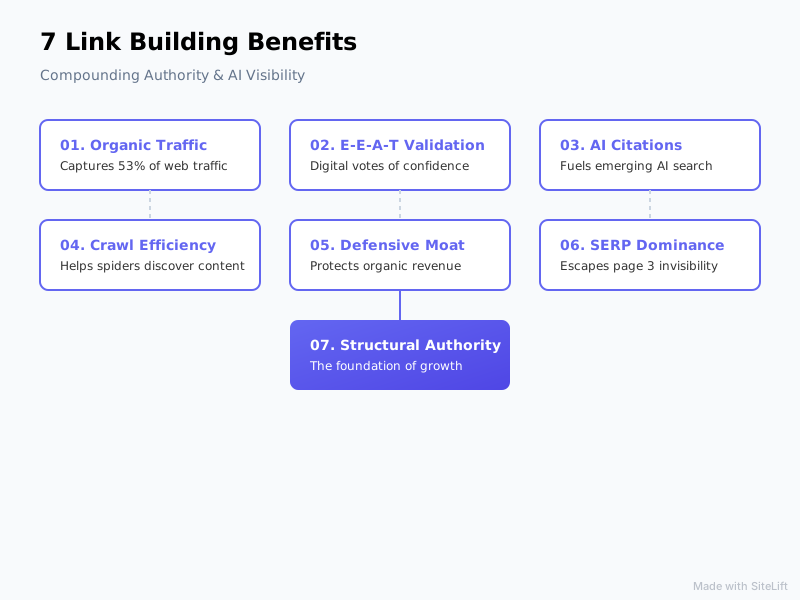
Infographic by SiteLift
| Benefit | Primary Impact | Timeline to Result | Effort Level | Key Metric |
|---|---|---|---|---|
| 1. Domain Authority & Rankings | Boosts sitewide organic positions | 3 - 6 Months | High | Domain Rating (DR/DA) |
| 2. Organic Traffic Growth | Multi-year compounding visitors | 6 - 12 Months | Continuous | Organic Sessions |
| 3. AI Search Visibility | Secures citations in SearchGPT & Perplexity | 1 - 3 Months | Medium | Generative Citation Rate |
| 4. Accelerated Crawling | Rapid discovery & indexing of pages | 1 - 4 Weeks | Low | Indexation Velocity |
| 5. High-Intent Referral Traffic | Pre-qualified visitors & direct sales | Immediate | Medium | Referral Conversion Rate |
| 6. Brand Credibility & PR | Stronger user trust & industry standing | 3 - 6 Months | High | Branded Search Volume |
| 7. Competitive SEO Moat | Shields domain from core algorithm shifts | 12+ Months | Continuous | SERP Ranking Stability |
Harnessing Link Building Benefits with Automated Distribution
Understanding the compounding link building benefits is straightforward; executing a reliable link acquisition strategy without drowning in outreach management is the real operational challenge. Manual link prospecting, outreach pitch writing, and publisher negotiation frequently take up valuable internal resources.
That is why forward-thinking companies rely on autonomous platforms like sitelift.io to automate authority growth. SiteLift offers an end-to-end publishing engine that generates targeted assets, integrates directly with popular CMS platforms, and distributes content across a curated premium publisher network. Instead of spending months chasing manual backlinks, SiteLift compounds your organic traffic, domain authority, and AI visibility on autopilot.
FAQ
What are the primary benefits of link building for SEO?
The primary link building benefits include boosting domain authority, driving sustainable organic traffic growth, accelerating page indexation, securing brand citations in AI search engines (SearchGPT, Perplexity), generating referral leads, and building long-term search algorithm resilience.
How long does it take to see organic traffic growth from new backlinks?
Most high-trust backlinks start signaling search engines within 2 to 4 weeks after indexing. However, compounding organic traffic growth typically becomes noticeable between 3 to 6 months as algorithms evaluate cumulative authority gains across your domain.
Does link building help with AI search engines like SearchGPT and Perplexity?
Yes. Large Language Models (LLMs) and generative search engines rely on established web citations to validate facts and synthesize entity relationships. Earning backlinks on authoritative web domains directly increases the probability of your site being featured as a source in AI-generated answers.
What is the difference between follow and nofollow backlinks for authority?
Follow backlinks explicitly pass authority equity (PageRank) to the target page, directly lifting domain authority metrics. Nofollow links instruct search engines not to pass authority equity, though they still deliver referral traffic, brand exposure, and natural backlink profile balance.
How does domain authority impact overall organic rankings?
Domain authority reflects your website's total trust footprint in search engine indexes. A higher domain authority metric enables new content pages to rank much faster for competitive search queries because search engines already trust your root domain.
— sitelift.io
Topics Covered:
- link building benefits
- benefits of backlinks for seo
- link building for domain authority
- backlinks and organic traffic growth
- brand visibility through link building
More from SiteLift

High Intent Keywords: How to Find and Win Searches Ready to Convert
Learn how to find high intent keywords, validate intent with SERP & CPC, and win ready-to-buy searches.

Competitive Keyword Analysis: How to Find and Steal Rival Keywords That Convert
Master competitive keyword analysis with our step-by-step guide. Learn how to run a keyword gap analysis, prioritize high-value terms, and scale traffic.

SEO Content Planner: How to Plan 90 Days of Compounding Content on Autopilot
Learn how to use an SEO content planner to build a 90-day compounding strategy. Automate briefs, map topical authority, and scale traffic on autopilot.