7 Best Link Building Tools for SEO to Scale Authority on Autopilot

Research by Siege Media reveals that over 65% of SEO professionals consider link building to be the most challenging aspect of search engine optimization. Sending hundreds of manual cold emails every week to secure a handful of backlinks is no longer a viable growth engine. If you want to scale domain authority and capture market share in competitive SERPs, you need the right link building tools for seo in your tech stack.
Modern search engines look far beyond simple anchor text matches. Both traditional web crawlers and AI answer engines like ChatGPT and Perplexity evaluate content using brand mentions, topical density, and sitewide link context.
We tested and evaluated the leading link acquisition, analysis, and distribution platforms on the market. In this guide, we break down the seven top software platforms that will help you scale backlink acquisition without burning through hundreds of hours of manual labor.
What Makes an Effective Link Building Tool in the AI Search Era?
Before picking a software platform, you need to understand how the backlink ecosystem has evolved. Cold email templates and generic outreach scrapers are yielding lower response rates every quarter. To build real topical authority, your tooling must meet modern technical standards.
Evaluation Criteria: Data Accuracy, Workflow Automation, and Scalability
An effective link building stack should solve at least one of three core bottlenecks: finding qualified prospects, automating communication, or directly distributing high-grade content across authoritative domains.
When reviewing tools, focus heavily on these technical criteria:
- Live Index Size and Freshness: Software relies on web crawlers. If a database takes weeks to detect fresh inbound links or broken targets, your team wastes time chasing stale opportunities.
- Email Deliverability Safeguards: Outbound outreach platforms must include domain warm-up sequences, automated email rotation, and MX record monitoring to protect your primary domain reputation.
- Workflow Automation: The best tools eliminate repetitive tasks like contact discovery, follow-up sequencing, and campaign performance reporting.
Balancing Automated Link Prospecting with White Hat Link Acquisition
Automation should never mean spamming website owners. Unsolicited, low-quality outreach can backfire, resulting in ignored emails or manual action penalties. According to Google Search Central documentation, artificial link schemes designed to manipulate search rankings violate webmaster guidelines and risk algorithmic suppression.
To maintain white hat link acquisition standards while growing, top SEO teams use a hybrid strategy. They combine precise automated link prospecting with strategic digital PR, high-value editorial assets, and automated content distribution systems.
1. SiteLift: Best for Fully Autonomous Content Distribution and Authority Building
Core Capabilities & Premium Content Distribution Network
SiteLift reimagines how growing companies scale search rankings and AI engine visibility. Rather than forcing teams to spend dozens of hours sending cold emails for a single backlink placement, SiteLift functions as an autonomous SEO engine.
It creates targeted, expert-level articles designed for search intent and pushes them across a premium content distribution network. This process creates high-authority context and natural inbound editorial references for your target pages automatically.
+-------------------------------------------------------------------+
|                        SiteLift Workflow                          |
+-------------------------------------------------------------------+
|  1. Auto-generate SEO/AI target content                           |
|  2. Distribute through premium syndication network                 |
|  3. Real-time keyword momentum & rank tracking                    |
+-------------------------------------------------------------------+
With native integrations for popular CMS platforms like WordPress, Webflow, and Shopify, SiteLift handles the publishing pipeline end-to-end. It continuously monitors keyword momentum, ensuring your brand builds sustained topical relevance in both traditional SERPs and generative AI search platforms.
Pros, Cons, and Best Use Case
- Pros: Fully automated publishing pipeline; zero manual email outreach required; guarantees distribution across high-grade contextual sites; native CMS integration.
- Cons: Built specifically for hands-off growth; not intended for teams that prefer manual cold-email outreach campaigns.
- Best Use Case: Fast-scaling B2B, SaaS, and e-commerce brands looking to scale domain authority and organic rankings on autopilot.
If you are interested in reading more about scaling SaaS authority without cold outreach, check out our guide on SaaS link building strategies.
2. Ahrefs: Best Backlink Analysis Software for Competitor Reverse-Engineering
Core Capabilities & Prospect Discovery
When it comes to raw backlink intelligence, Ahrefs remains a top industry standard. Its web crawler processes billions of web pages daily, giving search marketers an exceptionally reliable live backlink index.
+-------------------------------------------------------------------+
|                        Ahrefs Link Intersect                      |
+-------------------------------------------------------------------+
|  Competitor A Domain  ---> [ Backlink Source ]                    |
|  Competitor B Domain  ---> [ Backlink Source ]                    |
|                                     |                             |
|  Your Domain          ---> [ UNLINKED TARGET OPPORTUNITY ]        |
+-------------------------------------------------------------------+
Ahrefs excels at competitor reverse-engineering. By using the Link Intersect tool, you can instantly see which websites link to multiple direct competitors, but not yet to you. These domain targets represent warm prospects for outreach campaigns.
Pros, Cons, and Best Use Case
- Pros: Exceptionally fast backlink index; intuitive UI for link gap analysis; deep anchor text analysis metrics.
- Cons: High cost for enterprise crawl limits; no native email sending capability built into the app.
- Best Use Case: Data-driven SEO strategists who need reliable backlink analysis software to audit competitor link graphs and export targeted prospect lists.
Ahrefs research discovered that 90.63% of all web pages receive zero organic search traffic from Google, primarily due to lacking inbound links. Using a robust link analyzer ensures your content falls into the top decile that actually drives traffic.

3. Semrush: Best All-in-One Link Building Workflow and Gap Analysis
Core Capabilities & Outreach Management
Semrush provides an all-in-one search marketing platform equipped with a dedicated Link Building Tool wizard. It bridges the gap between raw data analysis and campaign execution.
+-------------------------------------------------------------------+
|                     Semrush Outreach Wizard                       |
+-------------------------------------------------------------------+
|  1. Enter target keywords & competitors                           |
|  2. System fetches candidate prospect sites                       |
|  3. Connect email client & send pitches directly from dashboard    |
+-------------------------------------------------------------------+
You begin by entering your target keywords and top competitors. Semrush automatically fetches candidate prospects, finds contact email addresses, and lets you send pitch emails directly from the interface. It also features a Backlink Audit module that helps you monitor domain health and identify toxic, spammy links before they trigger algorithmic penalties.
Pros, Cons, and Best Use Case
- Pros: Combines prospect discovery, outreach tracking, and link monitoring in a single platform; excellent backlink toxic-score detection.
- Cons: Interface can feel overwhelming due to the sheer volume of tools; prospect contact email enrichment can be hit-or-miss.
- Best Use Case: Digital marketing agencies and mid-market teams looking for a single tool to manage audits, keyword research, and manual link campaigns.
4. Pitchbox: Best Outreach Automation Tool for Agencies and Enterprise Teams
Core Capabilities & Cold Email Personalization
Pitchbox is built for large-scale digital PR teams and SEO agencies running multiple campaigns simultaneously. It integrates directly with major SEO metrics providers (including Ahrefs, Moz, and Majestic) to pull authority scores into your prospect pipelines automatically.
+-------------------------------------------------------------------+
|                      Pitchbox Campaign Stack                      |
+-------------------------------------------------------------------+
|  [ Ahrefs / Moz Data ] ---> Prospect Qualification Filter          |
|                                     |                             |
|  Automated Sequences   ---> Custom Field Personalization Tags     |
|                                     |                             |
|  Inbox Management      ---> Integrated Multi-Domain Sender        |
+-------------------------------------------------------------------+
As an outreach automation tool, Pitchbox streamlines personalized follow-up sequences. It supports custom field tags, template variable triggers, and team task management. This ensures prospect communications never slip through the cracks while safeguarding sender domain reputation.
Pros, Cons, and Best Use Case
- Pros: Enterprise-grade automation workflows; excellent native integrations with top SEO data providers; advanced deliverability management.
- Cons: Premium tier pricing puts it out of reach for solo founders and smaller websites; steep learning curve for new team members.
- Best Use Case: Enterprise SEO teams and link agencies that manage outreach across dozens of client domains.
5. Respona: Best for Automated PR and Content Promotion Campaigns
Core Capabilities & Contact Finder Integration
Respona combines podcast host directory search, blogger databases, and web prospecting into an intuitive outreach interface. It uses live search engines to discover high-ranking content in your niche, then automatically searches for the editorial contact details of the author.
+-------------------------------------------------------------------+
|                        Respona Pipeline                           |
+-------------------------------------------------------------------+
|  Live Search Query  ---> Content & Author Discovery               |
|                                   |                               |
|  Email Verification ---> AI Personalization Snippets              |
+-------------------------------------------------------------------+
Respona leverages AI snippets to generate personalized opening lines based on the content published on the prospect's website. Its built-in pitch templates make set up simple for tactics like unlinked brand mention outreach, resource page pitches, and guest post requests.
Pros, Cons, and Best Use Case
- Pros: Highly accurate built-in email lookup and verification; dynamic AI personalization snippets; polished user interface.
- Cons: Monthly credit limits require careful campaign planning; target prospect lists require manual review to remove irrelevant targets.
- Best Use Case: In-house content marketing teams running targeted, personalized promotion campaigns for core assets.
6. BuzzStream: Best for Digital PR Relationship Management (CRM)
Core Capabilities & Team Collaboration
BuzzStream operates like a dedicated Customer Relationship Management (CRM) platform specifically designed for digital PR professionals. Unlike typical email blast platforms, BuzzStream emphasizes building long-term relationships with journalists, editors, and webmasters.
+-------------------------------------------------------------------+
|                        BuzzStream PR CRM                          |
+-------------------------------------------------------------------+
|  Browser Extension ---> Capture Contact Data while Browsing       |
|                                  |                                |
|  Unified Dashboard ---> Track Team History & Media Relations      |
+-------------------------------------------------------------------+
Its browser extension lets you evaluate targets, scrape contact information, and add prospects to specific outreach lists directly while browsing the web. BuzzStream centralizes team communications, preventing multiple team members from accidentally pitching the same editorial publication twice.
Pros, Cons, and Best Use Case
- Pros: Highly customizable PR CRM; flexible contact tagging and relationship history tracking; accessible entry-level pricing.
- Cons: Template interface looks dated compared to newer tools; setup process requires time to configure workflows properly.
- Best Use Case: PR specialists and media relations teams who prioritize long-term journalist contacts over high-volume outreach.
Pro Tip: When managing outreach across multiple team members, always use a centralized PR CRM to maintain clear records of past communications. Re-pitching the same publisher within a short window can damage editor relationships and get your domain flagged as spam.
7. Connectively (formerly HARO): Best for High-Authority Editorial Placements
Core Capabilities & Journalist Pitching
Connectively connects journalists from major media outlets (like Forbes, Reuters, and Inc.) with subject matter experts who can provide quotes and commentary.
+-------------------------------------------------------------------+
|                   Connectively Pitching Pipeline                  |
+-------------------------------------------------------------------+
|  Journalist Request ---> Filter Alert Engine                      |
|                                 |                                 |
|  Subject Matter Expert -> Submit Targeted Insight Quote           |
|                                 |                                 |
|  Publication Release  -> Earn High-Authority Editorial Backlink  |
+-------------------------------------------------------------------+
Reporters post daily queries looking for industry perspectives. When your pitch gets chosen, you earn high-trust editorial backlinks from top-tier publications that are nearly impossible to acquire through cold outbound emails.
According to a comprehensive study by Backlinko analyzing 11.8 million Google search results, the #1 page on Google has an average of 3.8x more backlinks than positions #2 through #10. Earning backlinks on high-tier news publications remains one of the most reliable ways to close that gap.
Pros, Cons, and Best Use Case
- Pros: Unmatched backlink authority potential; direct access to mainstream media editors; 100% white hat acquisition model.
- Cons: Highly competitive response environment; pitching requires fast turnaround times; pitch acceptance rates can be low.
- Best Use Case: Founders, executives, and PR agencies looking to build authoritative brand mentions on major news publications.
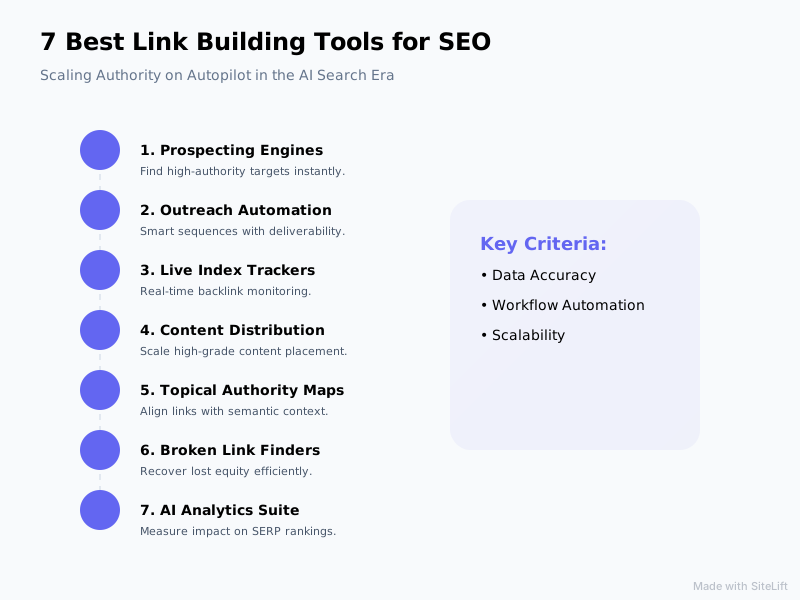
Infographic by SiteLift
Comparing the Best Link Building Tools for SEO: Feature Matrix
Selecting the right software stack depends on your budget, team bandwidth, and scaling goals. The comparison matrix below summarizes how these top tools stack up across critical operating criteria.
| Tool | Core Category | Automation Level | Manual Workload | Primary Target Audience |
|---|---|---|---|---|
| SiteLift | Autonomous Distribution | Fully Autonomous | Near Zero | Fast-scaling SaaS, B2B & E-commerce |
| Ahrefs | Backlink Analysis | Data Intelligence | High (Prospecting only) | Data-driven SEOs & Strategists |
| Semrush | All-in-One SEO Suite | Workflow Assisted | Medium-High | Digital Agencies & Marketing Teams |
| Pitchbox | Outreach Automation | High Sequence Automation | Medium (Campaign Mgmt) | Mid-to-Enterprise Agencies |
| Respona | PR & Content Outreach | Sequence & Contact AI | Medium | In-House Content Marketing Teams |
| BuzzStream | PR CRM Platform | Assisted Workflows | High (Relationship Focus) | Digital PR Specialists |
| Connectively | Expert Pitching Network | Manual Response Engine | High (Fast Pitching) | Executives, PR Agencies, Founders |
How to Choose the Right Link Building Tech Stack
Speed to Deployment vs. Manual Labor Required
If you analyze the traditional SEO software market, most platforms fall into one of two camps: intelligence tools that show you where backlinks exist (like Ahrefs or Semrush) or outreach management CRMs that help you pitch websites manually (like Pitchbox or BuzzStream).
The problem with relying solely on manual cold outreach tools is the massive operational footprint required. You need copywriters to draft pitches, SDRs to clean prospect lists, deliverability experts to monitor email domains, and campaign managers to respond to replies. For many growth teams, this manual burden creates an acquisition bottleneck.
+-------------------------------------------------------------------+
|                       The SEO Tool Stack Gap                      |
+-------------------------------------------------------------------+
|  Data Intelligence Tools  ---> Show you backlink gaps             |
|  Outreach CRMs            ---> Help you email site owners manually|
|                                                                   |
|  SiteLift                 ---> Bridges the gap with automated    |
|                                content distribution               |
+-------------------------------------------------------------------+
Why Autonomous Distribution is Underrated
In my experience, the most under-leveraged tactic for scaling domain authority today is autonomous content distribution. Rather than spending months pitching external editors for a single guest post backlink, leading brands use platforms that combine high-quality editorial generation with distribution networks.
If you want to read more about building a modern SEO tech stack, explore our breakdown on building an autonomous SEO stack for traffic growth. Additionally, don't overlook internal link equity—you can use our Free Internal Link Analyzer to spot orphan pages and fix click depth issues across your website.
Pro Tip: Avoid using cold email scrapers to send blast emails from your main corporate domain. Always separate manual cold outreach campaigns onto secondary sending domains to protect your primary domain's deliverability and reputation.
Scale Your Organic & AI Visibility with SiteLift
If your team is tired of managing outreach templates, unverified emails, and complex cold campaigns, it is time to upgrade your growth engine.
SiteLift takes the friction out of building domain authority. The platform generates targeted, high-intent editorial content and distributes it across a curated network of authoritative websites. It also integrates directly with your CMS and tracks real-time keyword performance.
Whether your goal is dominating Google search rankings or ensuring your brand is cited across AI engines like Perplexity and ChatGPT, SiteLift provides a hands-off publishing pipeline to scale authority on autopilot.
— sitelift.io
Frequently Asked Questions
What is the difference between outreach automation tools and automated link distribution?
Outreach automation tools focus on scraping contact data, setting up email sequences, and tracking manual pitch replies. Automated link distribution platforms, like SiteLift, handle the publishing process directly. They publish content across authoritative distribution networks, building natural backlink context without requiring cold email outreach.
Are automated link building tools safe from Google search penalties?
Yes, as long as you use tools that adhere to search quality guidelines. Software designed for competitor analysis, PR outreach, and high-quality content syndication is completely safe. The main risk comes from automated link spammers that place low-quality links on unmoderated link farms. Always prioritize contextual relevance and editorial quality.
How many backlinks do you need to rank on Google in 2025?
The number of backlinks needed depends on keyword difficulty and target domain authority. Ranking for low-competition, long-tail terms may require only a few contextual links. Highly competitive transactional terms often require hundreds of referring domains. Focus on acquiring steady, high-grade backlinks consistently rather than chasing a one-time metric target.
Can link building tools help improve visibility in AI search engines like ChatGPT and Perplexity?
Yes. AI answer engines pull answers from trusted, highly-cited web sources. When your site builds strong topical authority and earns consistent mentions across contextual websites, LLM crawlers are significantly more likely to source your content in AI-generated answers.
What is the typical cost of implementing enterprise link building software?
Entry-level prospect analysis tools start around $99 to $200 per month. Dedicated agency outreach automation platforms like Pitchbox or Enterprise Semrush plans usually range from $400 to over $1,000 per month. Autonomous platforms like SiteLift combine content generation, distribution, and tracking into unified tiers that scale based on target publishing volume.
Topics Covered:
- link building tools for seo
- automated link prospecting
- backlink analysis software
- outreach automation tools
- premium content distribution network
- white hat link acquisition
More from SiteLift

Rank Tracker API: Automate Keyword Monitoring Across Google and AI Search
Master rank tracker API integration. Learn how to automate keyword monitoring across Google SERPs and generative AI search engines with structured data.

Content Marketing for Link Building: Turn Every Article Into a Passive Backlink Magnet
Master content marketing for link building. Learn how to engineer linkable assets, target writer citation intent, and automate passive backlink acquisition.

SaaS Link Building: How to Scale Authority, Trials and ARR with Automation
Scale your SaaS link building without manual cold email. Learn how to use product-led assets, digital PR, and automated distribution to grow trials and ARR.