Rank Tracker API: Automate Keyword Monitoring Across Google and AI Search

If you have ever tried refreshing rank tracking dashboards across hundreds of client campaigns or enterprise keyword sets, you know the frustration. Legacy platforms throttle your requests, trap your data behind rigid UI widgets, and charge extortionate premiums just to export a simple CSV. To make matters worse, search is no longer just ten blue links.
Modern organic visibility requires programmatic access. Integrating a rank tracker API allows you to pull clean, real-time positional data directly into your own data lakes, internal platforms, and reporting tools. According to Backlinko's analysis of over 4 million Google search results, the first organic search result gets 27.6% of clicks, meaning even minor position slips can erase a significant chunk of your business revenue.
Here is how modern search engine results page (SERP) APIs function under the hood, how to monitor both Google organic rankings and generative AI engines, and how to automate your rank-tracking pipeline from scratch.
What Is a Rank Tracker API and Why Is It Essential for Modern SEO?
A rank tracker API is a programmatic interface that queries search engines on demand, parses the rendered search results, and returns structured data (typically JSON or XML). Instead of manually entering keywords into a software interface and waiting for scheduled weekly crawls, your code makes an HTTP request specifying the target keyword, engine, device, and exact geographic location.
Within seconds, the API returns your precise organic ranking alongside every other element rendered on that page.
Core Capabilities: Beyond Manual Dashboard Monitoring
Traditional SaaS rank trackers are built around predefined dashboards. While convenient for quick checks on a dozen keywords, they quickly become a bottleneck for data science teams and high-growth agencies.
A programmatic approach solves three major operational issues:
- Volume and Concurrency: You can check 10,000 keywords in parallel across thousands of localized postal codes without human intervention.
- Data Ownership: Instead of letting SaaS vendors lock your historical performance behind their proprietary metrics, your queries feed straight into internal data stores.
- Triggered Automation: You can connect keyword position changes directly to real-time marketing workflows, alerting developers when a page loses a featured snippet or alerting copywriters when a target phrase slips out of the top three.
For organizations running sprawling portfolio sites, adopting a dedicated programmatic pipeline or enterprise rank tracking system is often the only cost-effective way to track visibility across multiple markets without paying per-seat licensing fees.
The Shift from Traditional SERPs to Generative AI Search
The biggest disruption to search visibility since Google introduced universal search features is the rapid rise of Generative Engine Optimization (GEO). Search engines are increasingly synthesizing direct answers right at the top of the viewport.
BrightEdge research indicates that Google AI Overviews appear across a significant portion of commercial and informational search queries, fundamentally altering traditional click distributions. If an AI overview answers a user's question and cites three of your competitors, your ranking in position #1 of the standard organic links may yield only a fraction of its historical traffic.
A modern serp data api must do more than record your position among blue links. It needs to detect:
- Whether an AI Overview was triggered for the query.
- Which specific external domains and URLs are cited as references inside the generative snapshot.
- The exact text snippets generated by the model.
- Visibility on standalone answer engines such as Perplexity and ChatGPT Search.
+-----------------------------------------------------------+
| Traditional SERP:                                         |
| [Query] -> [Ad Units] -> [Rank #1 Blue Link] (27.6% CTR)  |
+-----------------------------------------------------------+
| Modern AI-Driven SERP:                                    |
| [Query] -> [AI Overview Box: Citations A, B, C]           |
|         -> [People Also Ask]                              |
|         -> [Rank #1 Blue Link] (Substantially Lower CTR)  |
+-----------------------------------------------------------+
Raw Data vs. Processed Metrics: What a SERP Data API Delivers
Off-the-shelf SEO tools often obfuscate search results behind proprietary indexes like "Keyword Difficulty" or "Visibility Indices." While helpful for high-level overviews, these synthesized metrics obscure the ground truth.
When you query an enterprise-grade SERP data engine, you receive unfiltered, point-in-time DOM extractions:
{
  "search_parameters": {
    "q": "best cloud data warehouse",
    "gl": "us",
    "hl": "en",
    "device": "desktop"
  },
  "search_information": {
    "total_results": 142000000,
    "time_taken_displayed": 0.42
  },
  "ai_overview": {
    "rendered": true,
    "references": [
      {
        "title": "Compare Data Warehouses",
        "url": "https://example.com/data-warehouses",
        "source": "Example Tech"
      }
    ]
  },
  "organic_results": [
    {
      "position": 1,
      "title": "Cloud Data Warehouses Compared for 2026",
      "link": "https://yoursite.com/blog/cloud-warehouses",
      "snippet": "A detailed breakdown of speed, cost, and query mechanics...",
      "sitelinks": [...]
    }
  ]
}
This granular structure makes it trivial to calculate your own custom share-of-voice scores, track competitor snippet usurpation, and measure volatility over time.
How Does a Real-Time SERP Tracking API Work Under the Hood?
Many teams consider building their own in-house scrapers using tools like Puppeteer or Playwright. Almost all of them abandon the project within six months.
Search engines dedicate massive engineering resources to detecting and blocking automated scraping. Reliable real-time serp tracking requires a complex, multi-layered proxy and fingerprinting infrastructure.

Proxy Networks, Fingerprint Masking, and Anti-Scraping Bypass
Google, Bing, and other search engines deploy behavioral heuristics, IP rate limiting, and sophisticated TLS-fingerprint profiling to identify automated traffic. If you fire 500 requests from an AWS or DigitalOcean IP range, you will quickly hit HTTP 429 errors and persistent CAPTCHAs.
A dedicated API provider handles this complexity through several defensive measures:
- Residential and Mobile Proxies: Queries rotate across millions of ethically sourced, ISP-assigned residential and 4G/5G mobile IP addresses worldwide.
- Canvas and WebGL Masking: Headless instances continuously randomize hardware fingerprints, audio contexts, screen resolutions, and available system fonts.
- TLS Fingerprint Emulation: Requests match the exact cipher suites, elliptic curves, and handshake protocols used by standard consumer browsers like Chrome on macOS or Android.
- Automated CAPTCHA Remediation: In-flight token challenges are resolved programmatically using specialized solvers before the payload ever reaches your callback.
Geo-Targeting and Device-Specific Crawling
Search results vary wildly based on physical proximity and hardware profiles. A search for a commercial software consultant run in London produces entirely different results than the same search in Singapore or Dallas.
Modern APIs allow you to pass exact geographic coordinates (UULE encoding), postal codes, or canonical location criteria matching the official Google Search Central location targeting specifications.
Furthermore, search algorithms use separate mobile-first and desktop ranking indexes. High-performance rank-tracking APIs simulate complete mobile user-agent profiles—including touch events, small viewports, and mobile-specific layout styles—to show you exactly what mobile users see in their local market.
Structured Parsing: Extracting Universal SERP Features
Raw HTML from a search results page is messy, highly minified, and updated constantly by search engine engineers. An effective API strips away the noise and extracts distinct layout components into a predictable schema:
- Organic listings: Core URLs, titles, descriptions, cached URLs, and breadcrumb trails.
- Featured Snippets: Paragraphs, bulleted lists, comparative tables, and associated media assets.
- People Also Ask (PAA): Expandable related questions along with their source links and extracted preview text.
- Local Packs: Map coordinates, aggregate review stars, operational hours, and direct call links.
- Rich Results & Carousels: Video timestamps, recipe cards, forum discussions (Reddit/Quora modules), and Product Schema integrations.
Pro Tip: Always capture and store the "People Also Ask" arrays alongside your organic rankings. PAA queries provide direct insight into how the search engine maps topical entity clusters around your core keywords.
Key Use Cases: Powering SEO Reporting Automation and Data Pipelines
A survey by Gartner reveals that digital marketing leaders cite marketing data integration and analytics automation among their top three technology spending priorities. Engineering teams do not invest in raw API access simply to look at charts; they do it to pipe rank intelligence into larger analytical systems.
Building Automated Client Dashboards and BI Pipelines
When you manage dozens of properties, manually updating client performance sheets is an expensive waste of analytical talent. By deploying an API, you can establish an automated ETL (Extract, Transform, Load) pipeline.
Rank changes can be pulled on a daily cron schedule, transformed in Python or dbt, and loaded straight into data warehouses like Google BigQuery, Snowflake, or Amazon Redshift. From there, you can connect tools like Looker Studio, Tableau, or Power BI to build custom SEO dashboards with a search engine ranking API without paying per-seat SaaS costs.
[SERP Tracking API]
       │ (JSON via Webhook)
       ▼
[Cloud Ingestion Function] (AWS Lambda / Cloud Run)
       │
       ▼
[Data Warehouse] (BigQuery / Snowflake / ClickHouse)
       │
       ├─► [Looker Studio / Tableau] (Automated Client Dashboards)
       └─► [Slack / Email Webhook]   (Volatility & Loss Alerts)
Dynamic Content Optimization and Rank Volatility Alerts
Ranking drops rarely follow a scheduled timeline. If an algorithm update or a technical site deployment breaks your canonical tags, you need to know within hours, not next week during an audit.
By leveraging daily rank tracking, you can build reactive alerting engines:
- Drop Detection: If an organic ranking for a revenue-critical keyword slips by more than three positions within 24 hours, fire an alert to a dedicated Slack channel.
- Intent Shift Alerts: If an organic link is displaced by an AI Overview or a video carousel, update the page's status in your CMS to trigger a content refresh.
- Cannibalization Warning: If the API returns a different internal URL for a tracked keyword than your target landing page, alert your editorial team immediately.
Tracking LLM Citations and AI Engine Visibility
As search behavior fragments across Google, Perplexity, Claude, and ChatGPT, ranking #1 on a classic SERP is no longer the sole goal. Digital PR and technical SEO teams are using APIs to monitor what is becoming known as Share of Model (SoM).
By querying endpoints designed for generative search engines, you can record:
- How often your domain is cited as an authority source for your target topic.
- What sentiment or summary context the AI engine associates with your product.
- Which authoritative third-party reviews and comparison articles are referenced most by the LLM when users ask for recommendations.
How to Plan and Execute a Keyword Ranking API Integration
Integrating an external data provider into your software architecture requires careful planning around latency, rate limits, and network reliability.
Evaluating Architecture: Webhook Callbacks vs. Polling Requests
When designing your ingestion architecture, you must choose between synchronous (real-time polling) and asynchronous (webhook callback) models.
Synchronous (Polling):
Client  ──[ POST Request ]──►  API Engine  (Holds connection open 3-7s)
Client  ◄──[ JSON Payload ]───  API Engine

Asynchronous (Webhooks):
Client  ──[ POST Batch Job ]──► API Engine  (Returns 202 Accepted)
...
API Engine ──[ POST Result ]──► Your Endpoint (Webhook receiver)
- Synchronous (Real-time): Your application opens an HTTP connection, waits while the API executes the search query and parses the DOM (typically 2 to 6 seconds), and receives the JSON directly in the response body. This approach works best for on-demand live rank audits and interactive user tools.
- Asynchronous (Webhooks/Batching): For tracking hundreds or thousands of terms, synchronous calls waste compute resources and run into gateway timeout limits. Instead, you send a bulk list of tasks to the API. The provider queues and processes the queries, then delivers the finished payload back to your designated webhook endpoint.
For detailed REST guidelines on building clean asynchronous consumers, review the MDN Web Docs HTTP guidelines covering request-response lifecycles and status codes.
Step-by-Step API Request and Response Workflow
Here is a conceptual implementation of how an asynchronous queue handles high-volume tracking:
- Dispatcher Phase: A scheduled task pulls active keywords from your database and creates a POST request payload containing targets, geographic parameters, and your secret authorization token.
- Acceptance: The API returns an HTTP
202 Acceptedresponse with a uniquebatch_id. - Ingestion Endpoint: Your web server exposes an unauthenticated HTTPS endpoint with a verified signature header to receive the completed webhook payload.
- Data Normalization: A worker service parses the incoming JSON, normalizes the attributes (mapping
rank_absoluteandrank_group), and appends the records to your historical database.
Data Storage and Normalization Strategies
Search engines frequently tweak page structures. If you store parsed rankings directly in flat, rigid relational database schemas, minor API updates can break your database ingestion pipeline.
Instead, adopt a hybrid storage pattern:
- Store the raw parsed JSON payload in an object store (like AWS S3 or Google Cloud Storage) or a
JSONBcolumn in PostgreSQL. This guarantees you never lose historical context, including newly introduced SERP features you may want to analyze later. - Extract core query variables (
keyword_id,ranking_position,url,serp_features_present,timestamp) into clean, partitioned relational tables optimized for fast query performance in your reporting tools.
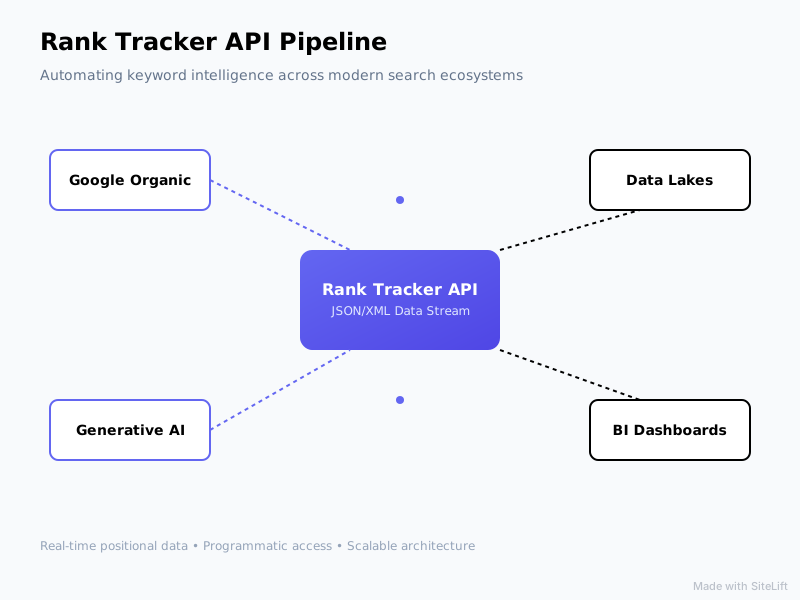
Infographic by SiteLift
Key Takeaways
| Consideration | Manual / Standard SaaS UI | Modern Rank Tracker API |
|---|---|---|
| Data Scalability | Limited by dashboard UI and seat licenses | Scales to millions of keywords via automated batch jobs |
| AI Search Visibility | Rarely tracked; limited to classic blue links | Captures AI Overviews, citations, and LLM answer engines |
| Integration Velocity | Manual CSV/XLS exports | Real-time automated pipes to BigQuery, Snowflake, and webhooks |
| Data Granularity | Abstracted proprietary visibility scores | Unfiltered, point-in-time DOM extractions and JSON payloads |
| Cost Efficiency | High monthly recurring cost per tracked term | Low unit cost per 1,000 queries with no seat limits |
Why Treating AI SERP Features as "Edge Cases" Is a Fatal Mistake
In our experience auditing organic visibility pipelines, we see the same critical mistake repeatedly: engineering and marketing teams configure their rank tracking to scrape only position numbers 1 through 10, discarding everything else on the page.
They treat Featured Snippets, Local Packs, and Google AI Overviews as secondary layout features rather than primary traffic drivers. This is a short-sighted way to evaluate search visibility.
When Google inserts an expansive AI Overview module above the organic results, your position #1 ranking is effectively pushed below the digital fold. Industry coverage on Search Engine Land consistently highlights how layout shifts and AI features alter user click paths, even when underlying positions appear unchanged in legacy tracking software.
If your tracking system does not record whether an AI summary was displayed—and whether your site was cited inside it—your traffic analysis is incomplete. You will spend weeks troubleshooting why an organic URL's clicks dropped 40% while its reported "rank" stayed at position #1.
Build your pipelines with an AI-first mindset. Track the citations inside the answer boxes just as aggressively as you track your blue links.
— sitelift.io
What Should You Look for in a Modern Rank Tracker API Provider?
Selecting an infrastructure provider involves weighing technical capabilities, data accuracy, and ongoing costs. When evaluating potential vendors, use these practical benchmarks:
Data Freshness, Latency, and SLA Guarantees
Ensure the provider offers genuine real-time querying rather than merely serving stale cached data from an internal database. While caching is useful for reducing costs on low-priority terms, verifying live algorithm changes requires freshly crawled search results. Look for providers that offer guaranteed uptime SLAs of at least 99.9% and synchronous response times averaging under five seconds.
Cost per 1,000 Queries and Scalability Thresholds
API economics follow a tiered model. Standard market rates for basic Google SERP scraping range from $0.50 to $3.00 per 1,000 successful queries, depending on parsing complexity and proxy requirements (mobile and hyper-localized postal code scraping typically command a premium). Make sure your provider does not charge for failed requests, blocked scrapes, or CAPTCHA loops.
Comprehensive Feature Support Across Multiple Search Engines
While Google accounts for the vast majority of search volume in most Western markets, your integration should remain flexible. Look for comprehensive multi-engine support, including:
- Alternative Search Engines: Bing, DuckDuckGo, Baidu, and Yandex.
- Vertical Platforms: YouTube, Google Maps, Google News, and Amazon Product Search.
- Generative Engines: Native endpoint support for parsing Perplexity, ChatGPT Search, and Google Gemini snapshots.
Automating Search Visibility with SiteLift
Setting up your own automated rank tracking pipeline is an essential first step. However, collecting rank data only reveals where your site stands; it doesn't do the actual work of closing keyword gaps, updating outdated pages, or expanding your authority across both traditional search and AI discovery engines.
This is where SiteLift changes the game. SiteLift is an autonomous SEO and AI visibility growth platform built to handle the entire search lifecycle on autopilot. Rather than requiring you to manually monitor ranking drops, draft new content, and distribute it by hand, the platform:
- Tracks keyword momentum and AI engine visibility in real time.
- Identifies emergent semantic search opportunities and topical gaps.
- Automatically creates targeted, editorial-quality content designed to rank in both traditional SERPs and generative AI answers.
- Distributes and indexes content across a curated premium publisher network.
- Integrates directly into your existing CMS (WordPress, Webflow, Shopify, Ghost) with zero technical overhead.
If you are ready to move beyond manual keyword spreadsheets and put your organic growth on autopilot, explore how SiteLift turns raw search intelligence into hands-free organic dominance.
FAQ
What is the difference between a rank tracker API and a rank tracking software platform?
A rank tracking software platform is an all-in-one web application with a graphical interface, fixed dashboards, and pre-built charts intended for direct human use. A rank tracker API is a developer-facing service that delivers raw, structured ranking data (typically in JSON format) directly into your own applications, scripts, or business intelligence databases, allowing for full customization and automated workflows.
Can a rank tracker API capture Google AI Overviews and generative AI answers?
Yes. Modern rank tracking APIs parse full HTML DOM structures and dynamic JavaScript content to identify when an AI Overview is present. They extract the full text generated by the AI engine along with the explicit URLs cited as source cards, allowing you to track your visibility within generative search snapshots alongside classic organic listings.
How frequently should I fetch keyword rankings using an API?
For most informational and evergreen search terms, tracking positions once every 24 hours is standard practice. Fetching data more frequently than once a day rarely provides actionable insights, as search engine indices do not fluctuate significantly minute-by-minute. However, for real-time news monitoring, high-stakes PR events, or technical site migrations, on-demand synchronous API calls can be triggered hourly or as needed.
Is scraping search engine results via an API legal and compliant?
Yes. Accessing publicly available web data has been upheld as lawful in multiple legal jurisdictions, notably reinforced by United States court rulings regarding public web scraping. Legitimate rank tracking API providers query public search results without accessing password-protected areas or scraping personal user data, operating within established data-gathering legal precedents.
How does a SERP API handle localized or mobile search results?
A robust SERP API allows you to pass specific geographic parameters, such as a country code, city name, coordinate pair, or postal code. The API uses localized proxy networks and coordinates (like Google's UULE parameter) to emulate a physical presence in that location. Additionally, passing a mobile user-agent instructs the search engine to render its mobile-specific interface and indexing results.
Topics Covered:
- rank tracker api
- serp data api
- automated rank tracking
- keyword ranking api integration
- real-time serp tracking
- seo reporting automation
More from SiteLift

The Best SEO Tools in Europe (2026): What Scaleups Should Actually Use
Compare top automated SEO software in Europe for rank tracking, multilingual growth, and GDPR compliance. Find the right platform for your scaleup.

Content Marketing for Link Building: Turn Every Article Into a Passive Backlink Magnet
Master content marketing for link building. Learn how to engineer linkable assets, target writer citation intent, and automate passive backlink acquisition.

SaaS Link Building: How to Scale Authority, Trials and ARR with Automation
Scale your SaaS link building without manual cold email. Learn how to use product-led assets, digital PR, and automated distribution to grow trials and ARR.