Enterprise Rank Tracking: How to Monitor Thousands of Keywords Across Markets

When you manage SEO for one site in one city, rank tracking is simple. When you manage enterprise rank tracking across 50,000 keywords, 20 countries, and four business units, it becomes an entirely different discipline.
I’ve seen enterprise teams drown in spreadsheets while revenue-driving keywords quietly slip. This guide gives you the operational framework to avoid that — how to structure your keyword universe, run multi-location tracking accurately, move beyond average rank to real visibility analytics, and automate reporting so teams actually act.
Key Takeaways
| What Enterprises Must Get Right | Why It Matters |
|---|---|
| Track keyword portfolios, not keyword lists with tags for intent, funnel, business unit, location, and language | Keeps thousands of keywords analyzable and tied to owners |
| Daily tracking for money keywords, weekly for long-tail plus on-demand checks after launches | Balances freshness, cost, and statistical signal |
| Multi-location rank tracking at country, city, and ZIP level with mobile/desktop split | Rankings can vary street by street; national averages hide risk |
| SERP visibility analytics > average rank: visibility share, share of voice, SERP feature ownership | Nearly 60% of searches end without a click, so position alone misleads |
| Automated keyword reporting with anomaly alerts and BI integrations | Turns data into playbooks for content, product, and execs |
What Is Enterprise Rank Tracking and How Is It Different from Standard Rank Tracking?
Standard rank tracking answers: Where do I rank for 200 keywords in the US? Enterprise rank tracking answers: What is our share of commercially relevant search demand across every market, language, device, and SERP feature that drives revenue, and how is it trending by segment?
That shift in question changes everything about tooling and process.
Definition and scope of enterprise rank tracking
At enterprise scale, you’re monitoring thousands to millions of keywords daily across locations, languages, devices, and search engines. You’re not just storing rank — you’re storing URL, SERP features present, competitor URLs above you, AI Overview presence, and historical volatility.
Google’s own documentation on how Google ranking systems work makes clear why this is complex: rankings are influenced by relevance, location, language, device, and constantly evolving systems. Multiply that by 30 markets and you need infrastructure, not a Chrome extension.
Scope typically includes:
- Core head terms, torso topics, long-tail expansion, branded vs. non-branded, and competitor conquest terms
- Google, Bing, YouTube, Amazon, and increasingly AI search surfaces
- Mobile vs. desktop, plus local pack, video, shopping, People Also Ask, and AI Overviews
- 13+ months of history for seasonality and year-over-year analysis
Enterprise SEO monitoring vs. SMB rank checkers
Most SMB tools break at enterprise volume. Here’s the practical difference:
| Capability | SMB Rank Checker | Enterprise SEO Monitoring |
|---|---|---|
| Keyword limits | 500 - 2,000 | 50,000 - 1M+ with API bulk management |
| Locations | National or 5-10 cities | Thousands of cities, ZIPs, and geo-grids |
| Segmentation | Folders | Multi-dimensional tagging + custom hierarchies |
| Users & permissions | 1-3 seats | SSO, roles for regions, agencies, business units |
| Data retention | 3-12 months | Unlimited / multi-year with BigQuery / Snowflake export |
| Alerting | Email for big drops | Anomaly detection by segment, Slack, PagerDuty, BI |
If your current tool forces you to split projects by country because it can’t handle tags, you don’t have enterprise SEO monitoring. You have five SMB accounts taped together.
Why scale changes everything: volume, markets, and stakeholders
Scale introduces three problems SMBs never face:
1. Volume without taxonomy is noise. 80,000 untagged keywords produce a meaningless average rank of 18.4. The same 80,000 keywords tagged by business unit, intent, and market produce 40 actionable insights.
2. Markets behave independently. A template change that lifts you in Germany can tank you in Brazil due to hreflang, translation, or local competitors. You need market-level baselines.
3. Stakeholders need different cuts. Your CMO wants visibility share by region. Your product team wants cannibalization by category. Your agency wants week-over-week wins by content cluster. One dashboard can’t serve them all.
Pro Tip: Never mix branded and non-branded in the same visibility score. Branded terms will mask a 15% drop in non-branded money keywords every time.
Why Does Enterprise SEO Monitoring Matter at Scale?
Because at scale, a two-position drop isn’t a vanity metric. It’s pipeline.
According to BrightEdge research, organic search drives 53% of trackable website traffic — still the largest channel for most enterprises. When you own thousands of commercial pages, small fluctuations compound fast.
Protecting revenue from high-value head and money keywords
Backlinko's analysis of 5 million Google searches found the #1 organic result earns an average click-through rate of 27.6%, with CTR falling sharply after position 3. For an enterprise, losing position 1 to 3 on 200 high-intent terms across 10 markets can mean tens of thousands of lost sessions per week.
Enterprise SEO monitoring protects that by:
- Isolating money keyword clusters — terms with proven conversion, not just volume
- Weighting visibility by search volume and click potential, not treating all keywords equally
- Tying rank segments to revenue in your BI tool, so a drop triggers the same urgency as paid performance
Managing volatility across algorithm updates and SERP layout shifts
Enterprises feel every core update disproportionately because they have large template footprints. One classifier change can hit 10,000 similar product or location pages at once.
Add AI Overviews, shopping boxes, video carousels, and local packs, and the classic “10 blue links” is gone. The 2024 zero-click search study from SparkToro and Datos found nearly 60% of Google searches in the US and EU end without a click. If you only track position, you’ll miss that you rank #2 but get zero clicks because an AI Overview and video pack push you below the fold.
You need early-warning detection for:
- URL swaps and cannibalization (two of your pages trading places)
- SERP feature invasions (PAA, AI Overview suddenly appearing on money terms)
- Competitor surges in a specific market or category
Aligning global SEO, content, product, and executive teams
Rank data is the common language — if it’s segmented correctly. I recommend three reporting layers:
- Executive: Market scorecard — visibility share, share of voice vs. 3 key rivals, AI Overview exposure
- Regional: Country / language dashboards with local competitors and SERP feature wins
- Working team: Page-level and cluster-level momentum with assigned owners and next actions
Without this, global SEO becomes a Slack thread of screenshots. With it, everyone knows who owns a drop in France and what the fix is.

How to Build an Enterprise Rank Tracking Framework for Thousands of Keywords?
You don’t need more keywords. You need a better architecture. Here’s how I structure it for large sites.
How to structure keyword portfolios with tagging and segmentation?
Think in universes, not lists:
- Core money universe (5-10% of keywords): Head terms and high-converting torso terms. Tracked daily, mobile + desktop, all priority locations.
- Supporting topics (20-30%): Informational and commercial investigation terms that feed product and sales pages. Tracked daily or 2-3x per week.
- Long-tail expansion (60%+): Low-volume, high-intent variations. Tracked weekly. Used for content gap discovery, not daily alerts.
- Brand and defensive: Branded, branded + modifier, executive names, competitor vs. you. Separate visibility score.
- Conquest: Competitor branded and comparison terms you target with landing pages.
Every keyword gets at least these tags: funnel stage, intent (informational, commercial, transactional, navigational), business unit, product category, location, language, device priority, and SERP feature opportunity (featured snippet, local pack, video).
That taxonomy lets you answer questions like: Show me non-branded, transactional visibility for Appliances in Mexico on mobile where a local pack is present. That’s enterprise SEO monitoring.
How often should you track: daily, on-demand, and real-time?
- Daily: Top 10-20% money and volatile terms. You need daily to catch algorithm tests, deployments gone wrong, and competitor pushes.
- Weekly: Long-tail and research topics. Daily noise here just burns crawl budget and budget.
- On-demand: After migrations, launches, hreflang fixes, or PR spikes. If you want to track search engine rankings in real time during a rollout, spin up a temporary high-frequency project rather than paying for real-time on everything.
Don’t chase real-time for 500,000 keywords. You’ll pay 10x for data no human will review. Invest in smart alerting instead.
Pro Tip: Freeze a baseline snapshot before any site migration or template change. Without a pre-change baseline by segment, you can’t prove impact — or roll back confidently.
How to prioritize what to monitor: head, torso, long-tail, and branded
Use a simple scoring model: Business Value x Volatility x Actionability.
- High value + high volatility + you can act (you have a page to optimize) = daily tracking + alerts
- High value + low volatility = daily tracking, weekly review
- Low value + high volatility = weekly tracking, no alerts
- Low value + low volatility = monthly sampling or discovery pool
Audit quarterly. Enterprises accumulate 30% dead keywords — discontinued products, old campaigns, agency-added fluff. Prune them or they dilute your visibility metrics and inflate costs.
How to Master Multi-Location Rank Tracking Across Markets?
This is where most enterprise programs fail. National rank is an average that describes no actual customer.
Tracking by country, city, ZIP, and Google Business Profile markets
Set up three tiers:
- National: Country-level engines (google.co.uk, google.de, google.com.br) for brand and category health.
- City / metro: Priority revenue cities. Essential for services, retail, SaaS with local sales teams, and anything with a local pack.
- Hyperlocal grids: For multi-location brands, track a grid of points around each store (e.g., 5x5 km grid) to see true local pack coverage. One city-center check hides that you’re invisible 3 miles away.
Your setup should also reflect engine mix. Global search engine market share data from StatCounter consistently shows Google holds more than 90% of global search share, so Google gets priority — but don’t ignore Bing for US desktop B2B, YouTube for how-to demand, and Amazon for retail product terms.
Handling language, hreflang, device, and search engine variations
Direct translation is a classic trap. Germans search handyvertrag vergleich, not a literal translation of “mobile phone contract comparison.” Work with native SEOs to build translated keyword equivalents based on local demand, not Google Translate.
Checklist for international accuracy:
- Separate projects or tagged segments per ccTLD / subfolder / subdomain + language
- hreflang validation tied to rank data — if the wrong locale URL ranks, flag it
- Mobile vs. desktop tracked separately in every market (mobile often 65%+ of impressions, with completely different SERP layouts)
- Local engine domains and language parameters, not just google.com with a proxy
Accounting for localization, personalization, and SERP features by market
SERP composition varies wildly. The US may show AI Overviews + video pack for your query, while Spain shows shopping + PAA. Your multi-location rank tracking must capture which features appear per market and whether you own them.
Run a quarterly QA:
- Verify proxy accuracy with spot checks from local VPNs or teammates
- Use de-personalized, location-precise mobile emulation for consistency
- Log SERP feature presence over time — a sudden AI Overview expansion explains CTR drops even when rank is stable
If you’re feeding this into warehouses, learn to build custom SEO dashboards using a search engine ranking API so regional managers see only their market, in their language, with their competitors.
How to Turn SERP Visibility Analytics into Action?
Average rank is the most overused and least useful enterprise metric. SERP visibility analytics is what replaces it.
From average rank to visibility share and share of voice
Average rank treats position 1 for a 10-search term the same as position 1 for a 100,000-search term. Visibility metrics fix that.
| Metric | What It Measures | Why It Beats Average Rank |
|---|---|---|
| Weighted Visibility Score | Rank weighted by search volume and estimated CTR curve | Reflects actual click opportunity |
| Share of Voice (SOV) | Your visibility vs. total visible demand in a segment | Shows market power, not just positions |
| SERP Feature Ownership | % of tracked SERPs where you own snippet, PAA, video, local, AI citation | Captures zero-click exposure |
| Click Potential | Visibility adjusted for SERP features that steal clicks | Explains traffic drops when rank holds |
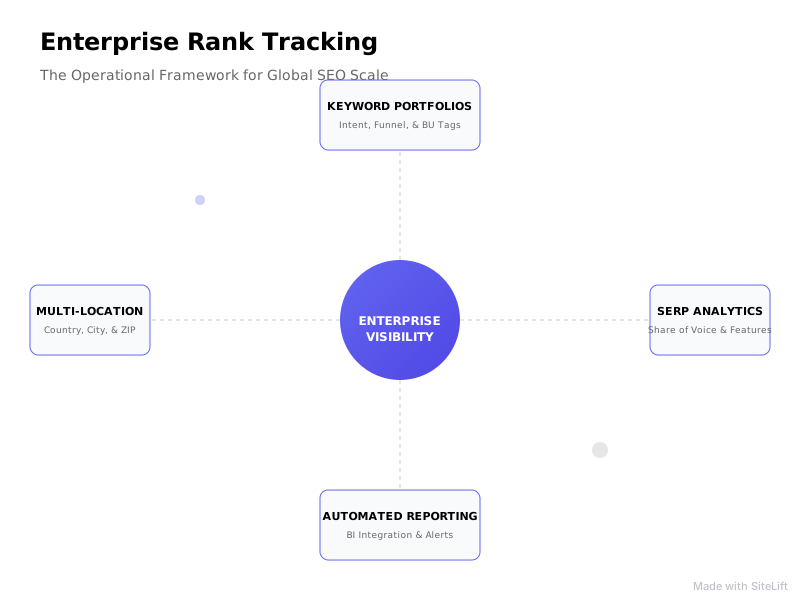
Infographic by SiteLift
Example: You hold position 2 on 50 terms, but AI Overviews appear on 40 of them and you’re never cited. Your average rank looks great. Your click potential is collapsing. Only SERP visibility analytics surfaces that.
For a deeper method on connecting these metrics to revenue, see this guide to turning raw SERP data into actionable growth.
Competitor benchmarking and SERP feature gap analysis
Pick 3-5 true SERP competitors per segment — not necessarily your business competitors. Wikipedia, Reddit, YouTube, and marketplaces often outrank direct rivals.
Monthly, run:
- SOV trend by category: Who gained when you lost? Filter to non-branded only.
- URL-level gap: Which competitor URLs repeatedly outrank you for clusters? That signals content format or authority gap, not just on-page tweaks.
- Feature gap: Where competitors own featured snippets, videos, or local packs you don’t. Brief content specifically for those formats.
I’ve seen enterprises recover 12% visibility in a quarter just by reclaiming PAA and snippet ownership with targeted FAQ blocks and tables — no new backlinks needed.
Automated keyword reporting that executives actually read
Nobody reads a 60-tab spreadsheet. Automated keyword reporting should be exception-based:
- Real-time anomaly alerts: Visibility drop >10% in any money segment, new cannibalization, competitor overtakes on top 20 terms → Slack + email to owner
- Weekly momentum summary: Top 10 wins/losses with URL, cause hypothesis, and owner — one page max
- Monthly market scorecard: Visibility share, SOV vs. rivals, SERP feature ownership, AI Overview presence, actions shipped
- API to BI: Push daily ranks, volume, and feature flags to BigQuery, Snowflake, or Looker. Join with sessions, pipeline, and revenue.
Action playbooks to attach to alerts:
- Visibility drops 10% in a market: Check deploys, hreflang errors, manual actions, then SERP layout change, then competitor content push — in that order.
- Competitor wins snippets: Analyze format (list vs. table vs. definition), rewrite to 40-60 word direct answer + supporting schema, re-track on-demand.
- Cannibalization appears: Consolidate or differentiate intent, fix internal linking anchors, de-optimize secondary page.
How to Choose the Right Enterprise Rank Tracking Platform?
Tools don’t fix broken taxonomy, but the wrong tool guarantees failure. Evaluate on enterprise realities, not marketing checklists.
Must-have features: scale, accuracy, integrations, and data retention
Demand these before you sign:
- Scale: 100k+ keywords, thousands of locations, daily mobile + desktop, without sampling tricks
- Location precision: Country, city, ZIP, and lat/long grids with transparent methodology
- SERP depth: Full SERP capture, feature tracking, AI Overview detection and citation tracking
- Segmentation: Unlimited tags, hierarchies by business unit / region / intent, saved views
- Integrations: API, BigQuery / Snowflake / Looker, Slack alerts, SSO/SAML, CMS hooks
- History: 2+ years retention, annotations for launches and updates, backfill on new keywords where possible
Ask for a live test: track 500 of your hardest money keywords in 5 markets for two weeks. Compare accuracy against manual checks and against your Search Console average position trends.
Common pitfalls that break enterprise tracking programs
I see the same five mistakes:
- Vanity tracking: Reporting on branded rank to show green dashboards while non-branded bleeds.
- Untagged bulk uploads: 100k keywords from a tool with no owner, no intent, no action.
- Desktop-only tracking in mobile-first markets.
- Ignoring SERP features and then blaming content for traffic loss caused by layout shifts.
- No connection to content operations — data sits in SEO while content ships blind.
Implementation checklist for rollout across markets
A practical 30-60-90 day plan:
Days 1-30: Audit & baseline Inventory all tracked keywords, remove dead terms, define tagging taxonomy, set market priorities, freeze baselines.
Days 31-60: Instrument Launch daily tracking for money universe, weekly for long-tail, configure location grids, connect API to BI, build three dashboard layers (exec, regional, working).
Days 61-90: Automate & act Turn on anomaly alerts, ship first snippet/feature optimization sprint, run competitor gap analysis per top category, tie visibility to pipeline reporting.
The goal isn’t perfect data. It’s a tight loop: detect → diagnose → ship → measure.
My Take: You’re Not Tracking Rankings, You’re Tracking Revenue Risk
I’ll be blunt: most enterprises I audit track too many keywords and understand too few of them.
They’ll proudly show me 250,000 keywords tracked daily, then go quiet when I ask which 500 actually drive demos, signups, or store visits. They celebrate average rank improving from 14.2 to 13.8 while share of voice for non-branded commercial terms drops 8 points in their biggest market.
In my view, enterprise rank tracking only earns its cost when it works like financial risk monitoring. You don’t watch every penny equally — you watch concentrated exposure. Ten head terms in Germany might be worth more than 20,000 long-tail terms globally. Treat them that way with tighter tracking, faster alerts, and named owners.
I also think the industry is in denial about zero-click. If nearly 60% of searches end without leaving Google, clinging to “position 3” as success is nostalgia. Visibility inside AI Overviews, PAA, video, and local packs is the ranking now. If your platform can’t tell you whether you were cited in the AI answer, you’re flying blind into the next two years of search.
Track less, tag better, and tie every segment to money. That’s the whole game.
Putting Enterprise Rank Tracking on Autopilot
Data without execution just creates anxiety. The bottleneck for most global teams isn’t insight — it’s shipping optimized content and updates fast enough across markets.
That’s why I recommend closing the loop between monitoring and publishing. When your tracking flags a visibility drop, a snippet loss, or a competitor surge in a market, you need to be able to brief, publish, and refresh without waiting six weeks for dev and content queues.
Platforms like sitelift.io are built for that compounding loop — automatically generating targeted content, distributing it, and tracking keyword momentum in real time so enterprise teams can scale coverage without manual intervention.
If you take one next step, make it this: pick your top money segment in one market, rebuild its tagging and alerts this week, and run a single optimization sprint against what SERP visibility analytics tells you. You’ll learn more in 14 days than in a year of national average-rank reports.
— sitelift.io
FAQ
What is enterprise rank tracking?
Enterprise rank tracking is the daily monitoring of thousands to millions of keywords across countries, cities, languages, devices, and SERP features. Unlike basic rank checkers, it includes segmentation by business unit and intent, visibility share and share-of-voice metrics, competitor benchmarking, multi-year history, and API integrations for enterprise SEO monitoring at scale.
How does enterprise rank tracking handle thousands of keywords across multiple markets?
It uses a tagged portfolio architecture rather than flat lists. Keywords are tagged by funnel stage, intent, business unit, location, language, and SERP feature opportunity. Tracking is then segmented by market with country, city, or ZIP-level proxies, separate mobile and desktop crawls, and localized keyword equivalents — not direct translations.
How often should enterprises track keyword rankings?
Track priority money keywords daily on both mobile and desktop, supporting topics 2-3 times per week, and long-tail weekly. Add on-demand tracking after migrations, product launches, or major content refreshes. Daily for everything wastes budget; weekly for money terms misses revenue risk.
What is the difference between average rank and SERP visibility analytics?
Average rank is a simple mean position that treats all keywords equally. SERP visibility analytics weights rankings by search volume, CTR potential, and SERP feature impact to calculate visibility share, share of voice, and feature ownership. It explains traffic changes even when average rank looks stable, especially with AI Overviews and zero-click results.
How does multi-location rank tracking work for global and local markets?
Multi-location rank tracking checks rankings using precise geolocation parameters for each market — national engines, city-level coordinates, or hyperlocal grids around stores. It captures local packs, language variations, hreflang-correct URLs, and device-specific layouts per location, so you see what customers in Munich vs. Madrid vs. Manhattan actually see.
Topics Covered:
- enterprise rank tracking
- enterprise seo monitoring
- multi-location rank tracking
- serp visibility analytics
- automated keyword reporting
More from SiteLift

How to Check Web SEO in Minutes: Instant Health, Indexing and Visibility Audit
Learn how to check web seo in minutes. Follow our step-by-step audit guide to fix indexing issues, boost Core Web Vitals, and dominate search.

AI for SEO: How to Automate Research, Content Creation and Distribution
Learn how to use AI for SEO to automate keyword research, generative content creation, CMS publishing, and search engine visibility.

SEO Tools in 2026: How to Build an Autonomous Stack That Grows Traffic on Autopilot
Discover how to build an autonomous stack with modern AI SEO tools, automated publishing workflows, and real-time rank tracking to grow organic traffic.