How to Track Search Engine Rankings Real-Time in Modern AI-Powered Search Engines
 For years, SEOs relied on a deceptively simple workflow: publish content, build backlinks, and wait for weekly rank tracking reports to show progress. But in the modern generative search era, learning how to track search engine rankings requires an entirely new playbook.
With Google’s AI Overviews, SearchGPT, and Perplexity rapidly rewriting the rules of visibility, static weekly reports are no longer just outdated—they are a liability. If you are still relying on legacy desktop tracking, you are essentially flying blind in a high-speed storm.
To survive and scale in this new environment, your tracking must be real-time, highly localized, and capable of monitoring both traditional organic listings and generative AI citations simultaneously.
Key Takeaways: Legacy vs. Modern Real-Time Tracking
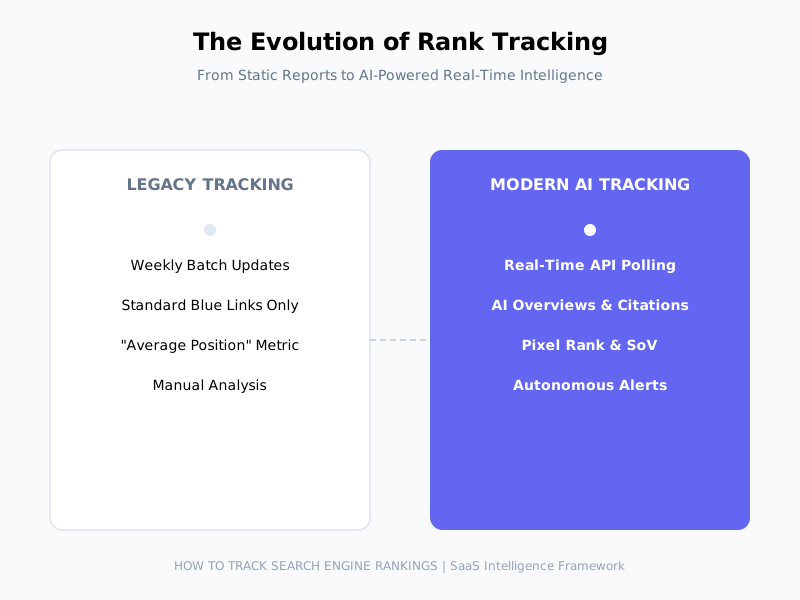
Before diving into the technical steps, let’s look at how tracking has evolved. If your current SEO stack still looks like the column on the left, it is time for an upgrade.
| Feature | Legacy Rank Tracking | Modern Real-Time AI Tracking |
|---|---|---|
| Update Frequency | Daily or weekly updates | Intra-day, real-time API polling |
| Tracking Scope | Standard blue links (desktop/mobile) | AI Overviews, SearchGPT, Perplexity citations, local map packs |
| Measurement Metric | Numerical position (e.g., Position #3) | Pixel Rank (distance from the top of viewport) & Share of Voice (SoV) |
| Localization | Country or city-level proxy | Precise GPS coordinate and multi-lingual browser emulation |
| Action Trigger | Manual report analysis and content updates | Automated alerts and autonomous content redeployment |
Why "Average Position" is the Most Dangerous Metric in SEO
In my opinion, relying on "average position" from tools like Google Search Console is the single biggest mistake European marketing teams make today. Average position is a lagging, smoothed-out metric that completely hides the violent hourly swings of modern search engine results pages (SERPs).
If your brand drops from position #2 to position #48 during a core algorithm update at 09:00, but recovers to position #5 by 17:00, your daily average might look perfectly healthy. In reality, you lost thousands of Euros in transactional traffic during peak business hours.
Furthermore, traditional positions do not account for visual real estate. According to research by Gartner, traditional search engine volume is projected to drop by 25% by 2026 as users turn to AI chatbots and conversational engines. If an AI overview occupies the top 800 pixels of a mobile screen, being "Position #1" in the organic blue links below it means you are effectively invisible.
Pro Tip: Stop reporting on numerical rank alone. Start measuring "Pixel Rank"—the literal vertical pixel distance of your organic listing from the very top of the screen.
Why Traditional Methods for How to Track Search Engine Rankings Are Failing
The Evolution from Static Blue Links to AI Overviews
The traditional search engine results page is dead. In its place is a dynamic, highly interactive canvas dominated by generative summaries, featured snippets, and interactive widgets.
Data published on Search Engine Land indicates that Google AI Overviews now appear in over 84% of informational queries in technology and SaaS sectors.
[Traditional Search] ---> 10 Blue Links ---> High CTR to Website
[Generative Search]  ---> AI Overview Summary ---> Zero-Click / Citation Attribution Only
When an AI engine synthesizes an answer directly on the screen, the user's click behaviour changes instantly. Instead of clicking the top result, they read the summary and occasionally click on the cited sources. If your organic keyword tracking setup does not track whether your brand is cited inside these AI-generated summaries, you are missing the entire picture of your search visibility.
Understanding Intra-Day Volatility Across European Markets
Europe is a highly fragmented digital landscape. Unlike the relatively uniform US market, European SEO requires tracking across dozens of localized languages, regional search engine variations, and strict data privacy frameworks.
According to Statcounter Global Stats, Google maintains over 91% of search engine market share across Europe. However, how Google behaves in Paris is vastly different from how it behaves in Berlin or London.
During major core updates, the top 10 search results undergo intra-day position shifts up to 3 times per day. If you only pull reports once a week, you will completely miss these volatile fluctuations, leaving your marketing team unable to react before your organic revenue drops.
How to Track Search Engine Rankings in Real-Time: A Step-by-Step Framework
Step 1: Establishing Core Organic Keyword Tracking Baselines
To build a resilient tracking framework, you must first categorise your keywords based on user intent and search layout.
- Informational Intent: Keywords like "how to automate SEO" are highly susceptible to AI Overviews. Track these for AI citation frequency.
- Commercial Intent: Queries like "best enterprise rank tracking software" often trigger comparison tables and local maps. Track these for pixel-above-the-fold visibility.
- Transactional Intent: High-value terms like "buy autonomous SEO platform" require real-time monitoring to protect your direct conversion funnels from competitor bidding or sudden algorithmic drops.
Step 2: Choosing Modern Rank Tracking Software with Real-Time Capability
When auditing potential rank tracking software, look past the marketing fluff. To handle modern AI search, your software must meet three strict technical criteria:
- On-Demand API Access: The ability to trigger real-time SERP scrapes via API rather than waiting for a scheduled daily run.
- Mobile-First Rendering: Search engines prioritize mobile indexing. Your tracker must emulate modern smartphone viewports, not just desktop browsers.
- Localized IP Proxies: To track rankings accurately in Munich, Madrid, or Milan, your tool must route queries through residential proxies located in those exact postal codes.
 ### Step 3: Integrating AI Search Ranking Tracking for Generative Engines
Traditional scrapers look for standard HTML tags like <h2> and <a> within blue links. Modern AI search ranking tracking requires parsing natural language outputs from LLMs.
Your tracking stack should monitor:
- Brand Mention Frequency: How often your brand name is mentioned in Perplexity or SearchGPT responses for your target industry queries.
- Citation Link Placement: Whether the AI engine includes a direct hyperlink to your domain in its reference footnotes.
- Sentiment Analysis: Whether the generative engine recommends your product as a top-tier solution or merely lists it as an alternative.
This is a core component of Search Experience Optimisation (SXO), which focuses on optimising for both human readers and AI crawlers simultaneously.
Leveraging SERP Volatility Tools for Proactive Search Management
 ### Distinguish Algorithm Updates from Localized Fluctuation
When rankings drop, panic often sets in. However, a sudden dip in position might not mean your site has been penalised. It could simply be a localized test by Google or a temporary reporting glitch.
This is where SERP volatility tools become invaluable. These tools calculate "sensor scores" by analyzing thousands of baseline keywords across the web.
If your personal rankings drop but the global volatility score remains low, the issue is likely isolated to your website (e.g., a broken redirect, a crawling block, or a competitor launching a superior page). Conversely, if the volatility index is spiking globally, you are witnessing a broader search engine algorithm update.
Pro Tip: During high-volatility periods, pause all major content updates. Let the SERPs stabilize for 48 to 72 hours before making structural changes to your pages.
Setting Automated Alerts for Instant Threat Detection
For European enterprise SaaS and e-commerce brands, manual monitoring is a waste of valuable engineering resources. You should set up automated alerts using webhooks that connect your rank tracker directly to your team’s Slack or Microsoft Teams channels.
Configure your alerts based on specific thresholds:
- Critical Alert: Any core transactional keyword dropping more than 5 positions within a 12-hour window.
- AI Loss Alert: Loss of a cited source link in a high-volume Google AI Overview.
- Competitor Alert: A direct competitor jumping more than 10 positions for a high-value commercial search term.
For a deeper look at budget allocation and managing resources during these volatile shifts, check out our guide on Search Engine Optimisation Cost in the UK.
Advanced Visibility Metrics: Beyond Simple Position Numbers
Measuring Share of Voice (SoV) and Pixel Rank
If you track 1,000 keywords, looking at individual positions is overwhelming. Instead, focus on Share of Voice (SoV). SoV calculates your overall visibility by weighting your rank against the search volume of each keyword.
$$\text{SoV} = \frac{\sum (\text{Keyword Volume} \times \text{CTR of Position})}{\sum \text{Total Search Volume of Cluster}}$$
To make this metric highly accurate for modern search, integrate Pixel Rank. Pixel Rank calculates the physical distance (in pixels) from the top of the browser viewport to your first organic element.
According to Google's official documentation on search appearance, rich snippets and visual elements can push even top-ranked organic results below the fold on mobile screens. If your Pixel Rank is greater than 1,000 pixels, your CTR will plummet, regardless of your numerical position.
Tracking Zero-Click Visibility and AI Citation Counts
A zero-click search occurs when a user finds their answer directly on the SERP without clicking through to any website.
To measure your brand's influence in a zero-click world, you must track:
- Featured Snippet Ownership: Are you providing the direct answer Google pulls into the top paragraph box?
- People Also Ask (PAA) Presence: How many accordion dropdowns inside the PAA box feature your content?
- AI Citation Share: The percentage of generative AI summaries in your niche that reference your domain as a primary source.
Building a Modern Real-Time SEO Stack with SiteLift
Staying ahead of search fluctuations manually is a losing battle. The sheer volume of data, combined with the speed of AI search updates, requires an automated, programmatic approach.
This is why we built SiteLift.
 SiteLift is an autonomous SEO and AI visibility growth platform designed to help European businesses dominate both traditional search engines and modern AI engines on autopilot.
Instead of manually analyzing rank drops and writing content updates, SiteLift’s autonomous pipeline:
- Tracks keyword momentum and AI citations in real-time.
- Automatically generates and optimizes targeted content to capture emerging search trends.
- Seamlessly distributes high-quality content across a premium network to build instant authority.
- Integrates directly with your existing CMS to deploy updates before your competitors even notice a shift in the SERPs.
By automating the loop between rank tracking, content generation, and indexing, SiteLift turns volatility into a competitive advantage.
FAQ
How often should I track search engine rankings in 2025?
You should track high-value, transactional keywords in real-time or at least multiple times per day. Informational and long-tail keywords can be monitored on a weekly basis. Real-time tracking is essential for detecting sudden algorithmic updates and protecting your core conversion funnels.
What is the difference between traditional rank tracking software and AI search ranking tracking?
Traditional rank tracking software monitors standard blue links and their numerical positions on a search page. AI search ranking tracking measures your brand’s visibility, mentions, and hyperlinked citations inside generative AI summaries like Google AI Overviews, Perplexity, and SearchGPT.
How do SERP volatility tools help prevent sudden organic traffic losses?
SERP volatility tools monitor global search fluctuations. By comparing your site's ranking drops to global volatility scores, you can determine if a traffic loss is due to a site-specific error (like a broken technical element) or a broader search engine core update, allowing you to execute the correct recovery strategy.
Can modern rank tracking tools monitor localized keywords across multiple European markets?
Yes, but you must choose enterprise-grade tools that utilize residential proxies and precise GPS coordinate emulation. This ensures you see the exact search results a user in a specific city (like Munich or Paris) would see, matching their local language and search intent.
Why does my position vary between standard search results and Google AI Overviews?
Google uses different algorithms to generate standard search results and AI Overviews. While traditional rankings rely heavily on classic PageRank and on-page optimization, AI Overviews prioritize high-context relevance, direct answers, and structured data, meaning you can rank highly in one but not the other.
Article generated by SiteLift
Topics Covered:
- how to track search engine rankings
- rank tracking software
- SERP volatility tools
- AI search ranking tracking
- organic keyword tracking
More from SiteLift

AI for SEO: How to Automate Research, Content Creation and Distribution
Learn how to use AI for SEO to automate keyword research, generative content creation, CMS publishing, and search engine visibility.

SEO Tools in 2026: How to Build an Autonomous Stack That Grows Traffic on Autopilot
Discover how to build an autonomous stack with modern AI SEO tools, automated publishing workflows, and real-time rank tracking to grow organic traffic.

Repurposing Content for SEO: How to Multiply Organic Reach Across Channels
Learn how repurposing content for SEO multiplies organic reach. Discover step-by-step strategies for syndication, AI visibility, and automation.