White Hat Link Building Techniques That Still Work for Google and AI Search

Google's helpful content updates, stricter spam policies, and the rapid rise of AI search engines like Perplexity, SearchGPT, and Google AI Overviews have completely upended organic search. If you are still relying on legacy outreach tactics or cheap directory submissions, your domain authority is likely stalling. Mastering modern white hat link building techniques is no longer just about passing PageRank—it is about establishing entity authority so both classic algorithms and Large Language Models (LLMs) cite your brand as an industry truth.
In this guide, we evaluate the five most effective, sustainable link building strategies working today. We analyzed each technique based on execution effort, scalability, cost efficiency, and overall impact on search engine rankings and AI citations.
Understanding White Hat Link Building Techniques in the Era of AI Search
What Makes a Backlink "White Hat" Today?
Historically, ethical link building meant avoiding private blog networks (PBNs), automated link farms, and obvious paid links without standard rel="sponsored" or rel="nofollow" attributes. According to the Google Search Central official documentation, any practice intended to manipulate ranking in Google Search results may be considered a link spam violation.
Today, the definition of white hat link building has evolved beyond simple compliance. A true white hat backlink is earned editorially. It provides genuine contextual utility to the reader, comes from a vetted domain with real human traffic, and represents an authentic vote of confidence from one publication to another.
+-----------------------------------------------------------------------+
|                       THE MODERN WHITE HAT TRIAD                      |
+-----------------------------------------------------------------------+
|  1. Contextual Utility  --> Does the link help the human reader?     |
|  2. Editorial Consent   --> Was the link chosen by a human editor?   |
|  3. Entity Relevance    --> Do both domains share topical authority? |
+-----------------------------------------------------------------------+
Criteria for Evaluating Modern Link Building Strategies
When evaluating backlink strategies for modern search, traditional SEO metrics like Domain Authority (DA) or Domain Rating (DR) only tell half the story. Large Language Models utilize Retrieval-Augmented Generation (RAG) to fetch live data from trusted web indexes. When an AI answer engine like Perplexity or Google AI Overviews generates a response, it looks for verified entity relationships and co-citations across authoritative publications.
To rank on page one of Google and surface inside AI engine answers, we evaluate every strategy against four core pillars outlined in the Moz Beginner's Guide to SEO:
- Topical Relevance & Entity Correlation: Does the referring site publish content closely aligned with your industry entity?
- Editorial Verification: Is the content filtered by human editors who enforce strict quality standards?
- Citation Potential for LLMs: Is the publishing domain included in common AI crawler training sets and live RAG retrieval pools?
- Link Velocity & Scalability: Can the process be executed consistently without triggering algorithmic spam filters?
The stakes could not be higher. According to research published on the Ahrefs Blog, 90.63% of all web pages get zero organic search traffic from Google, with a distinct lack of quality backlinks being a primary root cause. Furthermore, separate industry research from Backlinko revealed that the #1 result in Google has an average of 3.8 times more backlinks than positions #2 through #10.
Building a resilient digital presence requires focusing on high-integrity outreach and editorial earning. Here are the five techniques delivering real results.
1. Digital PR & Data-Driven Storytelling
Data-driven storytelling remains the most reliable strategy for earning high-tier, authoritative links at scale. Journalists, industry analysts, and top-tier news outlets constantly search for original statistics, market trends, and unique survey findings to back up their reporting.
By commissioning proprietary surveys, analyzing internal platform data, or aggregating public datasets into novel industry reports, your brand becomes the primary source for fresh insights. When journalists cover your findings, they naturally cite and link back to your original study page.
+-----------------------------------------------------------------------+
|                    DIGITAL PR CAMPAIGN PIPELINE                       |
+-----------------------------------------------------------------------+
|  [ Data Mining / Survey ]  -->  [ Content Asset & Visual Hook ]       |
|                                                |                      |
|  [ Editorial Backlink Earning ] <--  [ Targeted Journalist Outreach ] |
+-----------------------------------------------------------------------+
Step-by-Step Campaign Execution
- Uncover Unique Angles: Look for micro-trends or emerging shifts in your industry. If you run a SaaS platform, analyze anonymized user behavior patterns to reveal macroeconomic trends.
- Format for Press Consumption: Create a dedicated research landing page featuring concise key findings, clean data visualizations, and easy-to-copy quote snippets.
- Target Relevant Beat Reporters: Avoid mass blast emails. Identify writers who have published stories on your exact topic within the past 30 to 60 days.
A study by Siege Media revealed that Digital PR campaigns generating data-driven content produce 3x more top-tier backlinks than standard infographic outreach. Because AI search engines prioritize primary data sources when formulating responses to factual queries, acquiring digital PR backlinks from news outlets guarantees your content enters LLM context windows.
- Best for: Established brands, SaaS companies with proprietary user data, and agencies with dedicated research budgets.
- Standout strength: Earns powerful links from tier-1 media domains (DA 80+) that are virtually impossible to acquire through standard outreach.
- Main drawback: High upfront resource investment with variable outcome predictability per single campaign.
Pro Tip: When pitching journalists, put your single most surprising data point directly in the email subject line. Writers open pitches that instantly offer a headline for their next story.

2. Strategic Editorial Link Earning via Expert Contributions
Journalists and industry publications face constant deadlines and need verified expert opinions to validate their stories. Strategic editorial link earning involves placing your leadership team or subject matter experts directly into media coverage through quote placements, commentary, and expert interviews.
Platforms like Connectively (formerly HARO), Featured, Terkel, and specialized journalist networks allow site owners to respond to daily media queries. When a journalist uses your quote, they reward you with an editorial citation and backlink.
+------------------------------------------------------------------------+
|                     EDITORIAL QUOTE WORKFLOW                           |
+------------------------------------------------------------------------+
|  1. Media Query Monitoring (Connectively / Featured / Terkel)          |
|  2. Rapid Expert Pitch Submission (< 3 Hours from Post Time)           |
|  3. Editorial Review & Fact Verification                                |
|  4. Publication with Contextual Attribution Link                       |
+------------------------------------------------------------------------+
Transforming Brand Expertise into Authoritative Citations
To consistently secure quotes in respected trade journals:
- Respond Speedily: Media queries receive dozens of submissions within hours. Setting up alert workflows to respond within 120 minutes dramatically increases inclusion rates.
- Avoid Fluff: Provide concise, counter-intuitive, or highly specialized answers. Journalists prefer actionable commentary over generic definitions.
- Establish Verifiable Expertise: Ensure your expert spokesperson has an active LinkedIn profile and an optimized author bio page on your domain to pass Google's E-E-A-T (Experience, Expertise, Authoritativeness, and Trustworthiness) evaluation.
These expert contributions serve as powerful entity signals for AI models. When ChatGPT or Perplexity analyzes your brand, seeing your experts cited across trade media reinforces your domain's authority on specific subject matters.
- Best for: Founders, niche B2B software companies, consultants, and vertical subject matter experts.
- Standout strength: High success rates relative to time spent, yielding hyper-relevant contextual backlinks.
- Main drawback: Requires ongoing daily effort to review queries and craft tailored responses manually.
3. Premium Syndication and Curated Guest Distribution
Guest blogging earned a mixed reputation over the past decade due to low-quality, automated guest posts published on thin link farms. However, modern premium guest distribution across strictly vetted, industry-relevant publications remains one of the safest ethical link building strategies available.
Instead of mass-outreach to low-tier blogs, premium syndication focuses on co-authoring comprehensive editorial guides for respected trade journals and industry publications.
+-----------------------------------------------------------------------+
|                    LEGACY VS. MODERN GUEST POSTING                    |
+-----------------------------------------------------------------------+
| TACTIC           | LEGACY GUEST POSTING     | PREMIUM DISTRIBUTION    |
+------------------+--------------------------+-------------------------+
| Target Outlets   | Any blog accepting posts | Industry-leading media  |
| Content Depth    | 500-word spun articles   | 2,000+ word deep dives  |
| Primary Goal     | Exact-match anchor links | Thought leadership & PR |
| Google Compliance| High risk of penalty     | Fully white-hat compliant|
+-----------------------------------------------------------------------+
Moving Beyond Low-Quality Guest Blogging
To execute safe distribution, your strategy must prioritize topical co-citation. Rather than shoving exact-match anchor text into random paragraphs, your link should point to supporting evidence, proprietary tools, or expanded research guides on your domain.
When done correctly, premium syndication helps search engines map the relationship between your domain and target industry entities. For businesses looking to scale authority growth safely, adopting a modern SEO backlinks software strategy helps streamline publication distribution without relying on low-quality networks.
- Best for: Growing businesses, content teams with strong writing resources, and niche service providers.
- Standout strength: Complete control over content quality, placement context, and target landing page selection.
- Main drawback: Demands significant editorial effort to meet strict publisher guidelines and long publishing queues.
4. Broken Link Building 2.0 & Resource Page Claiming
Broken link building has been a foundational pillar of white hat SEO for years, but standard approaches have become saturated. Broken Link Building 2.0 upgrades this technique by targeting broken resource links on authoritative educational (.edu), governmental (.gov), and premier industry resource hubs, offering updated assets as seamless replacements.
Webmasters hate broken links because they harm user experience and pass dead signals to search engines. By finding dead links and offering an upgraded, live replacement asset, you provide immediate value to the webmaster.
+-----------------------------------------------------------------------+
|                     BROKEN LINK BUILDING 2.0                          |
+-----------------------------------------------------------------------+
|  [ Scan Industry Resource Pages ]  -->  [ Detect 404 / Dead External Links ]
|                                                        |              |
|  [ Pitch Direct Asset Replacement ] <--  [ Build Superior Updated Resource ]
+-----------------------------------------------------------------------+
Finding Dead Resources with Modern SEO Tools
- Identify High-Value Resource Pages: Use search operators like
kw + inurl:resourcesorkw + site:.edu "useful links"to discover curated resource hubs. - Scan for Dead Links: Run browser extensions or dedicated crawling software across these target hubs to uncover outbound links that lead to 404 errors or expired domains.
- Recreate and Improve: Analyze what the dead resource used to cover using historical web archives. Build a modernized, more comprehensive version of that content on your site.
- Reach Out with Value First: Inform the webmaster of the broken link as a helpful heads-up, suggesting your new resource as a convenient fix.
- Best for: In-house SEO teams with comprehensive educational resources, tools, calculators, or definitive ultimate guides.
- Standout strength: High conversion efficiency because your email helps the site owner fix an existing technical issue on their site.
- Main drawback: Requires systematic searching and vetting to find valid 404 targets that match your content offerings.
Pro Tip: Never lead your cold email with your request. Point out the exact location of the broken link on their page first, explain why it degrades their user experience, and suggest your replacement link near the bottom of the email.
5. Unlinked Brand Mention Reclamation
If you have operated a business, launched software, or spoken at events, chances are web sites have mentioned your brand name, product, or leadership team without adding a hyperlinked reference. Unlinked brand mention reclamation is the process of converting existing text mentions into functional contextual backlinks.
Because the author already knows your brand and found it valuable enough to mention in their publication, this outreach strategy delivers higher success rates than cold outreach.
+-----------------------------------------------------------------------+
|                     BRAND MENTION RECLAMATION                         |
+-----------------------------------------------------------------------+
|  1. Automated Web Monitoring (Brand / Product / Founder Mentions)     |
|  2. Link Presence Audit (Filter Out Unlinked Mentions)                 |
|  3. Value-Add Webmaster Contact (Suggest Contextual Link Destination) |
|  4. Conversion to Live Editorial Backlink                             |
+-----------------------------------------------------------------------+
Converting Mentions into Functional Backlinks
- Automate Monitoring: Set up tracking alerts for your brand name, trade names, executive names, and unique product titles across modern monitoring tools.
- Filter Out Existing Links: Check each new web page mention to confirm whether the reference includes an active link to your domain.
- Send a Friendly Attribution Pitch: Reach out to the author or web editor. Thank them for referencing your work, and politely ask if they would be open to hyperlinking the brand mention so their readers can find the official source.
This technique is ethical, non-intrusive, and helps search engines connect unlinked brand mentions with your canonical website entity.
- Best for: Well-established brands, funded startups, executives with public presence, and companies conducting active PR.
- Standout strength: Highest conversion rate of any link building outreach technique (often 20% to 35%).
- Main drawback: Direct reliance on existing public awareness; ineffective for brand-new domains with zero market footprint.
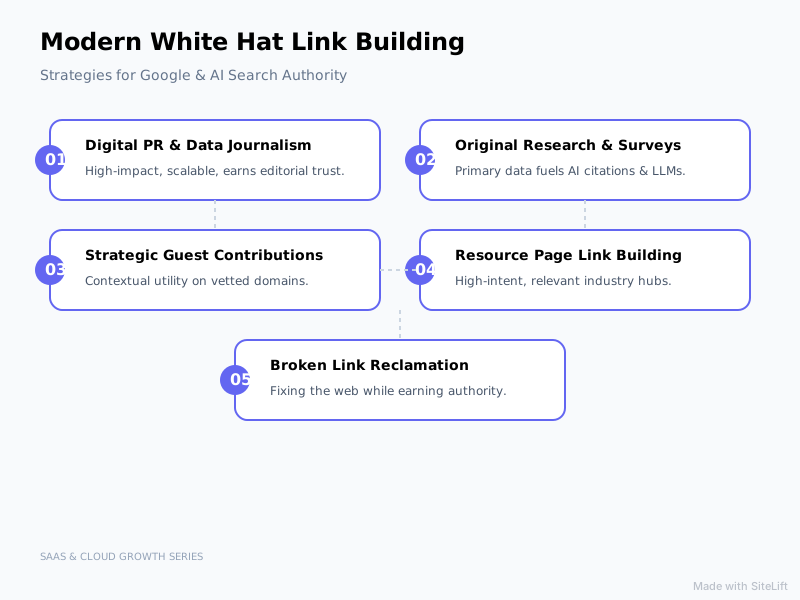
Infographic by SiteLift
Summary Comparison: Evaluating the Best White Hat Link Building Techniques
Selecting the right balance of white hat link building techniques depends heavily on your site's current domain maturity, internal resources, and content assets.
The framework below compares all five strategies to help you choose the best roadmap for your budget and growth targets:
| Link Building Technique | Target Audience / Match | Execution Effort | Scalability | Relative Cost | AI Search & Citation Impact |
|---|---|---|---|---|---|
| 1. Digital PR & Data Storytelling | Established Brands & SaaS | High | Medium | $$$$ | Very High (Primary source indexing) |
| 2. Strategic Editorial Quotes | Founders & Industry Experts | Medium | Medium | $$ | High (Entity correlation) |
| 3. Premium Guest Distribution | Content Teams & Agencies | Medium-High | High | $$$ | High (Contextual relevance) |
| 4. Broken Link Building 2.0 | Resource-Rich Sites | Medium | Medium | $$ | Moderate (Historical authority) |
| 5. Unlinked Brand Reclamation | Brands with Active PR | Low | Low-Medium | $ | High (Brand entity alignment) |
Choosing the Right Strategy for Your Domain Authority Level
- For New Domains (DA < 20): Focus heavily on Strategic Editorial Quotes and Premium Guest Distribution. Building early topical relevance establishes your initial entity baseline in search engines. Implementing a structured scalable backlinks SEO strategy through premium distribution ensures you build authority without risking search engine penalties.
- For Growing Domains (DA 20–50): Combine Broken Link Building 2.0 with Unlinked Brand Mention Reclamation to capture accessible links while building foundational assets.
- For Mature Domains (DA 50+): Invest in Digital PR & Data-Driven Storytelling. Top-tier news links solidify market leadership and dominate AI engine answer sources.
Final Verdict: Building a Future-Proof Link Portfolio
Relying exclusively on manual cold outreach to scale organic authority is fast becoming obsolete. Search engines and AI answer engines evaluate the holistic quality, topical depth, and editorial legitimacy of your entire digital presence.
If your link acquisition strategy relies on low-value guest posts or manual spam, an algorithmic update can erase your search visibility overnight.
Winning long-term organic search rankings requires building a continuous pipeline of publication-ready assets, maintaining strict editorial compliance, and acquiring links that deliver value to real human readers.
+-----------------------------------------------------------------------+
|                    THE FUTURE-PROOF BACKLINK PIPELINE                 |
+-----------------------------------------------------------------------+
|  [ Data Research ] --> [ High-Utility Content ] --> [ Scaled Distribution ]
|                                                            |          |
|  [ Sustainable Organic Traffic ] <-- [ AI Engine Citations & Links ]  |
+-----------------------------------------------------------------------+
For teams looking to accelerate authority growth without spending hundreds of hours on manual outreach, modern autonomous solutions like SiteLift offer an end-to-end platform for publishing targeted content and distributing it across curated networks. By leveraging safe auto link building techniques, businesses can compound their Google rankings and AI engine visibility on autopilot.
SiteLift provides an autonomous SEO engine that creates optimized content, publishes across vetted networks, and scales search authority safely.
— sitelift.io
FAQ
What is the difference between white hat and black hat link building?
White hat link building techniques adhere strictly to search engine webmaster guidelines. They focus on earning contextual backlinks naturally through high-quality content, genuine outreach, and editorial value. Black hat link building relies on manipulative tactics—such as buying low-quality link packages, using automated link farms, or operating Private Blog Networks (PBNs)—which violate search engine policies and risk severe manual penalties.
Do backlinks still matter for AI Search and LLM citations?
Yes, backlinks matter for AI search engines like Perplexity, ChatGPT, and Google AI Overviews. These platforms use Retrieval-Augmented Generation (RAG) to fetch context from web indexes. Websites with high editorial link equity and frequent co-citations across authoritative trade sources are far more likely to be retrieved and cited as official sources in AI-generated answers.
How long does it take to see results from ethical link building?
White hat link building is a compounding, long-term strategy. While search engine crawlers may discover new backlinks within days or weeks, significant improvements in organic rankings and domain authority typically materialize within 3 to 6 months. Factors influencing timeline include your domain's starting authority, niche competitiveness, and link acquisition velocity.
Can guest posting still be considered a white hat link building technique?
Guest posting is considered white hat when done for editorial contribution and thought leadership on reputable, relevant websites. It becomes a black hat or questionable practice when executed at mass scale using thin, spun content on non-relevant publications created solely for link placement. Always prioritize relevance, strict editorial guidelines, and value for the reader.
Topics Covered:
- white hat link building techniques
- ethical link building
- digital PR backlinks
- editorial link earning
- premium guest distribution
More from SiteLift

Content Marketing for Link Building: Turn Every Article Into a Passive Backlink Magnet
Master content marketing for link building. Learn how to engineer linkable assets, target writer citation intent, and automate passive backlink acquisition.

Ecommerce Link Building: Scale Product Authority and Revenue on Autopilot
Master ecommerce link building. Learn how to secure product page backlinks, execute digital PR, fix redirect leaks, and automate your store authority.

Crawling in SEO: How Google and AI Bots Discover and Rank Your Pages
Master crawling in SEO. Learn how Googlebot and AI scrapers discover pages, compare indexing vs crawling, and optimize your crawl budget.