Content Marketing for Link Building: Turn Every Article Into a Passive Backlink Magnet

If you have spent any time running cold email campaigns for backlinks, you know the soul-crushing reality of modern outreach. You scrape a list of five hundred blog editors, send personalized pitches offering an "infographic update" or a guest contribution, and end up with a 1% reply rate—half of which demand a $300 editorial fee.
Manual link begging is broken. Modern content marketing for link building flips this dynamic entirely. Instead of chasing webmasters, you construct high-utility articles that writers, reporters, and creators organically discover and reference in their own work. When you engineer your content around how professionals search for citations, your blog transitions from an empty megaphone into a compounding, passive backlink engine.
Key Takeaways
| Metric / Dimension | Traditional Manual Outreach | Content-Led Link Acquisition |
|---|---|---|
| Link Velocity | Linear (stops the moment you stop sending pitches) | Exponential (compounds as rankings and authority grow) |
| Cost Per Acquired Link | High variable cost (hours of manual prospecting & email fees) | Frontloaded production cost, near-zero marginal cost over time |
| Link Placement Quality | Frequently relegated to author bios or reciprocal resource lists | Contextual in-content citations as a definitive primary source |
| Algorithm Resilience | Vulnerable to link-spam penalties and manual reviews | Compliant with Google's focus on organic editorial link earning |
| Generative AI Visibility | Minimal impact on Large Language Model (LLM) training nodes | High citation frequency across search platforms and AI answer engines |
What Is Content Marketing for Link Building (and Why Does Cold Outreach Fail)?
Content marketing for link building is the strategic creation and distribution of editorial assets designed specifically to earn organic, contextual backlinks from other publishers. Rather than creating generic commercial content and manually soliciting links via email, this method focuses on producing pieces that serve as industry reference points.
The traditional link-building playbook—relying on the Skyscraper technique, uninvited broken-link pitches, and transactional guest post trades—yields diminishing returns. Editors and content managers receive dozens of formulaic outreach emails every morning. Their default reaction is not gratitude; it is the "Delete" button or a spam flag.
Manual Outreach Cycle:
[Prospect List] -> [Cold Pitch] -> [Follow-Up] -> [Negotiation/Fee] -> [Single Static Link]
(Process must be manually repeated for every individual backlink)

Content-Led Compounding Cycle:
[High-Utility Asset] -> [Initial Visibility/Syndication] -> [Rankings for "Citable Intent"]
       ^                                                                   |
       |------------------- [Writers Cite Asset as Source] <---------------|
According to comprehensive Ahrefs search visibility research, 90.63% of all content gets zero traffic from Google, and 66.31% of web pages have zero external backlinks. The reason most articles never secure inbound citations is simple: they were not engineered with citation utility in mind. They mimic what already ranks on page one without adding any net-new value that a journalist or researcher would need to cite.
Editorial Link Earning vs. Manual Pitching
Editorial link earning occurs when an author naturally integrates your resource into their content because it enhances their reader's experience or validates a factual claim.
Manual outreach positions you as a digital solicitor asking for a favor. In contrast, editorial link earning positions your brand as an authority. When a staff writer at a major trade publication drafts a guide on marketing budgets, they do not review cold emails from three weeks ago. They turn to search engines, type in queries like "average SaaS marketing spend 2026," and cite the first comprehensive, well-structured dataset they find.
If your article ranks for that research-driven query, you win the link without sending an email. That citation passes direct search equity, reinforcing your position in search engine result pages (SERPs) and solidifying your backlinks SEO strategy through premium content distribution.
The True Economics of Content-Led Link Acquisition
Cold email campaigns scale linearly. If your team sends 1,000 emails per month to secure 10 links, securing 20 links requires 2,000 emails, double the prospecting hours, and duplicate software seat licenses. The moment your team stops prospecting, your link velocity drops straight to zero.
Content led link acquisition behaves like an annuity. A single data benchmark study or functional tool may take forty hours to produce, structure, and distribute initially. However, once that asset secures baseline visibility on search engines, it attracts incoming links month after month with zero additional labor.
Over a 24-month horizon, the effective cost per link of a high-value asset falls toward zero, while manual outreach costs stay stubbornly flat or climb as digital gatekeepers tighten their editorial standards.
What Types of Content Serve as Reliable Passive Backlink Magnets?
Not every article on your blog can or should be a link magnet. An article explaining "How to Pick the Right CRM Software" targets commercial intent, not citation intent. Prospective buyers read it, but working journalists rarely link to it.
To build a reliable linkable assets strategy, you must produce content formats designed specifically to be referenced.

1. Proprietary Data Studies and Industry Benchmark Reports
Original data is the gold currency of the web. Writers constantly need statistics to validate their arguments, satisfy editors, and bring credibility to their claims.
A joint Backlinko viral content study analyzing 912 million blog posts revealed that while 94% of all online content earns zero links, original research and data-driven studies generate significantly more citations than standard opinion pieces. When you publish unique research:
- You become the exclusive primary source for those metrics.
- Bloggers cannot cite the insight without linking directly to your report.
- Your domain secures high-tier media mentions from trade journalists seeking fresh figures.
You do not need an enterprise budget to produce unique data. You can anonymize and aggregate your own product platform metrics, survey your customer base, or run an analysis across publicly available industry directories.
2. Utility-Driven Calculators, Frameworks, and Workflow Templates
Functional assets solve specific mathematical or structural problems. Instead of simply explaining a concept, they give the user a tangible output.
Examples of functional assets that attract organic citations include:
- Interactive Calculators: ROI calculators, severance pay estimators, or CAC-to-LTV ratio sheets.
- Downloadable Spreadsheets: Financial modeling sheets, editorial calendar templates, and hiring scorecards.
- Operating Frameworks: Diagnostic flowcharts and step-by-step decision trees.
When other writers write high-level guides on your topic, they rarely want to build their own spreadsheet template from scratch. Instead, they write: "You can use this handy [free calculator from Brand] to determine your numbers." That single editorial mention delivers a permanent, contextual backlink.
3. Definitional Standards and Coined Terminology
If you can identify an emerging pattern in your industry and give it a crisp, memorable name, you claim ownership of that concept.
Consider how industry leaders introduce terms like "Product-Led Growth," "Inbound Marketing," or "Zero-Click Content." Once the term gains traction across social platforms and podcasts, other authors write about it. Because you originated the concept, you hold the canonical definition, turning every mention of that coined term into an opportunity for a high-authority attribution link.
| Asset Type | Primary Target Audience | Why It Attracts Backlinks | Shelf-Life |
|---|---|---|---|
| Proprietary Data Reports | Journalists, Research Analysts, Newsletters | Provides irrefutable factual evidence for arguments | 1–2 Years (requires regular updates) |
| Interactive Calculators | Practitioners, Consultants, Managers | Direct practical utility; solves an active operational pain point | 3–5+ Years |
| Coined Concepts & Frameworks | Industry Strategists, Thought Leaders | Acts as the canonical definition for a new method | Indefinite (grows as the term spreads) |
| Step-by-Step Blueprints | In-house Teams, Technical Builders | Comprehensive bookmarkable reference manuals | 1–3 Years |
How Do You Implement Content Marketing for Link Building Step-by-Step?
Transitioning from speculative publishing to systematic link acquisition requires a repeatable operating framework. The following four-stage execution plan turns citation engineering into a predictable science.
Stage 1: Targeting 'Link Intent' and Sourcing Keywords
Keyword research for link acquisition differs substantially from keyword research for customer acquisition. To build link magnets, you search for queries typed by people who are currently writing content.
Look for high link-intent keywords within your niche by combining your core topic with modifiers such as:
[Industry] statistics[Niche] benchmarksAverage cost of [Service][Topic] calculator[Strategy] template
Analyze the existing top three search results for these terms. If the current ranking page features an outdated study from four years ago or a clunky, non-responsive calculator, you have discovered an immediate content gap.
Pro Tip: Look closely at the backlink profile of the current top-ranking page using your SEO tool of choice. If a page ranks #1 for an industry stats keyword and has hundreds of referring domains, that is direct market proof that authors regularly search for that phrase to find citations.
Stage 2: Structuring Editorial Elements for Frictionless Citation
Once a writer lands on your page, you have roughly ten seconds to hand them the exact statistic or definition they need. If they have to scroll through a meandering personal anecdote or a twelve-paragraph introduction, they will bounce back to Google and cite your competitor.
To maximize your citation rate, design for frictionless extraction:
- Highlight Key Stats Up Front: Place a dedicated summary box at the very top of your data study with bulleted, copy-pasteable data points.
- Provide Anchor-Ready Definitions: When defining concepts, write a clean, single-sentence definition wrapped in a styled blockquote or highlighted callout card.
- Embed Ready-to-Use Embed Codes: Beneath your charts, include a clean HTML embed code snippet with pre-formatted link attribution back to your URL.
- Use Clear Chart Labels: Ensure visual graphics display clear titles, axis labels, and your brand's subtle watermark so images can stand independently on social networks.
<!-- Example of an embed snippet that makes citation seamless -->
<div class="stat-highlight">
  <p><strong>Key Finding:</strong> Enterprise teams using automated distribution pipelines publish 4.2x more citable content than those relying on manual outreach.</p>
</div>
Stage 3: Integrating Digital PR for Backlinks Without Spamming
Publishing linkable assets and praying for discovery is an incomplete strategy. In the early stages, your asset needs initial visibility to start climbing the search results where writers can encounter it organically.
This is where digital pr for backlinks comes in. Rather than pitching random site owners to request links, your goal is to present your unique data to journalists who cover your specific beat:
- Identify the Right Beat Writers: Search media databases or platforms like X (Twitter) and Substack for writers who have covered similar benchmark studies within the last six months.
- Draft a High-Signal Summary: Never send a four-page pitch. Write a three-paragraph email outlining:
- The single most counterintuitive finding from your research.
- A direct link to the full dataset and high-resolution chart assets.
- An offer to provide an exclusive, original quote from your leadership team.
- Syndicate to Niche Newsletters: Curated industry newsletters run on fresh, insightful links. Getting featured in two prominent trade newsletters often drives the initial waves of traffic that catch the attention of corporate bloggers.
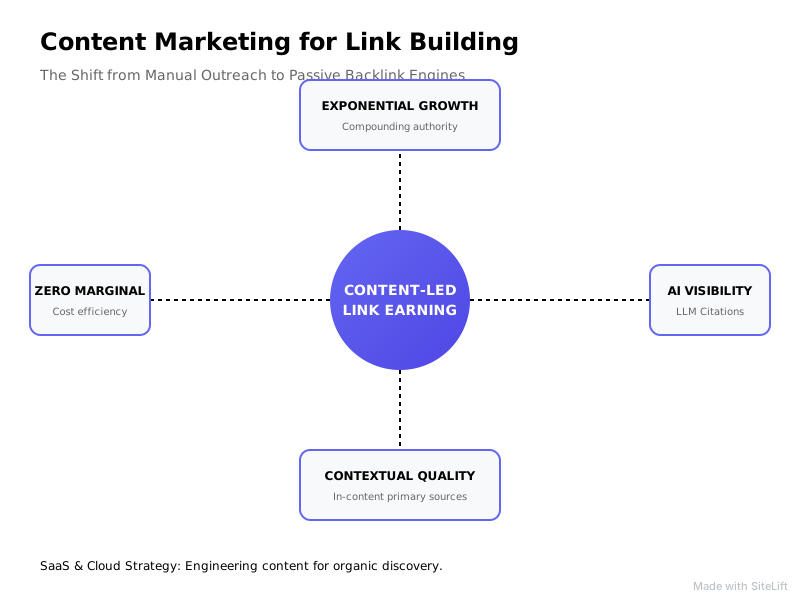
Infographic by SiteLift
How Can Autonomous Content Distribution Accelerate Passive Link Earning?
The greatest weakness of traditional content marketing is the distribution bottleneck. A brilliant research paper or custom-engineered calculator buried on page six of the SERPs earns zero passive citations, because working writers rarely venture past page one.
To bridge the gap between initial publication and sustained top-ranking visibility, forward-thinking teams rely on autonomous content distribution.
Autonomous Distribution Pipeline:
[Published Link Asset]
       │
       ├──► Multi-Network Syndication (Medium, Substack, Industry Hubs)
       ├──► Social & Community Node Seeding
       ├──► Search Engine Indexation & Momentum Tracking
       └──► Citations Earned via Natural Multi-Channel Discovery
Overcoming the Zero-Visibility Cold-Start Problem
When you launch a new linkable asset on a fresh or mid-tier domain, Google's algorithms have not yet assigned it the crawl budget or internal equity needed to compete against established legacy publications.
Relying purely on manual social sharing and word-of-mouth creates an extended cold-start delay. By utilizing automated workflows to syndicate, re-format, and broadcast your core insights across authoritative partner channels, you generate an immediate pulse of referral traffic and referral signals. For a deeper breakdown of how syndication compounds organic reach across diverse ecosystems, explore our guide on repurposing content for SEO.
Multi-Platform Syndication and Algorithmic Discovery
Writers do not only look for data points on Google. They read industry newsletters, monitor platform feeds, and track curated aggregators.
When your data is automatically adapted into:
- Executive summaries on platforms like LinkedIn,
- Long-form syndicated discussions on industry platforms, and
- Visual snackable graphics across developer and creator hubs,
you multiply the discovery surface of your asset. A writer who spots your chart on a secondary network often follows the breadcrumb trail back to your primary site to cite the canonical source in an upcoming client project or editorial column.
Amplifying Authority Across Search and Generative AI Engines
The rapid emergence of Large Language Models (LLMs) and conversational search platforms (such as Perplexity, ChatGPT search, and Google AI Overviews) has permanently altered how content is sourced.
These generative engines do not just index keywords; they evaluate entity relationships and extract verified factual claims to answer user prompts directly. When an AI search engine processes a prompt like "What is the standard conversion rate for SaaS demo pages?", it extracts answers from structured, authoritative source pages.
By optimizing your linkable assets with clean schema markup, definitive quantitative claims, and widespread multi-platform presence, your content becomes a primary retrieval candidate. As generative engines cite your domain as the source for their answers, high-intent researchers and creators reading those AI outputs click through to your domain, securing your position as the de facto authority.
How Do You Retrofit Existing Articles Into Long-Term Backlink Assets?
You do not always need to write brand-new content from scratch. Most established corporate blogs already sit on dozens of underperforming articles that command modest rankings but attract zero backlinks. With a focused editorial upgrade, you can convert these dormant pages into productive backlink magnets.
Step 1: Injecting Verified Statistics and Original Pull Quotes
Perform an editorial audit across your top twenty highest-traffic commercial or educational pages. Look for broad, unverified generalizations such as:
- "Most companies struggle with marketing attribution."
- "Site speed has a major impact on sales conversion rates."
Replace those vague statements with concrete, cited claims or your own verified data points. If you do not possess internal statistics, run a fast mini-survey across your social channels or customer email list, and package the findings directly into the section:
"In our survey of 240 enterprise marketing directors, 64% reported that attribution modeling remains their single greatest operational hurdle."
Other bloggers seeking evidence for their own articles will gladly cite your updated, highly specific statistic instead of a generic claim.
Step 2: Adding Visual Diagrams, Framework Charts, and Embeds
Text-heavy guides struggle to earn visual links. Whenever you explain a multi-step workflow, an architectural concept, or a process timeline, replace long bulleted lists with a bespoke visual diagram.
Ensure your visual assets follow standard reference conventions outlined in Moz's authoritative guides on link equity:
- Include high-contrast text readable at thumbnail sizes.
- Add your brand name and source attribution URL directly on the lower border of the image graphic.
- Add an HTML embed code block immediately below the graphic so other webmasters can easily display it on their sites while retaining a do-follow link to your original post.
Step 3: Pruning Low-Performing Content to Concentrate Domain Authority
Thin, duplicate, or outdated content dilutes your site's overall quality score in the eyes of modern search engines. If your site hosts dozens of thin 400-word blog posts from five years ago that earn no impressions, they siphon crawl budget away from your core link magnets.
Consolidate related underperforming posts into a single, comprehensive pillar guide using 301 redirects. Then, redistribute your internal link equity by linking from high-traffic top-of-funnel posts directly to your new data reports and functional tools. Concentrating your internal links passes accumulated PageRank straight into the assets you want writers to discover.
Why Passive Link Intent Is Painfully Underrated in SEO
The broader SEO industry remains fixated on transactional volume. Marketers spend untold hours analyzing keywords with massive monthly search volumes, only to find themselves stuck competing against multi-billion-dollar enterprise domains.
Meanwhile, they completely overlook low-volume keywords that carry immense "citation intent."
A keyword with only 150 searches a month might look useless inside a spreadsheet to an inexperienced growth manager. But if those 150 monthly searchers are freelance writers, digital journalists, and corporate marketing teams looking for reference data, ranking #1 for that single query can easily net you 10 to 20 contextual, high-DR backlinks every month on complete autopilot.
Stop treating every article on your site as a direct sales pitch. Some pages exist to capture buyers; others exist to build the domain authority required to make your commercial pages rank in the first place. When you embrace this division of labor across your site architecture, your link acquisition stops feeling like an uphill battle and starts behaving like a compounding flywheel.
Investing in passive citation intent turns your editorial team into an authority powerhouse, freeing your brand from the grind of cold outreach. — sitelift.io
Turn Your Editorial Strategy Into a Compounding Growth Engine
Engineering linkable assets is only half the battle; ensuring those assets receive the sustained visibility needed to win continuous editorial links is the real bottleneck. Doing this manually across dozens of platforms demands continuous prospecting, re-formatting, and technical overhead.
This is where SiteLift changes the game. As an autonomous SEO and AI visibility growth platform, SiteLift removes the manual friction from content production and authority building.
The platform continuously builds targeted, high-value content, automatically handles publication across popular CMS platforms, and syndicates your ideas across a curated network of authoritative publisher environments. By putting your assets directly into the discovery stream of search engines and generative AI agents, SiteLift compounds your topical relevance, builds durable domain authority, and tracks your organic momentum in real-time—all on autopilot.
To see how an automated pipeline can accelerate your link acquisition, explore our deep dive on building an automated SEO content management pipeline.
FAQ
What is the difference between content marketing for link building and traditional link building?
Traditional link building relies primarily on manual, outbound outreach—sending cold emails, submitting directory links, and negotiating manual link exchanges. Content marketing for link building relies on inbound discovery: engineering high-utility editorial assets (such as original research studies, calculators, or definitive frameworks) that writers, editors, and industry analysts naturally discover and cite as a primary source.
How long does it take for a linkable asset to start generating passive backlinks?
Passive link generation typically begins once an asset breaks onto the first page of search results for its target citation queries (e.g., industry statistics or framework keywords). Depending on your existing domain authority and initial distribution momentum, this typically takes between three to six months. Once positioned on page one, inbound links compound naturally over time without ongoing manual intervention.
Do you need a high Domain Authority to earn editorial backlinks through content?
No. While a higher Domain Authority helps content rank faster, sites with modest authority can regularly earn links from top-tier media outlets by publishing original primary data. Journalists and industry bloggers search for fresh facts, verified survey results, and novel insights. If your site is the only original source for that data, high-authority publications must cite and link to your domain regardless of your current authority score.
What is the single most effective type of content for passive link acquisition?
Empirical data studies and original benchmark reports consistently earn the highest volume of high-authority citations. A joint study by Backlinko and BuzzSumo covering 912 million articles demonstrated that original research and data reports earn significantly more backlinks than standard opinion columns or listicles, making primary data the highest-ROI asset type for organic link acquisition.
How does autonomous content distribution impact link velocity?
Autonomous distribution solves the zero-visibility cold-start problem. New articles often languish in search obscurity before they begin ranking. By automatically syndicating and amplifying linkable assets across diverse platforms, creator hubs, and search engines, autonomous distribution accelerates initial referral traffic and social discovery. This immediate exposure puts your assets in front of authors and researchers faster, dramatically shortening the time it takes to earn the first wave of natural citations.
Topics Covered:
- content marketing for link building
- linkable assets strategy
- content led link acquisition
- digital pr for backlinks
- editorial link earning
- autonomous content distribution
More from SiteLift

SaaS Link Building: How to Scale Authority, Trials and ARR with Automation
Scale your SaaS link building without manual cold email. Learn how to use product-led assets, digital PR, and automated distribution to grow trials and ARR.

Site Architecture for SEO and AI Search: Structure for Crawlers, Users and LLMs
Master site architecture for SEO, web crawlers, and AI engines. Discover how to build topic clusters, reduce click depth, and optimize crawl budget.

AI Search Optimization Services vs Autonomous Platforms: Which Scales Faster?
Compare ai search optimization services vs autonomous platforms on speed, cost & AI citations. See which scales faster and start compounding.