Site Architecture for SEO and AI Search: Structure for Crawlers, Users and LLMs

Building a website without a deliberate site architecture is like constructing a library without shelves, catalogue numbers, or genres. You might have thousands of brilliant books scattered across the floor, but nobody—neither a human patron nor an automated inventory scanner—can find what they need.
For years, search engine optimization treated structure as a basic hygiene checklist: make sure your navigation works, keep URLs clean, and submit an XML sitemap. But the landscape has shifted underneath our feet. According to research from BrightEdge, organic search accounts for 53.3% of all trackable website traffic across industries. Capturing that demand now requires designing a framework that satisfies three fundamentally different audiences: human visitors looking for solutions, legacy search engine crawlers indexing pages, and Large Language Model (LLM) scrapers extracting contextual entities for generative answers.
If your structural taxonomy fails to communicate context, your content will fail to rank in Google, let alone get cited in Perplexity or SearchGPT. Here is how to engineer a resilient, high-performing site structure built for the modern semantic web.
What Is Site Architecture and Why Does It Matter for Modern SEO?
At its core, site architecture represents the structural organization, taxonomic hierarchy, and internal linking framework of your digital assets. It dictates how pages relate to one another, how search bots traverse your domain, and how users navigate from broad entry points down to hyper-specific conversion pages.
Historically, SEO focused on ranking single URLs against individual keywords. You wrote an article, pointed a few links at it, and hoped for the best. Today, search engines evaluate topical clusters and categorical relationships. An unorganized domain confuses web spiders and fragments your authority. A coherent architecture, by contrast, pools topical signals so that every new piece of content you publish inherits contextual equity from day one.
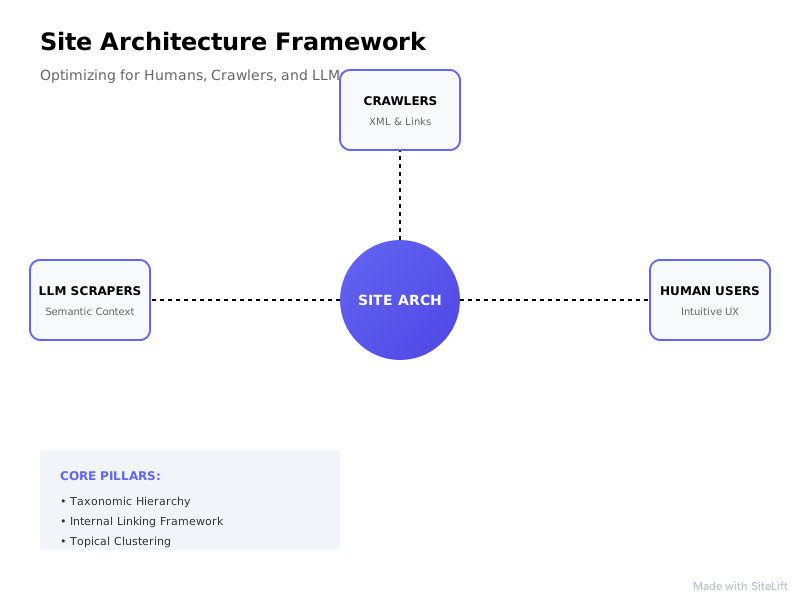
Infographic by SiteLift
Flat vs. Deep Site Hierarchies Explained
The debate between flat and deep site hierarchies comes down to balance: balance between categorical depth and click accessibility.
| Structural Attribute | Flat Site Architecture | Deep Site Architecture |
|---|---|---|
| Typical Click Depth | 1 to 3 clicks from homepage | 4 to 8+ clicks from homepage |
| Crawl Efficiency | Very high; spiders find URLs quickly | Poor; spiders exhaust budget before reaching deep pages |
| PageRank Distribution | Broad and fast across subpages | Diluted; leaf nodes receive minimal equity |
| Categorical Organization | Can become messy if catalogs exceed 5,000 URLs | Highly organized, but prone to creating crawl traps |
| Best Suited For | SaaS, B2B content hubs, small-to-medium publishers | Massive enterprise e-commerce (100k+ SKUs) |
A deep site hierarchy buries high-intent pages under multiple subdirectories (e.g., domain.com/category/subcategory/sub-subcategory/page). As URLs slip beyond 4 or 5 clicks away from the root, their organic visibility plummets.
According to Google Search Central crawl documentation, maintaining a shallow site architecture where critical content is accessible within 3 to 4 clicks ensures optimal crawl efficiency and rapid indexation. A flatter structure prevents valuable conversion assets from withering away in technical isolation.
The Evolution from Keyword Targeting to Topical Authority Architecture
Search engines no longer parse pages as standalone text files containing keyword densities. Ever since algorithms shifted toward natural language processing and entity extraction, search engines assess topical relationships across your entire domain.
When you adopt a topical authority architecture, you organize content into dedicated semantic hubs. Instead of treating twenty articles about "cloud security" as isolated blog posts, you structure them around a comprehensive pillar page with structured child nodes. This tells algorithms: We do not merely have an article about this subject; we possess an interconnected body of knowledge. Developing systematic content mapping strategies allows you to outline these topical nodes long before drafting a single paragraph.
How Information Architecture Influences User Engagement and Navigability
Search performance does not happen in a vacuum separated from user behavior. When information architecture adheres to intuitive conventions—such as consistent primary navigation, context-rich breadcrumbs, and descriptive internal anchors—visitor friction drops.
Users who find clear navigation pathways stay on-site longer, view more pages per session, and convert at higher rates. These positive interaction patterns generate clean engagement signals. Conversely, a confusing layout with broken internal pathways drives bounce rates up and degrades your brand's authority in the eyes of search algorithms.
How Do Search Crawlers and AI Bots Process Your Site Structure?
Search bots do not consume your website the way a human does. They do not admire your CSS styling or your hero imagery. They request raw HTML files, extract URLs, map dependencies, and parse text into structured entities.
To build an effective seo site structure, you must understand how both traditional web crawlers and modern AI bots parse your content.

Crawl Budget Optimization: Helping Spiders Discover High-Value Pages
Every site has a crawl budget: the number of URLs search bots can and want to crawl within a given timeframe. Googlebot allocates this based on your domain authority, your server's response times, and your structural health.
If your architecture contains duplicate URLs generated by faceted navigation, infinite calendar loops, or unindexed test pages, search crawlers burn through their budget on junk. Consequently, newly published or updated editorial pieces sit unindexed for weeks.
Proper crawl budget optimization removes low-value crawl paths. By keeping your site flat and maintaining clear navigational hierarchies, you ensure that search spiders dedicate their computational resources exclusively to high-value, indexable URLs.
Pro Tip: Use your server log files to monitor bot behavior. If Googlebot spends more than 15% of its crawl requests on 301 redirects, paginated parameters, or thin category variants, prune those paths out of your navigational menus immediately.
Differences Between Traditional Search Crawlers and AI Engine Scrapers
We are no longer building websites solely for Googlebot and Bingbot. An entire generation of LLM scrapers—such as GPTBot (OpenAI), ClaudeBot (Anthropic), and PerplexityBot—now comb the web. While these systems share underlying crawler mechanics with Google, their objective is different:
- Extraction vs. Indexing: Traditional search crawlers extract text to build an inverted search index matching keywords to documents. AI scrapers ingest text to build vector embeddings, extract factual claims, and map semantic relationships between entities.
- Contextual Scaffolding: LLM answer engines heavily rely on structured document trees. If a factual statement sits in an orphaned article lacking categorical parentage, an AI engine has low confidence in the entity's authority.
- Bandwidth and Depth Constraints: AI bots are aggressive, yet selective. If your architecture is clunky, slow, or requires executing heavy client-side JavaScript to render parent links, LLMs will scrape the raw markdown/HTML shell and miss the deeper context entirely.
Technical Hygiene: Sitemaps, Robots Directives, and Canonical Hygiene
A clean architectural design must be reinforced by technical infrastructure. The World Wide Web Consortium (W3C) web architecture principles highlight the importance of stable, unambiguous URL design for distributed data exchange.
- Dynamic XML Sitemaps: Split your sitemaps by content type (e.g.,
pages-sitemap.xml,articles-sitemap.xml,hub-sitemap.xml). Never allow 404s, redirected URLs, or canonicalized duplicates into an XML sitemap. - Robots.txt Controls: Explicitly disallow administrative directories, search filter endpoints, and staging assets. Do not block CSS or JavaScript files required for structural rendering.
- Self-Referential Canonicals: Ensure every canonical URL explicitly points to itself unless a duplicate or syndicated version intentionally defers to a master URL. This avoids parameter-based duplicate content traps that split link equity.
How to Build a Topical Authority Architecture for AI and Semantic Search
Transitioning to a topical authority architecture means abandoning random blog calendars in favor of engineered knowledge graphs. When your pages clearly link upward, downward, and horizontally within defined categories, search engines and LLMs can easily verify your domain's depth on any given topic.
                  [Homepage]
                      │
       ┌──────────────┴──────────────┐
  [Hub: Cloud Ops]             [Hub: Cyber Security]
       │                               │
 ┌─────┴─────┐                   ┌─────┴─────┐
[Cluster A] [Cluster B]         [Cluster C] [Cluster D]
 (Article)   (Article)           (Article)   (Article)
Designing Semantic Topic Clusters and Hub-and-Spoke Frameworks
The hub-and-spoke model organizes content systematically:
- The Hub (Pillar Page): A comprehensive, authoritative page providing a wide overview of a broad topic (e.g.,
/enterprise-analytics/). - The Spokes (Cluster Content): In-depth articles addressing sub-topics, questions, or specific workflows (e.g.,
/enterprise-analytics/real-time-pipelines/and/enterprise-analytics/anomaly-detection/). - The Cross-Links: Every spoke links back to its parent hub, and contextual links connect logically related sibling spokes.
This structure creates an unambiguous topical loop. When search algorithms evaluate the cluster, they see a cohesive library rather than isolated documents.
Structuring URL Hierarchies and Breadcrumb Trails for Contextual Depth
Clean URL structures help humans and algorithms instantly understand where a page lives inside your taxonomy. Compare these two paths:
- Messy:
domain.com/p?id=9812&category=tech - Semantic:
domain.com/solutions/fintech-automation/risk-modeling/
The semantic path mirrors the information architecture directly.
Reinforce this structure with breadcrumb navigation marked up using Schema.org standards. Breadcrumbs provide a persistent secondary navigation trail for users, and search engines display them directly within search engine results pages (SERPs). This visual hierarchy increases click-through rates while solidifying your category layers.
Feeding LLMs with Structured Data and Entity-Level Schema Markup
If you want generative search engines to quote your content, you must make your entities machine-readable. Using JSON-LD structured data removes the guesswork for AI bots trying to parse relationships.
Implement the following core schemas across your architecture:
Organization: Establishes your company name, logo, official social profiles, and primary domain entity.WebSite: Defines site search capabilities and establishes global site taxonomy.CollectionPage/ItemPage: Used on pillar pages and directory hubs to signify that a URL hosts a grouped index of assets.Article/TechArticle: Explicitly defines the author, publisher, publication date, and primary topic entities using theaboutandmentionsschema properties.
What Is the Role of Internal Linking in Scaling Site Architecture?
If taxonomy represents the blueprint of your website, internal links are the plumbing. Without internal links, PageRank and topical context cannot flow through your domain.
Data published by Backlinko reveals that pages ranking in Google position #1 have an average of over 3.8 times more backlinks and internal equity signals than lower-ranking positions. While external backlinks build overall domain strength, your internal linking architecture determines how that strength distributes to your highest-converting pages.
Distributing PageRank and Contextual Equity Across Content Hubs
PageRank passes from high-authority pages (usually your homepage and popular thought-leadership assets) through internal links to secondary and tertiary pages.
If your homepage links to your primary pillar pages, those pillars gain substantial equity. When those pillar pages link downward to specific bottom-of-the-funnel feature pages, that authority flows downstream.
Never squander internal equity on dead-end pages. Avoid linking repeatedly to login pages, terms of service, or generic external portals from your core body text. Ensure every contextual link serves a clear discovery purpose.
Automating Contextual Internal Linking Without Compromising Editorial Quality
As your content library expands from 50 to 5,000 URLs, manually managing internal links becomes unsustainable. Editors forget which articles already exist, leading to content silos and missed contextual links.
This is where internal linking automation enters modern SEO workflows. Sophisticated teams use semantic automation rules to analyze newly published articles, compare them against existing knowledge bases, and insert contextual anchor links automatically. Incorporating this mechanism into an automated publishing pipeline ensures that no new article is ever published into an architectural vacuum.
Pro Tip: Never automate internal links using uniform, keyword-stuffed anchor text. Vary your anchors naturally across exact-match synonyms, partial phrases, and natural entity mentions to avoid triggering over-optimization filters.
Identifying and Eliminating Orphan Pages and Click Depth Bottlenecks
An orphan page is a published URL that has zero internal links pointing to it from anywhere on the domain. These pages are invisible to web crawlers unless they are explicitly listed in an XML sitemap—and even then, search engines treat them as low-priority, low-value assets.
To resolve orphan pages and click depth bottlenecks:
- Audit Regularly: Run a crawl of your website using a headless crawler and cross-reference discovered URLs against your Google Analytics and server log databases. Any URL receiving organic traffic or listed in your database that lacks incoming internal links is an orphan.
- Re-integrate or Prune: If the orphaned page is valuable, integrate it into a relevant hub with contextual anchors. If the content is outdated, thin, or duplicative, set up a 301 redirect to a relevant live URL or return a clean 410 Gone status.
- Cap Click Depth: Ensure your primary content assets stay within 3 clicks of the homepage. Use contextual sidebars, category sub-menus, and pagination controls to bring buried URLs closer to the root.
How Do You Audit and Re-Engineer an Existing Site Architecture?
Overhauling a legacy website structure carries risk. If you change URLs recklessly or break existing navigational paths, your organic traffic can plummet. However, leaving a bloated, disjointed architecture intact guarantees that your visibility will slowly degrade over time.
A systematic audit and migration plan lets you restructure your domain safely.
Conducting a Systematic Site Architecture Audit
Before touching a single redirect or updating your navigation menu, map your existing technical landscape.
- Extract Crawl Data: Run an end-to-end crawl of your domain. Record the URL, HTTP status code, canonical tag, click depth, inlink count, and organic traffic metrics for every page.
- Evaluate Depth Distribution: Create a distribution chart showing how many pages sit at click depth 1, 2, 3, 4, and 5+. If more than 20% of your pages sit at depth 4 or deeper, your site requires flattening.
- Review Anchor Text Profiles: Check which phrases you are using for internal links. Are you wasting link equity on generic terms like "click here," "read more," or "source"? Replace these with descriptive, entity-rich anchors.
- Identify Silo Leaks: Verify whether child cluster pages are linking erratically across unrelated categories. If a spoke under your "Cloud Architecture" hub links arbitrarily to an unrelated article in your "Human Resources" hub, clean up those connections to protect topic integrity.
Safely Managing URL Migrations and Redirect Maps
If re-engineering your site architecture requires changing URL structures (for example, introducing clean categorical subdirectories), you must execute your redirects with extreme care:
- 1:1 Direct Mapping: Build a strict 1-to-1 redirect map. Never route bulk URLs to the homepage or broad category pages; redirect each old URL directly to its exact replacement page.
- Deploy Permanent 301 Redirects: Use server-level 301 redirects to transfer accumulated PageRank and search signals to the new paths.
- Update Internal Links at the Source: Do not rely on your own 301 redirects to route internal traffic. Update your internal links, menu items, and sitemaps so they point directly to the new 200 OK destinations. Chains of redirects slow down users and waste crawl budget.
Measuring Impact on Indexation, Search Rankings, and AI Citations
Once your new architecture goes live, monitor your performance across both traditional and AI-driven platforms:
- Google Search Console (GSC): Check the "Pages" indexation report. Look for a reduction in pages categorized under "Crawled - currently not indexed" and "Discovered - currently not indexed." A healthy architecture accelerates indexation rates.
- Click Depth Tracking: Re-crawl the live site post-migration to verify that all primary URLs now sit comfortably at a click depth of 3 or fewer.
- Generative AI Visibility: Monitor visibility tools and answer engines (SearchGPT, Perplexity, Copilot). Track whether citations of your brand increase as AI scrapers parse your streamlined, entity-rich topical clusters.
Key Takeaways
| Strategic Area | Core Best Practice | Primary Benefit |
|---|---|---|
| Hierarchy Design | Flat, categorical taxonomy (3–4 clicks max) | Rapid indexation and crawl budget preservation |
| Topic Clustering | Hub-and-spoke frameworks organized around entities | Signals clear categorical and topical authority |
| Crawling Hygiene | Pruned parameters, dynamic sitemaps, clean canonicals | Prevents search spiders from hitting dead ends |
| Internal Linking | Semantic, automated contextual linking | Balances PageRank distribution across deep pages |
| AI Optimization | Schema.org markup combined with clean markdown/HTML | Facilitates direct LLM entity extraction and citations |
Why "Perfect URL Siloing" Is Overrated (And What Actually Works)
I have watched dozens of technical SEOs spend months agonizing over the "perfect" directory hierarchy. They insist that an article must strictly live at domain.com/category/sub-category/year/month/title, and they construct elaborate, rigid barriers that ban any link from crossing outside its assigned silo.
In my experience, dogmatic siloing does more harm than good.
First, rigid directory trees break the moment your business evolves. If you rebrand a product or broaden a service line, your URLs become instantly outdated, forcing you into high-risk migration cycles.
Second, the modern web is relational, not purely hierarchical. While clear parent-child relationships are crucial for organizing your foundational hubs, forbidding horizontal links between complementary topics is a mistake. If your article on "Database Scaling" naturally supports a guide on "Payment Gateway Architecture," link them directly.
Search engines—and especially LLM answer engines—do not parse knowledge in isolation. They evaluate semantic webs. As long as your breadcrumbs establish a clear primary category, your internal linking should reflect how an expert thinks about the subject: fluid, interconnected, and practical. Build logical foundations, but do not let rigid taxonomy stifle your internal link equity.
— sitelift.io
Streamlining Your Site Architecture with SiteLift
Maintaining a modern, search-engine-ready architecture manually is challenging. Between mapping out semantic topic clusters, auditing click depths, and constantly updating internal links as your library grows, the technical overhead can overwhelm busy marketing and development teams.
This is where sitelift.io changes the game. SiteLift operates as an autonomous SEO and AI visibility growth platform, designed to manage your site's organic expansion from end to end.
Instead of manually maintaining complex internal link spreadsheets, SiteLift automatically connects your content assets into balanced, topically sound clusters. The platform generates targeted, high-value content, publishes it directly through your CMS, links it logically within your architecture, and distributes it across a curated network to build authority on autopilot.
By eliminating the manual friction behind internal linking and publishing hygiene, SiteLift ensures your site architecture remains flat, healthy, and primed for discovery across traditional search engines and AI answer engines alike.
FAQ
What is the ideal click depth for SEO and crawlability?
The ideal click depth for most websites is between 1 and 3 clicks from the homepage. High-priority landing pages, core service offerings, and authoritative pillar hubs should always remain accessible within 3 clicks. If non-paginated informational pages sit 5 or more clicks away from the root, search engines crawl them less frequently, and users are far less likely to find them.
How does site architecture differ for AI search engines compared to traditional search engines?
Traditional search engines scan HTML to index keywords and evaluate page authority via external link graphs. AI search engines (like Perplexity and SearchGPT) look for contextual entities, data consistency, and factual clarity to generate direct answers. AI engines benefit heavily from semantic topic clusters, clear parent-child schema structures, and easily parsable HTML text that contextualizes how different topics relate to each other.
What is the difference between a flat site architecture and a deep site architecture?
A flat site architecture keeps all pages within a few clicks of the homepage (typically 1 to 3 clicks), allowing link equity to distribute rapidly and making crawl discovery straightforward. A deep site architecture nests pages through long chains of subdirectories and subcategories (often 4 to 8+ clicks deep), which can dilute PageRank and bury valuable URLs away from search engine bots.
How does internal linking automation support crawl budget optimization?
Manual internal linking often leaves newer or deeper pages isolated, forcing search engine bots to rely exclusively on sitemaps to find them. Internal linking automation systematically links new articles to and from existing high-authority hubs using relevant semantic anchors. This gives search crawlers immediate, natural pathways to index new content without wasting time or crawl budget hunting down disconnected URLs.
When should a business consider a full site architecture overhaul?
A business should consider an architecture overhaul if:
- More than 20% of indexable pages sit at a click depth of 4 or greater.
- Important pages remain unindexed for weeks despite having clean XML sitemaps.
- The current URL structure reflects legacy product offerings rather than modern search intent.
- The domain suffers from extensive orphan pages, broken internal redirect chains, and diluted topical authority.
Topics Covered:
- site architecture
- seo site structure
- internal linking automation
- crawl budget optimization
- topical authority architecture
More from SiteLift

What Modern Technical SEO Services Must Include to Win in AI Search
Discover what modern technical seo services must include to win in AI search. Optimize technical site health, crawl budget, and schema markup today.

AI Search Optimization Services vs Autonomous Platforms: Which Scales Faster?
Compare ai search optimization services vs autonomous platforms on speed, cost & AI citations. See which scales faster and start compounding.

Visibility Tracker Explained: Measure True Share of Voice Across Google and AI Search
Discover how a visibility tracker measures search visibility scores and share of voice across Google and AI search engines to compound your organic reach.