What Is a Content Map? How to Plan Topical Authority That Compounds Traffic

Most digital publishing teams run on a hamster wheel. They publish three blog posts a week, chase whatever keyword has decent search volume on a generic SEO tool, and pray that Google notices. Six months later, organic impressions remain flat, and leadership wonders why content marketing feels like lighting cash on fire.
A strategic content map breaks that cycle. Rather than viewing content as isolated articles published chronologically, a content map arranges your website around interconnected subject matter. It turns your blog from a disconnected feed of random musings into a structured web of expertise designed to satisfy human intent and search algorithms simultaneously.
When built right, a content map is the blueprint that turns organic search into a compounding asset. Instead of fighting for scraps on single keywords, you claim entire topics.
What Is a Content Map (and How Does It Differ From a Content Calendar)?
Defining the Modern Content Map
At its core, a content map is a strategic architectural blueprint. It defines how every piece of content on your website connects to specific user personas, buying stages, search intent profiles, and semantic entities.
Rather than asking, "What should we write this Tuesday?", a content map asks:
- What fundamental entities define our domain's core expertise?
- What subtopics, questions, and edge cases must we cover to prove exhaustive depth?
- How do these URLs pass contextual relevance and equity to one another?
Think of your website as a physical library. An unmapped site throws every newly acquired book into an ever-growing pile in the lobby. A mapped site catalogs each volume into precise aisles, shelves, and subject classifications, making retrieval instantaneous for readers and catalogers alike.
                    ┌────────────────────────┐
                    │    CORE PILLAR PAGE    │
                    │ (Broad Target Keyword) │
                    └───────────┬────────────┘
                                │
        ┌───────────────────────┼───────────────────────┐
        ▼                       ▼                       ▼
┌───────────────┐       ┌───────────────┐       ┌───────────────┐
│ Sub-Cluster A │       │ Sub-Cluster B │       │ Sub-Cluster C │
│  (How-To/Why) │◄─────►│ (Comparative) │◄─────►│ (Data/Tools)  │
└───────┬───────┘       └───────┬───────┘       └───────┬───────┘
        ▼                       ▼                       ▼
┌───────────────┐       ┌───────────────┐       ┌───────────────┐
│ Long-Tail QA  │       │ Long-Tail QA  │       │ Long-Tail QA  │
└───────────────┘       └───────────────┘       └───────────────┘
Content Mapping vs. Editorial Calendars vs. Journey Maps
Marketers often conflate content maps with editorial calendars and customer journey maps. While they complement one another, their core functions differ:
| Framework | Core Question Answered | Primary Focus | Primary Output |
|---|---|---|---|
| Editorial Calendar | When do we produce and publish this? | Deadlines, production velocity, writer assignments | Chronological schedule |
| Journey Map | Who is experiencing this, and what do they feel? | Persona pain points, emotional friction, conversion paths | Customer experience timeline |
| Content Map | Where does each asset fit within our topical footprint? | Semantic relationships, entity depth, internal link equity | Architectural taxonomy & URL hierarchy |
A content calendar without a content map simply executes blind volume. According to Content Marketing Institute research, 73% of B2B marketers execute content marketing, but only 40% have a documented framework guiding their strategy. That disconnect explains why so many editorial calendars are packed with busywork that generates zero revenue.
Why Traditional Keyword Spreadsheets Fail in Semantic Search
For over a decade, SEO meant maintaining a massive spreadsheet of keywords, sorting by monthly search volume (MSV), and churning out one 1,500-word post per row.
Google no longer evaluates documents simply by matching keywords. Modern search engines rely on semantic search, entity extraction, and machine learning models like RankBrain and MUM. They do not read your article as an isolated bag of words; they assess how well your domain understands the conceptual graph of a topic.
If you write a single, isolated post on "enterprise cloud migration" without covering cloud security, legacy refactoring, data governance, and hybrid cloud costs, search engines perceive a gap in your knowledge. Ahrefs research shows that 90.63% of all web pages receive zero organic search traffic from Google—predominantly because they lack real topical depth, coherent internal linking, and referring authority.
A modern content map fixes this by prioritizing topical completeness over fragmented keyword targeting.
How Does a Content Map Build Compounding Topical Authority?
The Mechanics of Semantic SEO and Entity Relationships
Search engines view the web through entities: distinct, well-defined people, places, things, and concepts. When you publish content, Google cross-references your ideas against its Knowledge Graph.
       [Entity: CRM Software]
             ▲         ▲
             │         │
   (defines) │         │ (features)
             │         │
[Entity: Pipeline]    [Entity: Lead Scoring]
             ▲
             │ (utilizes)
             │
   [Entity: B2B Sales]
Implementing topical map seo means structuring your pages so search bots clearly see how concepts relate to one another. If your software manages B2B sales pipelines, your content map must systematically encompass related entities: sales forecasting, lead velocity, customer lifecycle value, and churn reduction. By systematically publishing connected nodes around those entities, you send an unmistakable signal: this site is a definitive source for this entire knowledge vertical.
Pillar-and-Cluster Architecture Explained
The most durable way to organize a content map is through the pillar-and-cluster model (also known as hub-and-spoke).
- Pillar Page (The Hub): A comprehensive, top-of-funnel overview covering a broad subject broadly (e.g., "The Complete Guide to Data Governance"). It targets competitive, high-volume keywords and introduces core subtopics without answering every edge-case question.
- Cluster Assets (The Spokes): Highly targeted articles focusing on specific long-tail queries, technical setups, and comparisons (e.g., "Data Governance Frameworks for Healthcare," "Data Catalog vs. Data Dictionary").
- Hyper-Specific Support Nodes: Quick-hit informational posts answering narrow questions (e.g., "How does HIPAA impact data lineage?").
A benchmark study by HubSpot indicates that companies publishing prioritized, cluster-based content regularly receive up to 3.5 times more organic traffic than those publishing unstructured posts. When a cluster covers every angle of a subject, Google rewards the entire cluster.

Optimizing Internal Linking and PageRank Flow
A content map is not just a plan for what to write; it is a structural diagram for PageRank distribution.
[Pillar Page: High PageRank / Backlinks]
       ▲                      │
       │ (contextual upvote)   │ (equity distribution)
       │                      ▼
[Cluster: Technical Setup] ◄──► [Cluster: Best Practices]
When an external site links to your comprehensive pillar post, that URL gains PageRank. If that pillar contains organized internal links to your deep cluster posts, that authority flows downward. In turn, when long-tail cluster posts earn links or convert visitors, they pass relevance back up to the pillar.
Pro Tip: Never rely on automated "related posts" widgets at the bottom of an article. Hand-curated contextual links inside the actual body text pass significantly higher semantic relevance because search engines read the surrounding words to understand the target page's context.
Following Google Search Central guidelines on clean site hierarchy ensures that web crawlers discover your deep cluster pages without chewing through crawl budget on dead ends.
How to Create an Actionable Content Map Step-by-Step
Building a content map requires moving methodically from raw data to architectural execution. Here is the exact framework to run.
Step 1: Entity Discovery and Keyword Clustering
Start by gathering every search query, customer question, and competitor topic relevant to your space. Export your target keyword universe from your chosen SEO research tool.
Instead of tackling this list line by line, perform keyword clustering. Clustering groups keywords that share the same underlying search intent, meaning a single URL can rank for dozens or hundreds of variants.
Raw Keyword Export:
├─ "content strategy template"
├─ "how to map content"
├─ "content mapping frameworks"
├─ "mapping content for seo"
└─ "content mapping sheet"

Automated Semantic Grouping:
└─ Cluster: "Content Mapping Guide & Frameworks"
   ├─ Primary Target: "content map"
   └─ Secondary Targets: "topical map seo", "site content structure"
Look for semantic overlap. If the top five SERP results for two different search queries show the exact same three URLs, Google treats those queries as the same intent. They belong to a single cluster node on your map, not two separate articles.
Step 2: Mapping Search Intent to Funnel Stages
A technically sound site that fails to generate pipeline is an expensive hobby. Every entry on your content map must pair a search intent profile with a commercial objective:
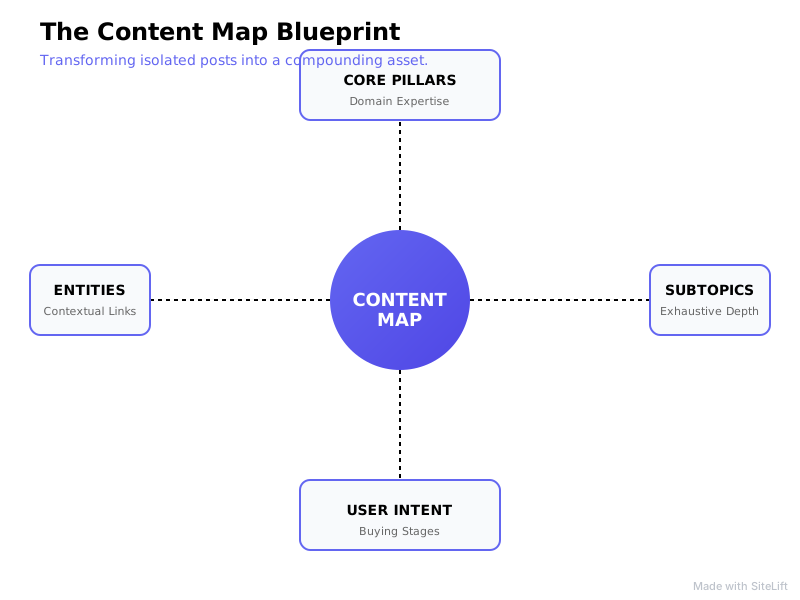
Infographic by SiteLift
- Top of the Funnel (TOFU) - Informational Intent: The searcher seeks answers, definitions, or broad education (e.g., "what is topical authority"). Focus on clear explanations and zero hard pitches.
- Middle of the Funnel (MOFU) - Commercial/Investigative Intent: The searcher is comparing approaches or tools (e.g., "manual content planning vs automated workflows"). Use comparison matrices, teardowns, and workflow tutorials.
- Bottom of the Funnel (BOFU) - Transactional Intent: The searcher is ready to choose a provider (e.g., "best programmatic SEO platform"). Guide them to product tours, case studies, and transparent pricing documentation.
Mapping intent prevents publishing high-volume informational content that attracts unqualified visitors who bounce within seconds.
Step 3: Designing the Site Content Structure and URL Hierarchy
Your content map should dictate your site content structure. How you organize directories signals topical depth directly to search engines.
Adopt a clean, predictable URL hierarchy that mirrors your pillar-cluster taxonomy:
example.com/learn/                    <- Educational Hub
example.com/learn/seo/                <- Pillar Page
example.com/learn/seo/content-mapping <- Cluster Asset
example.com/learn/seo/internal-links  <- Cluster Asset
This structure makes it straightforward for search engines to evaluate topical boundaries. If you operate an established site with flat URLs (example.com/post-name), you do not necessarily need to migrate every link—doing so risks broken redirects. Instead, use an internal link analyzer tool to spot weak link hierarchies and fix how your existing architecture communicates depth.
How Can Content Planning Automation Scale Your Topical Footprint?
Eliminating Bottlenecks with Autonomous Content Workflows
Planning out 150 interconnected cluster topics across four pillars looks great on a whiteboard. But execution is where most teams stall out. Manual research, drafting briefs, managing freelance writers, and formatting CMS fields can turn a 20-article cluster into an eight-month slog.
By the time you finish publishing month eight, the first three pieces are already out of date, and your topical map remains half-built in Google’s eyes.
This is where content planning automation changes the economics of search. By moving from static spreadsheets to dynamic platforms, teams can automatically:
- Group entity gaps into prioritized clusters
- Generate structurally sound outlines aligned with semantic search requirements
- Schedule and publish content systematically across parent and child nodes
Static Workflow (Manual, Slow):
Keyword Export ──► Spreadsheet ──► Manual Briefs ──► Freelancer ──► CMS Copy/Paste (Weeks per post)

Automated Workflow:
Entity Discovery ──► Algorithmic Clustering ──► Dynamic Pipeline ──► Auto-Sync to CMS (Days per cluster)
Teams using the SiteLift Content Planner can configure content parameters, define topical boundaries, and populate publication queues without micromanaging individual spreadsheets.
Maintaining Quality and Semantic Coherence at Scale
The primary risk of scaling content via automated pipelines is quality decay. If an automated system outputs repetitive, thin pages filled with generic assertions, your domain will suffer under search quality algorithms.
To keep large-scale content generation effective, automated systems must enforce structural rules:
- Entity Density & Variance: Ensure secondary entities appear contextually throughout the text.
- Distinct Perspectives: Avoid spinning the same core thesis across five different cluster articles.
- Structured Data Implementation: Include FAQ schemas, breadcrumb trails, and programmatic schema markup to highlight relationships between clusters.
Building an automated SEO content management pipeline ensures that your output velocity does not come at the expense of editorial integrity.
Monitoring Keyword Momentum and Closing Content Gaps
A content map is never finished; it is a live index. When you roll out a cluster, track your search performance not just by raw impressions, but by keyword momentum.
Search Query Velocity:
[Unranked] ──► [Positions 50-100] ──► [Positions 11-20] ──► [Top 10 Mainstream]
                      │                     │
               Identify Gaps        Add Supporting Nodes
If your cluster page on "internal link building" climbs to position 14 and stalls, your content map has an identified gap. You may be missing a specific child node covering "anchor text ratios" or "how to fix orphan pages." By identifying these performance plateaus, you can spin up the missing node, link it into the cluster, and break through to page one.
What Common Pitfalls Ruin a Content Mapping Strategy?
Keyword Cannibalization and Overlapping Search Intent
The single most common self-inflicted wound in SEO is keyword cannibalization. This happens when you publish multiple pages targeting the exact same search intent.
Page A: /blog/how-to-do-keyword-research/
Page B: /blog/keyword-research-guide/
                    ▼
Search Engine: "Which page is more relevant? Neither is definitive."
                    ▼
Result: Both URLs bounce between positions 18 and 45.
If two proposed topics would satisfy the exact same query intent for a reader, merge them into a single, comprehensive asset. Your content map must clearly assign one primary target URL to each core intent.
Orphan Pages and Weak Internal Link Hierarchies
An orphan page is an asset that has no incoming internal links from any other page on your website.
When you publish a new cluster piece and forget to link to it from your pillar—or fail to link between sister clusters—crawlers struggle to discover it. Worse, search engines will assume the page is unimportant.
Pro Tip: Establish a mandatory two-way linking rule. Whenever a new cluster node goes live, link up to its parent pillar, link across to at least one relevant sibling node, and edit an existing high-traffic page to link down to the new post.
Static Mapping: Forgetting the Content Lifecycle
Content maps often die inside forgotten Google Sheets. A company designs an ambitious topical architecture in Q1, publishes half of it, and by Q4, the sheet is abandoned.
A content map requires an ongoing lifecycle management process:
- Pruning: Deleting low-performing, thin, or dead pages that fail to rank and hold no commercial value.
- Consolidation: 301-redirecting decaying, overlapping URLs into a single, refreshed pillar.
- Refreshing: Updating outdated data, dead external citations, and old UI screenshots on core cluster pages.
Key Takeaways
| Core Component | Strategic Objective | Critical Action Item |
|---|---|---|
| Topical Hierarchy | Establish entity expertise across an entire subject vertical | Group pages into a strict pillar-and-cluster site architecture. |
| Intent Alignment | Match user intent to the correct sales funnel stage | Prevent content cannibalization by assigning one URL per primary intent. |
| Link Equity Flow | Funnel PageRank systematically across all topical nodes | Implement strict contextual two-way internal links between hubs and spokes. |
| Publishing Velocity | Build out topic clusters before competitors establish authority | Transition from manual spreadsheets to automated content pipelines. |
| Lifecycle Audits | Maintain high content quality across the site | Continuously prune, refresh, or consolidate decaying cluster assets. |
Why Static Spreadsheets Are Dead: My Take on Modern Publishing
I have spent years watching marketing teams build massive, beautiful, color-coded content mapping spreadsheets. They spend three weeks formatting dropdown menus, organizing persona tags, and assigning arbitrary publishing dates.
Then reality sets in.
A writer misses a deadline. A product update shifts priorities. Suddenly, the spreadsheet drifts out of sync with what is actually live on the site. Within two months, nobody opens the document. The team falls back into publishing random, disjointed articles that fail to build any measurable topical footprint.
The obsession with static planning documents is a relic of old search. In an era where search engines evaluate real-time entity graphs and use AI models to understand how content connects across the web, your content map cannot be a disconnected document tucked away in cloud storage.
It has to be directly integrated into your actual publishing pipeline.
Topical authority is not a creative exercise; it is an infrastructure challenge. The teams dominating search today do not out-brainstorm their competitors; they out-execute them structurally. They design a cluster, plug it into an automated engine, and publish connected, authoritative content faster than their competitors can finish writing their editorial briefs.
— sitelift.io
Scaling Your Content Architecture with Autonomous SEO
Building a complete content map manually requires an enormous investment of time, research, and technical oversight. From mapping entity graphs and preventing cannibalization to monitoring keyword velocity and maintaining link structures, manual execution often hits a ceiling.
This is why modern growth teams turn to platforms like SiteLift. SiteLift turns topical map strategies into an autonomous engine. The platform:
- Analyzes your domain to discover semantic entity gaps
- Structures content into high-performing pillar-and-cluster architectures
- Automatically generates and formats research-backed articles
- Distributes and syncs content directly to your CMS
- Continuously tracks keyword momentum to guide your site's ongoing growth
Instead of managing messy spreadsheets and coordinating scattered freelancers, you can run your entire organic search engine on autopilot.
FAQ
What is the difference between a content map and a topical map?
A topical map focuses purely on the semantic coverage of a subject—it details every entity, subtopic, question, and semantic relationship required to prove complete expertise to search engines. A content map takes that topical blueprint and operationalizes it: it adds customer journey stages, conversion goals, specific URL taxonomies, and internal linking structures to turn those topics into business revenue.
How does a content map prevent keyword cannibalization?
Keyword cannibalization occurs when multiple URLs compete for the exact same search intent. A content map solves this by assigning every target query and its related keyword cluster to a single canonical URL. Before creating a new piece of content, writers check the map to verify that the target intent is not already covered by an existing page.
How long does it take for a topical content map to compound organic traffic?
For most established domains, publishing a tightly linked cluster of 10 to 20 articles begins yielding measurable ranking shifts within 8 to 12 weeks. Compounding traffic acceleration generally peaks between 6 and 12 months as search engines crawl the interconnected cluster, register the depth of coverage, and redistribute PageRank across the entire group of pages.
Can you automate the content mapping and publishing process?
Yes. Modern autonomous SEO platforms can ingest your core domain topics, algorithmically cluster related search queries into semantic themes, construct the pillar-and-spoke hierarchy, and automate publishing directly to your CMS. This eliminates the manual administrative overhead of managing static spreadsheets and drafting disjointed individual posts.
How many cluster articles do you need per pillar page to establish topical authority?
There is no fixed universal number, as topical depth depends on the scope of the subject and competitor coverage. However, a reliable baseline is typically 8 to 15 well-targeted cluster articles per pillar page. Broad, highly competitive topics (such as "Cloud Computing") may require 30 to 50 child nodes to comprehensively cover all relevant entities and questions.
Topics Covered:
- content map
- topical map seo
- content planning automation
- keyword clustering
- site content structure
More from SiteLift

Daily Rank Tracking: Catch Google and AI Search Shifts Before Competitors
Master daily rank tracking to catch Google algorithm shifts, track AI search fluctuations, and protect your organic rankings before competitors react.

Bing Rank Tracker Guide: Win Bing, Copilot and AI-Powered Search Visibility
Master your Bing rank tracker strategy. Learn how to optimize for Microsoft Copilot citations, track keyword rankings, and dominate alternative search engines.

AI Generated Contents That Rank: Scaling Quality, Originality and Distribution
Learn how to scale AI generated contents that rank on Google. Master quality control, automated pipelines, E-E-A-T, and multi-channel distribution.