AI Generated Contents That Rank: Scaling Quality, Originality and Distribution

Producing ai generated contents that consistently capture top positions on search engine results pages is no longer a theoretical experiment. In early testing cycles, publishing raw outputs from large language models often resulted in generic prose that failed search intent. Today, enterprise SEO teams combine deep topical architecture, editorial verification, and syndication to turn algorithmic drafting into sustainable organic visibility.
When you treat generative engines as foundational drafting engines rather than autonomous replacements for editorial standards, search engines reward the output. The secret lies in marrying machine velocity with verifiable domain expertise.
What Are AI Generated Contents and How Have They Evolved?
The perception of machine-assisted writing has changed dramatically over the past few years. Initially viewed as a mechanism for spinning low-quality affiliate blogs, ai generated contents have evolved into sophisticated, data-rich assets capable of satisfying strict commercial queries. Modern workflows no longer rely on single-prompt generations; they utilize modular architectures where distinct models handle keyword intent mapping, entity extraction, drafting, and schema generation.
According to research from McKinsey, enterprise adoption of generative AI in marketing and sales function workflows increased by over 70% between 2023 and 2024. This massive migration reflects a fundamental shift: marketing leaders are moving away from manual, piecemeal copywriting toward automated, systematic workflows.
The Shift from Generic LLM Outputs to Strategic SEO Content
Early adopters made the mistake of asking commercial LLMs to "write a 1,500-word blog post about cloud computing." The resulting text was predictably vacuous—grammatically correct, but entirely stripped of unique perspective, actionable data, or structural depth.
Modern ai content generation operates on a vastly different paradigm:
- Content outlines are programmatically derived from search engine result page (SERP) entity analysis.
- Drafts are infused with dynamic variables such as brand-specific case studies, pricing metrics, and API documentation.
- Production pipelines execute multiple passes across copy to prune repetitive syntax and enforce distinct brand governance.
Understanding Google AI Content Guidelines and E-E-A-T Standards
For years, digital marketers debated whether search engines would penalize synthetic content. Google cleared the air in their official guidance on creating helpful content. Their stance is unambiguous: search ranking algorithms evaluate the helpfulness, accuracy, and utility of an article, rather than the mechanism used to write it.
Google evaluates pages against their E-E-A-T framework:
- Experience: Demonstrating authentic, first-hand exposure to the problem or subject matter.
- Expertise: Displaying deep technical understanding, correct terminology, and industry knowledge.
- Authoritativeness: Establishing the site and creator as a go-to source for the topical cluster.
- Trustworthiness: Providing accurate, verifiable facts backed by reliable citations and clear editorial sourcing.
If your automated pipeline churns out unverified claims, Google's spam filters will demote your pages regardless of whether an AI or a freelance writer wrote them. Conversely, machine-assisted workflows that provide comprehensive answers and verified data thrive under these criteria.
Why Modern Search Engines Prioritize Intent Over Author Identity
Google, Bing, and emergent AI search engines like Perplexity are information retrieval engines. Their commercial survival depends on satisfying user intent as quickly and accurately as possible.
A user troubleshooting a Python configuration error or evaluating SaaS churn reduction workflows does not care if an outline was synthesized by an algorithm. They care whether the code works, whether the pricing comparisons are accurate, and whether the solution solves their problem. By decoupling author identity from search value, modern algorithms judge pages on concrete semantic signals, structured data compliance, and user satisfaction metrics.
How Do You Ensure Quality and Originality in AI Content Generation?
Scaling publication volume without quality control is the quickest path to algorithmic penalties. If an autonomous engine publishes hundreds of thin articles, search crawlers quickly label the domain as low-utility programmatic spam.
Sustainable ranking requires a programmatic quality gate that operates before any asset hits the staging server.

Implementing AI Content Quality Control Mechanisms
A resilient ai content quality control workflow relies on automated validation loops. You should evaluate every draft across three discrete dimensions:
- Information Gain: Does this article provide new data, a fresh structural breakdown, or unique insights not already featured in the top five ranking pages?
- Entity Density: Does the copy contain the requisite semantic entities, related concepts, and technical terminology expected by search algorithms?
- Linguistic Variance: Has the system stripped out monotonous sentence structures, overused transitions, and repetitive introductory tropes?
Pro Tip: Configure an automated linter to scan AI drafts for passive voice overuse, repetitive transitional adverbs, and hallucinated web addresses before handing drafts over to your publishing pipeline.
Injecting First-Party Data, Proprietary Insights, and Unique Perspectives
The fatal flaw of unassisted generative content is that it averages the existing internet. If ten articles say the same thing, an LLM will summarize those ten articles, resulting in zero information gain.
To break this pattern, top-performing teams feed proprietary data directly into generation pipelines:
- Feed anonymized platform user metrics into drafting engines to generate industry benchmark reports.
- Include direct quotes and operational methodologies from internal product engineers.
- Embed custom calculation modules, proprietary teardowns, and proprietary performance benchmarks.
When your content features proprietary data that competitors cannot scrape or emulate, search algorithms recognize that asset as the primary source of truth, earning high-authority backlinks naturally.
Eliminating Common AI Hallucinations and Formulaic Phrasing
Generative engines are probabilistic text engines, not truth repositories. Left unchecked, they confidently state outdated statistics, invent non-existent platform features, and default to repetitive phrasing.
To eliminate these errors:
- Enforce Source Grounding: Require your pipeline to draft content exclusively against verified reference documents, research whitepapers, or authoritative knowledge graphs.
- Implement Automated Fact-Checking: Use secondary verification routines to isolate every statistic, brand mention, and numerical figure in a draft and cross-reference it against verified web sources.
- Ban Formulaic AI Tropes: Programmatically remove empty phrases like "in the fast-paced world of," "it is crucial to remember," or "navigating the complexities."
What Is an Automated Publishing Pipeline and How Does It Scale?
Publishing dozens of competitive articles manually each month creates major operational bottlenecks. Editorial coordination, formatting, link insertion, image optimization, and CMS management consume hours of team bandwidth.
An automated publishing pipeline replaces this manual friction with software orchestration, handling everything from keyword discovery to live deployment.
+-----------------------------------------------------------+
|              Automated Publishing Pipeline                |
+-----------------------------------------------------------+
                              |
                              v
   [ 1. Keyword Cluster Discovery & Intent Classification ]
                              |
                              v
   [ 2. Contextual Outline Generation & Entity Mapping ]
                              |
                              v
   [ 3. Grounded Drafting & First-Party Data Injection ]
                              |
                              v
   [ 4. Automated Quality Control & Fact-Checking Linter ]
                              |
                              v
   [ 5. Programmatic Internal Linking & Schema Generation ]
                              |
                              v
   [ 6. Headless CMS Deployment via REST API / Webhooks ]
Streamlining Research, Generation, and Formatting Workflows
An autonomous pipeline eliminates fragmented toolsets. Rather than jumping between keyword tools, drafting docs, and CMS portals, the pipeline connects these phases into a continuous loop:
- Automated Opportunity Discovery: Software analyzes ranking gaps, identifies long-tail variations, and groups queries into clear topical clusters.
- Structured Drafting: The system outputs clean Markdown with semantic heading hierarchies (H1, H2, H3), custom tables, bulleted lists, and structured summary modules.
- Asset Integration: The pipeline systematically generates context-relevant visual placeholders, schema snippets, and dynamic social cards without manual design work.
To explore this programmatic workflow in greater depth, review our comprehensive guide to AI search automation.
Seamless Integration with Popular CMS Platforms
A scalable pipeline must deliver finalized content directly into your web architecture without manual copy-pasting. Modern setups rely on REST APIs, GraphQL, or webhooks to deliver publication-ready assets into platforms like WordPress, Webflow, Ghost, or custom headless Next.js frameworks.
By mapping content fields directly to CMS parameters—such as meta descriptions, slug formats, canonical tags, featured images, and author profiles—the publication process runs on schedule without human intervention.
Automating Internal Linking and On-Page Schema Markup
Internal linking is critical for search algorithms to map your site's topical authority. Yet, manual internal linking across hundreds of articles is notoriously inconsistent.
Automated pipelines solve this challenge by evaluating site-wide content maps:
- When a new article is drafted, the system parses the existing inventory to identify semantically relevant anchors, programmatically inserting context-rich links to related guides.
- The pipeline retroactively updates older, high-authority articles to link back down to newly published daughter pages.
- Every post receives automated JSON-LD structured data (such as
Article,FAQPage, orTechArticleschemas), ensuring search crawlers parse entities, questions, and core topics accurately.
How Can You Scale AI Content Distribution Without Triggering Spam Filters?
Publishing content on your domain is only half the battle. If your site has low domain authority, search engine crawlers will index new pages slowly. Merely hitting "publish" on high volumes of content without an intentional distribution engine leaves your pages stranded in search engine sandboxes for months.
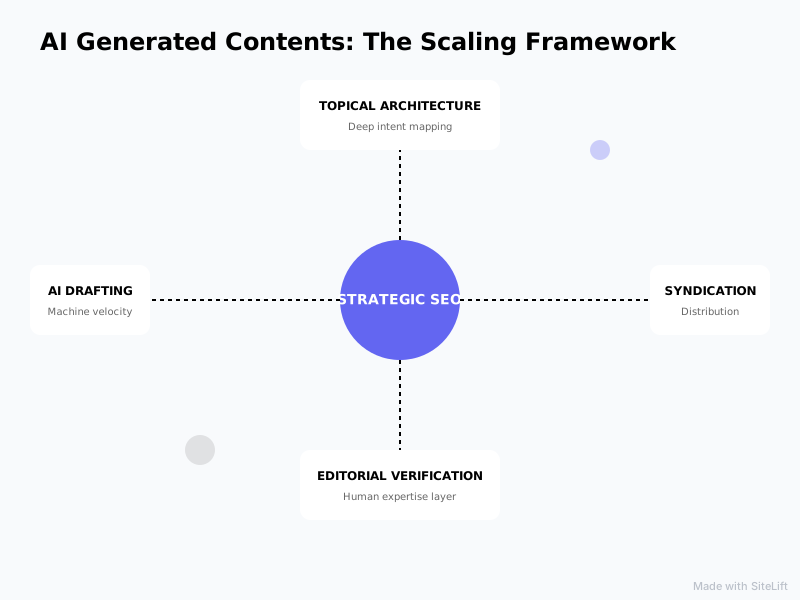
Infographic by SiteLift
Leveraging Curated Premium Networks for Multi-Channel Reach
To accelerate indexing and build domain authority, high-performing growth teams distribute and syndicate content across authoritative, curated publisher networks.
When you publish a new piece of content, syndication networks push summaries, canonicalized adaptations, and key takeaways across external trade platforms, industry newsletters, and social channels. These external signals demonstrate real audience engagement, signaling to search algorithms that the content is genuine and actively consumed by real users.
Combining Organic Search Optimization with Syndication
Syndication must be managed carefully to preserve core organic search performance:
- Canonical Tags: Ensure syndicated iterations reference the original article URL as the primary canonical source to prevent duplicate content issues.
- Contextual Syndication: Distribute only to networks relevant to your niche. Blasting SaaS articles across consumer coupon platforms destroys your topical relevance.
- Cross-Platform Repurposing: Configure your distribution engine to reformat long-form guides into succinct LinkedIn summaries, technical X threads, and newsletter briefs, all driving traffic back to your primary asset.
Tracking Keyword Momentum and Traffic Compound Gains in Real Time
To refine an automated strategy, you must track real-time performance indicators. Relying solely on Google Search Console's delayed reporting slows your decision-making.
Modern pipelines monitor keyword momentum dynamically:
- Track daily positional changes across primary, secondary, and long-tail query variations.
- Monitor indexation velocity—identifying which sub-clusters index within 24 hours versus those that stall.
- Feed ranking signals back into the content engine to systematically update, expand, or restructure pages that hit positions 4 through 15, pushing them into top-three visibility.
What Best Practices Ensure Long-Term Ranking for AI Generated Contents?
Ranking on page one is an ongoing process. Search queries evolve, competitors update their pages, and algorithm updates re-evaluate quality thresholds. Maintaining top rankings requires a proactive maintenance plan.
Industry data confirms that automated drafting is now standard practice across growth-oriented organizations. Research from HubSpot indicates that over 60% of marketing leaders leverage AI tools to assist in or automate blog content creation. Furthermore, Gartner predicts that by 2025, 30% of outbound marketing messages from large enterprises will be synthetically generated.
As automated publishing becomes the standard across corporate marketing, teams that prioritize long-term maintenance will outperform those that publish once and abandon their content.
Continuous Content Auditing and Programmatic Refreshes
High-performing teams treat content like software: it requires routine updates, bug fixes, and versioning. An automated refresh routine ensures your site stays fresh:
- Set automated triggers to audit content every four to six months.
- Automatically identify outdated statistics, dead links, or obsolete software instructions.
- Expand falling sections with newly surfaced long-tail queries and semantic entities to reclaim lost search volume.
Pro Tip: Prioritize content refreshes for articles that lose more than 15% of their organic impressions month-over-month. Often, updating external citations, adding an updated year to the title tag, and adding fresh FAQ schema recovers that lost traffic within days.
Balancing Automation Speed with Strategic Oversight
Autonomous publication does not mean setting your platform to maximum output and walking away. High-velocity systems still require human strategic oversight:
- Strategic Direction: Humans identify overarching commercial goals, evaluate emerging competitors, and define target keyword themes.
- Machine Execution: Software conducts research, maps semantic entities, drafts structured content, handles internal linking, and executes multi-channel distribution.
- Performance Calibration: Growth managers evaluate aggregate conversion metrics and refine internal pipeline prompts to double down on high-converting subtopics.
Scaling Organic Growth Across Competitive Cloud and SaaS Keywords
In competitive B2B SaaS and cloud software verticals, ranking for short-tail keywords like "cloud monitoring" requires immense domain authority. Generative publishing pipelines excel here by targeting hundreds of long-tail variations simultaneously:
| SEO Strategy | Manual Freelance Production | Programmatic AI Pipeline |
|---|---|---|
| Publishing Velocity | 4–8 articles per month | 30–100+ articles per month |
| Topical Coverage | Narrow, high-level topics | Deep, comprehensive cluster coverage |
| Cost per Asset | High ($150 – $500+) | Low operational marginal cost |
| Internal Linking | Manual, inconsistent | Programmatic, full-graph coverage |
| Indexing Velocity | Slow (relies on site crawl budget) | Accelerated via integrated distribution |
| Maintenance Cadence | Ad-hoc or rare | Automated, continuous monitoring |
By methodically addressing specific user queries across hundreds of niche technical questions, an automated strategy builds deep topical authority. Over time, this compounded authority enables your domain to compete for and win high-volume, competitive head terms.
Key Takeaways
| Core Area | Strategic Imperative | Impact on Organic Ranking |
|---|---|---|
| Google Alignment | Focus on search intent, factual accuracy, and E-E-A-T rather than author identity. | Protects site against programmatic spam penalties and algorithm sweeps. |
| Quality Verification | Ground generation on first-party data; eliminate repetitive tropes and hallucinations. | Delivers unique information gain that search engines prioritize and cite. |
| Pipeline Scale | Connect research, generation, headless CMS delivery, and schema markup into one engine. | Eliminates production bottlenecks, accelerating topical authority buildout. |
| Network Distribution | Distribute content through curated premium networks and cross-channel syndication. | Improves indexing speeds and drives early referral engagement. |
| Content Maintenance | Continuously refresh decaying content and monitor real-time keyword movements. | Compounds search traffic gains and preserves top rankings over time. |
Why Most Growth Teams Get Autonomous Publishing Backwards
Most growth marketing teams fail with generative content because they treat AI like an underpaid freelance copywriter rather than a software pipeline.
They hire an agency or an intern to type prompts into a chat window, copy-paste the text into WordPress, manually find a stock photo, and hit publish. Then, when that generic article drops off the rankings three months later, they claim that search engines penalize machine-written text.
That approach fundamentally misses the mark.
True publishing scale isn't about writing faster; it's about eliminating manual friction across your entire workflow. The teams dominating competitive search verticals today build integrated systems:
- They map hundreds of target keywords into structured semantic clusters.
- They generate comprehensive, fact-checked drafts grounded in verified industry data.
- They deploy pages automatically through CMS APIs with clean on-page schema.
- They distribute those assets across high-authority networks to secure rapid indexing and early engagement.
When you remove manual bottlenecks from research, formatting, linking, and distribution, organic SEO stops being an unpredictable creative gamble and becomes a reliable customer acquisition channel.
— sitelift.io
Automating Search Visibility with SiteLift
Scaling an enterprise publishing pipeline from scratch requires stitching together disparate keyword tools, AI APIs, CMS connectors, and syndication channels. For growth teams looking to skip that development overhead, SiteLift provides a complete, autonomous solution.
SiteLift automates the entire search visibility cycle:
- Intelligent Content Generation: Automatically creates comprehensive, intent-aligned articles built around proven ranking factors and strict E-E-A-T guidelines.
- Seamless CMS Integration: Pushes publication-ready assets, schema markup, and internal links directly to your WordPress, Webflow, or custom headless CMS without manual work.
- Premium Network Distribution: Syndicates your content across an authoritative network to drive early engagement and improve indexing speeds.
- Real-Time Keyword Tracking: Monitors keyword momentum dynamically, keeping your content optimized to capture and maintain top search positions.
If you are ready to scale your organic traffic without managing a complex freelance writing team, SiteLift turns organic growth into an automated process.
FAQ
Does Google penalize AI generated contents in search rankings?
No. Google's official search guidance explicitly states that content is evaluated based on its quality, helpfulness, and adherence to E-E-A-T guidelines, not how it was produced. Search engines penalize low-quality, misleading, or thin content designed exclusively to manipulate search rankings, regardless of whether it was created by an automated tool or a human writer.
How do you maintain originality and brand voice when using AI content generation?
Originality is maintained by grounding generation workflows in first-party data, proprietary metrics, customer case studies, and distinct brand style guides. Rather than relying on simple text prompts, sophisticated teams feed structured reference materials and proprietary insights into their generation pipeline, ensuring the output provides original value not found on competing pages.
What is an automated publishing pipeline and how does it work?
An automated publishing pipeline is an end-to-end software workflow that handles keyword research, content outlining, drafting, fact-checking, schema markup generation, internal linking, and CMS deployment without manual human steps. It connects generative language models to live website databases through webhooks or REST APIs, allowing businesses to scale content output consistently.
How can businesses scale content output without sacrificing E-E-A-T?
Businesses scale safely by establishing robust programmatic quality controls. This includes implementing automated fact-checking against verified data sources, programmatically injecting authentic author bios and editorial citations, citing trusted external industry research, and focusing every piece of content on solving a specific, searchable user problem.
Why is distribution critical for AI generated content to achieve search visibility?
Publishing content to a website only helps if search engines find, crawl, and index those pages quickly. Distributing content across curated publisher networks, industry newsletters, and social channels drives early engagement and builds external visibility. These real-world traffic signals show search engines that your content is trustworthy, speeding up indexation and keyword rankings.
Topics Covered:
- ai generated contents
- ai content generation
- ai content quality control
- automated publishing pipeline
- google ai content guidelines
More from SiteLift

Evaluating SEO Content Writing Services vs Automated AI Publishing Pipelines
Compare traditional seo content writing services with automated AI publishing pipelines. Discover which drives faster organic growth & higher ROI.

Modern Search Engine Optimisation Solutions: Embracing Autonomous SEO for Fast-Growing Brands
Transform enterprise organic traffic with autonomous search engine optimisation solutions. Streamline publishing pipelines and capture GEO visibility.

Daily Rank Tracking: Catch Google and AI Search Shifts Before Competitors
Master daily rank tracking to catch Google algorithm shifts, track AI search fluctuations, and protect your organic rankings before competitors react.