Evaluating SEO Content Writing Services vs Automated AI Publishing Pipelines

If you’re trying to scale your organic traffic without burning through your marketing budget, choosing between traditional seo content writing services and an automated AI publishing pipeline isn’t just a preference—it’s a strategic pivot. For years, businesses outsourced their editorial needs to freelance writers and boutique agencies, hoping those handcrafted pieces would steadily climb the SERPs. Today, that playbook is breaking down. Autonomous platforms are stepping in to handle everything from keyword clustering to CMS deployment, offering a level of consistency and velocity that manual workflows simply can’t match. The real question isn’t whether AI can compete; it’s whether your current setup can keep up with the speed modern search engines demand.
To make this comparison actionable, I’m evaluating both models across four measurable dimensions. First, content quality control—how each approach maintains accuracy, brand alignment, and SERP relevance. Second, scalability and speed—turnaround times and the ability to push volume without hitting approval bottlenecks. Third, cost structure—fixed SaaS pricing versus variable per-article fees and hidden management overhead. Finally, integration and workflow friction—how seamlessly the output plugs into your existing tech stack and distribution channels. We’ll run both approaches through these filters so you can see exactly where the trade-offs lie.
At a Glance: Service Model Comparison Table
| Feature | Traditional SEO Content Writing Services | Automated AI Publishing Pipelines |
|---|---|---|
| Cost Structure | High variable costs (per-article or monthly retainers) | Predictable fixed subscription pricing |
| Time to Publish | 10–21 days (briefs, drafting, revisions, approvals) | Minutes to hours (auto-generation & direct publishing) |
| Scalability | Limited by writer capacity, contracts, and approval chains | Near-infinite scaling within API and content limits |
| Quality Control Mechanism | Human editors, style guides, subjective review cycles | Real-time data alignment, automated fact-checking, curated networks |
| Integration Capabilities | Manual uploads or basic plugin syncs | Native CMS integration, automatic scheduling & distribution |
| Ideal Use Case | Niche brand storytelling, complex legal/technical documentation | High-volume search optimized articles, rapid domain authority building |
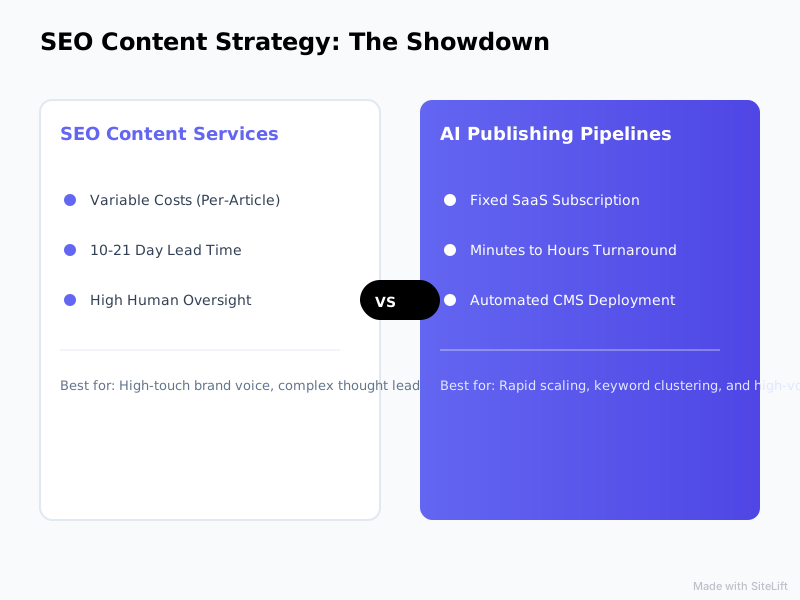
Infographic by SiteLift
How Do SEO Content Writing Services Stack Up in Content Quality Control?
Traditional agencies lean heavily on human editors to preserve brand voice and inject creative nuance. That human touch genuinely matters when you’re crafting executive thought leadership or navigating highly specialized industry jargon. But subjectivity cuts both ways. Without rigid oversight, human-led outputs can drift off-brand, miss emerging search intent signals, or fall behind competitor word counts. Ahrefs analysis consistently shows that pages ranking on page one of Google typically feature significantly higher word counts and more backlinks than those on page two. Chasing that depth manually often leads to production delays that hurt overall momentum. Google’s official guidance on handling AI-generated content confirms that search engines ultimately evaluate pages based on user value, not authorship, which levels the playing field for well-executed automation.
On the flip side, automated copywriting tools don’t guess—they optimize. These systems pull live SERP data, analyze ranking factors, and structure content around current algorithmic preferences. Content quality control shifts from subjective editing to algorithmic alignment. Modern platforms use real-time feedback loops to adjust readability scores, semantic relevance, and entity coverage before the article ever reaches your site. The risk of generic filler exists with any mass-production model, but autonomous setups mitigate this through curated distribution networks that filter low-quality outputs. Think of it as replacing a single editor’s gut check with a continuous, data-backed validation layer.
Pro Tip: Always upload your brand style guide and vocabulary restrictions to your automation platform. Restrictive keyword lists and tone presets prevent the AI from drifting into corporate blandness while maintaining structural SEO integrity.
Which Wins on Speed and Scalability: SEO Content Writing Services or Automation?
Hiring writers feels safe until you realize how many moving parts sit between a content brief and a live URL. Brief approvals, writer availability, revision rounds, and internal stakeholder sign-offs routinely stretch timelines to three or four weeks. Meanwhile, competitors are already capturing long-tail traffic. Manual agency workflows create a hard ceiling on output volume. Every new keyword cluster requires another contract negotiation, onboarding phase, and quality gate. You’re literally paying for downtime.
Autonomous pipelines erase that friction. Automated copywriting engines generate, format, and schedule content simultaneously. More importantly, they track keyword momentum in real-time. When a topic spikes or a competitor shifts strategy, the system adjusts targeting instantly rather than waiting for the next quarterly planning cycle. This agility compounds quickly. According to Semrush’s research on publishing frequency, sites that maintain consistent publication schedules see faster domain authority growth. An autonomous platform doesn’t just publish faster; it publishes smarter, targeting high-volume queries the moment they show commercial or informational traction.
The bottleneck disappears when you stop treating content as a discrete deliverable and start treating it as a continuous feed. Gartner reports that over 80% of enterprises will have used generative AI APIs deployed in production at least once by 2025. That adoption curve isn’t happening because marketers are chasing trends—it’s happening because manual production cycles simply cannot compete with algorithmic velocity.
`

`
What Are the Cost Implications and Long-Term Value?
Paying per article sounds straightforward until you factor in project management, revision cycles, and the opportunity cost of internal meetings that could be spent on strategy. Freelance and agency rates typically range from $150 to $500+ per piece, plus ongoing retainer fees for dedicated writers. Those numbers balloon fast when you’re targeting dozens of keywords monthly. In contrast, SaaS-based publishing pipelines operate on fixed subscription tiers. Your marginal cost per additional article drops toward zero as volume scales.
The math gets even clearer when you look at long-term ROI. HubSpot’s State of Marketing Report consistently highlights that companies prioritizing structured content marketing see measurably higher returns than those treating content as an afterthought. But consistency is the silent killer here. If you can’t sustain weekly publishing due to budget constraints or writer burnout, your ROI tanks regardless of individual article quality. Autonomous systems remove the variable entirely. You pay once, deploy continuously, and watch organic traffic compound. McKinsey’s analysis on generative AI projects trillions in annual economic value from AI-driven automation, with marketing and sales leading the charge precisely because they eliminate recurring headcount expenses tied to repetitive execution.
When you calculate total cost of ownership, traditional services carry invisible taxes: turnover risk, briefing miscommunication, and revision fatigue. Automated pipelines flatten those curves. You get predictable forecasting, unlimited iteration capability, and the ability to reallocate saved budget toward paid amplification or technical SEO improvements.
When Should You Choose Human Writers Over AI Automation?
I’m not here to claim machines replace human brilliance entirely. There are still domains where empathy, lived experience, and deep subject-matter expertise matter. Highly regulated industries like healthcare, finance, or legal advisory require certified professionals to draft compliance-heavy content. Similarly, executive thought leadership pieces benefit from personal anecdotes and industry-specific insights that algorithms can’t fabricate authentically.
The smartest operators are already running hybrid models. Use ai content generation for foundational SEO clusters, comparison pages, and timely newsjacking. Reserve human talent for flagship pillar content, brand narratives, and niche technical breakdowns. This division of labor maximizes budget while protecting brand integrity. Modern platforms actually support this split. Instead of forcing a binary choice, you can deploy autonomous infrastructure for volume while keeping senior writers focused on high-margin assets. The goal isn’t to eliminate humans; it’s to stop paying humans to do machine work.
My Honest Take on the Shift
Most teams overinvest in traditional seo content writing services because it feels safer. Hand-delivered manuscripts come with receipts, invoices, and a familiar approval chain. But safety rarely wins in search. The market has shifted from “who wrote it” to “does it solve the query?” I’ve watched agencies churn out beautifully written fluff that ranks nowhere, while lean, data-aligned automated batches capture featured snippets and drive qualified leads. If you’re still managing writer contracts instead of monitoring keyword momentum dashboards, you’re optimizing for process, not outcomes. Automate the baseline. Elevate the exceptional. It’s the only way to stay visible at scale.
Which Should You Choose?
Your decision hinges on your growth stage and content objectives. Stick with traditional services if you’re a boutique firm needing bespoke brand storytelling or operating in a heavily regulated niche where liability demands human verification. Move to an automated publishing pipeline if you’re aiming for rapid domain authority, consistent multi-channel distribution, and predictable scaling costs. The winners in this space aren’t choosing sides—they’re leveraging automation for volume and precision while reserving human capital for strategic differentiation.
If you’re ready to test the hybrid approach without hiring a full editorial department, platforms like SiteLift are built specifically for this transition. The system handles keyword discovery, auto-generation, CMS syncing, and premium network distribution while you monitor real-time performance metrics. It’s less about replacing your team and more about giving them a growth engine that runs in the background. Check out our guide on the top SEO content optimization tools to elevate your writing workflow if you want to audit your current stack before committing to full autonomy.
FAQ
Are automated ai content generation outputs safe from Google penalties?
Yes, provided the content aligns with Google’s E-E-A-T principles. The search giant evaluates pages based on user value, originality, and helpfulness, not authorship. When automated pipelines use real-time SERP data, cite verified sources, and avoid thin or duplicated phrasing, they comply fully with Google’s official stance on AI-generated content. Penalties usually target spammy, scraped, or purely machine-spun text—not structured, optimized automation.
How does automated copywriting compare to human seo content writing services in terms of engagement metrics?
Well-optimized automated articles consistently match or exceed human-written pieces on dwell time and scroll depth because they’re engineered around current search intent and readable formatting. Human writers still win on emotional resonance and unique narrative hooks, but for informational and transactional queries, data-driven automation delivers higher conversion-ready engagement by matching exactly what users are searching for right now.
Can an automated publishing pipeline integrate with my existing CMS like WordPress or HubSpot?
Absolutely. Modern autonomous platforms offer native API connections to major CMS ecosystems. They handle metadata injection, image alt-text generation, internal linking, and scheduled publishing directly within your dashboard. You won’t need to manually copy-paste posts or fight plugin conflicts—the pipeline pushes live content straight to your staging or production environment.
What is the typical time-to-market for search optimized articles using AI pipelines versus traditional agencies?
Traditional agencies typically require 10 to 21 days from brief to final publication, accounting for research, drafting, editing, and client approval. Automated pipelines compress that window to minutes or hours. Content goes from keyword trigger to published URL almost instantly, allowing you to capitalize on trending topics and seasonal demand without missing the window.
Is it possible to maintain unique brand voice when using autonomous SEO tools?
Yes, through customizable tone templates, vocabulary restriction lists, and style guide uploads. Most advanced systems allow you to define sentence length preferences, prohibited phrases, and industry terminology upfront. While AI won’t replicate your founder’s personal cadence perfectly, it can reliably maintain consistent brand messaging across thousands of articles while leaving room for human editors to polish high-value assets.
— sitelift.io
Topics Covered:
- seo content writing services
- ai content generation
- automated copywriting
- content quality control
- search optimized articles
More from SiteLift

Decoding SEO Agency Fees: Hourly Rates, Retainers, and Automated Alternatives
Uncover real SEO agency fees, from hourly rates and $3,000+ monthly retainers to cost-effective automated platforms. Maximize your organic ROI.

SEO Conversion Optimization: How to Turn Organic Search Readers into Paying Customers
Learn how to turn organic search visitors into paying customers with this step-by-step SEO conversion optimization guide. Optimize your CTAs and UX.

How to Choose SEO Audit Companies That Deliver Actionable Automation Roadmaps
Stop paying for static PDFs. Learn how to choose SEO audit companies that deliver developer-ready, automated roadmaps to scale your organic traffic.