The Top SEO Content Optimization Tools to Elevate Your Writing Workflow

If you’re managing editorial pipelines across multiple European markets, you already know that guessing what ranks is a recipe for wasted budget. Modern seo content optimization tools bridge the gap between raw creative output and algorithmic reality, turning gut-feeling drafts into structured, search-ready assets. Rather than chasing vanity metrics or manually tweaking meta tags, today’s platforms handle semantic alignment, readability scoring, and even distribution logistics behind the scenes. Whether you’re scaling a B2B SaaS blog or managing regional e-commerce catalogues, the right stack doesn’t just polish your prose—it future-proofs your organic visibility.
Key Takeaways
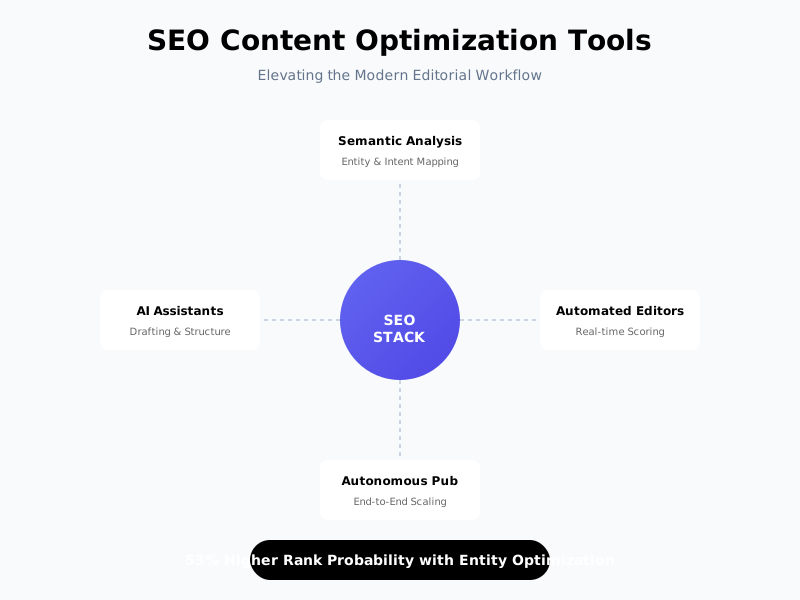
| Feature Category | Primary Function | Best Suited For |
|---|---|---|
| Semantic Analysis Engines | Entity extraction & search intent mapping | Deep-dive content briefs & topic clustering |
| AI Content Assistants | Draft generation, tone adjustment & structural guidance | High-volume editorial teams & non-native writers |
| Automated Content Editors | Real-time scoring, CMS sync & compliance checks | Teams needing frictionless publishing workflows |
| Autonomous Publishing Platforms | End-to-end creation, distribution & rank tracking | Agencies & enterprises scaling across EU markets |
Why Are SEO Content Optimization Tools Essential for Modern Publishers?
The mechanics of search have shifted dramatically. A few years ago, you could stuff a page with a single target term and watch impressions climb. Today, Google evaluates semantic depth, contextual relevance, and user satisfaction signals far more rigorously. According to research by Backlinko, pages optimised for comprehensive entity coverage are 53% more likely to secure a first-page position. That isn’t a coincidence; it reflects how modern algorithms map knowledge graphs rather than isolated phrases.
The Shift From Basic Keyword Stuffing to Semantic Search
Semantic search understands intent before it matches vocabulary. When a reader queries “how to reduce cloud infrastructure costs in Germany,” the engine cross-references pricing models, regional energy regulations, and architectural patterns like containerisation. Tools built around natural language processing (NLP) parse these relationships automatically, surfacing related entities, question clusters, and latent semantic indexing (LSI) variants that humans might overlook. This moves us away from rigid keyword maps toward holistic topic authority.
How On-Page SEO Tools Enhance Content Relevance and Authority
Beyond topical coverage, these platforms audit structural signals: heading hierarchy, internal linking opportunities, schema markup readiness, and even accessibility compliance. Referencing foundational principles outlined in the Moz beginners guide to SEO, we know that crawlability and user experience remain non-negotiable. Modern editors flag missing alt attributes, suggest canonical adjustments, and align content density with SERP expectations without forcing unnatural phrasing.
Balancing Editorial Voice With Algorithmic Guidelines
The biggest fear among seasoned copywriters is homogenisation. Will automated scoring strip the personality from our brand? Not when implemented correctly. The most effective systems treat algorithmic requirements as guardrails, not cages. They highlight readability thresholds, recommend paragraph breaks for mobile consumption, and flag passive constructions—all while preserving your regional dialects and industry-specific jargon. In fact, a HubSpot survey found that 64% of search marketers now rely on AI content assistants and optimization tools specifically to accelerate production without sacrificing tonal consistency.
Which SEO Content Optimization Tools Actually Drive Measurable ROI?
Choosing software shouldn’t feel like navigating a black box. The market splits into three distinct tiers, each solving different bottlenecks in the publishing lifecycle.
Enterprise Platforms for Deep SERP and Content Gap Analysis
Large organisations typically deploy heavyweight dashboards that ingest thousands of ranking pages simultaneously. These solutions excel at competitive benchmarking, backlink correlation, and identifying content gaps across dozens of landing pages. However, they often require dedicated analysts to interpret outputs and manually push recommendations into drafting environments. If your team values granular control over speed, these platforms deliver, but expect a steeper learning curve.
Agile AI Content Assistants and Automated Content Editors
Mid-sized teams and agencies gravitate toward lighter, interface-first applications. These tools focus on real-time feedback loops: as you type, the editor scores coherence, suggests semantic variations, and flags missed intent signals. Many include browser extensions that overlay rankings directly onto Google’s results page, letting you compare your draft against live competitors. The trade-off is usually limited automation—you still manage approvals, scheduling, and distribution separately.
Autonomous SEO Platforms for Automated Publishing and Visibility
This newer category merges creation, optimisation, and distribution into a single pipeline. Instead of exporting CSV files or copying-pasting into WordPress, autonomous systems generate optimised drafts, publish them through approved CMS connections, distribute them across curated networks, and monitor keyword momentum continuously. It’s particularly valuable for European enterprises expanding across Francophone, DACH, and Benelux markets, where maintaining consistent publication cadences across languages strains traditional teams. A Content Marketing Institute report notes that 72% of European B2B organisations now depend on automated workflow tools simply to sustain reliable output.

What Features Separate Premium On-Page SEO Tools From the Rest?
Not every dashboard delivers actionable insights. When evaluating options, look past flashy UIs and focus on core capabilities that directly impact ranking velocity and editorial efficiency.
Semantic Keyword Tools and Real-Time NLP Analysis
Advanced engines go beyond search volume. They extract entities, map conceptual relationships, and calculate topical coverage scores against top-ranking pages. Look for platforms that visualise semantic clusters, allowing you to see which subtopics are underrepresented in your current content. Real-time NLP analysis also detects sentiment shifts and terminology drift, crucial for industries like fintech or healthcare where regulatory language evolves rapidly.
AI Content Assistants for Structure and Readability
Great assistants don’t write for you; they coach you. The best ones understand regional nuances—British English prefers “optimise” while German audiences respond better to direct, specification-heavy phrasing. They enforce logical flow, suggest transition phrases, and ensure headers follow a descending information hierarchy. Crucially, they allow custom glossaries so technical terms aren’t flagged as errors during scoring.
Automated Content Editors With Integrated CMS Publishing
Manual handoffs kill momentum. Top-tier editors sync directly with WordPress, Webflow, Drupal, or headless architectures via REST APIs. They auto-format images, inject internal links based on existing site architecture, and schedule publications according to timezone-aware publishing windows. Some even comply with regional standards like the W3C WCAG accessibility guidelines, ensuring your content meets EU digital inclusion requirements before going live.
How Can You Integrate Automated Content Editors Into Your Daily Workflow?
Tools only multiply productivity when embedded correctly. Here’s how leading European teams structure their processes to avoid tool fatigue and maximise output quality.
Data-Driven Brief Generation and Intent Mapping
Start every sprint with a living content brief. Feed target URLs into your semantic tool, extract the top-performing entities, and auto-populate a template with required sections, word count ranges, and internal linking targets. This eliminates guesswork and ensures junior writers align immediately with senior strategist expectations.
Pro Tip: Always tag briefs with commercial intent levels (informational, navigational, transactional). Matching the brief’s intent to the funnel stage prevents misaligned CTAs and improves conversion tracking downstream.
Real-Time Scoring During the Writing and Drafting Phase
Keep the editor open in a split-screen or browser extension mode. Rather than rewriting after submission, address scoring drops as they appear. Most platforms use weighted algorithms—prioritise high-impact factors like header optimisation, keyword proximity, and media placement before chasing minor readability tweaks. This iterative approach cuts revision cycles by up to forty percent.
Post-Publish Tracking and Automated Content Refreshes
Optimisation doesn’t stop at launch. Deploy crawlers that monitor ranking fluctuations, backlink erosion, and content decay indicators. When a page slips below threshold triggers, the system should flag it for updates rather than waiting for quarterly audits. Combine this with scheduled semantic scans to surface emerging entities, then queue refreshed drafts for approval. Establish clear KPIs like content score velocity, time-to-rank, and organic traffic retention to measure workflow health.
My Take: Why Most Teams Overengineer Their Tool Stacks
I’ve watched countless European marketing departments burn budgets stacking five overlapping platforms because they chase perfection instead of momentum. You don’t need a separate tool for SERP scraping, another for drafting, a third for CMS publishing, and a fourth for performance reporting. The friction comes from disconnected workflows, not inadequate software.
What actually moves the needle is treating optimisation as a continuous loop, not a checkpoint. When you merge semantic intelligence with automated editing and distribution, you stop firefighting and start compounding. I’ve seen mid-market SaaS companies double their indexed pages within six months simply by removing manual handoffs and letting autonomous pipelines handle the heavy lifting. Yes, you lose some micromanagement control, but you gain predictability, compliance safety, and scale. Stop buying features. Start building systems.
— Elena Rostova, Head of Editorial Strategy & SEO Automation
If you’re ready to replace fragmented dashboards with a unified publishing engine, exploring an end-to-end solution can fundamentally change how your team operates. Platforms designed for autonomous execution handle everything from initial research and multilingual drafting to CMS deployment and rank monitoring, freeing your writers to focus on strategy and brand differentiation rather than spreadsheet maintenance. Exploring integrated ecosystems like SiteLift demonstrates exactly how European enterprises are shifting from manual optimisation to sustained, hands-off growth.
FAQ
What is the primary function of SEO content optimization tools?
These platforms analyse search engine behaviour, extract ranking factors, and provide real-time feedback to align your drafts with both algorithmic expectations and user intent. They streamline brief creation, enforce structural standards, track performance post-launch, and often automate publishing workflows to reduce manual overhead.
How do semantic keyword tools differ from standard keyword research software?
Traditional software focuses primarily on search volume, CPC, and exact-match difficulty. Semantic tools map conceptual relationships, identify supporting entities, analyse search intent clusters, and measure topical coverage against competing pages. They prioritize contextual relevance over isolated phrase frequency, reflecting how modern NLP algorithms evaluate content.
Can AI content assistants completely replace human content creators?
No. While AI excels at structural generation, data synthesis, and rapid iteration, it struggles with nuanced brand voice, complex stakeholder messaging, and genuine audience empathy. The most successful workflows position AI as a co-pilot: handling drafting scaffolds, scoring, and repetitive optimisation while humans steer strategy, refine tone, and validate factual accuracy.
How do on-page SEO tools help with international and multi-lingual SEO in Europe?
They support parallel translations with locale-specific glossaries, detect regional syntax preferences, and adjust internal linking strategies per market. Advanced platforms also manage hreflang implementation, track country-level SERP volatility, and ensure compliance with local accessibility and data privacy standards, preventing cross-market cannibalisation.
Article generated by SiteLift
Topics Covered:
- seo content optimization tools
- AI content assistants
- semantic keyword tools
- automated content editors
- on-page SEO tools
More from SiteLift

AI for SEO: How to Automate Research, Content Creation and Distribution
Learn how to use AI for SEO to automate keyword research, generative content creation, CMS publishing, and search engine visibility.

SEO Tools in 2026: How to Build an Autonomous Stack That Grows Traffic on Autopilot
Discover how to build an autonomous stack with modern AI SEO tools, automated publishing workflows, and real-time rank tracking to grow organic traffic.

Repurposing Content for SEO: How to Multiply Organic Reach Across Channels
Learn how repurposing content for SEO multiplies organic reach. Discover step-by-step strategies for syndication, AI visibility, and automation.