Google AI Search Change: What SGE and AI Overviews Mean for Your Traffic

The recent google ai search change represents the most radical structural shift to search engine result pages since universal search debuted decades ago. If you run a website, manage content, or rely on organic search for revenue, your relationship with the SERP has permanently shifted.
What began as an opt-in experiment in Search Labs—initially dubbed the Search Generative Experience (SGE)—has fully evolved into production AI Overviews across billions of consumer queries.
Rather than presenting a clean list of ten blue links, Google now attempts to answer complex multi-step questions directly at the top of the viewport. For digital publishers, SaaS platforms, and enterprise marketing teams, this generative shift brings an existential question: are AI Overviews a traffic killer, or do they simply raise the bar for what authoritative content must deliver?
Below is a breakdown of what this transformation actually looks like under the hood, how the mechanics of traffic distribution are shifting, and how to position your site to thrive in an AI-synthesized search environment.
Key Takeaways
| Strategic Area | Old Organic Paradigm | The AI Search Reality |
|---|---|---|
| Search Intent Handling | Single queries targeting discrete keywords | Multi-intent synthesis handling conversational queries |
| SERP Real Estate | Featured snippets occupy ~300px above fold | AI Overviews frequently occupy the entire above-the-fold screen |
| Click Behavior | High CTR on top 3 standard blue links | CTR compression on generic informational terms; higher-intent citation clicks |
| Content Evaluation | Keyword matching + basic backlinks | Multi-vector retrieval, information gain, and entity authority |
| Performance Tracking | Static keyword rank positions (1–10) | Generative inclusion, source citation frequency, and conversational visibility |
What Is the Google AI Search Change? From SGE to AI Overviews
To understand where organic discovery is heading, you first have to understand how Google migrated from an experimental interface into an AI-first search engine.
The Evolution: From Search Generative Experience (SGE) to AI Overviews
In May 2023, Google introduced SGE inside Google Labs. The interface was sluggish, generated massive colored blocks that pushed all content down, and occasionally suffered from hallucinations.
Over twelve months of continuous iteration, Google trimmed the latency, refined query-trigger thresholds, and formally rebranded the technology as AI Overviews during Google I/O 2024. As documented on Google's official Search updates blog, this transition marked the shift from an opt-in experimental sandbox to general web availability for hundreds of millions of users worldwide.
The rollout established that generative answers were no longer a fringe feature. Instead, AI Overviews became the default user experience for ambiguous, multi-layered, or comparative queries where traditional keyword matching fell short.
How AI Overviews Differ from Traditional Featured Snippets
Many marketers mistakenly treat AI Overviews as simply "bigger featured snippets." That assumption will derail your content strategy.
A traditional featured snippet operates on programmatic pattern matching. Google's scrapers identify a single paragraph, table, or list from a single ranking web page that answers a clear question, extracting that text verbatim.
By contrast, AI Overviews construct a net-new synthetic answer. The engine pulls factual fragments, concepts, and data points from a dozen or more disparate sources, cross-references them, and writes a dynamic summary on the fly.
[Traditional Featured Snippet]
Query -> Direct Scrape from Single URL -> Verbatim Display -> Single Source Link

[AI Overview / SGE Architecture]
Query -> Semantic Expansion -> Multi-Step Web Retrieval -> LLM Synthesis -> Synthesized Response + Source Carousel
When you study what defines high-quality content SEO in Google's AI era, this distinction is paramount. You are no longer competing merely to have the most concise definition; you are competing to provide distinct, trustworthy information fragments that a Large Language Model chooses to cite as validation.
The Underlying Architecture: Gemini and Multi-Step Retrieval
AI Overviews rely on a customized version of Google's Gemini models paired with a proprietary search ranking technique: Retrieval-Augmented Generation (RAG).
When a user submits a query:
- Google's system evaluates whether the query requires generative synthesis or whether traditional web results suffice.
- The search engine executes multiple sub-queries behind the scenes to gather candidate documents from the web index.
- Gemini processes these documents, discarding redundant data, identifying consensus facts, and generating a coherent answer.
- The system dynamically embeds link cards (citations) alongside specific statements in the generated response.
This multi-step retrieval pipeline means that a site does not need to rank in the coveted position one or two of the standard organic results to be cited inside the AI Overview. Mid-page authority pages that provide unique data or distinct angles are frequently lifted directly into the generative citation carousel.

How Does the Google AI Search Change Impact Organic Traffic?
The introduction of generative summaries alters user behavior, click paths, and search real estate. The impact, however, is not evenly distributed across all types of web traffic.
The Expansion of Zero-Click Searches and CTR Compression
The most visible consequence of this SERP overhaul is the dramatic drop in clicks for top-of-funnel informational queries.
Data published by SparkToro and JumpShot/Similarweb indicates that roughly 60% of Google searches end without a click to an external website. As AI Overviews synthesize direct answers for definitions, calculations, step-by-step troubleshooting, and quick comparisons, that zero-click baseline is accelerating.
According to research from Gartner, search engine volume for brands is projected to drop 25% by 2026 due to AI chatbots and virtual agents answering questions directly within search interfaces.
When an AI Overview occupies 800 to 1,200 vertical pixels on desktop—and effectively the entire visible screen on a smartphone—the traditional position-one organic result suffers severe click-through rate (CTR) compression. Even if your page retains the top organic rank, your link sits well below the fold.
The Bifurcation of Query Types: Informational vs. Transactional
Google does not trigger AI Overviews uniformly across every search. The engine's algorithms determine whether generative synthesis actually adds value or introduces unacceptable liability.
Research from BrightEdge revealed that AI Overviews trigger on more than 80% of complex healthcare queries, whereas they appear with far lower frequency on strictly transactional searches.
Query Type Sensitivity Matrix:

[Informational / "How-To" / Broad Research]
- AI Overview Frequency: VERY HIGH (70% - 85%+)
- Impact on Classic Organic CTR: Severe Compression
- Primary Objective: Earn citation links in the synthetic summary

[Commercial Investigation / Software Reviews]
- AI Overview Frequency: MODERATE (30% - 50%)
- Impact on Classic Organic CTR: Moderate Split
- Primary Objective: Secure brand entity inclusion in comparison carousels

[High-Intent Transactional / Direct Purchase]
- AI Overview Frequency: LOW (<15%)
- Impact on Classic Organic CTR: Minimal (Dominated by Shopping Ads & Local Packs)
- Primary Objective: Traditional Product Schema & Technical SEO
For software businesses and cloud platforms, middle-of-the-funnel comparative queries ("best project management tool for remote teams") trigger summaries that pull heavily from third-party reviews and software directories. If your brand is omitted from those synthesized lists, your organic pipeline dries up before prospects ever reach your website.
Traffic Reallocation: Citation Links vs. Standard Blue Links
While raw traffic volumes on top-of-funnel keywords are declining, the nature of the traffic that does click through has shifted.
When a user reads an AI Overview, their curiosity is either satisfied immediately (resulting in a zero-click search) or they identify a cited source that provides deeper, proprietary evidence. Users who click on citations within an AI Overview demonstrate significantly higher intent than traditional skim-and-bounce searchers.
The battleground of google AI overviews seo is not about capturing raw, low-intent impressions. It is about becoming the primary reference point that the LLM uses to back up its assertions.
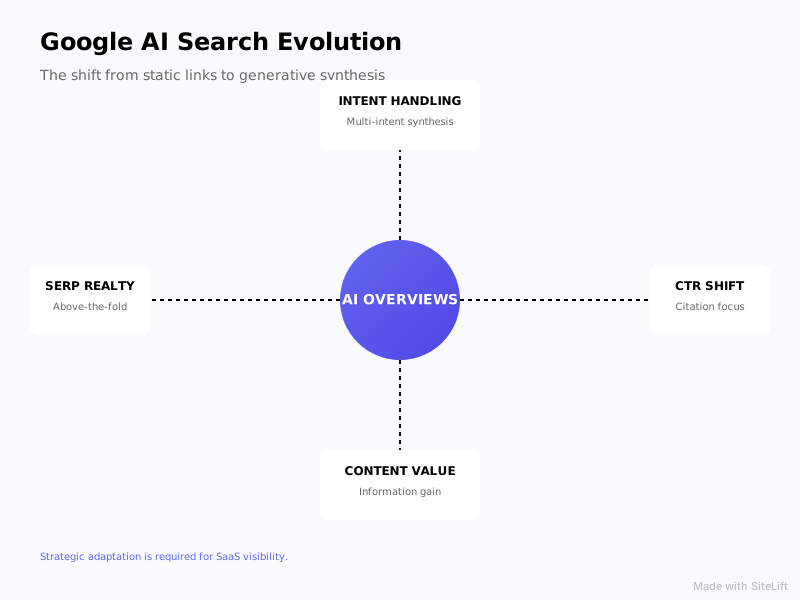
Infographic by SiteLift
SGE Optimization: How to Earn Citations and AI Visibility
Winning citations in Google's generative layer requires moving past superficial keyword optimization. Search models prioritize information density, unambiguous entity relationships, and verifiable sources.
Here is how to optimize your content architecture for generative engines.
Prioritizing Information Gain and Original Data
Google holds multiple patents regarding "Information Gain"—a metric that evaluates whether a new piece of content adds net-new information to the search index or merely regurgitates existing search results.
If an article summarizes the top five ranking pages without adding unique survey data, first-hand case studies, original screenshots, or novel frameworks, the generative engine has zero incentive to cite it. The AI can already generate that baseline summary on its own.
To optimize for information gain:
- Publish Proprietary Benchmarks: Run internal data analyses and release findings with concrete numbers.
- Introduce Named Frameworks: Create distinct models or processes (e.g., "The 4-Pillar Retention Loop") that require the AI to attribute the terminology to your brand.
- Include Direct Practitioner Commentary: Quote in-house subject matter experts to introduce first-person perspectives that cannot be scraped from competitor roundups.
Structuring Content for Semantic Clarity and Direct Extraction
Large Language Models rely on predictable syntactic structures to parse facts, steps, and conclusions accurately. If your content is buried in conversational filler or convoluted prose, the retrieval pipeline will skip it in favor of a cleaner source.
Follow these formatting principles:
- Direct Lead Sentences: Begin H2 and H3 subsections with a direct, comprehensive answer to the target concept before expanding into nuance.
- Ordered Semantic Lists: Use structured HTML lists (
<ol>and<ul>) when describing sequential processes or comparative feature sets. - Standardized HTML Tables: LLMs extract structured comparative data from standard HTML tables far more reliably than from complex graphic layouts or nested visual blocks.
- Technical Rigor: Ensure clean crawl paths and robust structured markup by evaluating what modern technical SEO services must include to win in AI search, specifically referencing official Google Search Central documentation on structured data and bot directives.
Pro Tip: Place a self-contained 40-to-60-word summary paragraph immediately underneath your primary question-based subheadings. AI retrieval pipelines frequently grab these modular answer blocks verbatim for overview synthesis.
Building Entity Authority and Digital Footprint Consistency
Gemini does not evaluate web pages in a vacuum; it evaluates entities—people, organizations, concepts, and products—and their established relationships in the Knowledge Graph.
If your company claims to be an authority on cloud security, but your brand entity has no external footprints verifying that authority across industry directories, technical publications, or corporate registers, your content will rarely be trusted for generative synthesis.
Strengthen your brand entity by:
- Maintaining consistent Name, Address, Phone, and About information across all digital profiles (LinkedIn, Crunchbase, GitHub, industry registries).
- Implementing exhaustive
Organization,Author, andItemPageschema markup that points explicitly to your entity nodes (sameAsproperties). - Earning co-citations in high-authority third-party publications alongside known industry entities.
How to Measure and Track AI Mode Search Visibility
Traditional rank tracking is fundamentally broken in an AI-first search landscape. Tracking whether you sit at "Position 3" tells you almost nothing about your actual impression share if a dynamic AI Overview pushes position three 1,400 pixels below the screen.
Understanding your true performance requires modern tooling and refined metrics.
The Blind Spots of Conventional Rank Trackers
Standard SERP scrapers make headless requests from fixed IP addresses, rarely triggering the dynamic client-side scripts that render AI Overviews. Furthermore, AI Overviews are highly personalized, fluctuating based on:
- User geographic location down to the metro level
- Search query history within an active session
- Account-level Search Labs configurations
If your analytics rely exclusively on legacy rank trackers, you are flying blind to your actual generative impression share.
Monitoring AI Overview Triggers in Google Search Console
While Google Search Console (GSC) does not yet provide a dedicated "AI Overview" filter, you can identify generative impacts by isolating specific behavioral signatures:
- Sudden CTR Divergence: Look for queries where total impressions remain stable or increase, while average position stays high (e.g., 1.8 to 2.5), yet CTR drops precipitously by 30% to 60%. This is the classic footprint of an AI Overview intercepting clicks.
- Long-Tail Query Expansion: Monitor the appearance of conversational, sentence-length queries in GSC. AI Overviews encourage users to ask follow-up questions, creating distinct multi-word query spikes.
To bridge these gaps, many teams are integrating specialized tools. If you are auditing your stack, review our guide on the core features required in an AI search tracking tool for LLM visibility to monitor citations across both Google and standalone answer engines like Perplexity.
Tracking Sourced Citations, Brand Mentions, and Assisted Conversions
Instead of tracking raw keyword rankings, update your SEO scorecards to track these three modern metrics:
- Citation Share of Voice: For your top 100 revenue-driving queries, what percentage trigger an AI Overview, and in what percentage of those overviews does your domain appear as a cited link card?
- Entity Mention Sentiment: When Gemini synthesizes roundups or comparisons including your brand, is your product framed favorably, neutrally, or negatively?
- Assisted Conversion Value: Track referral paths from generative sources. While overall session volume may decline, look for upticks in conversion rates, time on site, and demo requests from users arriving via cited links.
Editorial: Why the Panic Around AI Search Misses the Mark
Every time Google alters how results are presented, a familiar chorus declares that search engine optimization is dead. We heard it when Google launched universal image search, we heard it when the Local Pack absorbed local queries, and we heard it when Featured Snippets first rolled out.
The panic surrounding the google generative search update makes the same fundamental mistake.
SEO is not dying; it is shedding its lowest-value tier. For years, the industry rewarded digital content factories that churned out superficial 800-word articles designed solely to capture casual clicks. That business model is finished. If an algorithm can answer a user's question completely in three sentences, that content never offered real value in the first place.
I view AI Overviews as a massive net positive for authoritative businesses that produce genuine insight. When we publish rigorous research, deep product breakdowns, and original industry frameworks, Google's generative models do not erase our work—they use it as the bedrock for their answers.
The sites that will suffer are the aggregators, the generic affiliate mills, and the brands that treat content production as a volume game rather than an authority game. If you build a distinct point of view, AI Overviews become an automated referral engine, not an obstacle.
The brands that struggle in the era of generative search are not victims of an algorithm change; they are victims of an obsolete content strategy that prioritizes superficial volume over irreplaceable depth. — sitelift.io
What Does the Future of Search Mean for Content Strategy?
Adapting to the continuous evolution of ai mode search visibility requires restructuring how your marketing team allocates time, capital, and technology.
The Pivot from Volume-Only Keywords to Depth-Driven Content
The era of targeting hundreds of slight variations of the same keyword is over. Generative models cluster semantic intents effortlessly.
Instead of producing twenty separate posts targeting minor variations like:
- "how to track organic traffic"
- "tracking organic search performance"
- "how do I track seo results"
Consolidate those assets into a single, definitive guide that covers the subject with unmatched technical precision, interactive diagrams, and proprietary benchmarks. Focus your editorial resources on questions that require human experience, subjective evaluation, or proprietary business data.
Automating Routine Publishing to Focus on High-Value Insights
To remain competitive without burning out your editorial team, you must decouple routine technical content publishing from bespoke thought leadership.
Modern marketing teams leverage autonomous platforms like SiteLift to handle the complex, resource-intensive baseline work: continuous keyword discovery, technical SEO hygiene, programmatic publishing, and syndication across authoritative networks.
By automating the routine execution of your content pipeline, your internal strategists can focus entirely on high-leverage initiatives: conducting proprietary research, recording expert interviews, and establishing the deep brand authority that AI search engines actively look to cite.
Diversifying Beyond Traditional Organic Search
No business should rely entirely on a single discovery channel, especially during a platform transition of this scale.
While optimizing for AI Overviews and traditional organic search remains vital, insulate your traffic by building direct relationships with your audience:
- Owned Email Newsletters: Build subscriber lists that give you direct access to your audience without an algorithmic middleman.
- Community Presence: Engage actively in community hubs like Reddit, Discord, and specialized developer forums—spaces that Google is increasingly surfacing via its "Discussions and Forums" SERP modules.
- Direct Brand Recall: Invest in positioning that makes customers search for your specific company name rather than generic industry terms.
Pro Tip: Audit your current traffic analytics for queries that contain both your brand name and an informational modifier (e.g., "SiteLift SEO setup"). These queries are highly resistant to generative disruption because the user is specifically demanding your perspective.
FAQ
What is the difference between Google SGE and AI Overviews?
Google Search Generative Experience (SGE) was the experimental, opt-in testing phase hosted inside Google Search Labs starting in May 2023. AI Overviews is the official, fully deployed production feature that grew out of those tests. AI Overviews are faster, more tightly designed, and automatically served to standard searchers globally without requiring a Labs subscription.
How significantly will the Google AI search change reduce website traffic?
The traffic impact depends entirely on your content mix. Sites relying on generic, top-of-funnel informational queries (definitions, basic calculations, simple how-to guides) are seeing click-through rate declines between 20% and 50% due to zero-click answers. However, sites producing original data, proprietary research, and transactional content often experience steady traffic with higher conversion intent when cited as reference links.
How can a website get featured or cited in Google AI Overviews?
To earn citations in AI Overviews, focus on Information Gain: provide proprietary data, unique case studies, and original frameworks that do not exist elsewhere in Google's index. Structure your content with clear semantic HTML (bulleted lists, comparison tables, and direct definition paragraphs under descriptive headings), and maintain strong entity authority through Schema markup and third-party industry citations.
Can webmasters opt out of Google AI Overviews without losing regular organic rankings?
Yes, but with significant caveats. You can use standard robots meta tags like nosnippet, max-snippet, or data-nosnippet to prevent Google from displaying your content in AI Overviews. However, these directives also restrict your content from appearing in traditional featured snippets and can dramatically impair your regular SERP presentation. Google does not currently offer a method to opt out of AI Overviews while keeping full traditional snippet functionality.
Does technical SEO and schema markup still matter in AI search?
Technical SEO and structured data matter more than ever. Generative engines like Gemini rely on structured data (Organization, Article, Product, HowTo) to unambiguously connect entities, verify authorship, and parse factual claims. A fast, crawlable site with pristine semantic architecture makes it exponentially easier for Google's retrieval pipeline to parse your pages and cite them in AI Overviews.
Topics Covered:
- google ai search change
- google AI overviews seo
- SGE optimization
- google generative search update
- ai mode search visibility
More from SiteLift

What is Search Experience Optimization (SXO) and Why It’s the Future of SEO in Europe
Learn what Search Experience Optimization (SXO) is and why it's crucial for European brands to rank in AI search engines like Google SGE.

White Hat Link Building Techniques That Still Work for Google and AI Search
Discover 5 proven white hat link building techniques that earn top Google rankings and AI search citations. Master ethical link building today.

Ecommerce Link Building: Scale Product Authority and Revenue on Autopilot
Master ecommerce link building. Learn how to secure product page backlinks, execute digital PR, fix redirect leaks, and automate your store authority.