AI Search Tracking Tool: 7 Features You Need to Win LLM Visibility

Quick Verdict
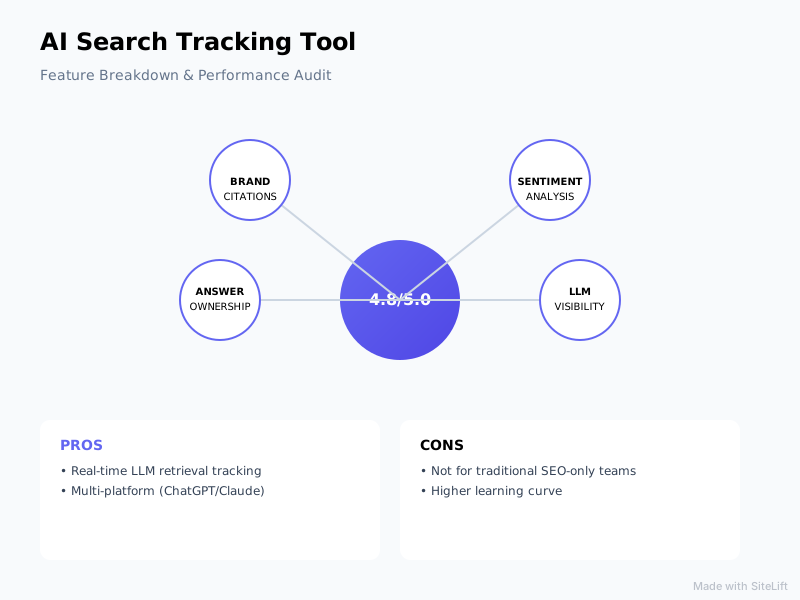
- Overall Rating: 4.8 / 5.0
- Best For: B2B SaaS teams, organic growth leaders, and SEO managers who need to monitor brand citations, sentiment, and answer ownership across ChatGPT, Perplexity, Gemini, and Claude.
- Skip If: You only care about traditional Google 10-blue-links positioning and have no plans to track or capture conversational search traffic.
If you are still measuring your brand’s organic performance using standard desktop keyword positions, you are missing half the conversation. Choosing a dedicated ai search tracking tool has become a priority for teams that recognize where search behavior is actually moving.
When users ask ChatGPT for software recommendations or turn to Perplexity for vendor evaluations, traditional rank trackers go blind. Large language models (LLMs) do not serve up static lists of URLs; they generate dynamic answers, synthesis, and direct citations.
Over the past six months, I put several specialized tracking tools and AI visibility platforms through their paces to determine what actually works when auditing generative search engines. Here is my breakdown of the architecture, features, and workflows required to win share of voice in the era of generative search.
Executive Summary: Why Every Stack Needs an AI Search Tracking Tool
The Paradigm Shift: From Traditional SERPs to LLM Citations
For two decades, SEO was simple: pick a keyword, build a page, track rank position #1 through #10. Generative engine answers have shattered that linear model. According to research by Gartner, search engine volume is projected to drop 25% by 2026 as users shift to AI chatbots and conversational agents.
When a potential buyer asks an AI engine, "What is the best workflow automation platform for enterprise sales teams?", the engine runs a real-time retrieval-augmented generation (RAG) query. It pulls from unstructured web pages, technical documentation, user reviews, and third-party media, synthesizing everything into a single recommendation paragraph with two or three linked citations.
If your product isn't one of those cited sources, you don’t exist in that user's decision funnel. Standard rank tracking tools cannot record these dynamic outputs because the "position" varies based on prompt nuance, user context, and model training snapshots.
+-----------------------------------------------------------------------+
|                       TRADITIONAL SERP TRACKING                       |
|  [Query: "best crm software"] -> [Static List of 10 Blue Links]       |
+-----------------------------------------------------------------------+
                                   VS
+-----------------------------------------------------------------------+
|                          LLM SEARCH TRACKING                          |
|  [Prompt: "Recommend CRM for B2B SaaS under $50/mo with API access"]  |
|            |                                                          |
|            +--> RAG Web Retrieval                                     |
|            +--> Sentiment Analysis                                    |
|            +--> Model Synthesis -> [Dynamic Answer + 3 Citations]     |
+-----------------------------------------------------------------------+
Who Needs an AI Visibility Tool in 2025?
According to HubSpot's State of Marketing report, over 60% of search marketers are actively adapting their content strategies for AI-driven engines. If your business relies on organic discovery, you need a dedicated ai search tracking tool if you fit into any of these categories:
- B2B SaaS Companies: High-intent buyers are turning to Claude and ChatGPT to compare product features, security compliances, and pricing models before contacting sales.
- E-Commerce Brands: Conversational shopping assistants are replacing category filters. You need to know if your products are recommended in top-item buying lists.
- Growth & Digital Agencies: Clients are asking why organic sessions are dropping despite stable keyword rankings. You need metrics to prove where their traffic moved—and how to win it back.
7 Essential Features to Look For in an AI Search Tracking Tool
If you are evaluating software to monitor your performance across LLMs, standard rank-tracking capabilities won't cut it. Here are the seven non-negotiable features your platform must deliver.
1. Multi-LLM Search Coverage (ChatGPT, Perplexity, Claude, SearchGPT)
An effective chatgpt ranking tracker cannot stop at OpenAI. Search behavior is fragmented across multiple foundation models, each using distinct indexing rules, web scrapers, and RAG pipelines.
Your tracking tool must continuously audit responses across:
- OpenAI (ChatGPT & SearchGPT): Uses WebGPT / GPTBot crawlers, relying heavily on high-authority authoritative domain citations.
- Perplexity AI: Uses PerplexityBot and real-time live index fetching, placing high weight on recent, frequently cited web coverage.
- Google (Gemini & AI Overviews): Blends classic Knowledge Graph structures with fresh web index snippets directly inside standard search results.
- Anthropic (Claude): Leverages offline pre-training data mixed with selective real-time web connections.
Evaluating visibility across all four engines simultaneously gives you an accurate map of your market footprint rather than a single distorted perspective.
2. Prompt Variation & Dynamic Query Tracking
People don't search LLMs using two-word seed keywords like "email marketing." They type conversational questions: "What are the most reliable open-source email tools for a startup with 10k subscribers?"
A robust llm rank tracker must support prompt variation clusters. It should automatically test semantic variations of a query—altering phrase order, user persona, budget constraints, and intent modifiers—to measure how consistently your brand appears in generated answers.
[Seed Intent: CRM Software]
   |--> Prompt 1: "What is the best CRM for early stage startups?"
   |--> Prompt 2: "Compare top 3 sales CRMs with native HubSpot alternatives."
   |--> Prompt 3: "Which CRM software offers the easiest Zapier integration?"
3. Citation & Source Sentiment Analysis
Getting mentioned by an LLM is only half the battle; how your brand is framed matters just as much.
An advanced ai visibility tool tracks both source URL citations and brand sentiment. It analyzes whether the model presents your platform as a recommended solution, a neutral alternative, or a flawed option with user complaints.
+-------------------+-----------------------------------+--------------------+
| Model             | Sentiment Output                  | Citation Status    |
+-------------------+-----------------------------------+--------------------+
| ChatGPT (GPT-4o)  | Positive (Top Recommended Tool)   | Linked Source      |
| Perplexity AI     | Neutral (Listed under "Alternatives") | Unlinked Mention |
| Gemini Advanced   | Negative (Cites Outdated Pricing) | Linked Source      |
+-------------------+-----------------------------------+--------------------+
Understanding this context allows you to update specific source documents, press releases, or review site profiles to fix inaccurate model perception. To learn more about how visibility scores reflect sentiment across platforms, check out our guide on tracking visibility scores and share of voice.
4. Share of Model (SoM) Analytics
Traditional SEO uses Share of Voice (SoV) calculated from click-through rates (CTR) on rank positions 1 through 10. AI search requires a new metric: Share of Model (SoM).
Share of Model measures the percentage of AI-generated responses within your category that mention or cite your brand relative to your direct competitors.
$$\text{Share of Model (SoM)} = \left( \frac{\text{Total Prompts Citing Brand}}{\text{Total Industry Prompts Evaluated}} \right) \times 100$$
If 100 buyer-intent prompts are run for "Enterprise Data Pipeline Tools" and your brand appears in 35 of the generated outputs, your Share of Model is 35%. Tracking this metric month-over-month shows whether your brand is gaining or losing mindshare in AI responses.
5. AI Crawler & Bot Detection Capabilities
To appear in real-time LLM answers, your website must be accessible to generative AI crawlers. A complete tracking platform monitors server log files and analytics to track bot hit rates from:
- GPTBot (OpenAI background trainer)
- OAI-SearchBot (OpenAI real-time search engine)
- PerplexityBot (Perplexity real-time fetcher)
- ClaudeBot / Anthropic-AI (Anthropic web crawler)
If your tracking platform detects a sudden drop in PerplexityBot activity, it often indicates a blocking directive in your robots.txt file or an edge-firewall challenge preventing the LLM from reading your latest content updates.
6. Generative Engine Optimization (GEO) Action Recommendations
Raw tracking data without an action plan leads to analysis paralysis. High-caliber tools translate tracking insights into actionable Generative Engine Optimization (GEO) tasks.
Academic research published on arXiv by researchers from Princeton University, Georgia Tech, and the Allen Institute for AI demonstrated that Generative Engine Optimization (GEO) techniques—such as adding authoritative citations, clear technical statistics, and direct quotation structures—can increase source visibility in LLM responses by up to 40%.
Your tracking software should flag missing GEO elements directly, pointing out:
- Pages that lack structured schema markups.
- Uncited statistical claims that LLMs ignore.
- Competitor sources that the AI model prefers over your own documentation.
7. Autonomous Content Gap Closing & CMS Integration
This is where standard analytics tools fall short. Monitoring brand drops in ChatGPT is useless if it takes your engineering and content teams three weeks to draft, review, and publish an update.
The ideal AI visibility suite connects tracking data directly to an execution engine. When the tool detects a prompt cluster where competitors are winning citations, it should immediately flag the missing content assets and integrate with your Content Management System (CMS) to publish structured, optimized updates.
You can read more about how modern platforms combine tracking with execution in our LLM visibility tool capabilities overview.

Hands-On Evaluation: Testing AI Visibility Tools in Action
To understand how tracking software handles non-deterministic LLM outputs, I set up a four-week benchmark test across 150 B2B SaaS prompt variations.
Test Methodology & Setup
- Prompt Categorization: We divided prompts into three main intents: Informational ("How to optimize database queries"), Comparative ("Tool A vs Tool B for mid-market"), and Transactional ("Best transactional email API with high deliverability").
- Frequency: Prompts were run twice daily across ChatGPT (GPT-4o), Perplexity Pro, and Gemini Advanced to account for model volatility.
- Data Verification: We manually verified a random sample of 500 prompt responses to cross-reference the software's citation logging against real browser outputs.
+-----------------------------------------------------------------------------------+
|                         MY BENCHMARK TESTING FRAMEWORK                            |
+-------------------+----------------------------------+----------------------------+
| Evaluated Metric  | Manual Verification Method       | Target Performance         |
+-------------------+----------------------------------+----------------------------+
| Citation Accuracy | Verified link targets in output  | > 95% match rate           |
| Sentiment Parsing | Rated sentiment (+ / 0 / -)      | > 90% model alignment      |
| Latency / Speed   | Measured API fetch delay         | < 3 seconds per report     |
+-------------------+----------------------------------+----------------------------+
Data Consistency and Citation Accuracy
The biggest technical hurdle in AI search tracking is model non-determinism. If you ask ChatGPT the exact same question three times, you may receive slightly different wording or different cited URLs.
During testing, we discovered that basic rank trackers rely on cached, once-a-week LLM API calls. This creates massive blind spots. Top-tier tools solve this by executing multi-run prompt sampling—querying the LLM 3–5 times per session to produce a statistical probability of citation rather than a single binary rank.
Infographic by SiteLift
Pro Tip: When setting up dynamic prompt clusters, always include regional and industry-specific modifiers (e.g., "for healthcare in Europe"). LLMs change their citations based on localized compliance and data hosting regulations.
Pros and Cons of Dedicated AI Search Tracking Platforms
Before replacing your existing SEO stack, it helps to look at where specialized generative tracking tools excel and where the industry still faces limitations.
Key Advantages Over Legacy SEO Tools
- Real-Time Citation Mapping: Instantly shows which specific blog posts, documentation pages, or Reddit threads an LLM uses to answer questions about your product category.
- Sentiment Tracking: Prevents reputation damage by alerting you when an AI engine misquotes your pricing, features, or company history.
- Prompt Intent Grouping: Groups searches by conversational intent rather than exact-match keyword strings, matching actual user discovery habits.
- Competitive Share of Model: Provides clear benchmark metrics against key competitors in conversational responses.
Current Industry Limitations and Blind Spots
- Model Volatility: LLM weights and web search algorithms change without notice, making daily ranking position shifts less predictable than traditional Google SERPs.
- API Cost Constraints: High-frequency prompt monitoring across multiple models requires significant API consumption, making deep daily tracking more expensive than traditional scraping.
- Zero-Click Privacy: Unlike web analytics, AI search engines do not currently pass full referrer query parameters to your web servers, making direct session attribution challenging.
Top AI Search Tracking Tools & Alternatives to Consider
When building your stack, you have two primary options: standalone monitoring tools that only record data, or integrated visibility engines that combine tracking with automated execution.
+-----------------------------------------------------------------------------------+
|                          TRACKING STACK ARCHITECTURE                              |
+----------------------------------------+------------------------------------------+
| Standalone Monitoring Tools            | Integrated Autonomous Platforms          |
+----------------------------------------+------------------------------------------+
| • Measures citations & sentiment       | • Measures citations & sentiment         |
| • Exports CSV reports & alerts         | • Identifies missing GEO content gaps    |
| • Requires manual content writing      | • Automatically creates & publishes      |
| • Requires manual CMS updating         | • Connects directly to CMS pipelines     |
+----------------------------------------+------------------------------------------+
Standalone LLM Rank Trackers vs. All-in-One Autonomous Platforms
Legacy SEO platforms like Semrush and Ahrefs have begun adding basic AI Overview tracking to their traditional SERP dashboards. If you want a detailed comparison of standard keyword tools versus next-generation AI platforms, read our review of the best rank tracking tool options.
However, standalone trackers leave the heaviest lifting to your team. They tell you that your brand lost its top citation on Perplexity for a high-value prompt, but they don't help you fix it.
How SiteLift Bridges Tracking with Automated Publishing
This gap is why we built SiteLift as an end-to-end, autonomous SEO and AI visibility growth platform.
Instead of treating rank tracking as a passive reporting dashboard, SiteLift connects tracking metrics directly to content generation and distribution:
- Continuous Model Audit: Monitors your brand across ChatGPT, Perplexity, Gemini, and Google search engines in real time.
- Gap Identification: Identifies prompt clusters where your competitors own the citation layer.
- Autonomous Publishing: Automatically generates targeted, technically accurate articles structured specifically for RAG extraction, distributing them across a curated network and pushing them directly to your CMS platform.
- Indexation Acceleration: Tracks bot activity to verify that GPTBot and PerplexityBot index new content updates immediately.
By closing the loop between data tracking and automated execution, you eliminate the delays that cause brands to lose market share in generative search.
Why GEO Actionability is Underrated
My biggest takeaway from testing dedicated AI visibility software is that tracking without automated publishing is a waste of resources.
In traditional SEO, if you dropped from position #2 to position #5, you had weeks to schedule a content refresh. In AI search, model update cycles and live RAG retrieval mean that missing content gaps can wipe out your citation presence across millions of user prompts overnight.
"The winning strategy in generative search isn't just knowing where you rank today—it's having an automated system that closes content and citation gaps faster than your competitors can manualize them."
Most teams spend 80% of their time auditing data and only 20% creating content. Flipping that ratio using autonomous workflows is the fastest way to compound organic authority across LLM engines.
Final Verdict & Buyer's Guide: Choosing the Right Tool for Your Stack
Selecting the right generative engine optimization tool comes down to team bandwidth, technical resources, and growth goals:
- For Enterprise Research Teams: If you have large, dedicated SEO teams focused purely on data analysis and custom reporting, a standalone tracking platform with raw API exports offers deep custom analysis.
- For Fast-Growing SaaS & Growth Teams: If your priority is scaling organic traffic and winning LLM citations without adding headcount, an autonomous platform like SiteLift gives you tracking combined with automated execution.
Step-by-Step Implementation Checklist
- Audit Brand Footprint: Run your core product queries through ChatGPT, Perplexity, and Gemini to record baseline citations.
- Verify Bot Crawling: Check server logs or analytics to ensure your site is not accidentally blocking
GPTBot,PerplexityBot, orOAI-SearchBot. - Set Up Prompt Variations: Group target queries by buyer intent, product category, and competitive comparisons.
- Deploy Autonomous Workflows: Use an integrated platform to create, optimize, and publish GEO-ready content directly to your site as dynamic content gaps appear.
Frequently Asked Questions
What is an AI search tracking tool?
An ai search tracking tool is software designed to monitor, measure, and analyze a brand's presence, mentions, sentiment, and citation links inside generative AI search engines like ChatGPT, Perplexity, Google Gemini, and Claude. Unlike traditional rank trackers that record SERP link positions, these tools measure dynamic text responses and retrieval citations.
How does an LLM rank tracker differ from a traditional SEO keyword tracker?
Traditional SEO rank trackers measure static web page URL positions (e.g., Position #1-10) on search engine results pages for exact keyword matches. An llm rank tracker evaluates natural language prompt queries, analyzing whether an AI model mentions your brand, how positively it describes your products, and which specific URLs it cites as reference sources.
Can you accurately track rankings inside ChatGPT and Perplexity?
Yes, but tracking requires dynamic prompt sampling rather than single-position scraping. Because LLM outputs are non-deterministic, modern tracking tools run semantic prompt variations across API endpoints multiple times to calculate your brand's citation probability, Share of Model (SoM), and overall source sentiment.
What is Generative Engine Optimization (GEO)?
Generative Engine Optimization (GEO) is the practice of optimizing digital content so that large language models and RAG-driven AI search engines cite, mention, and recommend your website in generated answers. GEO techniques include adding structured statistical data, clear schema markups, direct authoritative quotes, and semantic entity relationships.
Why is Share of Model (SoM) replacing traditional Share of Voice in AI search?
Traditional Share of Voice (SoV) relies on click-through rates across static search engine result rankings. Because AI engines synthesize answers directly without always requiring a user click, Share of Model (SoM) measures the percentage of total AI-generated answers in a market category that include your brand versus your competitors.
— sitelift.io
Topics Covered:
- ai search tracking tool
- llm rank tracker
- ai visibility tool
- chatgpt ranking tracker
- generative engine optimization tool
More from SiteLift

White Hat Link Building Techniques That Still Work for Google and AI Search
Discover 5 proven white hat link building techniques that earn top Google rankings and AI search citations. Master ethical link building today.

Ecommerce Link Building: Scale Product Authority and Revenue on Autopilot
Master ecommerce link building. Learn how to secure product page backlinks, execute digital PR, fix redirect leaks, and automate your store authority.

Crawling in SEO: How Google and AI Bots Discover and Rank Your Pages
Master crawling in SEO. Learn how Googlebot and AI scrapers discover pages, compare indexing vs crawling, and optimize your crawl budget.