Best Rank Tracking Tool: 7 Must-Have Features for SEO and AI Search in 2026

Finding the best rank tracking tool used to be straightforward: you uploaded a CSV of keywords, picked your target geography, and checked a dashboard once a week to see if your blue links climbed or dropped.
That playbook is officially broken. Search engines have evolved from static link directories into dynamic, AI-synthesized answer engines. With Google AI Overviews, ChatGPT Search, and Perplexity reshaping how users discover brands, traditional rank trackers that only monitor classic position numbers leave you blind to where your traffic actually goes. According to BrightEdge research, organic search continues to drive 53.3% of all trackable web traffic, meaning organic visibility remains the lifeblood of customer acquisition—provided you are tracking the metrics that actually matter.
In this guide, I break down the 7 mandatory features required for modern search visibility monitoring and put the five top contenders head-to-head so you can select the platform built for how search operates today.
Top Keyword Rank Tracker Comparison: At-a-Glance Summary
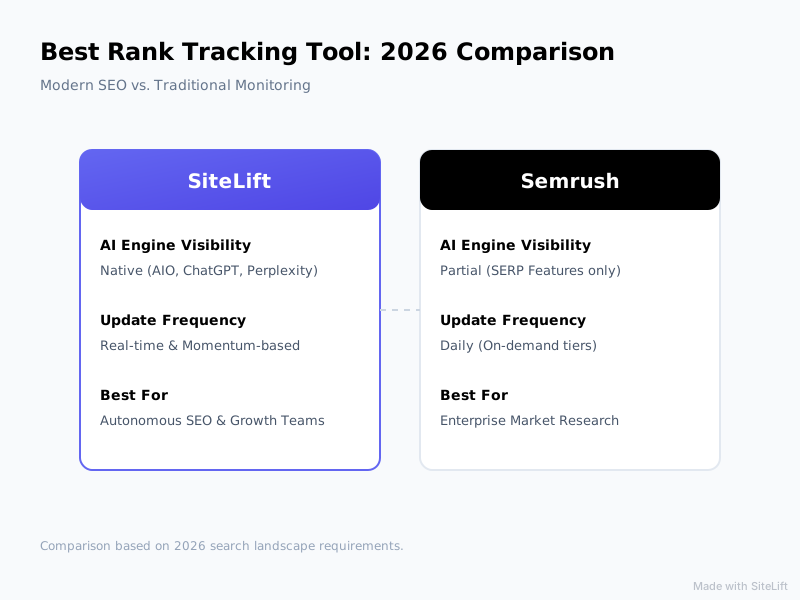
Here is how the leading platforms stack up across classic search metrics, modern AI monitoring, reporting capabilities, and automated execution.
| Platform | Best For | AI Engine Visibility | Update Frequency | Multi-Engine Coverage | Starting Price | Core Trade-Off |
|---|---|---|---|---|---|---|
| SiteLift | Autonomous SEO & AI visibility | Native (Google AIO, ChatGPT, Perplexity) | Real-time & momentum-based | Google, Bing, Copilot, LLMs | Custom / Tiered | Tailored for growth teams seeking automated execution over manual spreadsheets |
| Semrush | Enterprise market research | Partial (SERP features & AI Overviews tracking) | Daily (On-demand on select tiers) | Google, Baidu | $139.95/mo | Steep pricing tiers; passive monitoring with no automated content remediation |
| Ahrefs | Backlink-aware rank auditing | Limited (SERP features) | Weekly to daily (credits apply) | Google, YouTube, Bing, Yahoo | $129/mo | Consumes plan credits rapidly; slower refresh cycles on base subscriptions |
| AccuRanker | Ultra-fast high-volume SERP tracking | Emerging SERP features | On-demand / Instant | Google, Bing, YouTube, Baidu | $129/mo (1k kw) | Pure measurement tool; lacks content generation or integrated workflow automation |
| SE Ranking | Budget-conscious agencies | Moderate (SERP feature logging) | Daily / Every 3 days | Google, Bing, Yahoo, YouTube | $52/mo | Lacks native LLM citation tracking and real-time autonomous execution |
Infographic by SiteLift
Pricing vs. Value Breakdown for Teams and Agencies
When running a keyword rank tracker comparison, the sticker price rarely reflects your true operational cost.
- Legacy all-in-one suites (Semrush, Ahrefs): You pay a steep monthly seat fee and an additional premium for daily position refreshes, API calls, and extra keyword limits. They deliver vast historical datasets, but your team still has to spend hours diagnosing ranking drops and manually drafting fixes.
- Pure-play trackers (AccuRanker): Highly cost-efficient per keyword if your sole objective is watching position volatility across thousands of terms with on-demand speed. However, you will need separate tools for content auditing, gap analysis, and publishing.
- Autonomous platforms (SiteLift): Instead of paying for a passive dashboard that merely logs drops, you invest in a system that links rank monitoring directly to production, diagnostics, and syndication. The return on investment comes from reclaiming hundreds of hours of manual agency or in-house labor.
What Makes the Best Rank Tracking Tool in 2026? 7 Core Evaluation Criteria
Evaluating tracking tools based solely on keyword count and cost-per-check is an outdated approach. Modern search landscapes demand systems that measure dynamic visibility and trigger fast, corrective action.
                  ┌──────────────────────────────────────────────┐
                  │   7 Core Features of a 2026 Rank Tracker     │
                  └──────────────────────┬───────────────────────┘
                                         │
     ┌───────────────────┬───────────────┴───────────────┬───────────────────┐
     ▼                   ▼                               ▼                   ▼
┌───────────────┐ ┌───────────────┐             ┌───────────────┐ ┌───────────────────┐
│ AI Visibility │ │  Real-Time &  │             │  Hyper-Local  │ │  Share of Voice   │
│  Monitoring   │ │   Momentum    │             │   Tracking    │ │ (Pixel/AIO Share) │
└───────────────┘ └───────────────┘             └───────────────┘ └───────────────────┘
     │                   │                               │                   │
     └───────────────────┼───────────────────────────────┴───────────────────┘
                         │
     ┌───────────────────┴───────────────────────────────┐
     ▼                                                   ▼
┌───────────────────────────────┐       ┌─────────────────────────────────────┐
│ Automated SEO Reporting       │       │ Native Automated Content            │
│ & Anomaly Detection           │       │ Remediation Pipelines               │
└───────────────────────────────┘       └─────────────────────────────────────┘
1. Traditional SERP Tracking vs. AI Engine Visibility Monitoring
A standard top-10 ranking no longer guarantees traffic. A study by SparkToro and Datos revealed that approximately 58.5% of Google searches in the US result in zero clicks. Much of that shift is driven by generative answers absorbing clicks before users ever see classic organic positions.
The premier platforms monitor both:
- Traditional SERP features: Featured snippets, video carousels, People Also Ask (PAA), image packs, and local map packs.
- AI visibility monitoring: Tracking brand citations, contextual recommendations, and source links across Google AI Overviews, ChatGPT Search, and Perplexity. If an LLM answers a query using your competitor as the cited authority, your rank tracker needs to flag that immediately.
2. Granular Precision: Localized, Mobile, and Real-Time SERP Tracking Features
Search results differ across desktop and mobile devices, down to specific postcodes. Robust serp tracking features must include:
- Hyper-local GPS and postal-code targeting: Essential for multi-location brands and local service businesses where rankings fluctuate from one street corner to the next.
- On-demand ranking refreshes: Waiting seven days—or even 24 hours—to confirm whether an algorithm update hit your core URLs leaves you vulnerable. You need the ability to ping SERPs on demand.
3. Share of Voice (SoV) and Pixel Height Visibility
Position 1 below an AI Overview, an ad block, and a local pack is functionally equivalent to Position 6 on a clean results page. Advanced tracking calculates pixel depth and weighted Share of Voice (SoV), factoring in visual real estate, search volume, and click-through probability rather than relying on vanity numbers.
4. Automated SEO Reporting and Anomaly Triggers
Static weekly PDF reports often arrive too late. Teams need automated seo reporting backed by algorithmic anomaly alerts. If impressions drop by 15% on a core topic cluster or your primary competitor overtakes your position on commercial-intent queries, the platform should notify your Slack channel or inbox instantly.
5. Velocity and Momentum Tracking for New Assets
Research published by Ahrefs found that only 5.7% of newly published pages rank in the Google top 10 for at least one keyword within a year. A modern tracker shouldn't simply report that your new page sits outside the top 50; it should track initial indexing velocity, early impressions, and positional acceleration to confirm whether an asset is building momentum.
6. Multi-Engine & Alternative Platform Coverage
While Google retains dominant market share, Microsoft Copilot integration has made Bing tracking essential for B2B teams. Exploring a dedicated Bing rank tracker guide to win Bing, Copilot, and AI visibility highlights how alternative engines now drive high-converting enterprise traffic.
7. Direct Pipeline Integration: Moving from Passive Observation to Action
The biggest flaw of legacy trackers is passivity: they report that a keyword dropped from #3 to #8, leaving the diagnosis and content updates entirely to you. Modern systems bridge measurement with remediation, feeding positional loss data directly into your content production and optimization workflow to trigger updates automatically.

SiteLift: Best for Autonomous Rank Tracking and AI Search Visibility
Most tracking tools act like a car speedometer: they inform you of your speed, but if you drift toward a guardrail, they do nothing to steer you back on course. SiteLift was engineered to close that operational gap by uniting rank tracking with an automated publishing engine.
Core Capabilities: Real-Time Momentum and Generative Engine Tracking
SiteLift tracks classic search engines alongside generative answer engines. It evaluates traditional positions across desktop and mobile, while simultaneously measuring ai visibility monitoring metrics: tracking whether your brand is cited as a source inside Google AI Overviews, ChatGPT Search, and Perplexity responses.
Instead of treating keywords as isolated entries in a spreadsheet, SiteLift groups them into thematic clusters. It tracks velocity and momentum from the moment content is published, logging whether new pages are climbing smoothly toward Page 1 or stalling out early.
More importantly, it closes the loop. When the platform detects that a high-priority URL is losing ground or that a competitor has claimed an AI snippet, it triggers remedial actions across its automated publishing pipeline. It updates existing content, enriches source citations, and distributes authoritative supporting assets across its curated network without requiring manual intervention.
Pros, Cons, and Distinct Differentiators
Pros:
- Full-loop execution: Bridges rank tracking, automated content generation, and distribution in one architecture.
- Generative search native: Tracks visibility in AI engines alongside classic search results.
- Autonomous remediation: Automatically identifies content decay and pushes updates directly to connected CMS platforms.
- Built for scale: Designed for growth teams that need to dominate competitive clusters without hiring armies of manual SEO writers.
Cons:
- Not a legacy ad-hoc audit tool: Tailored for automated growth and keyword velocity rather than deep, manual backlink auditing.
- Different operating paradigm: Teams accustomed to manual spreadsheet tracking will need to adapt to an autonomous workflow.
Semrush (Position Tracking): Best for Comprehensive Enterprise SERP Analytics
Semrush remains one of the gold standards for traditional enterprise organic intelligence. Its Position Tracking tool provides deep analytical visibility into standard search environments.
Core Capabilities: SERP Feature Breakdown and Competitor Discovery
Semrush excels at dissecting traditional search layouts. Its Position Tracking tool lets you monitor rankings across multiple devices, locations, and languages down to specific zip codes. It documents up to 40 distinct SERP features, showing whether your domain owns a featured snippet, site links, local pack listing, or knowledge panel.
Its competitor discovery tab is particularly effective. As competitor domains enter your tracked keyword sets, Semrush maps their Share of Voice and visual presence alongside yours. For broader architectural analysis, enterprise teams managing massive collections of global URLs often rely on specialized methodologies, as outlined in our breakdown of enterprise rank tracking across markets.
┌─────────────────────────────────────────────────────────────┐
│ Semrush Position Tracking Dashboard Snapshot                │
├─────────────────────────────────────────────────────────────┤
│ Target: example.com | Location: United States (Desktop)      │
│ Visibility: 42.8% (+1.2%) | Estimated Traffic: 184.2K      │
│                                                             │
│ SERP Features Owned:                                        │
│  [✓] Featured Snippets (14)   [✓] Local Pack (6)            │
│  [✓] People Also Ask (88)     [!] AI Overviews (Tracking)   │
└─────────────────────────────────────────────────────────────┘
Pros, Cons, and Platform Limitations
Pros:
- Deep historical database with years of competitive tracking data.
- Granular daily updates on desktop, mobile, and localized search results.
- Robust Share of Voice and estimated organic traffic calculations.
Cons:
- High cost of expansion: Tracking multi-location setups or adding thousands of keywords triggers steep price jumps.
- Passive metrics: Semrush notifies you of rank drops, but fixing the issue requires manual research, brief drafting, content rewriting, and CMS uploads.
- AI search is an add-on layer: Its core architecture is built around legacy 10 blue links rather than native answer-engine citations.
Ahrefs (Rank Tracker): Best for Backlink-Aware Organic Visibility Monitoring
Ahrefs is widely regarded for its web index and backlink intelligence. Its Rank Tracker module integrates ranking positions directly with off-page authority metrics.
Core Capabilities: Competitor Benchmarking and Traffic Share Metrics
Ahrefs Rank Tracker provides clean visual charts depicting rank distribution (positions 1–3, 4–10, 11–20, and 21–50+). It plots your progress against up to 10 competitors simultaneously, calculating traffic share based on its proprietary clickstream estimations.
Its primary advantage is integration with Ahrefs' backlink graph. When viewing keyword movements, you can evaluate your target URL's Domain Rating (DR), URL Rating (UR), and referring domains side-by-side with your competitors'. This helps diagnose whether a ranking drop is due to content relevance or a sudden backlink deficit.
Pro Tip: Never diagnose a drop in rankings by looking at the page in isolation. Check the historical backlink acquisition curve of the competitor who replaced you; if they spiked in high-authority referring domains over the last 14 days, content edits alone won't reclaim the position.
Pros, Cons, and Platform Limitations
Pros:
- Clean, intuitive interface with clear historical trending lines.
- Seamless connection to backlink intelligence, referring domains, and anchor text data.
- Helpful SERP feature tracking across classic search features.
Cons:
- Update latency on base tiers: Standard plans default to 7-day update cycles unless you pay significant add-on fees for daily tracking.
- Credit consumption model: Browsing data and pulling deep SERP histories consumes account credits quickly.
- No autonomous remediation: Similar to Semrush, Ahrefs acts purely as a monitoring station; the legwork of updating content falls on your team.
AccuRanker: Best for On-Demand Speed and High-Volume SERP Tracking
If raw speed, massive scale, and instant data refreshes are your top priorities, AccuRanker is a standout specialist.
Core Capabilities: Instant Keyword Refresh and Dynamic Tagging
While broad suites refresh ranks in scheduled batches, AccuRanker allows users to hit an on-demand refresh button and pull verified SERP positions within seconds. This feature is invaluable during core algorithm updates when search volatility spikes, an industry phenomenon covered extensively by Search Engine Land.
AccuRanker handles enterprise portfolios tracking tens of thousands of keywords without interface lag. Its dynamic tagging feature allows users to filter and segment keywords by search intent, URL structure, seasonal campaigns, or pixel ranking depth on the fly.
Pros, Cons, and Platform Limitations
Pros:
- Fastest rank updates in the industry with on-demand manual refreshes.
- Clear Share of Voice calculations based on pixel position and visual search space.
- Highly scalable pricing that remains cost-effective for large enterprise portfolios.
Cons:
- Single-purpose tool: Offers no backlink analysis, site auditing, or content drafting tools.
- Lacks workflow automation: AccuRanker excels at showing you what happened 30 seconds ago, but provides no built-in publishing engine to fix underperforming pages.
SE Ranking: Best Value Rank Tracker for Agencies Needing Automated Reporting
SE Ranking has grown from a budget alternative into a dependable platform for boutique agencies and mid-sized businesses looking for rich reporting without enterprise-tier pricing.
Core Capabilities: White-Label Client Reports and Historical SERP Snapshots
SE Ranking provides daily rank tracking across Google, Bing, Yahoo, and YouTube. It tracks mobile and desktop results down to the city and zip-code level with high accuracy.
Where SE Ranking stands out is its automated seo reporting. Agencies can build automated, white-label client reports featuring custom branding, scheduled email sends, and drag-and-drop widgets. The platform also preserves historical SERP snapshots, allowing you to view the exact layout of a results page on the day a ranking shift occurred.
Pros, Cons, and Platform Limitations
Pros:
- Highly competitive pricing with flexible tracking frequency options.
- Polished white-label reporting engines ideal for client-facing agencies.
- Includes helpful supplemental tools like website audits and social schedulers.
Cons:
- Real-time agility is limited compared to dedicated speed engines like AccuRanker.
- Lacks native integrations for automated content updates or AI-driven visibility pipelines.
- Generative engine monitoring (ChatGPT, Perplexity citations) is still nascent compared to modern platforms.
Choosing the Best Rank Tracking Tool: Which Platform Fits Your SEO Stack?
Every software stack has unique priorities. Choosing the right tool depends on your team's size, operational model, and technological maturity.
                     ┌─────────────────────────────────────────┐
                     │   Which Platform Fits Your Workflows?   │
                     └────────────────────┬────────────────────┘
                                          │
         ┌────────────────────────────────┼────────────────────────────────┐
         ▼                                ▼                                ▼
┌──────────────────┐             ┌──────────────────┐             ┌──────────────────┐
│  Autonomous /    │             │  All-in-One      │             │  Enterprise      │
│  Modern Search   │             │  Legacy Auditing │             │  Speed & Scale   │
└────────┬─────────┘             └────────┬─────────┘             └────────┬─────────┘
         │                                │                                │
         ▼                                ▼                                ▼
     SiteLift                     Semrush / Ahrefs                     AccuRanker
   (AI Visibility +              (Deep backlink &                   (Instant refresh +
   Auto Remediation)             historical audits)                 high-volume terms)
Best for Autonomous Teams: SiteLift
If you want to move past passive spreadsheets and deploy an autonomous organic growth system, SiteLift is the top choice. It pairs classic position monitoring with generative AI citation tracking and links directly to automated content optimization and syndication pipelines. For forward-thinking operators, building an automated growth engine—detailed in our guide on building an autonomous SEO stack—is the fastest way to compound organic traffic without increasing headcount.
Best for All-in-One Legacy Workflows: Semrush or Ahrefs
If your workflow requires in-depth competitive intelligence, historical backlink analysis, and traditional SERP feature tracking within a single system, choose Semrush for market research or Ahrefs for link-profile auditing. Just be prepared to manage content production and manual updates separately.
Best for Enterprise Speed and High Keyword Volumes: AccuRanker
If you already run a mature internal content production team and strictly require instant, on-demand SERP position checks across 20,000+ terms, AccuRanker offers the fastest, most reliable dedicated tracking environment available.
Best for Boutique Agencies: SE Ranking
If you manage several small-business client accounts and need reliable daily rank tracking paired with automated white-label client reporting on a modest budget, SE Ranking offers the best balance of features and cost.
Why Passive Rank Trackers Are Becoming Obsolete
I've tested and managed rank tracking setups across hundreds of thousands of keywords over the last decade. Looking at the current search landscape, standard tracking dashboards feel increasingly like relics.
Logging that a page dropped from position 2 to position 7 on a Tuesday is completely unhelpful if:
- You don't realize an AI Overview pushed the top organic result below the fold.
- A generative engine like Perplexity is answering the query directly using your competitor's data as a cited reference.
- Your team takes three weeks to prioritize, rewrite, and publish an updated URL.
By the time most organizations identify a ranking drop in an analytics export, review it in a sprint meeting, assign a writer, and refresh the page, the traffic loss is already baked in. The modern search landscape moves too quickly for retrospective tracking.
The industry is pivoting toward unified systems: platforms that track where users and answer engines look today, diagnose why visibility shifted, and trigger corrective content updates immediately. Measurement without rapid execution is simply a record of lost revenue.
If you're ready to transition from passive spreadsheets to an autonomous engine that monitors generative and classic search while actively growing your organic footprint, explore what sitelift.io can do for your business.
— sitelift.io
Frequently Asked Questions About Rank Tracking Tools
What is the best rank tracking tool for tracking AI search results like ChatGPT and Google AI Overviews?
The best tool for generative search tracking is SiteLift. Unlike legacy suites that focus almost entirely on standard 10 blue links, SiteLift provides native ai visibility monitoring. It monitors your brand's inclusion, citations, and authority within Google AI Overviews, ChatGPT Search, and Perplexity, while maintaining comprehensive tracking across traditional search engines.
How often should a keyword rank tracker update rankings?
For dynamic industries or volatile queries, your tracker should update daily at a minimum, with on-demand refresh capabilities during algorithm rollouts. While weekly tracking suffices for broad, slow-moving informational queries, core commercial terms require daily or real-time monitoring to detect sudden position changes and algorithmic penalties quickly.
What is the difference between rank tracking and share of voice (SoV)?
Rank tracking measures the specific numerical position of a URL for a single keyword query (e.g., Position 4). Share of Voice (SoV) is a holistic metric that weighs your visual presence across an entire keyword cluster against available visual real estate, search volume, click probabilities, and SERP features. SoV provides a much more accurate reflection of actual market reach than isolated rank numbers.
Can rank tracking tools track hyper-local or map pack rankings accurately?
Yes, modern platforms support local tracking down to the city, postal code, or specific GPS coordinate level. Tools like Semrush, AccuRanker, and SE Ranking allow you to track map pack listings (local 3-packs) alongside organic rankings. This localized visibility is vital for multi-location brands, as results shift significantly between different neighborhoods within the same city.
Why is automated SEO reporting important in modern rank tracking?
Automated SEO reporting eliminates the manual labor of exporting CSVs and assembling client or stakeholder dashboards. More importantly, automated reporting systems feature built-in anomaly detection. Instead of waiting for a monthly review, marketing teams receive instant alerts when visibility drops or competitors capture key SERP real estate, enabling immediate corrective updates.
Topics Covered:
- best rank tracking tool
- keyword rank tracker comparison
- serp tracking features
- ai visibility monitoring
- automated seo reporting
More from SiteLift

Daily Rank Tracking: Catch Google and AI Search Shifts Before Competitors
Master daily rank tracking to catch Google algorithm shifts, track AI search fluctuations, and protect your organic rankings before competitors react.
What Is a Content Map? How to Plan Topical Authority That Compounds Traffic
Learn how to build a strategic content map. Discover how entity clustering and pillar-cluster architecture compound your organic traffic.

Bing Rank Tracker Guide: Win Bing, Copilot and AI-Powered Search Visibility
Master your Bing rank tracker strategy. Learn how to optimize for Microsoft Copilot citations, track keyword rankings, and dominate alternative search engines.