Daily Rank Tracking: Catch Google and AI Search Shifts Before Competitors

If you still rely on weekly or monthly ranking check-ins, you are navigating modern search blindfolded. Search engine results pages (SERPs) are no longer static grids of ten blue links that sit undisturbed for weeks. Between generative AI snapshots, layout tests, and rolling algorithmic updates, search visibility shifts by the hour.
Implementing daily rank tracking gives growth teams the diagnostic speed required to safeguard mission-critical organic positions. Rather than diagnosing catastrophic traffic drops weeks after they happen, tracking visibility on a 24-hour cycle allows you to isolate drops, understand algorithmic volatility, and remediate technical or content issues before they swallow revenue.
What Is Daily Rank Tracking and Why Is It Critical for Modern Search?
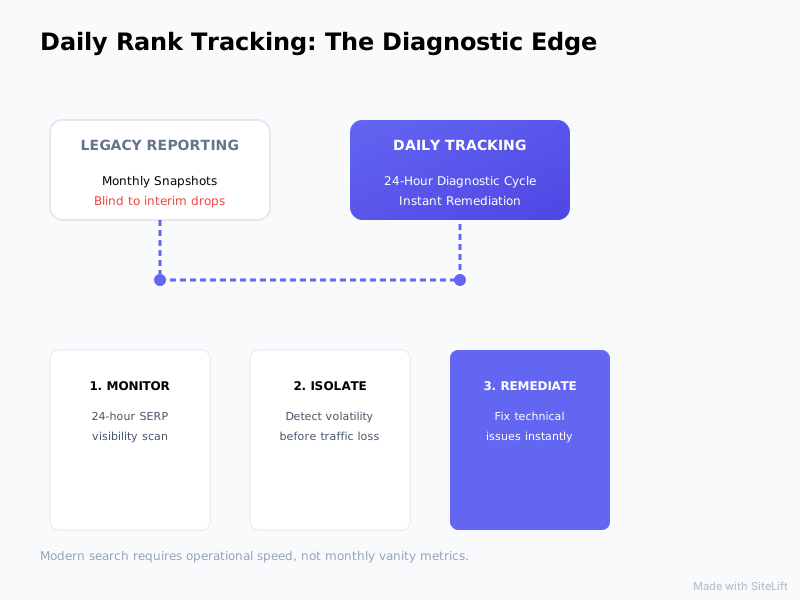
Daily rank tracking is the practice of monitoring your website's organic search positions across target keywords every 24 hours. Unlike legacy search reporting—which treated ranking snapshots as a monthly vanity metric for executive slide decks—modern daily tracking functions as an operational diagnostic system.
Google does not wait for your scheduled monthly audit to overhaul its search layout or recalculate domain authority. When search algorithms adjust, visibility changes instantly.
Legacy Reporting:   [Day 1: Rank #2] -----------------------------> [Day 30: Rank #18] (Loss discovered)
Daily Rank Tracking: [Day 1: #2] -> [Day 3: #5] -> [Day 4: Alert!] -> [Day 5: Fixed & Recovered]
The Limitations of Weekly and Monthly Keyword Audits
Relying on weekly or monthly snapshots introduces dangerous blind spots:
- Invisible interim drops: A URL might drop from position 2 to position 14 on Tuesday due to an inadvertent canonical tag override, linger there for six days costing thousands in conversions, and bounce back to position 6 right before your Monday report runs. You see a minor fluctuation; your balance sheet sees a revenue hole.
- Averaging fallacies: Monthly reports flatten micro-volatility into smooth averages. An average ranking of 4.2 can hide severe swings between positions 1 and 18, obscuring genuine instability.
- Inability to identify cause and effect: If you publish four new articles, update your navigation, and optimize metadata across a product hub in the same two-week window, a monthly rank check cannot accurately tell you which action triggered a ranking move.
How Real-Time Rank Tracking Protects Core Commercial Positions
High-intent commercial keywords drive the lion's share of inbound pipeline for SaaS, cloud, and digital platforms. According to empirical studies published on the Ahrefs blog, 90.63% of all web pages receive zero organic search traffic from Google. The small fraction of content that does capture traffic relies heavily on positions 1 through 3.
When you implement real-time rank tracking, you create a protective perimeter around these core assets. If your highest-converting landing page dips from rank 1 to rank 4, a daily cadence alerts you within hours. That immediate notice allows your growth team to check whether a competitor published fresh research, a schema markup broke, or Google temporarily reshuffled search intent.
The Hidden Revenue Costs of Delayed SERP Visibility Data
When a high-value page drops in visibility, the financial impact begins accumulating immediately:
| Metric Impact | 24-Hour Detection Window | 30-Day Detection Window |
|---|---|---|
| Average Time to Identify Issue | < 24 Hours | 30 Days |
| Traffic Loss Window | 1–3 Days | 30–60+ Days |
| Diagnostic Context | High (exact code/content diff available) | Low (scores of site changes obfuscate root cause) |
| Pipeline Risk | Isolated to micro-fluctuations | Severe revenue and demo pipeline disruption |
If a core bottom-of-funnel keyword worth 1,500 monthly organic visits at a 4% conversion rate drops five positions, you lose dozens of warm leads for every week the issue goes unnoticed. Waiting for Google Search Console (GSC) to populate its aggregated, delayed data means you are operating on a 48- to 72-hour lag at best—an eternity in competitive niches.
How Are AI Search Fluctuations and Dynamic SERPs Changing Rank Tracking?
Rank tracking is no longer just about tracking blue hyperlinks. The explosion of AI-generated answers has upended organic search mechanics entirely.
Traditional SERP:               Modern Generative SERP:
+--------------------------+    +--------------------------+
| 1. Organic Result #1     |    | [Google AI Overview]     |  <- Absorbs Clicks
| 2. Organic Result #2     |    | [People Also Ask]        |
| 3. Organic Result #3     |    | 1. Organic Result #1     |  <- Pushed Below Fold
+--------------------------+    +--------------------------+
Tracking Volatility in Google AI Overviews and Generative Answers
Google AI Overviews (formerly SGE) and generative engine tools inject summaries directly into search queries, fundamentally altering organic click-through rates. According to research by SparkToro, nearly 60% of Google searches conclude without a click to an external website.
When Google inserts an AI Overview above standard organic positions, your "Position 1" ranking can be pushed down hundreds of pixels below the mobile or desktop fold. Monitoring ai search fluctuations on a daily cadence helps you identify when your target queries trigger AI answers, whether your content is cited as an underlying source, and when generative tests displace your core listings.
For a deeper dive into adjusting your visibility metrics across answer engines, read our guide on how to track search engine rankings in real time.
Addressing Zero-Click Search Variations and Layout Changes
SERP real estate is highly elastic. Depending on your query, Google dynamically serves:
- Featured snippets and definitions
- "People Also Ask" (PAA) accordions
- Video carousels and visual cards
- Local map packs and product grids
Traditional rank trackers only tell you that you occupy "Position 2". But daily layout tracking shows whether Position 2 sits above the fold or behind three expandable interactive modules. Daily visibility scores that account for absolute pixel height and rich feature presence provide a much clearer indicator of traffic risk than raw positional numbers.
Distinguishing Algorithmic Shifts from Intent Rewrites
Google frequently tests search intent. For instance, an informational query might temporarily serve direct software comparison landing pages. If Google switches user intent back toward educational long-form guides, your comparison page might tumble ten spots overnight.
Observing these ai search fluctuations day over day lets you distinguish an isolated algorithm test from a broad, intentional rewrite of SERP query semantics.

What Are the Primary Benefits of Daily Keyword Monitoring for Growth Teams?
Transitioning to systematic daily keyword monitoring transforms organic search management from a reactive guessing game into an empirical feedback loop.
Rapid Detection of Technical De-indexing and Cannibalization
Technical errors happen unexpectedly. A staging deployment can inadvertently push a noindex meta tag to production, or a faulty CDN rule can start returning 503 errors to Googlebot.
Daily monitoring catches:
- Sudden de-indexing drops: If a top-performing URL plummets from position 2 to position 95+ overnight, it is almost always a technical glitch or an accidental de-index directive.
- Internal keyword cannibalization: If daily tracking reveals that your intended target page keeps swapping positions with an older blog post, you have an active cannibalization issue splitting page authority.
Pro Tip: If a critical URL suddenly vanishes from the top 100 on a single day while the rest of your domain remains stable, check your server response headers and canonical tags before rewriting any copy. True content obsolescence causes gradual decay, not a cliff dive to position zero.
Real-Time Competitor Intelligence and Counter-Optimization
Your competitors are actively working to outrank you. With daily tracking, you can reverse-engineer their moves as they happen.
Industry coverage from Search Engine Land consistently highlights how rapidly competitor counter-optimizations can erode market share during competitive product cycles. If a competitor suddenly jumps five spots on a target keyword, a quick look at their page reveals their playbook: Did they refresh their statistics? Add custom interactive tools? Secure an authoritative backlink?
Daily monitoring surfaces these changes early, giving you ample time to respond before their gains solidify. You can also explore how automated validation accelerates this process in our breakdown of keyword checking on autopilot.
Accurate Attribution for Content Publishing and Algorithm Updates
When you publish a new topic cluster or execute a site-wide internal linking overhaul, how long does it take for Google to reward you?
Daily data allows you to plot exact deployment dates against ranking lift curves. If your rankings begin rising 72 hours after updating an internal hub structure, you can confidently validate your SEO strategy and justify future resource allocation.
How to Configure Meaningful SERP Volatility Alerts Without Notification Fatigue
Receiving an alert for every single micro-movement across 2,000 tracked keywords leads to alert fatigue. If your team's Slack channel pings every time a keyword shifts from position 24 to position 26, those notifications will quickly be muted and ignored.
Infographic by SiteLift
Setting up an effective alert architecture requires deliberate threshold filtering:
[Rank Tracker Engine]
         │
         ├──> Top 3 Commercial URLs (Alert on +/- 2 positions) ──> Slack: #seo-critical
         │
         ├──> Positions 4-10 (Alert on drop > 3 positions)    ──> Weekly Review Queue
         │
         └──> Positions 11-50 (Alert on jump into Top 10)     ──> Slack: #seo-wins
Setting Position-Tiered Thresholds (Top 3 vs. Striking Distance)
Segment your tracked keywords by business impact and current position:
- Tier 1: Core Commercial Money Keywords (Positions 1–3): Configure strict alerts. Trigger an immediate notification if any URL in this group drops more than 1 or 2 positions. A minor movement here causes immediate click decay.
- Tier 2: Striking Distance Keywords (Positions 4–15): Set alerts for positive momentum (e.g., breaking into the top 3) or severe drops (falling out of the top 20). Ignore standard 1-to-2 spot daily noise.
- Tier 3: Informational / Discovery Terms (Positions 16–50+): Only trigger alerts when a URL jumps into striking distance (position 10 or better).
Isolating Core Algorithm Rolling Updates with SERP Volatility Alerts
Google frequently rolls out multi-week core updates. According to market data from the Moz algorithm tracking systems, SERP volatility indices regularly cross high-turbulence thresholds during major Google updates. Similarly, Semrush Sensor data frequently tracks SERP volatility indices exceeding 7.0 out of 10 during rolling Google updates, reflecting substantial ranking reshuffles within 24-hour windows.
When broad market volatility metrics spike across your industry vertical, individual rank drops are rarely caused by a localized page bug. SERP volatility alerts help contextualize individual rank drops: if 40% of your tracked keywords move simultaneously while the entire vertical exhibits volatility, you are witnessing an algorithmic core rollout rather than a localized technical penalty.
Filtering Out Expected SERP Testing and Google Shuffling
Google often conducts brief A/B tests on live search queries, temporarily promoting a URL to evaluate its engagement metrics before returning it to its baseline position.
To filter out this intentional "Google dance":
- Apply a 48-hour smoothing rule before triggering high-priority engineering tasks.
- Require an anomalous positional shift to sustain itself across two consecutive daily crawl cycles before declaring an emergency.
- Track keyword groups by tag or intent rather than obsessing over single URLs in isolation.
Key Takeaways: Modern Rank Tracking Overview
| Tracking Dimension | Legacy Periodic Audits | Modern Daily Rank Tracking |
|---|---|---|
| Crawl Frequency | Bi-weekly or monthly | Every 24 hours |
| Detection Speed | 14 to 30 days post-incident | Under 24 hours |
| SERP Feature Analysis | Ignored or limited to desktop links | Monitors AI Overviews, PAAs, and layout compression |
| Alert Sensitivity | None (manual report generation) | Tiered thresholds based on commercial value |
| Remediation Loop | Slow, reactive triage | Immediate, proactive diagnosis and counter-action |
Why Automated Remediation Beats Obsessive SERP Watching
Here is my candid opinion: Tracking rankings every day is useless if all you do is stare at the dashboard.
I have worked with dozens of growth teams who treat their rank tracker like a stock ticker. They obsess over every daily decimal shift, pull emergency fire alarms when a keyword moves from rank 3 to rank 5, and burn hours arguing in Slack about whether an algorithmic phantom update hit them overnight.
Watching your rankings decline in high resolution does not fix your rankings.
Rank tracking software should not be an emotional surveillance tool. It should be an automated trigger system. If your rank monitoring is not connected to a structured remediation workflow—updating copy, refining schema, adjusting internal link architecture, or injecting fresh citations—you are wasting time.
The future belongs to growth teams that pair daily SERP data directly with automated content adjustments and immediate publishing capabilities. Knowing you lost rank is table stakes; having the programmatic capability to fix it before your competitors notice is how you win.
— sitelift.io
How Can Brands Turn Daily Rank Tracking into Autonomous SEO Actions?
The traditional SEO lifecycle is broken by delay:
- A rank drop occurs on day 2.
- An analyst notices it on day 18.
- A strategy ticket is drafted on day 25.
- Copywriters update the content on day 40.
- Engineering publishes the update on day 55.
By the time the updated content is re-crawled, two months of potential revenue have vanished, and the competitive landscape has evolved again.
Manual Workflow (55-day lag):
[Rank Drop] ──> Wait for Audit ──> Strategy Meeting ──> Copywriting ──> Dev Deploy ──> [Recovery?]

Autonomous Workflow (48-hour loop):
[Rank Drop] ──> Automated Metric Trigger ──> Fresh Content/Link Remediation ──> Instant Deploy
Closing the Gap Between Observation and Remediation
Modern SEO requires closing the loop between data capture and tactical remediation. When daily rank tracking flags a loss in topical authority or reveals that a competitor's expanded subtopic took your position, manual counter-measures take too long.
Forward-looking platforms connect rank telemetry directly to content pipelines. If a key commercial page displays declining momentum over consecutive daily cycles, the system should instantly recommend or draft supplemental supporting content to reinforce the topic cluster.
To understand how publishing velocity reinforces your domain authority, take a look at our analysis of fresh content SEO.
Automating Content Refreshes and Internal Link Redistribution
When organic positions dip, the solution is rarely a complete page rewrite. More often, it requires:
- Updating stale statistics and facts
- Adding direct answers to newly surfaced search intent
- Reallocating internal links from recently published high-authority pages to support dropping URLs
Connecting your rank-monitoring signals to automated publishing infrastructure lets you identify at-risk URLs and programmatically redistribute contextual internal links across your broader domain network, restoring search equity in days rather than quarters.
Future-Proofing Organic Visibility in an Autonomous Search Era
As search engines lean more heavily into artificial intelligence, manual rank maintenance becomes increasingly impractical. Managing thousands of evolving keyword variations across desktop, mobile, and generative platforms requires software that pairs monitoring with action.
This is why we built sitelift.io. SiteLift operates as an autonomous SEO and AI visibility growth platform, tracking keyword momentum while continuously generating, optimizing, and deploying content across integrated CMS platforms on autopilot. Rather than just tracking your ranking drops on a chart, SiteLift continuously builds topical authority and distributes high-value content to help you capture and hold top-tier search visibility.
Frequently Asked Questions
What is daily rank tracking and how does it work?
Daily rank tracking is the automated process of checking and recording your website's search engine rankings across designated target keywords every 24 hours. Enterprise rank trackers query search engines across specific geolocations, devices, and interfaces, capturing both traditional organic positions and rich SERP elements like AI Overviews and featured snippets.
Will daily rank tracking hurt my site or violate Google's guidelines?
No. Daily rank tracking queries search engines directly using isolated proxies, headless browsers, or third-party search APIs. It sends zero artificial traffic to your actual web server and does not violate Google's Webmaster Guidelines, as it does not manipulate or interfere with the target site's infrastructure.
How does daily rank tracking differ from Google Search Console data?
Google Search Console provides delayed, aggregate performance data based on actual user impressions and clicks, typically operating on a 48- to 72-hour reporting lag. Daily rank trackers provide point-in-time, simulated rank checks on a precise 24-hour schedule, allowing you to identify volatility and inspect real-time SERP layouts without waiting for GSC to update.
How do I manage notification fatigue when tracking hundreds of keywords daily?
Implement a tiered alerting framework. Only configure real-time notifications (such as Slack alerts) for your most critical commercial keywords when they drop out of top-tier positions. For secondary and tertiary discovery keywords, use aggregated weekly volatility reports or threshold rules that only alert you when a URL climbs into striking distance.
Can daily rank tracking monitor appearances in AI Overviews and answer engines?
Yes. Modern daily tracking platforms actively parse search engine results pages for the presence of generative AI Overviews, ChatGPT Search citations, and interactive modules. They verify whether your brand's URLs are cited as source references within generative snapshots alongside your standard organic rankings.
Topics Covered:
- daily rank tracking
- daily keyword monitoring
- serp volatility alerts
- real-time rank tracking
- ai search fluctuations
More from SiteLift

SEO Reporting Dashboards That Prove ROI: How to Choose One
Compare SEO reporting dashboards that show real ROI, not vanity metrics — real-time data, stakeholder-ready reports, and what to look for before you buy.

What Is a Content Map? How to Plan Topical Authority That Compounds Traffic
Learn how to build a strategic content map. Discover how entity clustering and pillar-cluster architecture compound your organic traffic.

Bing Rank Tracker Guide: Win Bing, Copilot and AI-Powered Search Visibility
Master your Bing rank tracker strategy. Learn how to optimize for Microsoft Copilot citations, track keyword rankings, and dominate alternative search engines.