SEO Reporting Dashboards That Prove ROI: How to Choose One
 Managing organic growth across European markets is a complex puzzle. You are not just dealing with one search engine or a single language; you are balancing regional search behaviours, multiple currencies, and strict regulatory frameworks. If you are trying to prove organic value to a board of directors in Frankfurt, Paris, or London, showing them a basic PDF of keyword rankings will not work.
To win their trust—and secure your budget—you need a modern seo reporting platform that translates technical search metrics into clear, bottom-line business revenue.
Before we dive into the strategic shifts required to win over European executives, let us look at the core differences between outdated tracking methods and modern, ROI-focused reporting.
Key Takeaways: Traditional vs. Modern European SEO Reporting
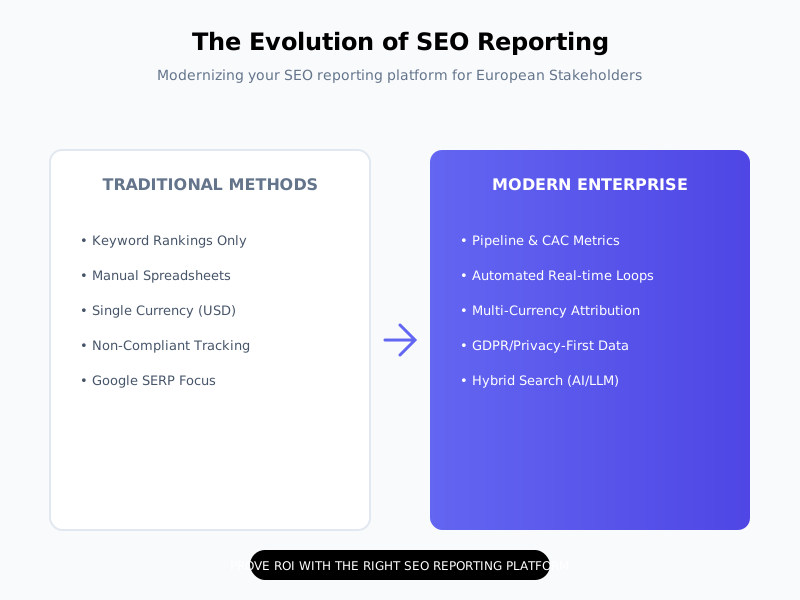
| Reporting Element | Outdated Traditional Reporting | Modern European Enterprise Reporting |
|---|---|---|
| Primary Metric | Keyword rankings and search volume | Market share, pipeline contribution, and customer acquisition cost (CAC) |
| Data Privacy | Unfiltered cookie tracking (GDPR non-compliant) | Privacy-first, server-side tracking and compliant organic traffic analytics |
| Currency Support | Single currency (typically USD) | Multi-currency attribution (EUR, GBP, CHF, SEK) |
| Workflow | Manual spreadsheets and static slides | Automated SEO reports with real-time publishing loops |
| Search Channels | Traditional Google SERP only | Hybrid search (Google, Bing, and AI search engines/LLMs) |
 ## Why Do Traditional SEO Metrics Fail to Convince European Stakeholders?
European C-suite executives are notoriously pragmatic. They operate in highly competitive, multi-jurisdictional environments where capital efficiency is heavily scrutinised. When digital marketing teams present reports filled with search engine optimization jargon, a disconnect occurs.
Moving Beyond Vanity Rankings to Executive Revenue Metrics
According to Gartner, over 65% of enterprise marketing leaders struggle to clearly demonstrate organic search ROI to non-technical executives. Showing a German CFO that your main commercial keyword moved from position 8 to position 4 is meaningless without context. They want to know how that movement impacts pipeline velocity, customer lifetime value, and enterprise revenue.
To bridge this gap, your seo reporting platform must connect organic search visibility directly to your CRM and business intelligence tools. The conversation must shift from "we rank number one for this term" to "this cluster of organic content generated €140,000 in qualified pipeline this quarter."
Navigating Multi-Market and Multi-Language Search Complexities
Europe is not a monolith. A strategy that works in the UK will not translate directly to Italy or Poland. Consumers search differently, use distinct regional dialects, and have varying buying behaviours.
If your reporting tool cannot isolate performance by country, language, and search engine, your data is essentially diluted. For instance, while Google dominates, regional preferences and search habits vary. Your reporting must show localized performance across distinct regional sub-domains and country-specific search engines without merging them into a single, confusing "European" bucket.
Addressing Strict European Data Privacy Standards in Organic Attribution
Data privacy is a major operational hurdle for European marketers. With the strict enforcement of GDPR guidelines, relying on legacy tracking scripts that ignore user consent is a recipe for compliance audits and heavy fines.
When cookie consent banners are rejected by users, traditional analytics platforms lose tracking accuracy, leading to massive gaps in conversion attribution. A modern reporting framework must leverage privacy-compliant organic traffic analytics and server-side tracking to ensure you can still attribute sign-ups and sales to organic search without violating user trust or European laws.
What Essential Features Define a Modern Enterprise SEO Reporting Platform?
To satisfy both your technical team and your executive board, your reporting software must do more than pull basic API data. It needs to serve as a predictive engine.
Automated SEO Reports for Hands-Free Stakeholder Updates
Research from Econsultancy shows that digital marketing teams spend up to 12 hours per week manually compiling client and internal performance reports. This is a massive waste of human capital.
[Data Collection] ➔ [Data Normalisation] ➔ [Automated Insights] ➔ [C-Suite Dashboard]
       ▲                                                                 │
       └────────────────── Real-Time API Updates ────────────────────────┘
By utilising automated SEO reports, you can schedule tailored dashboards to be sent directly to your stakeholders on a weekly or monthly basis. The marketing manager gets the granular page-level data, while the CMO receives a high-level executive summary focusing on share of voice and cost acquisition savings.
Real-Time Rank Tracking Across Regional and Global Markets
Search engine results pages (SERPs) are highly dynamic. Localised search intent means that a user searching for enterprise software in Munich sees different results than one in Vienna, even though both search in German.
Your platform must offer real-time rank tracking down to the city level. This allows your team to spot local algorithmic shifts immediately and adjust your content distribution strategy before performance drops.
Pro Tip: Never present global average ranking positions to country managers. Always segment your ranking data by local search engines (e.g., google.de, google.fr) to show true local market penetration.
Keyword Momentum Dashboard to Identify Growth Opportunities Early
Traditional rank trackers only tell you where you stand today. A keyword momentum dashboard, however, tracks the velocity of your rankings. It highlights which keyword clusters are rising rapidly in search engine visibility before they actually start driving massive traffic. This predictive insight allows you to double down on winning content topics before your competitors realise there is a trend.
 ---
---
How Can You Measure and Prove Real SEO ROI Across European Operations?
Proving ROI requires a clear methodology that connects organic impressions to actual bank deposits. Here is how to build that framework.
Attributing Organic Traffic Analytics to Multicurrency Revenue Pipelines
If your enterprise operates across the UK, Switzerland, and the Eurozone, your reporting must handle GBP, CHF, and EUR seamlessly. A robust dashboard integrates with your CRM (like Salesforce or HubSpot) to track the exact currency value of conversions. This allows you to show that your French organic traffic is converting at a higher average order value in EUR than your British traffic in GBP, helping you allocate resources more effectively.
Benchmarking Search Visibility Across Traditional SERPs and AI Engines
The search landscape is changing rapidly. Users are increasingly turning to generative AI engines and LLMs to find answers.
Traditional Search (Google/Bing) ───► Keyword Rankings ───► Click-Throughs
Generative AI Engines (LLMs)     ───► Brand Mentions    ───► Direct Referrals
Your reporting platform can no longer limit itself to traditional blue links. It must track your brand's visibility and citations within AI-generated search results, ensuring your business remains visible however your audience chooses to search.
Calculating Customer Acquisition Cost (CAC) Reductions from Organic Channels
A study by Forrester found that organizations leveraging automated reporting and AI-driven SEO workflows achieve a 3x faster time-to-market for digital campaigns. One of the most compelling ways to prove organic ROI is to compare it to your paid search (PPC) spend.
By tracking the organic equivalent value—what you would have paid in Google Ads to get the same volume of traffic—you can clearly show how your organic strategy is lowering the company's overall customer acquisition cost (CAC).
How to Evaluate the Best SEO Reporting Platform for Your Tech Stack?
Choosing the right tool is not just about features; it is about how well it fits into your existing ecosystem and complies with local regulations.
Seamless Integration with CMS Platforms and Enterprise Data Warehouses
Insights are useless if they do not lead to action. The best reporting systems connect directly with your Content Management System (CMS) and enterprise data warehouses (like BigQuery or Snowflake). This allows you to turn data insights into automated content updates and publishing workflows, creating a continuous loop of measurement and optimization.
White-Label Capabilities for Agencies Managing European Brands
For agencies operating across Europe, brand consistency is vital. You need a platform that offers sophisticated white-labeling. This goes beyond adding your logo to a PDF; it means hosting interactive dashboards on your own custom domain, complete with localized language options for your regional clients.
Data Sovereignty, Governance, and GDPR Compliance Standards
Where is your reporting data hosted? For European enterprises, this is a critical security question. Ensure that your chosen SaaS platform hosts its data within EU-based data centres (such as Frankfurt or Dublin) and fully complies with European data sovereignty guidelines.
My Contrarian Take: Why Traditional Rank Tracking is Quietly Misleading Your C-Suite
If you are still sending weekly rank-tracking spreadsheets to your executive team, you are actively harming your internal credibility.
Here is the truth: static keyword rankings are a vanity metric.
In a world of highly personalised, localized, and AI-driven search results, the concept of a single "ranking position" is obsolete. Two users sitting in the same office building in Brussels can see entirely different search results for the exact same query based on their search history and device preferences.
When you report that a keyword is "in position 3," you are presenting a simplified, often inaccurate view of your search visibility.
Instead, we need to train our stakeholders to look at keyword momentum and share of voice.
What percentage of the total search market in your industry does your brand control? How fast is your organic footprint expanding compared to your top three competitors?
These are the metrics that map directly to market share and revenue. Shift your reporting to focus on these macro-trends, and you will find that your C-suite is suddenly much more willing to sign off on your budget requests.
Pro Tip: Replace "Average Position" in your executive summaries with "Organic Share of Voice (SoV)" and "Estimated Revenue Contribution." It immediately elevates the conversation from a technical task to a strategic business discussion.
— Marcus Vance, Head of Organic Strategy at SiteLift
Streamlining Your SEO Reporting for European ROI
Ultimately, selecting the right platform is about bridging the gap between technical execution and executive business strategy. If you are tired of manually stitching together data from disjointed tools, it might be time to look at an autonomous solution.
 This is where SiteLift comes in. As an autonomous SEO and AI visibility growth platform, SiteLift is built to help businesses scale their organic reach on autopilot.
Instead of just telling you what went wrong last month, SiteLift automatically generates targeted content, distributes it across a curated premium network, integrates with your existing CMS, and tracks your keyword momentum in real-time. It handles the heavy lifting of execution and reporting, allowing your team to focus on high-level strategy and compounding your digital authority across both traditional search engines and emerging AI platforms.
FAQ
What is an enterprise SEO reporting platform?
An enterprise SEO reporting platform is a software solution designed to consolidate search performance data from multiple regions, languages, and search engines into unified, business-focused dashboards. Unlike basic tracking tools, it integrates with enterprise CRMs, data warehouses, and CMS platforms to connect search metrics directly to business revenue.
How frequently should automated SEO reports be delivered to executive stakeholders?
For C-suite executives, monthly or quarterly reports are ideal, focusing on high-level business KPIs like market share, revenue pipeline, and CAC savings. For operational marketing teams, weekly automated updates are more appropriate to track real-time rank tracking shifts and campaign momentum.
How do European data privacy laws (GDPR) impact organic traffic analytics?
GDPR requires explicit user consent for tracking cookies, which often leads to data gaps when users decline tracking. To maintain accurate attribution, modern platforms must use privacy-first, server-side tracking and compliant organic traffic analytics that respect user privacy while preserving conversion data.
What is the difference between real-time rank tracking and a keyword momentum dashboard?
Real-time rank tracking shows your current ranking position for specific keywords at any given moment. A keyword momentum dashboard analyzes the speed and direction of your ranking trends over time, providing predictive insights into which content topics are gaining traction before they peak in search volume.
How do multi-language requirements affect SEO reporting across European markets?
Multi-language requirements mean that search performance must be segmented by country and language code. A robust reporting platform must isolate these variables to prevent regional data dilution, ensuring you can see exactly how your strategies are performing in distinct markets like French-speaking Switzerland versus German-speaking Switzerland.
Article generated by SiteLift
Topics Covered:
- seo reporting platform
- automated SEO reports
- real-time rank tracking
- keyword momentum dashboard
- organic traffic analytics
More from SiteLift

AI for SEO: How to Automate Research, Content Creation and Distribution
Learn how to use AI for SEO to automate keyword research, generative content creation, CMS publishing, and search engine visibility.

SEO Tools in 2026: How to Build an Autonomous Stack That Grows Traffic on Autopilot
Discover how to build an autonomous stack with modern AI SEO tools, automated publishing workflows, and real-time rank tracking to grow organic traffic.

Repurposing Content for SEO: How to Multiply Organic Reach Across Channels
Learn how repurposing content for SEO multiplies organic reach. Discover step-by-step strategies for syndication, AI visibility, and automation.