Bing Rank Tracker Guide: Win Bing, Copilot and AI-Powered Search Visibility

For years, search engine optimization felt like a one-horse race. Marketers poured almost all of their resources into Google, treating other platforms as minor afterthoughts. But the search landscape has fundamentally shifted. With Microsoft Copilot processing complex, conversational queries and the resurgence of desktop search, ignoring Microsoft's ecosystem is a costly mistake. To win in this new era of AI-powered answers, you need a reliable bing rank tracker to measure your search footprint, optimize for generative citations, and capture high-intent enterprise traffic.
This guide explores how tracking your Bing keyword performance is no longer just about monitoring alternative search engine rankings—it is your direct gateway to mastering AI search visibility.
Key Takeaways
| Metric / Aspect | Google Search | Bing & Microsoft Copilot |
|---|---|---|
| Primary Audience | Global mobile & multi-device | Enterprise, B2B, desktop, Windows/Edge defaults |
| Indexing Speed | Crawl-dependent (hours to weeks) | Instantaneous via the IndexNow protocol |
| Ranking Signals | Deep semantic vector systems, entity relationships | Exact-match anchor text, clear metadata, social signals |
| AI Integration | Google Gemini / AI Overviews | Microsoft Copilot (grounded in Bing index) |
| Tracking Focus | Traditional SERP positions | SERP features, AI citations, conversational answers |
Why Is Bing Keyword Tracking Critical in the Era of Copilot and AI Search?
Most SEO teams ignore Bing because they look strictly at global mobile market share. If you only look at mobile phones, Google is the undisputed leader. But if you look at where business decisions are actually made—desktop computers in corporate environments—the picture changes dramatically.
The Expansion of Bing Desktop and Enterprise Market Share
According to data from StatCounter Global Stats, Bing accounts for over 10% of the worldwide desktop search market, reaching over 14% in regions like North America. In corporate and enterprise environments, Microsoft Edge is the default browser, and Bing is the default search engine.
These corporate users represent an incredibly lucrative audience. They are B2B buyers, procurement officers, software buyers, and executives searching on their work computers. If you are not actively monitoring your bing keyword tracking performance, you are blind to how this high-value audience interacts with your brand.
How the Bing Index Powers Microsoft Copilot and Generative Answers
The rise of generative AI has changed the definition of search visibility. Microsoft reports that Microsoft Copilot processes queries grounded in real-time web search powered directly by the Bing search index. This is a crucial distinction. Copilot does not invent answers from thin air; it uses Retrieval-Augmented Generation (RAG) to pull real-time data from the web.
[User Query in Copilot]
       │
       ▼
[Bing Search Index Query] ──► [Top Organic Results (High Bing Authority)]
       │
       ▼
[Copilot RAG Engine] ──► [Generative Answer with Grounded Citations]
If your website ranks in the top organic positions on Bing, you are significantly more likely to be featured as a clickable citation in Copilot's conversational responses. Tracking your organic rank on Bing is essentially tracking your copilot search visibility. To understand how this works in real-time across various engines, you can read our deep dive on how to track search engine rankings in real-time.
Key Differences Between Bing and Google Ranking Signals
You cannot assume that your Google rankings mirror your Bing rankings. The two search engines run on entirely different algorithmic principles:
- Exact-Match Keywords: Bing still places a heavy emphasis on exact-match keywords in your page titles, H1 tags, URLs, and meta descriptions. While Google relies on semantic vector systems to interpret intent, Bing favors direct keyword matches.
- Anchor Text: Bing values clean, keyword-rich anchor text from internal and external links.
- Social Signals: Bing openly acknowledges that social media shares and engagement play a role in its ranking algorithm, whereas Google has historically downplayed this connection.
- Domain Age and Authority: Bing tends to favor older, established domains with a history of consistent publishing. You can check your domain's raw strength using our free domain rating checker to see how your site compares to competitors.
What Is a Bing Rank Tracker and How Does It Function?
A dedicated bing rank tracker is software designed to monitor your website's keyword positions specifically within the Bing search engine results pages (SERPs). Unlike general SEO suites that treat Bing as an afterthought toggle, a specialized tracker accounts for the unique layouts, localized indexes, and API integrations of the Microsoft ecosystem.

Core Mechanics of Bing SERP Scraping and API Tracking
A tracker gathers ranking data through two primary methods: direct SERP scraping and official API integrations. By using location-specific IP addresses, the rank tracker simulates real user queries across different regions. This prevents search engines from serving personalized results based on previous search history, ensuring you get clean, objective ranking data.
Additionally, advanced rank tracking platforms connect directly with the Microsoft Bing Webmaster API. This hybrid approach combines scraped SERP data with first-party performance metrics to provide a highly accurate view of your organic footprint.
Monitoring Desktop vs. Mobile Rankings and Geo-Targeted Results
Because Bing's market share is heavily concentrated on desktop, tracking desktop rankings is paramount. A quality rank tracker allows you to split your tracking campaigns by device type.
Furthermore, localization is incredibly precise on Bing. A user searching for enterprise software in Chicago will see different organic listings and Copilot citations than a user in London. Your tracker must support hyper-local tracking down to the city or postal code level to give your sales and marketing teams accurate geographic data.
Tracking Generative Snippets, Copilot Answers, and Rich Media
The modern Bing SERP is highly visual and interactive. It features:
- Copilot Preview Panes: Generative text boxes that appear at the top or side of the organic results.
- Video Carousels: Direct integrations with YouTube and Bing Video.
- Rich FAQ Snippets: Expandable questions pulled directly from structured schema markup.
A modern rank tracker does not just give you a flat number like "Position 4." It tells you whether your site is winning these rich interactive elements, helping you understand your true share of search engine real estate.
How to Track Bing Rankings Using Bing Webmaster Tools vs. Dedicated Trackers?
When it comes to monitoring your performance, you have two primary paths: using Microsoft's free first-party tool or investing in a dedicated, autonomous tracking platform. Both have their place in a modern SEO stack.
Leveraging Search Performance Reports in Bing Webmaster Tools
Bing Webmaster Tools is an exceptional, free resource that every webmaster should configure. The Search Performance report displays:
- Total Impressions: How many times your site appeared in search results.
- Total Clicks: How many users clicked through to your site.
- Average CTR: Your click-through rate across different queries.
- Average Position: Where your pages ranked over a selected timeframe.
It is highly reliable for analyzing historical trends and identifying which pages are driving actual traffic to your site.
Limitations of First-Party Data for Daily Competitive Intelligence
While Bing Webmaster Tools is great for post-campaign analysis, it has major limitations for active campaign management:
- Data Lag: The performance data is usually delayed by 2 to 3 days, making it impossible to see the immediate impact of a new content publish or optimization.
- No Competitor Tracking: You cannot track your competitors' keyword positions. You only see data for websites you own and verify.
- Data Sampling: For high-volume sites, Bing samples search query data, meaning you do not get a complete picture of long-tail keyword performance.
Advantages of Autonomous Third-Party Tracking Platforms
Dedicated third-party trackers fill these gaps by offering real-time, automated monitoring of both your site and your competitors.
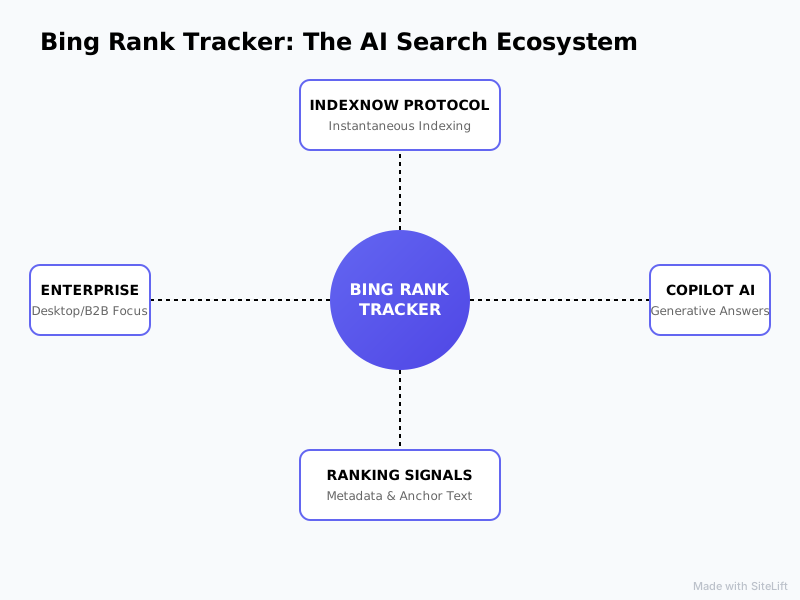
Infographic by SiteLift
| Feature | Bing Webmaster Tools | Dedicated Bing Rank Tracker |
|---|---|---|
| Cost | Free | Paid subscription |
| Data Freshness | 48-72 hour delay | Daily or real-time updates |
| Competitor Tracking | No | Yes (unlimited competitor tracking) |
| Alerting Systems | Minimal | Instant alerts for rank drops or gains |
| API Access | Limited to owned domains | Full raw data export via API |
For organizations running large-scale campaigns, manual tracking is impossible. Utilizing enterprise rank tracking allows you to monitor thousands of keywords across multiple international markets simultaneously.
How Can You Optimize Content to Improve Bing and Copilot Search Visibility?
Tracking your rankings is only half the battle. Once you identify keyword opportunities, you must optimize your content specifically for Bing's unique ranking criteria and Copilot's retrieval systems.
Accelerating Discovery with the IndexNow Protocol
Traditional search engine indexing relies on web crawlers finding your sitemaps and slowly indexing your pages over days or weeks. Bing bypassed this slow process by co-creating the open-source IndexNow protocol.
IndexNow allows websites to instantly notify search engines whenever content is created, updated, or deleted. When you publish an article, your CMS sends a simple API request to IndexNow. Bing immediately schedules a crawl, often indexing your new content within seconds. Data from Microsoft Bing Webmaster Tools shows that websites adopting the IndexNow protocol experience significantly faster crawl and indexation speeds, processing billions of URL updates daily across participating engines.
On-Page Optimization Tailored for Bing's Search Algorithm
To climb the ranks on Bing, you need to align your on-page SEO with its structured, literal parsing engine:
- Exact-Match Heading Hierarchy: Ensure your target keyword is present in your main H1 title and at least one H2 heading.
- Clean URL Structures: Avoid dynamic parameters. Use descriptive, keyword-rich URLs (e.g.,
example.com/bing-rank-tracker-guide). - Optimized Meta Tags: Draft compelling meta descriptions that contain your primary keyword. You can test your pixel widths and visual layout using our free SERP preview tool.
- Structured Schema Markup: Implement Organization, Product, Article, and FAQ schema. Bing relies heavily on structured data to build its rich SERP features.
Structuring Content for Generative AI Citations and Copilot Extracts
Copilot pulls information from the web to synthesize conversational answers. To make your content highly "extractable" for AI engines, structure your pages with clear, logical formatting:
- The Q&A Format: Use H3 headings styled as questions, followed immediately by a direct, 2-3 sentence answer.
- Data Tables: Format comparison data, pricing, and specifications in clean Markdown or HTML tables. AI models love structured tables because they are easy to parse and present to users.
- Bullet Lists: Break down step-by-step processes or list features using unordered or ordered bullet points.
Pro Tip: To get cited by Copilot, place a concise 2-3 sentence summary directly under your H2 or H3 headings. Copilot frequently pulls these direct definitions as grounded citations.
What Features Should You Look for in a Modern Bing Rank Tracker?
If you are evaluating software to monitor your Microsoft search footprint, do not settle for a basic rank checker. Look for a platform that addresses the modern reality of AI-driven search.
Tracking Frequency, Geolocation Accuracy, and SERP Feature Tracking
At a minimum, your tracker should provide daily updates. Search volatility can happen overnight, especially during search engine algorithm updates. Ensure the tool can track alternative search engine rankings as well. Engines like Yahoo, DuckDuckGo, and Ecosia are powered primarily by Bing's index. Winning on Bing means winning across this entire secondary search ecosystem.
AI Visibility Scoring and Multimodal Search Tracking
Legacy trackers only measure standard blue links. A modern tracker must measure your "AI Visibility Score." This metric tracks whether your brand is cited in generative search blocks, such as Microsoft Copilot answers, Google's AI Overviews, or other LLM-driven interfaces.
Seamless CMS Integration and Automated Content Remediation
The ultimate goal of tracking is action. If a critical keyword drops from Position 2 to Position 8, you do not just want a notification; you want a solution.
Advanced platforms integrate your ranking data directly with your CMS. If a ranking drops, the system can automatically flag the page for content remediation, suggesting semantic updates, fresh keyword placements, or schema corrections to win back your lost visibility. You can even build your own custom reporting systems by leveraging a search engine ranking API to automate your internal workflows.
Why Bing is the Most Underrated Growth Channel in Search Right Now
Most marketing departments are suffering from collective tunnel vision. They spend millions of dollars fighting for highly competitive keywords on Google, accepting skyrocketing ad costs and shrinking organic click-through rates. Meanwhile, they ignore a massive, highly qualified audience sitting right in front of them.
We believe that Bing is the single most undervalued organic channel available to businesses today. Because Google's search results have become increasingly congested with ads, product grids, and AI overviews, organic real estate there is harder to claim than ever.
Bing, on the other hand, offers a cleaner path to high-intent B2B audiences. Because its algorithm is more straightforward and rewards clean technical execution—like instant indexing via IndexNow and exact-match keyword structuring—you can achieve top rankings much faster.
Moreover, optimizing for Bing is a double win. By securing top organic rankings, you feed the exact data source that Microsoft Copilot uses to generate its conversational answers. You are not just optimizing for a search engine; you are training the AI assistant that millions of corporate professionals use every day to make purchasing decisions. It is time to stop treating Bing as an optional checkbox and start treating it as a core pillar of your digital growth strategy.
Scale Your Search and AI Visibility Autonomously with SiteLift
If you are tired of spending hours manually tracking rankings, updating content, and chasing search engine algorithm changes, it is time for a different approach.
SiteLift is an autonomous SEO and AI visibility growth platform designed to help businesses dominate search and AI engines on autopilot. Instead of requiring you to manually react to rank drops, SiteLift automatically generates targeted, high-performing content, distributes it across a curated premium network, integrates seamlessly with your CMS, and tracks keyword momentum in real-time.
By combining real-time keyword tracking with autonomous content creation and instant IndexNow publishing, SiteLift provides a complete end-to-end pipeline to compound your organic traffic, secure Copilot citations, and build domain authority without manual intervention.
Let SiteLift handle the technical heavy lifting while you focus on scaling your business.
— sitelift.io
FAQ
Why are my keyword rankings different on Bing compared to Google?
Bing and Google use entirely different ranking algorithms. While Google focuses heavily on semantic search, entity relationships, and user engagement signals, Bing places a higher value on exact-match keywords in titles and URLs, clean anchor text, social media signals, and domain age.
Does Microsoft Copilot use the Bing search index for its citations?
Yes. Microsoft Copilot uses Retrieval-Augmented Generation (RAG) to ground its conversational answers in real-time. It queries the Bing search index to find the most authoritative, relevant pages and uses those sources as clickable citations in its responses.
Can I track Bing keyword rankings for free using Bing Webmaster Tools?
Yes, Bing Webmaster Tools provides free search performance data, including impressions, clicks, CTR, and average keyword positions for your verified website. However, it does not allow you to track competitor rankings, and the data is typically delayed by 2 to 3 days.
How often do Bing rank trackers update their position data?
Most professional third-party rank trackers update their keyword position data once every 24 hours. Some enterprise-grade platforms offer real-time or on-demand ranking updates to help you monitor immediate algorithm shifts.
Does ranking higher on Bing also improve visibility on DuckDuckGo and Yahoo?
Yes. Alternative search engines like DuckDuckGo, Yahoo, and Ecosia rely heavily on Bing's search index to power their organic results. Improving your Bing rankings and optimizing your technical SEO for Bing will naturally boost your visibility across these alternative search engines.
Topics Covered:
- bing rank tracker
- bing keyword tracking
- bing webmaster tools
- copilot search visibility
- alternative search engine rankings
More from SiteLift

Daily Rank Tracking: Catch Google and AI Search Shifts Before Competitors
Master daily rank tracking to catch Google algorithm shifts, track AI search fluctuations, and protect your organic rankings before competitors react.

What Is a Content Map? How to Plan Topical Authority That Compounds Traffic
Learn how to build a strategic content map. Discover how entity clustering and pillar-cluster architecture compound your organic traffic.

AI Generated Contents That Rank: Scaling Quality, Originality and Distribution
Learn how to scale AI generated contents that rank on Google. Master quality control, automated pipelines, E-E-A-T, and multi-channel distribution.