Fresh Content SEO: How Publishing Frequency and Recency Drive Rankings

Rankings decay silently. A guide that dominated the top spot for eighteen months suddenly drops to position six, then slips onto page two. Mastering fresh content seo is the difference between watching hard-won organic impressions bleed out and running a digital asset that consistently captures compounding traffic.
Search engines exist to satisfy user intent, and user intent rarely stands still. When algorithms detect shifts in user behavior, industry standards, or product ecosystems, they re-evaluate the relevance of older content. Maintaining search dominance requires understanding both the algorithmic mechanics of content recency and the operational strategies behind sustained publishing.
What Is Fresh Content SEO and Why Does Google Value Recency?
Fresh content SEO is the dual practice of steadily publishing relevant new URLs and systematically updating existing content to maintain relevance, rankings, and crawl frequency. It is not about changing timestamps or rewriting meta descriptions to trick an indexer. It is about actively preserving the informational value of your domain.
The Evolution of the Content Freshness Ranking Factor
Google formalized content recency over a decade ago. In late 2011, Google rolled out its Freshness Update, building upon its earlier patent for scoring document freshness based on search query intent. As documented in Search Engine Land industry analysis, the update originally impacted roughly 35 percent of all search queries.
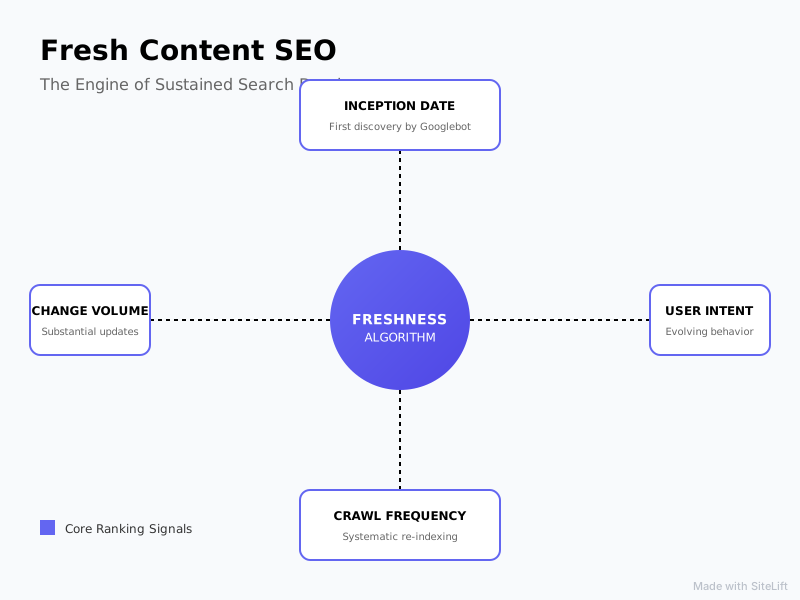
Over time, that broad algorithmic hammer evolved into a nuanced, machine-learned scoring layer. Today, the content freshness ranking factor does not simply favor the newest document. Instead, Google evaluates several distinct recency signals:
- Inception date: When Googlebot first discovered and indexed the URL.
- Substantial change volume: The degree to which core page content changes relative to boilerplate elements.
- Update frequency: How often the core body text, data points, and media receive revisions over time.
- Rate of incoming fresh links: The velocity at which new external domains link to the page.
How Search Engines Score Content Age and Timeliness
Search engines score document age relative to the specific query. When a user queries a topic, Google calculates a freshness decay curve.
For queries that require current context, Google applies an aggressive decay curve where older documents lose ranking equity quickly. For evergreen educational topics, the decay curve remains flat, allowing older documents to retain authority—provided their technical signals and reference points remain accurate.
When you modify a document, search engines do not automatically reset the clock to zero. According to technical guidelines in Google Search Central documentation, algorithms inspect the ratio of updated body text to unchanged content. Modifying a single sentence or swapping a date in an H1 produces virtually zero freshness equity, whereas updating data sets, restructuring sections, and replacing dead links trigger genuine algorithmic re-evaluation.
Freshness vs. Evergreen Authority: Finding the Strategic Balance
A common misconception is that freshness and evergreen authority are opposing strategies. They are complementary forces.
Evergreen content builds backlink equity, historical trust, and foundational topical authority. However, unmaintained evergreen content eventually succumbs to "information decay"—broken links, obsolete technical workflows, and outdated references that degrade user experience.
Pairing high-value evergreen frameworks with proactive maintenance creates an enduring competitive advantage:
Total Page Value = (Historical Backlink Equity + Domain Authority) × Information Accuracy (Freshness)
If information accuracy drops to zero because of obsolete data, total page value plummets—regardless of historical backlink equity.
How Does Google's 'Query Deserves Freshness' (QDF) Algorithm Work?
Not all queries demand up-to-the-minute information. Google governs this distinction via its Query Deserves Freshness (QDF) algorithmic system.
Algorithmic Triggers for Query Deserves Freshness
QDF relies on real-time pattern detection. Rather than relying solely on predetermined keyword categories, Google actively monitors global information streams to determine when a topic requires recent pages.
The primary triggers for QDF include:
- Search volume velocity: A sudden, statistically abnormal surge in search queries for a term or entity.
- News aggregation activity: A spike in coverage across verified Google News publishers and industry publications.
- Social and conversational velocity: High-volume user discussion across community forums and web ecosystems.
When these three vectors align, Google temporarily rewrites the SERP layout, demoting older static pages and elevating recently crawled URLs to the top of the search results.

Analyzing Search Intent: When Does Recency Trump Authority?
Search intent dictates the weight of freshness. The search engine categorizes queries into distinct freshness buckets:
- High-Freshness Needs (News & Breaking Trends): Natural disasters, political developments, or sudden corporate shifts. Authority takes a temporary back seat to raw recency.
- Cyclical & Recurring Freshness: Annual events, award ceremonies, and recurring buying guides (e.g., "best enterprise CRM software"). Here, Google prioritizes pages demonstrating updates for the current cycle.
- Low-Freshness Needs (Foundational Knowledge): Mathematical theorems, historical accounts, or definitions (e.g., "what is HTTP status code 404"). Authority and comprehensive coverage easily outrank recency.
Understanding where your target keywords sit on this spectrum prevents wasted optimization efforts.
SERP Volatility and Transient Ranking Spikes
When you publish a new page targeting a topic impacted by QDF, search engines often grant the URL a temporary ranking boost. This is not an algorithmic error; it is an active testing window.
During this initial window, Google measures real-time engagement signals: click-through rates, scroll depth, session duration, and subsequent search behavior (such as whether users bounce back to click another result). If the new URL demonstrates superior user satisfaction compared to established legacy URLs, it secures long-term baseline rankings. If engagement is weak, the URL drops once the transient freshness score decays.
SEO Publishing Velocity vs. Historical Content Optimization: Where Should You Invest?
Search teams frequently debate whether to invest limited resources into launching new pages or refining existing ones. The most successful operations pursue both simultaneously through dedicated systems.
The Compounding Impact of High SEO Publishing Velocity
SEO publishing velocity measures the number of indexable, high-value pages a site publishes over a given timeframe. High velocity creates a compounding footprint across organic search.
Research published in HubSpot marketing research on blogging benchmarks shows that companies publishing 16 or more blog posts per month generate approximately 3.5 times more organic traffic than those publishing 0 to 4 posts.
Consistent publishing unlocks several structural benefits:
- Accelerated topical coverage: You capture the long tail of search intent faster, building dense topical clusters.
- Increased crawl frequency: Search bots identify the domain as an active publishing hub, increasing indexation speed for every new URL.
- Diverse backlink acquisition: Every new authoritative asset serves as a net-new passive backlink target.
The ROI of Historical Content Refreshing
While high velocity drives domain expansion, updating existing pages delivers the fastest return on investment.
A widely cited study by Backlinko found that updating and republishing historical blog posts with new content and images can increase organic search traffic by over 100%.
Historical optimization works efficiently because the URL already possesses internal links, indexation history, and external authority. Instead of waiting months for a page to climb through the indexation tiers, a refreshed page often regains lost rankings within days of a recrawl.
| Metric / Dimension | New Content Production (Publishing Velocity) | Historical Content Optimization (Refreshing) |
|---|---|---|
| Primary Objective | Expand keyword footprint & build topical authority | Reclaim declining traffic & maximize existing authority |
| Time to Impact | 3 to 12 months for maturation | Days to weeks post-recrawl |
| Resource Demand | High (research, drafting, graphic creation) | Moderate (auditing, updating data, restructuring) |
| Traffic Risk | Low (additive traffic) | Low-to-Moderate (requires preserving core intent) |
| Crawl Budget Impact | Increases overall crawl demands | Rewards existing crawl patterns with higher value |
Infographic by SiteLift
The Danger of Thin Velocity: Why Volume Without Value Fails
Publishing speed without quality controls produces catastrophic results. Following Google's Helpful Content System updates, indexation engines aggressively prune low-value, thin content from search results.
According to a study from the Ahrefs research blog, only 5.7% of all newly published pages will rank in the top 10 search results for at least one keyword within a year of going live. Flooding an index with generic, superficial content does not build authority; it dilutes crawl equity and signals low domain utility.
Pro Tip: Before scaling your publishing cadence, ensure every piece of content meets strict primary research, unique data, and clear search-intent standards. Speed should amplify quality, never substitute for it.
To understand the core quality metrics Google evaluates during this process, review our guide on high-quality content SEO.
How Does Fresh Content SEO Influence AI Overviews and Crawl Budgets?
The emergence of modern Large Language Model (LLM) search engines has dramatically changed how freshness affects discoverability.
Crawl Budget Economics and Re-Indexing Cadence
Crawl budget represents the number of URLs Googlebot can and wants to crawl on your site within a specific timeframe. It is dictated primarily by two factors: crawl capacity limits and crawl demand.
Crawl demand rises when search engines detect that a site frequently updates its high-value content. If Googlebot visits your site and repeatedly finds that pages have changed substantively, it assigns a higher re-indexing priority to your domain.
Conversely, if Googlebot crawls 500 URLs over several weeks and finds zero meaningful changes, it reduces crawl frequency to preserve bandwidth.
LLMs and Generative Search Engines: Why Modern AI Overviews Crave Fresh Data
Generative engines like Google AI Overviews, Perplexity, and ChatGPT rely on Retrieval-Augmented Generation (RAG) architectures. RAG systems pull live index data to ground LLM responses in verifiable reality.
These generative systems prioritize freshness for several operational reasons:
- Hallucination suppression: Outdated source data causes models to return deprecated features, expired pricing, or obsolete technical methods.
- Citation bias toward the latest consensus: Models weight sources that match the most recent factual state of an entity.
- Real-time synthesis: Generative engines need documents that confirm current year standards to synthesize immediate answers for complex user queries.
If your content uses outdated references or discontinued terminology, generative models skip your URL during the retrieval step, favoring competitors whose content confirms current realities.
Technical Signals: Sitemaps, Last-Modified Headers, and Structured Data
You must communicate freshness programmatically so search engines do not rely solely on slow, resource-heavy visual page rendering.
Ensure your technical infrastructure communicates changes directly:
- XML Sitemap
<lastmod>tags: Only update this timestamp when substantial content changes occur. Faking<lastmod>values without real body updates leads search engines to ignore the tag entirely. - HTTP
Last-ModifiedandIf-Modified-Sinceheaders: Implement proper server headers returning304 Not Modifiedwhen bots arrive and nothing has changed. This conserves crawl budget for pages with real updates. - Schema Markup (
dateModified): Ensure yourArticleorBlogPostingstructured data accurately includes an explicitdateModifiedproperty matching your visible on-page timestamp.
How to Build a Scalable Freshness Engine With Automated Content Updates
Relying on manual spreadsheets and ad-hoc editorial reviews to maintain hundreds or thousands of URLs leads to compounding technical debt. Maintaining consistent freshness requires structured operational workflows.
Conducting a Systematic Content Decay Audit
The first step in building a sustainable freshness engine is identifying which pages are suffering from decay.
Identify Decay -> Quantify Gap -> Update Body & Technicals -> Request Recrawl -> Measure Rebound
Follow this framework to pinpoint decaying assets:
- Map 12-month traffic trajectories: Pull organic traffic data from Google Search Console and analytics platforms. Flag URLs showing 15% or greater drops in traffic over a trailing 90-day window.
- Evaluate keyword impressions vs. CTR: If impressions remain stable but click-through rates decline, users likely perceive the snippet as outdated (e.g., an old year in the title tag).
- Detect keyword rank slippage: Identify pages that fell from positions 1–3 into positions 4–10. These URLs retain significant authority and require only targeted information updates to reclaim top spots.
For a deeper dive into diagnosing structural drops, check out how to run a systematic SEO content audit.
Implementing Automated Content Updates and Distribution Workflows
Manual updates often create bottlenecks. A single editorial team can rarely research, rewrite, edit, and republish dozens of historical articles each month while simultaneously maintaining a high new-publication velocity.
This is where automated content updates become a decisive competitive advantage. Modern automated publishing pipelines integrate directly with your CMS to:
- Continuously scan existing pages for outdated facts, references, and broken links.
- Enrich historical articles with current industry data, refined search intent targets, and upgraded structured data.
- Distribute refreshed and new assets across curated distribution networks, stimulating immediate crawl activity and authority signals.
Pro Tip: Automate the detection and structural refresh of time-sensitive data (such as statistics, pricing tables, and tooling recommendations), but preserve the unique editorial voice and established internal linking architecture of the original piece.
To see how modern growth engines orchestrate these workflows, explore our framework on building an autonomous SEO content strategy.
Measuring Publishing Velocity Against Real Keyword Momentum
Do not measure freshness efforts through vanity metrics like total word count or raw pages published. Track metrics that reflect true algorithmic response:
- Average Crawl Latency: How many hours pass between publishing an update and Googlebot fetching the URL?
- Time-to-Index (TTI): How quickly do newly published URLs transition from "Discovered - currently not indexed" to the live primary index?
- Historical Rank Recovery Rate: What percentage of decaying URLs successfully reclaim top-3 rankings within 30 days of an update?
- Topical Footprint Expansion: The net growth of keywords ranked in positions 1–10 across your primary topical clusters.
Key Takeaways
| Core Area | Strategic Imperative | Algorithmic Mechanism |
|---|---|---|
| Recency Value | Update pages with substantial body changes, not just dates. | Content freshness ranking factor scores substantive changes over boilerplate tweaks. |
| QDF Alignment | Target high-volatility topics with fast, comprehensive coverage. | Query Deserves Freshness detects search surges and temporarily boosts new content. |
| Publishing Mix | Balance net-new URLs with systematic historical refreshes. | New posts compound long-tail footprint; historical refreshes provide rapid traffic recovery. |
| AI Overviews | Supply clear, recent data to win retrieval queries. | RAG models favor current data sources to prevent hallucinations. |
| Technical Stack | Align XML <lastmod>, HTTP headers, and schema markup. |
Conserves crawl budget and signals exact update times to search bots. |
Why Most Teams Get the Freshness Update Completely Backwards
Most content teams treat content freshness as an administrative chore. They sit down once a year, manually swap the year in their H1 tags from 2024 to 2025, hit update, and wonder why their traffic continues to drop.
Search algorithms aren't fooled by cosmetic adjustments. Google has spent billions of dollars designing neural networks that parse semantic meaning, user behavior, and structural document changes. If an article claiming to be "updated" still discusses deprecated features, references dead sources, and lacks coverage of developments from the past twelve months, the algorithm simply discounts the update.
Real content freshness is an active engineering problem. You are competing against every other site in your niche for finite crawler attention, finite user patience, and finite positions in AI Overview snippets. Teams that view content as a permanent, dynamic software product—requiring continuous deployment, regular updates, and bug fixes—consistently outperform teams that view content as static PDFs left to age on a web server.
Treating your content library like a living software repository rather than an archival library is the single highest-leverage operational shift an SEO team can make. — sitelift.io
Scaling Your SEO Engine on Autopilot
Maintaining high publishing velocity while systematically defending your historical rankings against content decay requires substantial engineering and editorial resources.

This operational bottleneck is why we built sitelift.io. SiteLift functions as an autonomous SEO and AI visibility growth platform designed to scale your organic presence automatically. By combining real-time keyword discovery, autonomous content production, and proactive updates directly within your CMS, SiteLift eliminates the friction of maintaining an enterprise-grade publishing engine.
Instead of manually chasing declining URLs and struggling to maintain publishing frequency, your brand can compound topical authority and capture top-tier generative engine visibility on autopilot.
FAQ
Does changing the publish date on a blog post improve SEO rankings?
Changing only the visible date or the XML timestamp without modifying the body of the article will not improve SEO rankings. Google’s indexing systems compare document revisions. If the algorithm determines that changes are purely cosmetic or nonexistent, it ignores the updated date and retains the previous historical timestamp.
How often should existing content be updated for SEO?
High-competition commercial pages and annual guides should be comprehensively reviewed every 3 to 6 months. Evergreen foundational content can typically be audited annually. However, if a page drops rankings or impressions by more than 15% over a 90-day period, it should be updated immediately regardless of its previous schedule.
What is Google's Query Deserves Freshness (QDF) algorithm?
Query Deserves Freshness (QDF) is an algorithmic system within Google search that evaluates whether user intent for a specific topic demands real-time or recent information. Triggered by surges in search volume, news coverage, and social activity, QDF temporarily elevates recently published or updated content above older, authoritative pages.
How does publishing velocity influence domain authority and crawl budget?
A high, consistent publishing velocity signals to search engines that your site is an active resource. This increases crawl frequency, meaning Googlebot checks your domain more often. When high-volume output is paired with strong topical relevance, it speeds up indexation across the entire site and accelerates the compounding of topical authority.
Can automated content updates trigger search engine penalties?
Automated content updates only carry risks if they generate low-quality, programmatic content designed to manipulate search algorithms without providing utility. When automation is used intelligently—such as updating factual datasets, refreshing citations, improving readability, and maintaining schema—it aligns directly with search engine quality guidelines and improves overall search performance.
Topics Covered:
- fresh content seo
- query deserves freshness
- content freshness ranking factor
- automated content updates
- seo publishing velocity
More from SiteLift

AI for SEO: How to Automate Research, Content Creation and Distribution
Learn how to use AI for SEO to automate keyword research, generative content creation, CMS publishing, and search engine visibility.

SEO Tools in 2026: How to Build an Autonomous Stack That Grows Traffic on Autopilot
Discover how to build an autonomous stack with modern AI SEO tools, automated publishing workflows, and real-time rank tracking to grow organic traffic.

Repurposing Content for SEO: How to Multiply Organic Reach Across Channels
Learn how repurposing content for SEO multiplies organic reach. Discover step-by-step strategies for syndication, AI visibility, and automation.