What Defines High-Quality Content SEO in Google’s AI-Driven Search Era?

The days of engineering content solely to please search engine crawlers are officially over. If your team is still relying on 2,500-word generic summaries, repetitive keyword stuffing, and thin programmatic listicles, your organic performance is likely falling off a cliff. Mastering high-quality content seo requires a fundamental shift: you must deliver unique information gain, deep technical authority, and genuine user utility that an algorithmic AI overview cannot simply replicate.
Google has fundamentally rebuilt its retrieval architecture. Today, algorithms evaluate whether your content contributes original perspective or merely rehashes what already exists across the index.
| Dimension | Legacy Content SEO (Pre-AI Search) | Modern High-Quality Content SEO |
|---|---|---|
| Primary Objective | Matching keyword queries and density | Providing proprietary information gain & resolving intent |
| Content Depth | Inflated word counts and generic filler | Condensed, scannable data, original analysis, and media |
| Evaluation Model | Isolated keyword optimization | Holistic helpful content system and semantic entity networks |
| AI Integration | Raw unedited generation or outright avoidance | Strategic human-AI hybrid workflows with editorial governance |
| Trust Vector | Backlinks and page-level anchor text | Full e-e-a-t guidelines compliance and verified brand footprint |
What Does High-Quality Content SEO Mean in the AI Search Era?
High-quality search optimization no longer means checking off traditional on-page boxes. Ten years ago, you could target a primary query, sprinkle secondary phrases across H2 tags, secure a few guest posts, and coast to position one. Today, search engines parse natural language at an ontological level. Google looks at concepts, entities, and the context surrounding facts.
Achieving success with high-quality content seo means building assets that answer complex questions faster, clearer, and more authoritatively than any other resource on the web.
Traditional SERP Journey:
Search Query ──> Blue Link Click ──> Read Generic Guide ──> Return to SERP

Modern Generative SERP Journey:
Search Query ──> AI Overview (Direct Answer) ──> Zero-Click Resolution
                                      └──> Click to High-Gain Source (Proprietary Data / Unique Angle)
The Shift from Keyword Matching to Information Gain and Semantic Depth
Google holds a patent for calculating an "information gain score" for candidate documents. In simple terms, when someone searches for a topic, Google’s systems analyze what the user has already seen or what typical sources say. If your page simply repeats the same four points found across the top five search results, your information gain score is near zero.
To rank, your content must contribute something additive:
- Original industry metrics or survey results
- Contrarian or experience-backed viewpoints
- Step-by-step technical execution models
- Proprietary diagrams or operational templates
Semantic depth means addressing the entire ecosystem of an entity rather than peppering a single target phrase throughout the page. When evaluating a subject, search engines examine co-occurring entities, relational attributes, and logical follow-up questions. If your coverage lacks these semantic relationships, the algorithm categorizes it as superficial.
How AI Overviews and SGE Redefine Click-Through Intent
Generative features like Google’s AI Overviews have rewritten search behavior. A study conducted by SparkToro revealed that nearly 60% of Google searches on mobile and desktop end without a click to an external website. When the search engine delivers an immediate answer inside the SERP, zero-click behavior naturally rises.
Furthermore, research published by Gartner predicts that organic search traffic to brand websites could decrease by up to 25% by 2026 due to the mainstream integration of conversational AI engines and direct answer overviews.
This reality changes how you approach user intent:
- Commodity queries are dead for traffic: Basic queries like "what is bounce rate" are answered directly in the search interface. Writing basic definitions won't drive pipeline.
- High-intent commercial queries require proof: Buyers who click through an AI summary want deep comparisons, transparent pricing breakdowns, and authentic workflow validation.
- Citation optimization matters: To appear inside AI Overviews and generative snapshots, your content must state definitive, factual answers in clean, extractable syntax.
Decoding Search Quality Rating Principles in Algorithmic Evaluation
While human raters do not directly assign ranking positions to individual URLs, their evaluations serve as the benchmark for training Google’s machine-learning systems. The principles laid out in Google's Search Quality Rater Guidelines reveal what automated systems are trained to reward.
The raters look for pages with a clear, beneficial purpose. Pages designed exclusively to monetize traffic without providing meaningful utility receive the lowest quality scores. Modern core ranking systems emulate these human evaluations programmatically. They look for content written with precision, transparent business details, and distinct evidence of creator expertise.
Pro Tip: Structure your key conclusions in the first 20% of the article. Answering the primary search intent early satisfies users who need quick verification, while signaling topical clarity to both algorithmic crawlers and AI answer extractors.
How Does Google’s Helpful Content System Evaluate Web Content?
The mechanisms that originated as the standalone "Helpful Content Update" are no longer isolated events. They operate as foundational components of Google's core ranking systems.
Google Core Evaluation Pipeline
┌─────────────────────────────────────────────────────────┐
│ Web Content Ingestion                                   │
└────────────────────────────┬────────────────────────────┘
                             │
                             ▼
┌─────────────────────────────────────────────────────────┐
│ Helpfulness & Originality Classifier                    │
│ • Sits across whole-site footprint                      │
│ • Detects search-engine-first vs. people-first patterns │
└────────────────────────────┬────────────────────────────┘
                             │
            ┌────────────────┴────────────────┐
            ▼                                 ▼
   [High Information Gain]           [Derivative / Scaled]
            │                                 │
            ▼                                 ▼
   Promoted in Core SERPs /          Sitewide Algorithmic
      AI Overview Citations                Demotion
Understanding how the helpful content system operates within core updates is vital for maintaining steady organic visibility.
The Integration of Helpful Content Systems into Core Ranking Algorithms
Google rolled the Helpful Content System directly into its core algorithm to evaluate sites continuously. Rather than waiting months for a scheduled update, the system applies continuous assessments to site-wide content quality.
If a site hosts a high volume of unhelpful, thin, or rewritten articles, a sitewide dampener can depress visibility across the entire domain. Removing or heavily refactoring that low-utility material is often the only way to recover performance for genuinely valuable pages.
Differentiating People-First Content from Search-Engine-First Content
Search-engine-first content is created primarily to capture traffic numbers, regardless of whether the brand has any authentic expertise on the topic. People-first content solves a tangible challenge for a specific audience.
Google makes this distinction plain in its guidance on creating helpful, people-first content. Ask yourself these core questions:
- Would this content exist on your site if search engines did not exist?
- Does the reader leave feeling they learned enough about a topic to achieve their goal, or do they need to hit the back button to find a better source?
- Are you writing about a niche topic simply because it shows search volume, despite having zero internal expertise or authority in that vertical?

Identifying Content Signals Flagged for Scaled Content Abuse
With large language models readily accessible, the internet has seen a flood of auto-generated content published without strategic oversight. Google’s anti-spam policies explicitly target "scaled content abuse"—the practice of producing large volumes of pages to manipulate rankings, regardless of whether automation, humans, or a hybrid approach is used.
Key signals that trigger algorithmic flags include:
- Publishing hundreds of pages that rephrase the same core seed keywords without adding local, contextual, or proprietary data.
- Scraping, stitching, or lightly rewriting existing search results without primary research.
- Generating programmatic pages across broad categories where the site holds no verified entity authority.
Why Are Google’s E-E-A-T Guidelines Critical for Long-Term Visibility?
Google’s e-e-a-t guidelines (Experience, Expertise, Authoritativeness, and Trustworthiness) serve as the standard for measuring content credibility. While initially focused on "Your Money or Your Life" (YMYL) topics like finance and healthcare, E-E-A-T now influences virtually every commercial and informational query.
                        ┌───────────────────┐
                        │    EXPERIENCE     │
                        │  (First-hand use) │
                        └─────────┬─────────┘
                                  │
         ┌────────────────────────┼────────────────────────┐
         │                        │                        │
         ▼                        ▼                        ▼
┌──────────────────┐    ┌───────────────────┐    ┌──────────────────┐
│    EXPERTISE     │    │   TRUSTWORTHINESS │    │ AUTHORITATIVENESS│
│(Technical depth) │───▶│ (The Anchor Core) │◀───│(Industry standing│
└──────────────────┘    └───────────────────┘    └──────────────────┘
According to Google's Search Quality Rater Guidelines, Trust is the central and most critical metric supporting the other three E-E-A elements. Without proven trust, experience and expertise cannot save a page from poor rankings.
The Addition of First-Hand 'Experience' in an Era of Synthetic Text
When Google updated its guidelines to include Experience alongside Expertise, it drew a clear line between knowing about something and actually doing it. An AI model can summarize the theoretical steps to migrate an enterprise database. It cannot describe the real-world operational headaches, configuration errors, and practical troubleshooting that occurred during a specific deployment.
To demonstrate experience:
- Include first-hand screenshots, interface walkthroughs, or system logs.
- Discuss specific points of friction, failures, and unexpected outcomes encountered during execution.
- Use authentic project data, benchmark tests, or operational timelines.
If you are developing a technical footprint, combining hands-on testing with disciplined standards for content quality ensures your material holds up under close scrutiny.
Establishing Clear Proof of Expertise and Industry Authoritativeness
Authoritativeness reflects your brand's standing within your market. It is not just about who wrote the piece; it is about how other authoritative entities view the creator and the publishing platform.
To build meaningful authoritativeness:
- Establish entity footprint: Maintain structured, machine-readable author bios connected to verifiable LinkedIn profiles, academic publications, or external industry mentions.
- Earn contextual citations: Secure editorial mentions and backlink references from established publications in your specific vertical, as tracked across Search Engine Land and other industry monitors.
- Keep topic clusters focused: Build deep contextual relevance by answering related problems within a single domain before branching into adjacent topics.
Trustworthiness as the Foundational Pillar of Quality Evaluation
Trust is earned through transparency and accuracy. It is impossible to achieve durable organic rankings if your site obscures who is behind the content or presents speculative claims as settled facts.
Make sure your site prominently features:
- Clear editorial guidelines, fact-checking processes, and update logs.
- Transparent business information, accessible contact details, and terms of service.
- Direct citations and attribution links to primary source research rather than secondary aggregators.
What AI Editorial Standards Ensure Content Meets Quality Thresholds?
Generative AI is a powerful tool for research, ideation, and initial drafting. However, using unedited AI outputs directly on commercial websites almost always produces bland, generic prose that fails core helpfulness checks. Scaling traffic requires rigorous, enterprise-grade ai editorial standards.
| Quality Control Phase | Objective | Verification Actions |
|---|---|---|
| 1. Source Verification | Fact-checking and citation validation | Validate all statistics against primary source documents; eliminate hallucinations. |
| 2. Information Gain Injection | Adding unique organizational data | Insert internal platform metrics, proprietary case studies, and contrarian perspectives. |
| 3. Voice & Tone Alignment | Removing synthetic linguistic patterns | Strip out empty adjectives, rhetorical clichés, and generic transition phrases. |
| 4. Structural Scannability | Enhancing user experience (SXO) | Add summary tables, distinct subheadings, short paragraphs, and clear answer boxes. |
Building a Collaborative Hybrid Human-AI Content Workflow
The most effective publishing teams use a hybrid model. AI tools handle rapid outline organization, discover sub-intent angles, and draft baseline concepts. Human subject-matter experts (SMEs) and experienced editors then step in to inject the real-world experience, critical analysis, and nuanced tone that models lack.
This workflow guarantees that every published asset delivers genuine value. It respects the reader's time while keeping your editorial calendar moving efficiently.
Enforcing Rigorous Fact-Checking and Eliminating Hallucinations
Large language models are probabilistic text engines, not factual databases. They frequently generate plausible-sounding citations, non-existent statistics, or outdated technical claims.
Your editorial process must mandate that:
- Every statistic has a direct link pointing back to its original research home.
- Technical steps and code snippets are verified inside a staging environment before publication.
- Historical facts and regulatory references are cross-checked against official documentation.
Publishing unverified claims compromises your site's Trust score, which can undermine domain-wide organic visibility.
Enriching Automated Drafts with Proprietary Data and Expert Quotes
To turn foundational drafts into high-performing resources, infuse them with proprietary insights that cannot be scraped elsewhere:
- Pull anonymized trends from your internal platform analytics.
- Include direct quotes from in-house engineers, executives, or customers.
- Build custom calculation tools, downloadable frameworks, or step-by-step schematics.
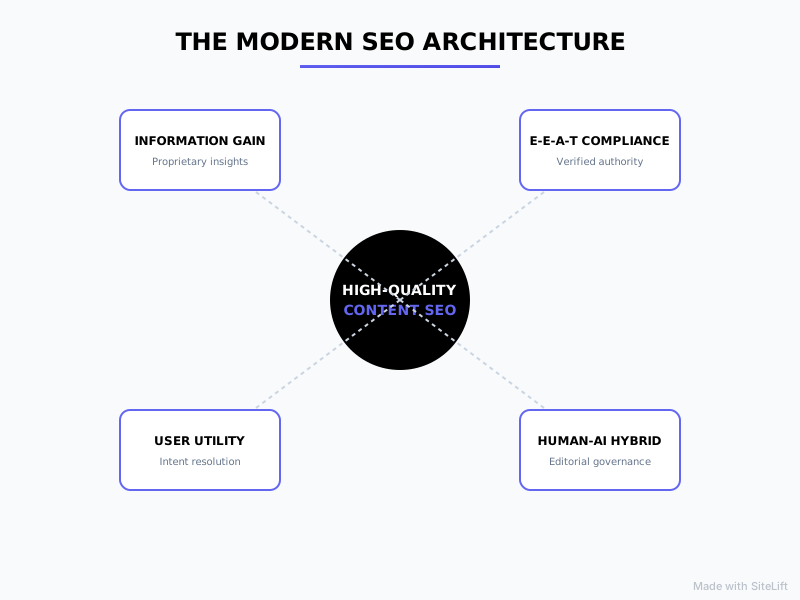
Infographic by SiteLift
When planning your editorial production, remember that high-volume publishing without experiential depth will trigger quality dampeners. Balancing output scale with rigorous editorial oversight is crucial, a reality we often explore when showing how early-stage startups can outrank industry giants through smarter, focused content plays.
How Can You Audit and Optimize for High-Quality Content SEO?
Maintaining an authoritative library requires ongoing optimization. High-performing organizations run continuous audits to spot content decay, information gaps, and structural issues before traffic drops off.
Conducting Content Decay and Information Gap Audits
Over time, high-ranking pages lose relevance as competitors publish newer data, product features evolve, or search intents shift.
Use this audit checklist to identify pages in need of an update:
- Identify decaying URLs: Pinpoint pages that have lost 15% or more of their organic impressions or clicks over a rolling 90-day window using Google Search Console.
- Review the updated SERP: Analyze the pages currently ranking in the top three positions. Are they offering newer research? Have user expectations shifted toward interactive tools or video demonstrations?
- Plug the information gap: Update outdated statistics, replace dead references with fresh primary sources, and expand on under-developed subtopics.
Optimizing Semantic Structure for Human Readers and Machine Parsers
Strong content architecture serves both human readers and search engine crawlers. A wall of uninterrupted text creates friction, drives up bounce rates, and makes entity extraction difficult for AI engines.
- Use strict heading hierarchies: Maintain a clean structure (H1 $\rightarrow$ H2 $\rightarrow$ H3) without skipping levels.
- Keep paragraphs tight: Limit paragraphs to two to four sentences to improve mobile readability.
- Design for Search Experience Optimization (SXO): Incorporate responsive data tables, callout boxes, and descriptive bullet points. Pairing content depth with practical SEO user experience strategies keeps visitors engaged and signals high utility to Google.
Tracking Post-Publishing Performance and Quality Signals
To understand how Google's automated systems perceive your content, monitor these leading indicators:
Comprehensive Quality Tracking:
├── Engagement Metrics:
│   ├── Average engagement time per session
│   ├── Scroll depth and interaction events
│   └── Return visitor frequency
└── Semantic & Authority Signals:
    ├── Growth in branded search volume
    ├── Appearance in AI Overview citations
    └── Unprompted editorial backlinks
If a URL pulls high impression numbers but low engagement time, users are likely bouncing to find clearer answers elsewhere. Treat this as an immediate prompt to streamline the page structure, cut out filler, and highlight practical solutions earlier in the piece.
Pro Tip: Pay close attention to brand-plus-keyword queries in Search Console. When users search for your brand alongside technical topics, it indicates your domain has established durable entity authority in that specific subject area.
Why Information Gain Is Massively Underrated
I've watched countless marketing teams spend tens of thousands of dollars churning out "skyscrapers" of generic content. They take the top five articles ranking for a keyword, blend them together into a monolithic 4,000-word guide, and wonder why their rankings crater six months later.
This copycat strategy completely misses the point.
The web does not need another generic explainer detailing "What is Cloud Computing?" What readers—and Google's machine-learning models—actually want is hard-earned, practical insight. They want to know why your latest migration failed, how much your infrastructure costs really jumped, and the exact steps you took to solve the problem.
If you don't have a distinct perspective or original data to share, you shouldn't be publishing the article. In an ecosystem increasingly dominated by synthetic, zero-marginal-cost text, point-of-view and genuine experience are the ultimate competitive moats.
High-quality content is not defined by how thoroughly you rephrase the consensus. It is defined by the unique, irreplaceable value you contribute beyond it. — sitelift.io
Scaling High-Quality Content Autonomously
Executing high-level content optimization consistently across hundreds of pages is a heavy operational lift. Teams often struggle to balance research depth, technical consistency, and publishing frequency without burning out their writers and editors.
This is where automated optimization infrastructure changes the game. Modern platforms like sitelift.io help teams produce authoritative, intent-matched content that complies with rigorous search quality standards out of the box. By uniting systematic entity coverage, automated keyword clustering, real-time performance tracking, and seamless CMS delivery, the platform allows you to scale organic visibility on autopilot without sacrificing quality.
FAQ
Does Google penalize content created with generative AI?
Google does not penalize content solely because it was generated by an AI tool. The search engine's official guidelines clarify that content is evaluated based on its utility, accuracy, and adherence to E-E-A-T principles, not its production method. However, using unedited AI text to rapidly create low-quality, derivative pages to manipulate search rankings violates Google's scaled content abuse policies and can trigger manual actions or algorithmic demotions.
How does Google calculate 'information gain' in search rankings?
Google holds patents focused on determining an information gain score by comparing the specific data, concepts, and facts in a document against the content a user has already reviewed on that topic. If a page presents unique data, original solutions, or novel source material beyond what is available across standard search results, it receives a higher score. This makes the content more likely to rank prominently or be selected as an authoritative source in AI Overviews.
What is the difference between E-E-A-T guidelines and algorithmic ranking factors?
E-E-A-T (Experience, Expertise, Authoritativeness, and Trustworthiness) is not a single, direct, algorithmic ranking factor or numeric score. Instead, it is the conceptual framework taught to human Search Quality Raters to evaluate the performance of Google's algorithms. Google uses the feedback from these raters to train and refine its automated ranking systems, meaning those systems are specifically tuned to reward pages that exhibit strong E-E-A-T signals.
How often should existing content be refreshed to maintain quality scores?
High-competition commercial content should undergo light reviews every three to six months and deep structural audits annually. If a page begins losing organic impressions or rankings for its core entities, an immediate update is warranted. A quality refresh should focus on updating dated statistics, replacing broken outbound links, clearing out redundant text, and adding newly available internal case studies or workflow examples.
Can small websites outrank large publications in an AI-driven search environment?
Yes. Large media brands frequently publish shallow, generalized overviews across hundreds of different categories. An agile, focused website that demonstrates deep, specialized experience in a single topic area can build stronger topical authority within that niche. By providing proprietary data, genuine hands-on walkthroughs, and precise answers, smaller sites regularly outrank enterprise legacy domains in both traditional search results and AI answer snapshots.
Topics Covered:
- high-quality content seo
- e-e-a-t guidelines
- search quality rating
- helpful content system
- ai editorial standards
More from SiteLift

SEO Conversion Optimization: How to Turn Organic Search Readers into Paying Customers
Learn how to turn organic search visitors into paying customers with this step-by-step SEO conversion optimization guide. Optimize your CTAs and UX.

How to Choose SEO Audit Companies That Deliver Actionable Automation Roadmaps
Stop paying for static PDFs. Learn how to choose SEO audit companies that deliver developer-ready, automated roadmaps to scale your organic traffic.

The Truth About Guaranteed SEO Services: Red Flags and Real Ranking Predictability
Exposing guaranteed SEO services scams. Learn red flags, real ROI timelines, and how to drive predictable organic traffic safely.