SEO for Startups: How Early-Stage Companies Can Outrank Established Giants

When you are building a new company, every dollar of runway and every minute of engineering time matters. Legacy marketing playbooks tell you to buy your way to the top with paid ads, but paid acquisition is a temporary, increasingly expensive fix. To build a sustainable growth engine, you need a deliberate seo for startups strategy—a hyper-focused, agile approach designed to steal high-intent organic search traffic from multi-billion dollar incumbents.
Established giants might have millions of dollars in marketing budgets and Domain Ratings (DR) hovering in the 80s or 90s, but they are slow, bureaucratic, and bound to generic keywords. As an early-stage startup, you have speed, agility, and the ability to target hyper-specific user pain points before anyone else even notices them.
Here is how you can use a modern bootstrap search strategy to outmaneuver the giants and build a compounding source of customer acquisition.
Key Takeaways: The Startup SEO Blueprint
| Growth Lever | Enterprise Approach | Startup Playbook (The Agile Alternative) |
|---|---|---|
| Target Keywords | High-volume, generic head terms (e.g., "CRM software") | Zero-volume, long-tail, hyper-specific queries |
| Content Engine | Slow, agency-led, multi-month approval cycles | Rapid, automated, founder-guided content scalability |
| Link Acquisition | Expensive PR firms, generic guest posts | Data-led PR, product-led loops, high-signal directories |
| Technical Stack | Legacy monolithic CMS, heavy enterprise code | Modern headless setups, optimized SSR, automated SEO pipelines |
Why Is SEO for Startups Fundamentally Different from Enterprise SEO?
To win at organic search, you must first accept that you cannot play the same game as enterprise companies. If you try to target the exact same broad, high-volume keywords as a legacy competitor, you will burn your runway with nothing to show for it.
According to research from First Page Sage, the top organic result on Google yields an average click-through rate (CTR) of 39.8%. However, legacy brands have occupied those top spots for years. Trying to displace them on head terms is a losing battle for a domain with zero authority.
+-----------------------------------------------------------------+
|                      THE ORGANIC TRAFFIC GAP                    |
|                                                                 |
|  Legacy Giants:                                                 |
|  [Broad Head Terms] ---> [High DR Authority] ---> [39.8% CTR]   |
|                                                                 |
|  Early-Stage Startups:                                          |
|  [Long-Tail Queries] -> [Agile Content] --------> [High Intent] |
+-----------------------------------------------------------------+
The Asymmetry Problem: Budgets, Domain Authority, and Time
Enterprise SEO is built on brute force. Large corporations can afford to spend tens of thousands of dollars monthly on content agencies, link-building packages, and technical audits. They have thousands of existing pages passing internal link equity, allowing them to rank for competitive terms almost instantly.
Startups, by contrast, face a cold-start problem. You are launching on a brand-new domain with a Domain Rating of zero. You have no backlink profile, no search history, and a lean team wearing multiple hats. Your primary constraint is time; you need to show early stage growth and traction before the runway runs out.
Speed as a Superpower: Agility Over Red Tape
What startups lack in authority, they make up for in execution speed. In an enterprise organization, publishing a single blog post can take weeks. It must pass through SEO managers, content editors, product marketing managers, brand compliance, and legal teams.
As an early-stage startup, you can identify an emerging industry trend, write an authoritative piece of content, and index it within 24 hours. This speed allows you to capture search traffic for new technologies, API integrations, and industry shifts long before legacy competitors can update their roadmaps.
Why Paid Acquisition Alone Unsustainably Drains Runway
Many founders rely solely on Pay-Per-Click (PPC) ads on Google and LinkedIn to drive early traffic. While paid acquisition offers immediate feedback, it does not compound. The moment you stop spending, your traffic drops to zero.
Worse, customer acquisition costs (CAC) on ad platforms have risen dramatically over the past decade. According to BrightEdge, organic search accounts for approximately 53.3% of all trackable web traffic across industries. Relying entirely on paid channels means you are ignoring more than half of your addressable market while continuously draining your capital. Investing in organic search builds an informational moat that lowers your CAC over time, allowing your startup to scale sustainably.

What Is the Bootstrap Search Strategy to Outmaneuver Industry Giants?
To outrank established giants, you need a bootstrap search strategy that focuses on efficiency, intent, and structural advantages. Instead of fighting head-on, you must execute a flanking maneuver.
The David Strategy: Targeting Zero-Volume and Long-Tail Keywords
Most keyword research tools (like Ahrefs or Semrush) estimate search volume based on historical search patterns. Because of this, they often show "zero volume" for newly emerging search queries, highly specific technical questions, or niche B2B workflows.
Enterprise SEOs usually filter out these zero-volume keywords because their KPIs are tied to high-volume traffic metrics. This is your opportunity.
Zero-volume and long-tail keywords often carry incredibly high buying intent. For example, a keyword like "best CRM" is highly competitive and transactional, but "CRM with native bidirectional Notion sync for real estate agents" might show zero search volume. Yet, the person searching for that exact phrase is ready to buy. By targeting these hyper-specific queries, you can secure easy rankings and drive highly qualified startup organic traffic that converts at a much higher rate.
The Programmatic and Hub-and-Spoke Architecture
Instead of writing isolated blog posts, structure your site using a hub-and-spoke (or topic cluster) model. This architecture organizes your content into logical groups, helping search engine crawlers understand your topical expertise.
- The Hub Page: A comprehensive, high-level guide on a core topic (e.g., "The Ultimate Guide to B2B SaaS Billing").
- The Spoke Pages: Detailed, highly specific subtopics that link back to the hub (e.g., "How to handle dunning management in SaaS," "Multi-currency billing setup," "SaaS billing compliance in the EU").
              [ Hub Page: SaaS Billing Guide ]
                /            |             \
               /             |              \
  [Spoke: Dunning]   [Spoke: Multi-Currency]  [Spoke: EU Compliance]
By linking these pages together systematically, you distribute link equity across your entire site. When one spoke page starts ranking and earning links, it naturally lifts the rankings of the hub and all other connected spoke pages.
Leveraging Competitor Alternative and Comparison Pages
One of the most effective ways for early-stage companies to capture high-intent traffic is by building "Alternative to [Competitor]" and "[Competitor A] vs [Competitor B]" landing pages.
Prospects searching for these terms are at the very bottom of the marketing funnel. They are actively evaluating tools and are ready to make a purchasing decision.
- Build dedicated comparison landing pages that objectively compare your product with legacy alternatives.
- Highlight your unique value proposition, modern UX, or developer-friendly features.
- Avoid cheap mudslinging; instead, focus on clear, feature-by-feature breakdowns and real user reviews.
By positioning your startup as the modern, agile alternative to bloated enterprise software, you can intercept high-value prospects right before they swipe their credit cards. If you need to scale this strategy without hiring a massive marketing team, exploring affordable search engine optimization services for startups can help you deploy comparison playbooks efficiently.
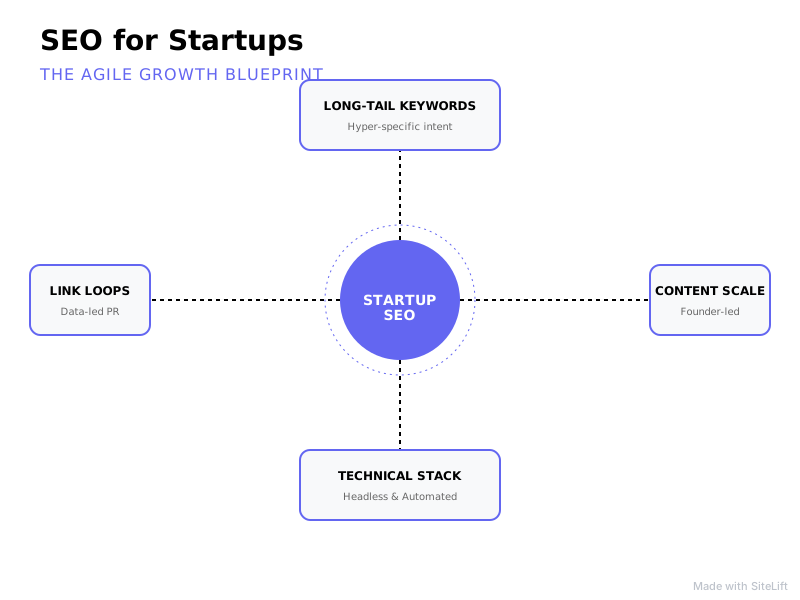
Infographic by SiteLift
How Can Startups Build Content Scalability Without Incurring Massive Costs?
For a lean startup, writing content is often a bottleneck. Founders don't have time to write 20 articles a month, and hiring top-tier freelance writers can easily cost thousands of dollars per piece. Achieving content scalability requires smart automation and leveraging your internal engineering and product knowledge.
Establishing Topic Clusters and Authority Moats
To build an authority moat, you must cover a topic exhaustively. If you only write three articles about your niche, Google will not view you as an authority. You need to map out every question, problem, and workflow your target customer experiences.
Instead of manual drafting, map these clusters using a spreadsheet or mind map. Group them by search intent:
- Informational: How-to guides, industry definitions, and conceptual explanations.
- Commercial: Tool roundups, feature comparisons, and evaluation templates.
- Transactional: Pricing pages, product integrations, and sign-up flows.
Automating the End-to-End Content Pipeline with AI and Tooling
The rise of generative AI has changed the SEO landscape. However, simply generating low-quality, copy-paste AI articles will not work. According to Ahrefs' research, 90.63% of pages online get zero organic search traffic from Google, largely due to a lack of backlinks and search intent alignment.
To scale without sacrificing quality, you must combine AI efficiency with human expertise. Use AI to handle the heavy lifting: keyword clustering, outline generation, and initial drafting. Then, have your team edit the output to add original insights, product screenshots, and brand voice.
Many modern SaaS brands are moving away from traditional agencies that charge massive monthly retainers for slow, manual writing. Instead, they are adopting automated workflows that connect directly to their CMS, allowing them to publish optimized content at scale. You can read more about why companies are making this transition in our analysis of B2B SEO agencies vs AI workflows.
Repurposing Technical and Product Knowledge into SEO Assets
Your startup is constantly producing valuable internal knowledge. Your engineers are solving complex technical challenges, your product managers are writing detailed feature specs, and your customer support team is answering specific user questions.
Do not let this knowledge go to waste. Repurpose it:
- Turn internal engineering post-mortems or architecture decisions into technical blog posts.
- Convert customer support tickets into quick, highly targeted help-center articles that rank for long-tail troubleshooting queries.
- Package proprietary product data (anonymized and aggregated) into original industry reports.
How Do Early-Stage Companies Earn Authoritative Backlinks from Day One?
Search engines use backlinks as a primary signal of trust and authority. Earning links to a brand-new website is notoriously difficult, but startups have several unique advantages that legacy brands cannot replicate.
Data-Led PR: Using Proprietary Product Metrics for Inbound Links
The single most effective way to earn high-authority backlinks passively is by publishing original data. Journalists, bloggers, and industry analysts are constantly looking for data points, statistics, and charts to back up their claims.
If your startup processes transactions, manages developer workflows, or analyzes social media trends, you are sitting on a goldmine of proprietary data.
- Aggregate the data: Anonymize and pull interesting trends from your database (e.g., "We analyzed 10 million API calls to see why integrations fail").
- Visualize the insights: Create simple, clean charts and infographics.
- Write a data report: Publish the findings in a dedicated, highly optimized post.
- Pitch to journalists: Reach out to writers in your niche who cover industry trends.
When other websites reference your statistics, they will naturally link back to your report as the original source, building your domain authority on autopilot.
Digital PR and Founder Thought Leadership
Founders have a unique narrative that corporate marketing departments do not. You are building something new, challenging the status quo, and navigating the highs and lows of startup life.
Leverage this narrative for digital PR:
- Podcasts: Pitch yourself as a guest on niche industry podcasts. Podcast hosts always link to their guests' websites in the show notes.
- HARO / Connectively: Monitor platforms where journalists look for expert quotes. Providing rapid, high-quality insights on technical topics can land you links from major publications like TechCrunch, Forbes, or industry-specific trade journals.
- Build in Public: Share your revenue milestones, technical hurdles, and lessons learned on Twitter/X and LinkedIn. This transparency often attracts organic press coverage and high-quality editorial links.
Unlinked Brand Mentions and High-Signal Startup Directories
As your startup gains traction, people will begin talking about you online. Often, bloggers or journalists will mention your brand name without including a link. Use tools like Google Alerts or BuzzSumo to track these mentions. When you find an unlinked mention, send a polite email thanking the author and asking if they would mind turning the mention into a link.
Additionally, ensure you submit your startup to high-signal directories and communities:
- Product Hunt
- BetaList
- Crunchbase
- G2, Capterra, and Trustpilot (for SaaS startups)
These directories provide clean, authoritative, and highly relevant foundational links that signal to search engines that your business is legitimate.
What Technical SEO Foundations Must Every Early-Stage Startup Master?
A brilliant content strategy will fail if search engine crawlers cannot easily access, render, and index your website. Startups often use modern web frameworks that, if not configured correctly, can severely damage their search visibility.
Core Web Vitals and Modern JavaScript Framework Pitfalls
Many modern startups build their websites using Single Page Application (SPA) frameworks like React, Next.js, Vue, or Nuxt. While these frameworks offer incredibly fast, app-like user experiences, they can create significant issues for search engine optimization.
By default, client-side rendered (CSR) applications serve an empty HTML shell to the browser, using JavaScript to render the actual content. While Googlebot has gotten much better at rendering JavaScript, it is still not perfect. It requires more time and resources, often leading to delayed indexing or pages not being indexed at all.
Pro Tip: Always use Server-Side Rendering (SSR) or Static Site Generation (SSG) for your public-facing marketing pages and blog. Frameworks like Next.js make it easy to pre-render pages on the server, delivering clean, fully formed HTML to search crawlers instantly.
Ensure you follow Google's Search Central documentation on technical guidelines to optimize your Core Web Vitals, focusing on:
- Largest Contentful Paint (LCP): How fast the main content loads.
- Interaction to Next Paint (INP): How responsive your page is to user inputs.
- Cumulative Layout Shift (CLS): Ensuring your page layout remains stable as assets load.
Crawl Budget and Information Architecture for Scalable Apps
If your startup has a programmatic database (e.g., a directory of local services, a database of open-source libraries, or user-generated profiles), you need to manage your crawl budget carefully. Search engine crawlers do not have infinite time to spend on your site.
- Robots.txt: Explicitly block search engines from crawling app-specific, non-public pages (e.g., user dashboards, settings pages, checkout funnels).
- XML Sitemaps: Keep your sitemap updated automatically, containing only clean, indexable URLs (no 404s, redirects, or canonicalized pages).
- Canonical Tags: Use canonical tags correctly to prevent duplicate content issues, especially if your product pages can be accessed via multiple URL parameters or filtering options.
Tracking Keyword Momentum and Setting Meaningful North Star Metrics
In the first 90 days of your startup's SEO journey, tracking conversions or demo sign-ups as your primary metric can be discouraging. SEO is a compounding channel, and early progress is often invisible in your analytics dashboard.
Instead, track keyword momentum:
- Impressions: Are your target pages beginning to appear in search results, even on pages 5 or 10 of Google?
- Average Position: Is your average ranking for target keywords steadily climbing?
- Ranked Keywords: Is the total number of keywords your site ranks for increasing month-over-month?
                      SEO METRIC EVOLUTION

  Phase 1 (Days 1-60)     --->  Phase 2 (Days 60-120)   --->  Phase 3 (Days 120+)
  - Search Impressions          - Clicks & Traffic            - Sign-ups & Demos
  - Ranked Keywords             - Low-Competition Rankings    - Organic Revenue / CAC Redux
Once you establish search visibility, you can shift your focus to organic traffic, click-through rate optimization, and conversion rate optimization (CRO) to turn searchers into paying users.
Editorial: Why the Traditional Agency Model is Broken for Startups
Let's be completely honest: the traditional SEO agency model is a startup killer.
Most agencies operate on a monthly retainer model, charging anywhere from $5,000 to $10,000 per month. In exchange, they promise a set of monthly deliverables—usually a technical audit, some basic keyword research, and four to six blog posts.
For an early-stage company, this is a terrible allocation of resources.
- Lack of Speed: Agencies move at a glacial pace. They spend the first 30 to 60 days "onboarding" and conducting audits, while your runway is actively burning.
- Lack of Context: Freelance writers hired by agencies rarely understand your deeply technical product or your highly specific buyer personas. They produce generic, surface-level content that fails to build trust or convert users.
- No Scalability: You cannot build a massive organic footprint when you are limited to publishing one article a week.
To win against legacy giants, startups must break free from the retainer trap. Instead of outsourcing your growth to a disconnected agency, you should invest in software-driven, autonomous pipelines that handle the operational heavy lifting of SEO. This allows your team to focus on what actually matters: product innovation, customer feedback, and high-level strategy.
If you are wondering whether organic search is still a viable channel in the era of AI and Search Generative Experience (SGE), check out our deep-dive analysis on is SEO still worth it in 2025.
Leveraging Automation to Drive Startup Organic Traffic
Building a scalable, high-performing organic search engine does not require a massive marketing department or a six-figure agency budget. By combining a smart, programmatic approach with modern automation tools, early-stage companies can easily compete with—and outrank—industry incumbents.
This is exactly why we built SiteLift.
SiteLift is an autonomous SEO and AI visibility platform designed to help startups build compounding organic search engines on autopilot. Instead of managing complex content pipelines, hiring expensive writers, and manually tracking technical errors, SiteLift automates the entire publishing pipeline:
- Autonomous Content Generation: Automatically identifies high-intent, low-competition keywords in your niche and generates highly optimized, publication-ready content.
- Seamless CMS Integration: Integrates directly with your existing website and CMS platforms, publishing and updating content automatically.
- Real-Time Tracking: Monitors keyword momentum, search rankings, and organic growth in real-time, allowing you to see exactly what is working.
If you are ready to scale your startup's organic traffic, reduce your dependency on paid ads, and build a sustainable source of inbound leads, let SiteLift do the heavy lifting for you.
Frequently Asked Questions (FAQ)
When should an early-stage startup begin investing in SEO?
Startups should lay the foundations for SEO on day one. While you do not need to publish 100 articles immediately, establishing your site on a clean, crawlable technical stack, setting up Google Search Console, and securing high-signal directory links should happen as soon as your domain is registered. This ensures that when you are ready to scale your content engine, your site is already trusted by search engines.
How long does it take for a new startup domain to see organic traffic results?
For a brand-new domain with zero authority, it typically takes 3 to 6 months to see significant organic traffic. However, you can see earlier indicators of success—such as rising search impressions and rankings for long-tail, low-competition keywords—within the first 30 to 60 days. Using a programmatic hub-and-spoke strategy can accelerate this timeline.
Can a startup realistically outrank enterprise giants with high domain ratings?
Yes, absolutely. While enterprise giants have massive domain authority, they are often slow to adapt to new trends, bound by strict brand guidelines, and focused almost entirely on high-volume keywords. Startups can outrank them by targeting emerging trends, long-tail and zero-volume queries, and by building highly comprehensive, user-focused comparison pages that enterprises are too risk-averse to publish.
Should early-stage startups focus on programmatic SEO or manual content creation?
The ideal approach is a hybrid model. Use programmatic SEO to scale landing pages for templated, high-intent queries (e.g., integration pages, comparison pages, and local search terms). Use automated, AI-assisted workflows to build out your informational topic clusters, and reserve manual writing for highly strategic, founder-led thought leadership pieces and product launch announcements.
What are the best SEO metrics for early-stage companies to track?
In the early stages, focus on leading indicators of organic growth: search impressions in Google Search Console, the total number of ranking keywords, and average position trends. As your domain gains authority, shift your focus to lagging indicators: organic unique visitors, conversion rates from organic landing pages, and customer acquisition cost (CAC) reduction compared to paid channels.
— sitelift.io
Topics Covered:
- seo for startups
- early stage growth
- bootstrap search strategy
- startup organic traffic
- content scalability
More from SiteLift

SEO Conversion Optimization: How to Turn Organic Search Readers into Paying Customers
Learn how to turn organic search visitors into paying customers with this step-by-step SEO conversion optimization guide. Optimize your CTAs and UX.

How to Choose SEO Audit Companies That Deliver Actionable Automation Roadmaps
Stop paying for static PDFs. Learn how to choose SEO audit companies that deliver developer-ready, automated roadmaps to scale your organic traffic.

What Defines High-Quality Content SEO in Google’s AI-Driven Search Era?
Discover what defines high-quality content SEO today. Learn how to optimize for Google's AI Overviews, master E-E-A-T guidelines, and outrank generic copy.