SEO Conversion Optimization: How to Turn Organic Search Readers into Paying Customers

If you have spent months building organic traffic only to realize your revenue isn't growing along with your analytics dashboard, you are not alone. Getting people to click on your search results is only half the battle. True business growth happens when you master seo conversion optimization—the art and science of turning casual search engine visitors into active, paying customers.
Many marketing teams fall into the trap of chasing page views as a vanity metric. But traffic without conversions is just an expensive hobby. In this guide, we will show you how to audit your existing search traffic, align your content with user intent, and implement highly effective design and copy tweaks to maximize your revenue.
What You Need
| Category | Requirements |
|---|---|
| Tools Required | Google Analytics 4 (GA4), a heatmapping tool (like Hotjar or Microsoft Clarity), and an SEO platform (like Semrush) |
| Skills Needed | Basic copywriting, search intent analysis, and a fundamental understanding of your CMS |
| Time Investment | 4 to 6 hours for initial audit and setup; 1 hour per week for ongoing optimization |
What is SEO Conversion Optimization (SXO) and Why Does It Matter?
Historically, search engine optimization (SEO) and conversion rate optimization (CRO) lived in separate silos. SEO teams focused on rankings, keywords, and backlinks. CRO teams focused on button colors, copy, and checkout flows.
When you bridge these two disciplines, you get Search Experience Optimization (SXO). SXO focuses on the entire journey: from the moment a user types a query into Google to the moment they complete a purchase or sign up for your newsletter.
According to research by Backlinko, the top organic result on Google enjoys an average click-through rate (CTR) of 27.6%. This highlights the immense value of ranking high. However, if those visitors land on a page that fails to solve their problem or guide them to the next step, they will bounce. That bounce sends a negative signal to search engines, hurting your rankings over time.
The Intersection of SEO and CRO
SXO is the ultimate competitive advantage because it aligns your business goals with Google's core mission: providing the absolute best answer to a user's query. By optimizing for user experience, you satisfy search algorithms while simultaneously capturing more search visitor leads.
Prerequisites: Setting Up Your Conversion Tracking Infrastructure
Before modifying your content, you must establish a baseline. You cannot optimize what you do not measure.
- Configure GA4 Conversion Events: Set up explicit conversion events for micro-conversions (e.g., newsletter sign-ups, lead magnet downloads) and macro-conversions (e.g., product purchases, demo bookings). Refer to our organic search analytics guide to build a privacy-first, conversion-attributed analytics dashboard.
- Calculate Your Baseline Organic Conversion Rate: Use this simple formula to determine your current performance: $$\text{Organic Conversion Rate} = \left( \frac{\text{Total Organic Conversions}}{\text{Total Organic Sessions}} \right) \times 100$$
- Deploy Heatmaps and Session Recordings: Install a tool like Microsoft Clarity to watch how search visitors navigate your high-traffic pages. Look for "rage clicks" or areas where users stall.
Step 1: Map Search Intent to the Right Content Offerings
One of the most common reasons search traffic fails to convert is "intent mismatch." If a user searches for a high-level informational term, they are not ready to buy. Pushing a hard sales pitch at this stage will only drive them away.
Identifying Informational vs. Transactional Intent
To categorize your target keywords, use an SEO tool like Semrush to analyze their search intent.
- Informational: The user wants to learn something (e.g., "how to scale organic traffic").
- Commercial: The user is researching options (e.g., "best automated SEO platforms").
- Transactional: The user is ready to buy or sign up (e.g., "SiteLift pricing").
Matching the Offer to the Reader's Journey Stage
To capture search visitor leads effectively, your offer must match the visitor's current mindset.
[Informational Intent] ---> Offer: Free Template / Checklist (Soft Lead Gen)
[Commercial Intent]    ---> Offer: Product Comparison / Case Study (Nurture)
[Transactional Intent] ---> Offer: Free Trial / Direct Demo (Hard Conversion)
For top-of-funnel (ToFu) informational posts, avoid direct sales pitches. Instead, offer a contextual lead magnet—such as an interactive template, a PDF checklist, or an exclusive email course—that naturally expands on the blog post's topic.
Actionable Step: Audit your top 10 highest-traffic informational blog posts. Replace any generic "Book a Demo" sidebars with a highly specific, downloadable resource that solves the exact problem described in the article.
Step 2: Optimize Your Content Call to Action (CTA) for SEO Conversion Optimization
A generic "Contact Us" button at the very bottom of a 2,000-word blog post is where conversions go to die. To improve your seo conversion optimization metrics, your call to action must be highly visible, contextually relevant, and strategically placed.
The Power of Contextual Inline CTAs
Data from HubSpot reveals that personalized, contextual call-to-actions (CTAs) convert 202% better than generic, default versions. Rather than relying on a global sidebar CTA, write custom inline text CTAs that flow naturally within your article's paragraphs.
Here is an example of how to write a compelling, contextual content call to action:
- Weak CTA: Click here to download our SEO guide.
- Strong CTA: Want to replicate this exact setup? Download our free 12-point SEO Audit Checklist to find and fix your site's hidden technical issues in under an hour.
Designing High-Converting Sidebar and Exit-Intent Elements
While inline CTAs perform best for engaged readers, you can capture departing traffic using exit-intent popups. Configure these popups to trigger only when a user's cursor moves toward the browser's close button, offering them a friction-free way to stay connected.

Pro Tip: Place a text-based, inline CTA within the first 20% to 30% of your article. A significant portion of organic readers scan the introduction and first few paragraphs before bouncing. Capturing their attention early ensures you do not lose them entirely.
Step 3: Implement Core SXO Tactics for Better User Experience
If your site is slow, clunky, or difficult to read on mobile devices, your conversion rates will suffer. Google prioritizes user experience, and your visitors do too.
Improving Page Load Speed and Core Web Vitals
Page speed is a critical ranking factor and a massive conversion driver. Research by Portent shows that a website loading in 1 second boasts a conversion rate 3x higher than a site taking 5 seconds to load. Every millisecond of delay directly impacts your bottom line.
| Page Load Time (Seconds) | Conversion Rate Multiplier | Revenue Impact |
|---|---|---|
| 1 Second | 3.0x (Peak Efficiency) | Maximum ROI |
| 2 Seconds | 1.5x | Moderate Drop |
| 3 Seconds | 1.1x | High Friction |
| 5+ Seconds | 1.0x (Baseline) | Severe Revenue Leak |
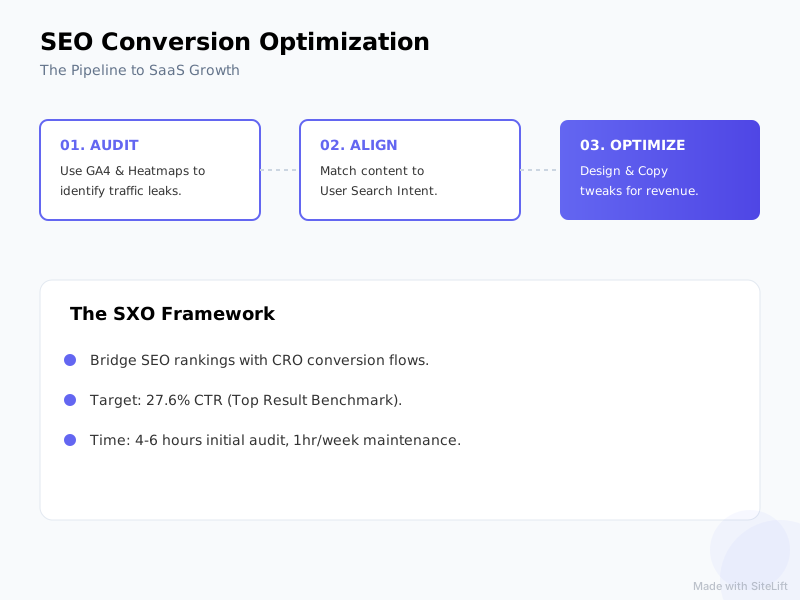
Infographic by SiteLift
Simplifying Site Navigation and Mobile Readability
A key component of modern sxo tactics is ensuring your site is exceptionally easy to read on mobile devices, where more than half of global search traffic originates.
- Clean Typography: Use a highly legible font size (at least 16px to 18px) with generous line spacing (1.5 to 1.6).
- Short Paragraphs: Keep paragraphs limited to 2 to 4 sentences. Large blocks of text are intimidating on mobile screens and lead to rapid bouncing.
- Eliminate Intrusive Interstitials: Avoid full-screen popups that block the main content immediately upon page load. This practice frustrates users and can trigger Google search penalties.
To dive deeper into optimizing your site's design for search engines, explore our guide on SEO user experience to gain a distinct competitive edge.
Step 4: A/B Test Your Landing Pages and Copy
You should never rely on guesswork to optimize your organic conversion rates. Instead, run structured A/B tests to identify what truly resonates with your search audience.
Formulating a Testable Hypothesis
A great A/B test begins with a clear, data-driven hypothesis.
- Weak Hypothesis: Let's change the button color and see if more people click it.
- Strong Hypothesis: By changing our generic CTA button from "Submit" to "Get My Free Audit," we will align the button copy with the reader's desire for immediate value, resulting in a 15% increase in sign-ups.
Running Low-Risk Tests on High-Traffic Pages
Do not try to test your entire website at once. Focus your efforts on your top 10 organic traffic-driving pages. These pages provide enough daily traffic to reach statistical significance quickly.
- Test One Variable at a Time: Focus on either the headline, the CTA copy, the button color, or the form length. Testing multiple elements simultaneously makes it impossible to isolate what drove the change.
- Minimize Form Fields: Every additional field you add to a signup form decreases your conversion rate. Ask only for essential information (e.g., First Name and Email). You can gather qualifying details later in your nurturing sequence.
- Use a Statistical Significance Calculator: Ensure your test reaches at least a 95% confidence level before implementing the winning variation permanently.
Pro Tip: When running A/B tests on organic landing pages, ensure your testing tool does not create duplicate URLs. Use client-side redirection or dynamic content swapping to keep search crawlers focused on a single, canonical URL.
Editorial Opinion: Why "Pure" SEO is a Dying Strategy
If you are still optimizing content solely for algorithms, you are playing a losing game. The era of keyword stuffing and writing formulaic, 3,000-word blog posts just to satisfy search engines is over.
With the rise of AI-driven search engines and search generative experiences, users expect immediate, high-quality answers. If your content exists simply to rank rather than to genuinely help, convert, or inspire, your visibility will decline.
The future of organic growth belongs to brands that treat SEO and conversion optimization as a single, unified workflow. If your organic content does not build trust and guide readers toward a logical next step, then ranking number one is meaningless.
Common Pitfalls: Why Your SEO Traffic Isn't Converting
If your organic traffic is high but your conversion rate remains flat, look out for these common issues:
- Targeting High-Volume, Low-Intent Keywords: It is easy to get excited about ranking for a massive industry term. However, if that term is too broad, it will bring in unqualified visitors who have no interest in your product or service. Focus on high-intent, long-tail keywords instead.
- Friction-Heavy Conversion Funnels: If a search visitor clicks your CTA only to be met with a slow-loading page, a 10-field form, and a mandatory phone verification step, they will leave. Streamline your checkout and signup flows to make converting as effortless as possible.
- Broken Links and Slow-Loading Scripts: Over time, websites accumulate broken links, outdated tracking scripts, and heavy files that quietly degrade the user experience. Conduct a monthly technical audit to clean up these performance bottlenecks.
The Expected Outcome: What Success Looks Like for Your Pipeline
When you successfully align your SEO strategy with conversion optimization, you unlock compounding returns.
Instead of constantly spending more money on paid ads to acquire leads, your organic search pipeline becomes a self-sustaining engine. As your organic rankings rise, your customer acquisition cost (CAC) drops, driving up your overall business profitability.
To learn more about how organic search remains highly profitable in the modern era, read our detailed analysis on Is SEO still worth it in 2025? to see how modern search strategies reduce CAC.
Scaling Your SXO Strategy with SiteLift
Executing this entire process manually—writing targeted content, analyzing user search intent, building contextual CTAs, and tracking real-time keyword performance—requires significant time and resources.
This is where SiteLift can help. As an autonomous SEO and AI visibility growth platform, SiteLift automates your entire publishing pipeline.
SiteLift generates search-optimized content tailored to your audience's intent, distributes it across a premium network, integrates seamlessly with your existing CMS, and tracks keyword momentum in real-time. By automating the manual heavy lifting, SiteLift allows you to focus on what matters most: growing your business and serving your customers.
FAQ
What is a good organic conversion rate for SaaS websites?
For SaaS websites, a good organic conversion rate typically ranges between 1.5% and 3% from organic traffic to a lead or free trial sign-up. Top-performing SaaS companies often see conversion rates of 5% or higher on their high-intent, commercially focused landing pages.
How does Search Experience Optimization (SXO) differ from traditional SEO?
Traditional SEO focuses primarily on driving traffic to a website through keyword optimization, technical site audits, and backlink building. SXO goes a step further by optimizing the entire user journey. It combines traditional SEO with user experience (UX) design and conversion rate optimization (CRO) to ensure that once a visitor lands on your site, they have a fast, seamless, and engaging experience that leads to a conversion.
How can I turn informational blog traffic into qualified leads?
To turn informational blog readers into qualified leads, avoid aggressive sales pitches. Instead, offer highly relevant, context-aware lead magnets—such as checklists, spreadsheets, or templates—that help the reader implement the advice in your article. Use inline text CTAs within the first 30% of the post to capture readers before they bounce.
Which tools are best for tracking SEO conversion optimization?
The most effective tools for tracking your SEO conversion optimization efforts include Google Analytics 4 (GA4) for tracking conversion events and attribution, Microsoft Clarity or Hotjar for heatmaps and session recordings, and Semrush or Ahrefs for analyzing keyword intent and organic search performance.
— sitelift.io
Topics Covered:
- seo conversion optimization
- organic conversion rate
- search visitor leads
- content call to action
- sxo tactics
More from SiteLift

How to Choose SEO Audit Companies That Deliver Actionable Automation Roadmaps
Stop paying for static PDFs. Learn how to choose SEO audit companies that deliver developer-ready, automated roadmaps to scale your organic traffic.

What Defines High-Quality Content SEO in Google’s AI-Driven Search Era?
Discover what defines high-quality content SEO today. Learn how to optimize for Google's AI Overviews, master E-E-A-T guidelines, and outrank generic copy.

The Truth About Guaranteed SEO Services: Red Flags and Real Ranking Predictability
Exposing guaranteed SEO services scams. Learn red flags, real ROI timelines, and how to drive predictable organic traffic safely.