Is Search Engine Optimization Worth It in the Era of Generative AI and SGE?
 If you ask a conventional performance marketer whether is search engine optimization worth it in 2025, they might point to Google's Search Generative Experience (SGE), Perplexity, and OpenAI's SearchGPT as evidence of an impending traffic collapse. With zero-click queries rising and AI summarising top answers before a user ever sees a blue link, it is natural to question whether investing in organic search still delivers a measurable return on investment.
The short answer is yes—organic visibility remains the most profitable growth channel in B2B and consumer technology. However, the mechanism behind that profitability has fundamentally changed. The old playbook of writing 800-word blog posts stuffed with secondary keywords to capture top-of-funnel clicks is dead.
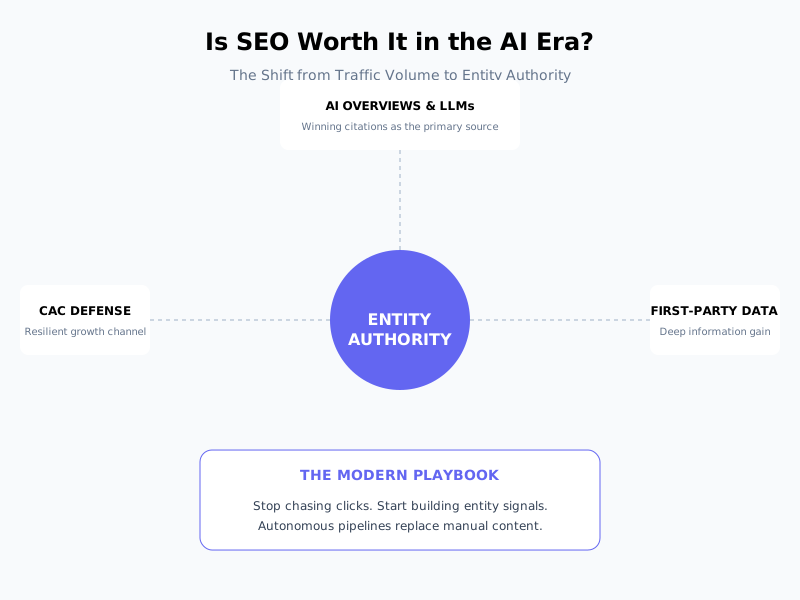
Today, organic search is no longer just about driving immediate site visits from search engine results pages (SERPs); it is about securing entity authority so your brand is cited as the primary source inside AI-generated answers, LLM knowledge bases, and hyper-targeted commercial queries.
For European tech, SaaS, and enterprise brands navigating tighter ad margins, strict GDPR compliance standards, and rising pay-per-click (PPC) costs, search engine optimization isn't just worth it—it is the single most resilient defense against skyrocketing Customer Acquisition Costs (CAC).
Executive Overview: Traditional SEO vs. Modern AI Search Strategy
| Metric / Dimension | Traditional SEO Playbook | Modern Generative & Autonomous SEO |
|---|---|---|
| Primary Goal | Rank #1–3 for high-volume keywords | Win citations in AI Overviews, LLMs, & high-intent queries |
| Content Focus | Surface-level informational guides | Deep Information Gain, first-party data, & entity signals |
| Production Model | Manual writing or slow agency retainers | Autonomous SEO pipelines with human expert oversight |
| User Intent Target | Broad top-of-funnel (ToFu) queries | Mid-to-bottom-of-funnel (MoFu/BoFu) commercial intent |
| Privacy Compliance | Heavily reliant on third-party retargeting | Privacy-first organic capture (GDPR/DMA compliant) |
| ROI Profile | Linear traffic growth based on manual output | Exponential, compounding brand momentum & pipeline growth |
Is Search Engine Optimization Worth It in 2025 and Beyond?
To understand why organic search remains unmatched, you have to look at how user behaviour is splitting. While casual informational queries ("what is the capital of Sweden?") are increasingly resolved directly inside conversational interfaces, commercial intent ("best enterprise CRM for European financial compliance") has become more focused and valuable than ever.
When prospects prepare to spend budget, they do not rely on a single AI summary. They cross-reference source citations, check brand reputations across niche media networks, and search for real-world user experiences.
+-----------------------------------------------------------------------------------+
|                            THE MODERN SEARCH PIPELINE                             |
+-----------------------------------------------------------------------------------+
|                                                                                   |
|  [ User Prompt / Query ]                                                          |
|            │                                                                      |
|            ▼                                                                      |
|  ┌─────────────────────────────────────────────────────────────────────────────┐  |
|  │ AI Search Engine / SGE Layer (Perplexity, ChatGPT, Google AI Overviews)     │  |
|  └─────────────────────────────────────────────────────────────────────────────┘  |
|            │                                                                      |
|            ├──────────────────────────────────────┐                               |
|            ▼                                      ▼                               |
|  [ Direct Answer Provided ]             [ Source Citations & Recommended Entities ]
|  (Zero-Click Informational)             (High-Intent Commercial Click-Through)    |
|                                                   │                               |
|                                                   ▼                               |
|                                         ┌───────────────────┐                     |
|                                         │ High-Value Buyer  │                     |
|                                         │ Direct Conversion │                     |
|                                         └───────────────────┘                     |
+-----------------------------------------------------------------------------------+
The Direct Answer: Why Organic Visibility Remains Unmatched
The direct answer to whether is search engine optimization worth it comes down to unit economics. Organic visibility provides a compounding return that paid media simply cannot replicate.
When you pause your Google Ads or LinkedIn Sponsored Content campaigns, your lead flow drops to zero overnight. When you build structured organic authority, every article, data report, and entity reference you publish continues to capture high-intent buyers month after month without an incremental cost per click.
Furthermore, organic search traffic carries a level of trust that paid ads lack. European buyers—particularly in conservative B2B sectors across DACH (Germany, Austria, Switzerland), the Nordics, and the UK—display high ad-blindness. Citing organic research and appearing as the recommended answer in an AI overview signals category leadership far more effectively than a sponsored banner.
How the Rise of SGE and AI Engines Alters the Value Equation
Google's Search Generative Experience (SGE) and independent AI search engines like Perplexity rely on web crawlers to supply the factual grounding for their responses. When an AI generates an overview for a query like "how to scale B2B data pipelines securely," it doesn't invent the answer out of thin air. It extracts data from highly authoritative, structured web pages that demonstrate deep subject-matter expertise.
A study from BrightEdge revealed that AI Overviews now appear in over 84% of informational and commercial research queries across major business verticals. Rather than eliminating search engine optimization, SGE shifts the focus from winning a simple hyperlink to winning the underlying citation. If your platform is cited as the primary recommendation inside an SGE answer card, your click-through rate (CTR) carries significantly higher purchase intent than a legacy blue link ever did.
Comparing Organic Search ROI Against Paid Acquisition Channels
In Europe's tech hubs—from London and Amsterdam to Berlin and Stockholm—paid customer acquisition costs have surged dramatically over the last three years. Increased competition on ad auctions, combined with the deprecation of third-party cookies under the EU's General Data Protection Regulation (GDPR) and the Digital Markets Act (DMA), has made paid retargeting both costlier and less accurate.
According to research from HubSpot, organic search delivers an average conversion rate 5.3 times higher than paid search ads for B2B technology companies in Europe. While PPC is ideal for short-term testing or seasonal promotions, relying on it as your primary growth engine drains operating margins.
Organic search acts as an inflation hedge: as paid cost-per-clicks (CPCs) rise across competitive terms, the relative value of every organic visit your site attracts increases proportionally.
How Generative AI and SGE Are Reshaping the Value of SEO
The integration of Large Language Models (LLMs) into search engines means that search engines no longer evaluate content merely by matching keywords. They evaluate content based on semantic relationships, authoritativeness, and information gain.
 ### Navigating the Zero-Click Reality and Information Gain
It is true that search traffic volume for generic, definition-style keywords is declining. Gartner predicts that search engine volume will drop by 25% by 2026 due to AI chatbots and conversational agents.
However, panic over this statistic misses a crucial detail: the 25% drop consists overwhelmingly of low-value, zero-intent traffic—people looking for quick spellings, simple math, or basic definitions.
       LEGACY SEARCH TRAFFIC (2020)              MODERN SEARCH TRAFFIC (2025+)
+---------------------------------------+   +---------------------------------------+
|  [ Informational Clicks ]  (70%)      |   |  [ Zero-Click AI Answers ] (40%)     |
|  (Low Intent / High Volume)           |   |  (Resolved directly in SERP)          |
|                                       |   |                                       |
|  [ Research & Evaluation ] (20%)      |   |  [ Information-Gain Clicks ] (35%)    |
|                                       |   |  (High Intent / Nuanced Analysis)     |
|  [ High-Intent Buyers ]   (10%)       |   |  [ High-Intent Buyers ]      (25%)    |
+---------------------------------------+   +---------------------------------------+
To capture value in this environment, your strategy must focus on Information Gain—a concept explicit in Google's helpful content guidelines. Information gain measures the amount of novel, unique insight a page offers beyond what already exists on the web.
If your article merely rehashes the top 5 search results, an AI search engine will synthesize it into a generic summary and skip linking to you entirely. But if your content contains original survey data, proprietary benchmarks, or unique industry commentary, AI engines are forced to cite your domain as the definitive source.
From Keyword Rankings to Entity Authority and AI Recommendations
Traditional SEO treated web pages as isolated buckets of keywords. Modern Generative Engine Optimization (GEO) treats your domain as a structured entity within a broader knowledge graph.
AI engines evaluate your brand using several core entity signals:
- Structured Schema Markup: Clearly defining your products, organization, authors, and customer reviews using Schema.org vocabulary.
- Digital PR & Co-citations: How frequently your brand is mentioned alongside industry keywords on recognized media outlets and independent software review platforms.
- Topic Clusters: Deep, interlinked content hubs that cover every nuance of a subject, demonstrating complete topical authority rather than superficial coverage.
When an executive asks Perplexity or ChatGPT to "compare top-rated European enterprise localization platforms," the model scans its index for entities that consistently display high authority across these parameters. Winning that recommendation is worth more than tens of thousands of top-of-funnel blog visits.
Generative Engine Optimization (GEO) as the Next Evolution of SEO
Generative Engine Optimization (GEO) is not a replacement for standard search engine optimization; it is its natural evolution. While traditional SEO optimizes for indexing algorithms and keyword density, GEO optimizes for transformer-based neural networks and citation mechanisms.
To rank in both traditional SERPs and AI overviews, content must be structured logically with clear heading hierarchies, bulleted summaries, direct answers to common questions, and explicit semantic context. Brands that adopt GEO early establish a clear advantage in conversational search spaces before their competitors even realize the search surface has shifted.
What Is the True ROI of Modern Organic Traffic for Businesses?
Calculating the value of organic search requires looking past basic web analytics sessions and examining the full acquisition pipeline. When measured accurately, the return on investment of modern organic traffic routinely outperforms every other channel in a modern marketing mix.
 ### Evaluating Customer Acquisition Costs (CAC) in High-Growth SaaS
For European SaaS and cloud businesses, managing Customer Acquisition Cost (CAC) is central to maintaining healthy SaaS metrics like CAC Payback Period and Lifetime Value (LTV) ratios.
A study by McKinsey revealed that companies combining smart AI automation with content marketing achieve up to a 30% reduction in Customer Acquisition Costs. By automating the production and distribution of high-quality search assets, businesses compress their payback periods from 18 months down to under 6 months.
Let's compare the unit economics of Paid Search vs. Autonomous Organic Search over a 12-month trajectory for a mid-market European software provider:
PAID SEARCH (PPC) ACQUISITION TRAJECTORY
Month 01: €20,000 Spend ──► 100 Demo Requests ──► €200 Per Acquisition
Month 06: €20,000 Spend ──►  90 Demo Requests ──► €222 Per Acquisition (Ad Inflation)
Month 12: €20,000 Spend ──►  80 Demo Requests ──► €250 Per Acquisition (Ad Inflation)
TOTAL SPEND: €240,000 | TOTAL LEADS: 1,080 | AVERAGE CAC: €222

AUTONOMOUS ORGANIC SEARCH TRAJECTORY
Month 01: €5,000 Platform Investment ──►  15 Demo Requests ──► €333 Per Acquisition
Month 06: €5,000 Platform Investment ──► 120 Demo Requests ──► €41 Per Acquisition
Month 12: €5,000 Platform Investment ──► 350 Demo Requests ──► €14 Per Acquisition
TOTAL SPEND: €60,000 | TOTAL LEADS: 2,100 | AVERAGE CAC: €28.50
The Compounding Nature of Evergreen Content and Media Assets
Unlike paid advertising, where value resets to zero every billing cycle, organic assets represent digital capital. An enterprise guide published today continues to index, gather backlinks, train LLM vectors, and capture search intent for years.
When you consistently release authoritative content across a curated media ecosystem, your domain authority compounds. Over time, each new page you publish ranks faster and requires fewer direct backlink campaigns because the overall domain entity is trusted by search crawlers.
Measuring AI-Driven Conversions Beyond Traditional Google Analytics
Standard web analytics platforms like Google Analytics 4 (GA4) are notoriously flawed when tracking AI-driven conversions. When a buyer asks ChatGPT for software advice and directly types your brand URL into their browser, GA4 logs that visit as "Direct" traffic.
To measure the full impact of modern organic visibility, growth teams must track multi-touch attribution models that include:
- Brand Search Volume Spikes: Monitoring increases in direct branded queries following organic publishing pushes.
- AI Citation Tracking: Tracking how often your brand domain appears in citations across ChatGPT, Perplexity, and Google AI Overviews using dedicated real-time tools.
- Self-Reported Attribution: Adding a simple "How did you first hear about us?" field on conversion forms—where buyers frequently report "AI recommended you" or "Found your research on Google."
For a deeper dive into measuring these metrics effectively for executive teams, explore our detailed guide on choosing the right SEO reporting platform to prove ROI to your European stakeholders.
How Can Businesses Future-Proof Their SEO Strategy?
Knowing that search engine optimization remains critical is only half the battle. The crucial question for European executive teams is how to execute an organic strategy efficiently without getting bogged down in slow content cycles or ballooning agency fees.
Scaling High-Quality Publishing with Autonomous SEO Pipelines
The traditional method of building organic visibility—hiring an expensive external agency, spending three months on keyword strategy, and waiting weeks for a couple of articles—is completely outdated. The velocity of modern web indexing requires a platform approach.
By implementing autonomous SEO pipelines, brands automate the labor-intensive mechanics of publishing:
- Topical Opportunity Mapping: Continuously scanning search engines and LLM outputs to identify real-time keyword gaps.
- Structured Content Generation: Producing comprehensive, expert-led content optimized for both human reader experience and algorithmic crawlers.
- Automated Distribution Networks: Publishing content directly across CMS platforms and high-authority distribution networks to build immediate domain signals.
This programmatic velocity allows brands to cover entire topical ecosystems in weeks rather than years, locking down authority before legacy competitors react.
Optimising Content for E-E-A-T and First-Party Insights
Automated publishing velocity must never come at the expense of content quality. Google's quality evaluator guidelines heavily weight E-E-A-T (Experience, Expertise, Authoritativeness, and Trustworthiness).
                  ┌─────────────────────────────────────────┐
                  │               E - E - A - T             │
                  └─────────────────────────────────────────┘
                                       │
        ┌──────────────────┬───────────┴───────────┬──────────────────┐
        ▼                  ▼                       ▼                  ▼
┌──────────────┐   ┌──────────────┐        ┌──────────────┐   ┌──────────────┐
│  EXPERIENCE  │   │  EXPERTISE   │        │ AUTHORITY    │   │ TRUSTWORTHY  │
│ First-hand   │   │ Subject-     │        │ Industry     │   │ Clear data,  │
│ usage, real  │   │ matter skill │        │ recognition, │   │ transparent  │
│ case studies │   │ & credentials│        │ citations    │   │ sources      │
└──────────────┘   └──────────────┘        └──────────────┘   └──────────────┘
To ensure your automated publishing pipeline ranks long-term, inject unique first-party data into every asset:
- Include proprietary customer stats and internal benchmark data.
- Quote key internal product leaders and industry experts.
- Feature real customer implementation stories and verified outcomes.
- Embed concrete technical walk-throughs that generic AI summaries cannot replicate.
To understand how user experience metrics intersect with modern organic optimization, review our guide on Search Experience Optimization (SXO) and why it's the future of SEO in Europe.
Building Omnichannel Brand Momentum Across Curated Networks
Relying entirely on your main website domain is no longer sufficient. Search engines and AI models construct brand confidence by evaluating references across the broader web.
An effective, modern organic visibility strategy distributes core ideas across a curated network of industry publications, high-authority media channels, and niche technology hubs. When AI crawlers see your brand cited consistently across multiple independent web domains, your overall entity score climbs, reinforcing your primary site's rankings.
Editorial Opinion: Why Traditional SEO Agencies Are a Bad Investment in 2025
An honest perspective from our growth team.
I spent over a decade watching traditional marketing agencies bill European enterprises €10,000 per month for "organic strategy retainers." Inevitably, six months later, the client receives a 40-page PDF report filled with vanity metrics—impressions, keyword movement on non-converting terms, and vague promises that "SEO takes 12 to 18 months to show results."
Let me be direct: that traditional agency model is broken.
In an environment where AI models re-index the web continuously, paying human teams to manually spend three weeks drafting a single piece of basic informational content is a waste of capital. Agencies love this manual friction because it justifies their billable hours. But for a high-growth SaaS business trying to control CAC, it is a growth bottleneck.
TRADITIONAL AGENCY MODEL
[ Strategy Phase: 4 Weeks ] ──► [ Writing Phase: 3 Weeks ] ──► [ Client Review: 2 Weeks ]
RESULT: 2 Articles Published Per Month | High Cost | Slow Feedback Loop

AUTONOMOUS PLATFORM MODEL
[ AI Opportunity Identification ] ──► [ Expert Human Oversight ] ──► [ Automated Multi-Channel Publishing ]
RESULT: 30+ High-Authority Assets Published Per Month | Low Cost | Rapid Authority Scaling
The future belongs to hybrid autonomous systems. Software should handle keyword discovery, content architecture, schema generation, real-time rank tracking, and platform distribution on autopilot. Human strategists should focus exclusively on positioning, brand voice, and proprietary data injection.
Brands that embrace autonomous publishing platforms scale their organic digital footprint at 10% of the cost of a traditional agency retainer, while achieving 5x the publishing velocity. If you are still relying on a slow manual content calendar, you aren't just overpaying—you are ceding market share to competitors who treat content production as a high-velocity software pipeline.
Pro Tip: Never evaluate an organic search campaign on traffic volume alone. Measure pipeline velocity, demo bookings, and cost-per-acquisition. 1,000 visitors searching for a commercial solution are worth far more than 100,000 visitors reading a generic definition post.
Pro Tip: Audit your current content library for Generative Engine Optimization. Check whether your core product pages clearly state direct answers in the top 200 words, use concise structured lists, and implement complete Schema organization data.
"The question isn't whether organic search is worth it—it's whether your current operating model is fast and efficient enough to win in an AI-first search environment."
*> — Lukas Weber, Growth Director at SiteLift
Final Verdict: Is Search Engine Optimization Worth It for European Businesses?
Core Executive Summary for Decision-Makers
To summarize the strategic landscape for enterprise decision-makers:
- Search optimization is highly worth the investment, but the playing field has evolved from legacy blue links to complete entity management across Google SGE, Perplexity, and LLM search interfaces.
- Paid ad efficiency is declining across European markets due to regulatory privacy changes (GDPR/DMA) and rising auction costs, making owned organic channels essential for stable customer acquisition.
- Zero-click searches filter out low-intent traffic, concentrating real financial value into high-intent commercial research terms and source citations.
- Autonomous SEO pipelines dramatically reduce operational production costs, delivering a far higher ROI than traditional agency retainers or manual content teams.
Strategic Action Plan for European Tech and SaaS Brands
To capitalize on modern search visibility without ballooning overhead:
- Step 1: Audit Your Entity Signals. Ensure your brand's schema data, executive profiles, and product information are cleanly structured across major web indices.
- Step 2: Transition to High-Gain Content. Replace generic informational articles with data-backed reports, proprietary benchmarks, and detailed technical comparisons.
- Step 3: Deploy Autonomous Publishing Pipelines. Platform tools like SiteLift streamline keyword tracking, content generation, and distribution to systematically build organic market share on autopilot.
- Step 4: Track Real-Time Rankings. Modern SERPs change dynamically based on AI summary tests. Ensure you monitor keyword momentum real-time using modern tools—read our guide on how to track search engine rankings real-time in modern AI-powered search engines to stay ahead.
 By automating your publishing infrastructure with sitelift.io, your growth team bypasses manual bottlenecks, scales content velocity across curated media ecosystems, and captures intent across search engines and AI interfaces—delivering compounding traffic and market authority automatically.
Frequently Asked Questions About SEO ROI and AI Search
Is search engine optimization worth it for small and medium businesses in 2025?
Yes, search engine optimization is exceptionally valuable for small and medium-sized businesses (SMBs), particularly those operating in specialized B2B niches. While large enterprises often dominate broad informational search terms, SMBs can leverage targeted long-tail keywords and localized entity strategies to capture hyper-focused, high-converting buyer intent. Furthermore, by using autonomous publishing platforms like sitelift.io, SMBs can achieve the publishing scale and technical authority of enterprise competitors without hiring massive internal marketing teams.
How does Google's Search Generative Experience (SGE) affect organic traffic ROI?
Google's Search Generative Experience (SGE) reduces traffic for top-of-funnel, broad informational queries by delivering direct summaries within the search results page. However, it significantly increases the value of organic traffic for commercial and mid-funnel queries. When your brand is cited as a trusted source within an SGE response card, the visitors who click through to your site carry higher commercial intent, resulting in higher conversion rates and a stronger overall return on investment.
Can AI replace traditional SEO agencies and internal marketing teams?
AI and autonomous SEO platforms do not eliminate the need for human marketing leaders, but they do make traditional, high-retainer agency models obsolete. Software platforms now handle labor-intensive execution—such as continuous keyword opportunity mapping, schema tagging, technical content optimization, and multi-channel distribution—on autopilot. This allows internal marketing teams to shrink their execution budgets and focus on high-level positioning, brand story, and strategic offer creation.
What is Generative Engine Optimization (GEO), and how does it differ from SEO?
Traditional Search Engine Optimization (SEO) focuses on optimizing web pages to rank in traditional search engine results pages by targeting specific keyword densities, building link profiles, and maintaining site architecture. Generative Engine Optimization (GEO) focuses on optimizing your digital footprint so that Large Language Models (LLMs) and conversational search engines (like ChatGPT, Perplexity, and Google AI Overviews) recommend your brand as an authoritative source when answering user prompts. GEO emphasizes structured data, entity authority, and high Information Gain.
How do autonomous SEO platforms help lower customer acquisition costs?
Autonomous SEO platforms drastically lower Customer Acquisition Costs (CAC) by removing the human manual labor bottlenecks associated with content creation and distribution. By automatically generating optimized, structured content and publishing it across high-authority networks, platforms like SiteLift allow businesses to scale their organic search footprint at a fraction of the cost of traditional copywriting teams or agencies. This compounding organic footprint drives a steady volume of inbound demo requests and sign-ups without increasing paid ad spend.
Article generated by SiteLift
Topics Covered:
- is search engine optimization worth it
- future of SEO
- AI search engines
- organic traffic ROI
- autonomous SEO value
More from SiteLift

AI Search Optimization Services vs Autonomous Platforms: Which Scales Faster?
Compare ai search optimization services vs autonomous platforms on speed, cost & AI citations. See which scales faster and start compounding.

Visibility Tracker Explained: Measure True Share of Voice Across Google and AI Search
Discover how a visibility tracker measures search visibility scores and share of voice across Google and AI search engines to compound your organic reach.

LLM Visibility Tool: How to Measure and Grow Your Brand in ChatGPT and Perplexity
Discover how to use an LLM visibility tool to monitor ChatGPT brand mentions, track Perplexity citations, and scale your AI share of voice.