LLM Visibility Tool: How to Measure and Grow Your Brand in ChatGPT and Perplexity

For twenty years, digital discovery followed a predictable pattern: a buyer typed a keyword into Google, scanned ten blue links, clicked through to two or three websites, and made a decision.
That playbook is disintegrating. Today, enterprise decision-makers and high-intent consumers ask conversational AI models for direct recommendations. If you want to know whether your product gets recommended when a buyer asks ChatGPT or Perplexity for the best solution in your category, an LLM visibility tool is no longer optional—it is the foundational piece of software your marketing stack is missing.
Generative engines do not generate pageviews; they synthesize answers. When an executive asks, "Which cloud security vendor should we evaluate for SOC2 compliance?", the AI does not serve up a list of blog posts. It synthesizes a definitive, unranked list of three vendors, explains why, and provides footnote citations.
If your company is absent from that synthesis, you do not just lose a click. You lose the deal before the buyer ever reaches a browser.
Below, we examine how an LLM visibility tool tracks your presence across major foundation models, how generative engines select their sources, and the exact playbook you can use to capture generative engine mindshare.
Key Takeaways
| Metric / Dimension | Traditional SEO | Generative Engine Optimization (GEO) |
|---|---|---|
| Primary Metric | SERP Rank, Impressions, Organic CTR | LLM Share of Voice (SoV), Citation Frequency |
| Discovery Channel | Google, Bing (Ten Blue Links) | ChatGPT, Perplexity, Claude, Copilot |
| Content Evaluation | Backlinks, PageSpeed, Keyword Density | Entity Salience, Information Gain, Consensus Authority |
| User Experience | Clicks through to site | Zero-click synthesized answer + footnote citations |
| Monitoring Tooling | Rank trackers (Ahrefs, Semrush) | Dedicated LLM visibility tools & prompt simulators |
What is an LLM Visibility Tool and Why Does It Matter for Modern Brands?
An LLM visibility tool is a platform that systematically tracks, measures, and analyzes how large language models (LLMs) mention, cite, and recommend your brand across conversational search prompts.
Unlike traditional rank trackers that query a search engine API for static URLs, an AI search monitoring platform simulates real user interactions across models like OpenAI's GPT-4o, Anthropic's Claude 3.5 Sonnet, and Perplexity Pro. It evaluates prompt variations, records whether your brand appears in the synthesized response, identifies the footnote citations backing that recommendation, and analyzes the sentiment of the output.
Traditional Search: Query ──> Web Crawler ──> PageRank Index ──> 10 Blue Links ──> Click
AI Generative Engine: Prompt ──> RAG Retrieval ──> Neural Synthesis ──> Answer + Citations
The Paradigm Shift: From Traditional SERP Rankings to Generative Synthesis
For two decades, search marketing focused on click-through rates. You targeted long-tail keywords, built links to boost domain rating, and optimized title tags to drive visits.
Generative engines completely rewrite that dynamic. A study by SparkToro revealed that zero-click searches account for nearly 60% of all Google searches. As users migrate to conversational interfaces, zero-click behavior is becoming the standard.
When a user asks Perplexity or ChatGPT for product advice, the conversation concludes right inside the application interface. If your brand is part of that synthesized answer, you establish immediate authority. If you are not mentioned, you are completely invisible—regardless of whether your website ranks #1 on Google's traditional results.
Understanding LLM Share of Voice Across Conversational Engines
LLM share of voice measures the percentage of brand mentions your company secures across a defined cluster of conversational prompts relative to your competitors.
In traditional search, calculating impression share is straightforward: Google Search Console tells you how often your URL appeared on a search page. In conversational search, visibility is non-deterministic. Two users asking the exact same question may receive subtly different synthesized summaries depending on system prompts, location, and the model's retrieval mechanisms.
An LLM visibility tool solves this by running prompt clusters repeatedly across multiple models. It calculates an aggregate share of voice score, helping you understand whether your brand owns 60% of recommendations in your niche or if a rival startup is quietly monopolizing the AI's retrieval context.
The Direct Impact of AI Search Visibility on Pipeline and Brand Authority
Visibility in conversational search carries higher purchase intent than traditional informational queries. When someone asks an LLM for recommendations, they are rarely browsing casually; they are looking for a validated shortcut to a complex purchasing decision.
Gartner predicts that traditional search engine volume will decline by 25% by 2026, driven by consumers turning to AI conversational agents. When buyers rely on LLMs to build software vendor shortlists or choose high-end hardware, an omission from the model's answer completely removes your sales team from the conversation.
Conversely, being consistently cited by ChatGPT creates an immediate halo effect. The buyer views the recommendation not as sponsored placement or clever SEO, but as an objective consensus synthesized from the broader web.
How Do AI Search Engines Decide Which Brands to Recommend?
To influence how AI engines evaluate your company, you must understand the mechanics behind their recommendations. Models do not simply make arbitrary choices; they rely on specific data retrieval patterns.

The Architecture of Retrieval-Augmented Generation (RAG)
Foundation models suffer from two primary limitations: knowledge cutoffs and hallucinations. To solve this, conversational engines like ChatGPT and Perplexity use Retrieval-Augmented Generation (RAG).
When a user submits a prompt:
- The engine transforms the query into semantic search vectors.
- It retrieves the most relevant, authoritative web pages, reviews, and documents from a live index or vector database.
- It passes those retrieved documents into the context window of the LLM along with the original question.
- The LLM synthesizes an answer using only the most trusted source data, appending citations directly to the facts it mentions.
If your site's content cannot be retrieved during step two—or if web crawlers cannot easily parse your page structure—the LLM cannot cite you.
Primary Citation Vectors: Perplexity Live Web Indexes vs. ChatGPT Knowledge Cutoffs
Understanding the difference between real-time retrieval and pre-trained weights is essential for effective generative engine optimization:
- Perplexity AI: Operates as an answer engine built on real-time web retrieval. It crawls the web continuously, relying heavily on platforms like Reddit, independent review sites, authoritative blogs, and technical documentation. It weights recency, factual density, and direct source attribution heavily.
- ChatGPT (Search & Browse): Leverages Microsoft Bing's web index alongside OpenAI's web retrieval systems (such as OAI-SearchBot and GPTBot). When ChatGPT searches the web, it queries search indexes, scrapes top pages, and synthesizes answers based on both live data and the historical associations encoded in its pre-trained weights.
If your website blocks AI crawlers in your robots.txt, you will immediately vanish from live RAG pipelines. You can easily test whether your domains are inadvertently blocking these indexing engines by running your URL through an AI crawler access checker.
The Critical Role of Third-Party Authority, Mentions, and Digital PR
LLMs are designed to minimize hallucinations by seeking consensus. If your website claims that your platform is "the leading analytics software," an LLM will rarely take that at face value.
Instead, the model looks for corroboration across independent third-party sources:
- Review aggregators (G2, Capterra, Trustpilot)
- Industry roundups from reputable publications
- Discussions on forums like Reddit, GitHub, and Stack Overflow
- News mentions and digital PR placements
A brand with modest domain authority that is frequently cited across ten independent product comparison articles will consistently beat a high-DA corporate website that only talks about itself.
Core Features to Demand in an LLM Visibility Tool
Not all monitoring platforms are built the same. As the AI search monitoring software category evolves, you should ensure any platform you evaluate offers these three non-negotiable capabilities.
┌────────────────────────────────────────────────────────────────────────┐
│                   LLM VISIBILITY MONITORING PLATFORM                   │
├─────────────────────────┬──────────────────────────┬───────────────────┤
│ Multi-Model Prompting   │ Citation Mapping         │ Sentiment & Gaps  │
│ - OpenAI (GPT-4o)       │ - Domain-level scraping  │ - Brand tone score│
│ - Anthropic (Claude)    │ - URL source attribution │ - Hallucination   │
│ - Perplexity Pro        │ - Referral trail audits  │ - Competitor win  │
│ - Google Gemini         │ - Knowledge source links │   rates           │
└─────────────────────────┴──────────────────────────┴───────────────────┘
Multi-Model Prompt Simulation and Automated Tracking
Your prospective buyers do not use a single AI engine. An engineering leader might rely on Claude 3.5 Sonnet, a product manager might run daily research through Perplexity Pro, and an executive might rely entirely on ChatGPT Plus.
A robust llm visibility tool must run scheduled, multi-model prompt simulations across every major engine. It should test diverse prompt variations at scale—including direct queries ("best CRM for startups"), comparative prompts ("HubSpot vs Salesforce"), and persona-driven prompts ("recommend a lightweight CRM for a 10-person agency"). If you are building out your tracking framework, you can review our prompting guide for AI search to structure these prompt libraries effectively.
Source Citation Mapping and Domain Attribution
Knowing that your brand was left out of an answer is helpful; knowing why is actionable.
Top-tier tools do not just check for brand mentions; they map the exact URLs cited in the generated footnotes. If Perplexity recommends your top three competitors for an enterprise query, the platform should highlight the exact blog posts, forum threads, or review directories that supplied the model with that information. This provides your team with a clear roadmap of where you need to build presence and earn citations.
Sentiment, Hallucination, and Competitive Gap Analysis
Large language models can get things wrong. An unmonitored LLM might claim your product lacks an essential feature that you launched six months ago, or confuse your pricing model entirely.
Comprehensive AI search monitoring software tracks:
- Mention Sentiment: Is the recommendation enthusiastic, neutral, or accompanied by caveats?
- Factual Accuracy: Is the model stating outdated limitations or hallucinating pricing?
- Competitive Share: Which competitors appear alongside your brand, and who gets top billing in synthesized comparison lists?
Pro Tip: Pay close attention to "caveat clauses" in AI answers. If an engine says "Brand X is powerful, but users report difficult onboarding," that single synthesized line can crater enterprise conversion rates. Flag these issues early with automated sentiment alerts.
How to Measure and Benchmark Your LLM Share of Voice Step-by-Step
Measuring your generative presence requires a systematic process. Here is how to benchmark your brand's AI search footprint from scratch.
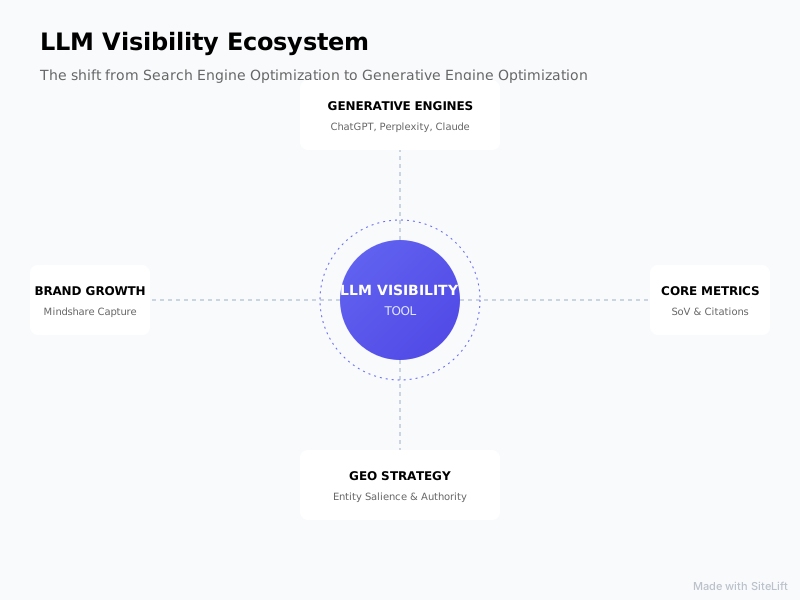
Infographic by SiteLift
Step 1: Establishing Your High-Intent AI Prompt Repository
Do not track vanity keywords. In AI search, short-tail keywords like "email marketing" are meaningless because users query LLMs using full natural language sentences.
Group your prompt repository into four core categories:
- Category Discovery: "What are the top enterprise tools for [use case]?"
- Comparative Analysis: "What are the key differences between [Your Brand] and [Competitor]?"
- Persona/Constraint Queries: "Recommend an SOC2-compliant alternative to [Competitor] for healthcare startups."
- Problem-Centric Discovery: "How can we automate internal documentation without hiring an agency?"
Aim for an initial batch of 50 to 100 high-intent prompt variations that mirror how real buyers evaluate your category.
Step 2: Tracking ChatGPT Brand Mentions and Citation Velocity
Once your repository is configured, begin running automated daily or weekly tracking runs. Monitor two distinct variables:
- Mention Rate: The percentage of prompt runs where your brand name is explicitly mentioned in the response text.
- Citation Velocity: The speed at which new URLs from your domain appear as footnote citations in models that browse the web (such as Perplexity and ChatGPT Search).
Tracking chatgpt brand mentions alongside source URLs reveals whether your brand is stored natively in the model's parametric weights or if you are winning visibility through real-time web retrieval.
Step 3: Calculating AI Share of Voice Against Primary Competitors
To quantify your performance for leadership teams, calculate your AI Share of Voice (SoV) across your target prompt cluster using this formula:
$$\text{LLM Share of Voice (%)} = \left( \frac{\text{Total Mentions of Your Brand}}{\text{Total Mentions of All Category Brands across All Runs}} \right) \times 100$$
For example, if you run 50 prompts across 3 models (150 total answers), and your brand is mentioned 45 times while all category brands combined are mentioned 180 times, your LLM Share of Voice is 25%.
Total Tracked Query Runs: 150
├── Total Competitor Mentions: 135
└── Your Brand Mentions: 45
    └── LLM Share of Voice = (45 / 180) * 100 = 25.0%
Benchmark this monthly. If your SoV climbs while organic search traffic stays flat, your generative marketing efforts are working where it counts.
Generative Engine Optimization (GEO): How to Actively Grow Your Visibility in ChatGPT and Perplexity
Monitoring your share of voice is half the battle; actively increasing it is how you win. This process is known as Generative Engine Optimization (GEO).
A seminal research paper published by researchers at Princeton University, Georgia Tech, and Allen AI (available on arXiv) demonstrated that specific GEO strategies can boost brand visibility in generative engines by up to 30% to 40%. The researchers found that incorporating authoritative quotations, factual statistics, and technical citations dramatically increased the probability that an LLM would select and cite a source.
Here is how to apply those principles directly to your content and technical strategy.
Structuring Content for High Retrieval Likelihood (Clear Semantic Schema & Data Density)
LLMs and RAG systems prioritize passages that present clear, unambiguous facts. If your content is buried in fluffy storytelling or vague sales copy, the retrieval model will pass over your text in favor of a concise, information-dense resource.
- Lead with Direct Definitions: Answer core questions in the first sentence of a section ("X is an enterprise platform that does Y through Z").
- Use Data and Hard Metrics: Use verifiable statistics, original research, and proprietary figures. Models prefer citing hard numbers over generic observations.
- Implement Structured Schema: Mark up your content using
TechArticle,SoftwareApplication, andFAQPageJSON-LD schema so retrieval bots can parse entity relationships cleanly. - Optimize with
llms.txt: Provide an organized index of your site's most important documentation and product specifications. You can create one quickly using a free llms.txt generator.
Expanding Your Off-Page Entity Footprint Across Trusted Vector Sources
Because LLMs prioritize consensus, on-page optimization alone will not secure top recommendations. You must systematically build an entity footprint across the sites LLMs use for retrieval.
- Dominate Reddit and Technical Communities: Perplexity and Google Gemini frequently surface discussions from Reddit and niche forums. Ensure your product is naturally and objectively discussed in community threads reviewing solutions in your space.
- Earn Inclusion in Comparison Roundups: Identify the top five third-party websites Perplexity cites when answering queries in your category. Reach out to those publishers and secure placement in their roundups.
- Maintain Consistent Entity Profiles: Ensure your product features, founding year, pricing model, and headquarters details match across Crunchbase, G2, Wikipedia, and LinkedIn. Conflicting data causes models to lose confidence in their answers.
Pro Tip: Evaluate your technical foundations before investing heavily in off-page PR. Run your website through an AI search readiness checker to verify that your robots.txt, schema markup, and content structures are properly configured for AI retrieval.
Autonomous Content Scaling and Continual Refresh Pipelines
Models update their understanding of the web constantly. Perplexity pulls live web pages daily, while ChatGPT regularly updates its browsing indexes. If your competitors produce updated, authoritative analysis on new industry developments while your site remains static, their URLs will quickly displace yours in RAG citations.
Maintaining generative authority requires:
- Regularly updating product specifications, integration lists, and comparison pages.
- Publishing high-velocity, research-backed content answering emergent user questions.
- Distributing authoritative content across external channels to establish multi-source consensus.
Why Passive Tracking Alone is a Trap: Our Perspective
Most software companies treat AI search monitoring the exact same way they treated rank tracking in 2012: they buy a dashboard, set up twenty alerts, check their scores every Monday, and do nothing about the results.
Passive monitoring tells you that you are losing market share, but it does not change the outcome.
The teams winning the generative search shift understand that monitoring is simply the diagnostic layer. The operational layer is where the game is won. When an llm visibility tool informs you that Perplexity omits your product for a high-value purchase query, the response cannot be a quarterly meeting.
You need an immediate publishing and distribution pipeline that:
- Creates an information-dense, highly citable answer to that query.
- Structures the data with clean semantic schemas that AI crawlers can digest effortlessly.
- Publishes and distributes that content across authoritative networks so the retrieval engine encounters consensus the next time it searches.
If you only measure your decline, an LLM visibility tool simply gives you front-row seats to your own irrelevance. The true winners will be the brands that automate both sides of the equation: measuring their share of voice and deploying autonomous content infrastructure that captures it.
— sitelift.io
Automating Your AI Visibility with SiteLift
If you are looking to secure and grow your presence across conversational engines without adding headcount to your marketing team, sitelift.io provides the end-to-end infrastructure you need.
SiteLift bridges the gap between AI search analytics and proactive growth. Instead of merely alerting you when your competitors are cited in ChatGPT or Perplexity, SiteLift's autonomous platform:
- Identifies High-Value AI Search Gaps: Discovers the exact transactional and comparative prompts where your brand is missing from the synthesis.
- Generates Retrieval-Optimized Content: Automatically writes data-dense, structured articles designed specifically to meet RAG retrieval standards.
- Distributes Across Authority Networks: Publishes and syndicates authoritative content to establish the third-party consensus LLMs require.
- Tracks Real-Time Momentum: Monitors your AI Share of Voice across leading foundation models so you can see your citations climb week over week.
Stop guessing whether generative engines recommend your product. Visit sitelift.io today to audit your AI search footprint and put your generative growth on autopilot.
FAQ
What is an LLM visibility tool?
An LLM visibility tool is a specialized software platform designed to track, measure, and analyze how a brand is mentioned, cited, and recommended by conversational artificial intelligence models like ChatGPT, Perplexity, Claude, and Google Gemini. Unlike traditional SEO rank trackers that monitor static search engine results pages, an LLM visibility tool simulates natural user prompts to quantify a brand's generative share of voice and identify the third-party web sources driving AI recommendations.
How does Generative Engine Optimization (GEO) differ from traditional SEO?
While traditional SEO focuses on optimizing web pages to rank higher on search engines and earn clicks to a website, Generative Engine Optimization (GEO) focuses on getting your brand synthesized and cited inside AI-generated answers. GEO prioritizes information density, authoritative third-party consensus, clear entity definitions, and technical data structures over traditional ranking factors like exact-match keyword density and backlink quantities.
Why does my brand rank #1 on Google but not appear in ChatGPT or Perplexity responses?
Traditional search algorithms and generative engines use completely different ranking mechanisms. Google uses PageRank and link-based authority signals to rank blue links, whereas LLMs use Retrieval-Augmented Generation (RAG) to synthesize answers from trusted, consensus-driven sources. If your site blocks AI crawlers, lacks clear semantic structure, or lacks corroborating mentions on trusted third-party review sites and industry forums, an AI engine will bypass your site in favor of sources that offer clear, multi-source verification.
How often do AI engines refresh their knowledge and citation sources?
Knowledge refresh intervals depend heavily on the specific AI engine. Dedicated answer engines like Perplexity retrieve live web data in real time with every prompt, meaning new content can be indexed and cited within hours or days. Conversational models like ChatGPT alternate between pre-trained weights (which update periodically during major model training cycles) and live web browsing (which accesses real-time search indexes as needed).
Can an LLM visibility tool alert me if an AI hallucinates incorrect information about my company?
Yes. One of the primary functions of an enterprise AI search monitoring platform is detecting sentiment and factual accuracy issues. When a large language model hallucinates outdated pricing, attributes discontinued features, or invents inaccurate limitations about your software, a quality visibility tool flags the anomaly so your marketing and PR teams can update off-page reference materials and correct the AI's consensus sources.
Topics Covered:
- llm visibility tool
- ai search monitoring
- chatgpt brand mentions
- generative engine optimization
- llm share of voice
More from SiteLift

Single Page Application Search Engine Optimization: The Complete Rendering and Indexing Guide
Master single page application search engine optimization: rendering, indexing, Core Web Vitals & audits. Fix your SPA SEO today.

Best Rank Tracking Tool: 7 Must-Have Features for SEO and AI Search in 2026
Discover the best rank tracking tool for modern search. Compare SiteLift, Semrush, Ahrefs, and more across AI visibility, speed, and automated reporting.

Daily Rank Tracking: Catch Google and AI Search Shifts Before Competitors
Master daily rank tracking to catch Google algorithm shifts, track AI search fluctuations, and protect your organic rankings before competitors react.