Visibility Tracker Explained: Measure True Share of Voice Across Google and AI Search

For years, search engine optimization operated on a deceptively simple scoreboard: position tracking. If your primary keyword moved from position four to position one, you uncorked the champagne. You expected organic traffic to double overnight.
Today, that correlation is fundamentally broken.
You can rank in the top three organic results for a lucrative query and still find your site buried beneath an AI Overview, a four-pack of sponsored ads, a video carousel, and a People Also Ask accordion. If users never lay eyes on your link, that top ranking is a vanity metric. This disconnect is why modern marketing teams rely on a visibility tracker instead of a bare-bones rank tracker. A modern visibility tracker looks beyond isolated keyword positions to quantify how often, how prominently, and where real human beings—and AI models—actually encounter your brand.
Here is a look at what search visibility actually means in the age of generative search, how to measure your true digital footprint, and how to track your brand across both traditional SERPs and artificial intelligence engines.
Key Takeaways
| Metric / Dimension | Traditional Rank Tracker | Modern Visibility Tracker |
|---|---|---|
| Primary Metric | Average position (1–100) | Search visibility score & share of voice SEO (0–100%) |
| Search Engine Coverage | Google desktop & mobile blue links | Google SERP features, AI Overviews, ChatGPT, Perplexity, Gemini |
| Weighting Inputs | Unweighted rank position | Position, click-through rate curve, search volume, pixel depth |
| Zero-Click Accounting | Ignored | Factored into click potential and impression weighting |
| Actionability | Reactive alert when rank drops | Predictive momentum tracking and automated content gap remediation |
What Is a Visibility Tracker and Why Does It Matter in 2026?
A visibility tracker is an analytics platform that calculates your brand's aggregate market presence across organic search surfaces. Instead of generating a long spreadsheet of keyword coordinates, it produces a dynamic search visibility score and calculates your share of voice SEO. This captures the real percentage of addressable search demand your domain claims compared to competitors.
+-----------------------------------------------------------------------------------+
|                            MODERN SEARCH VISIBILITY                               |
|                                                                                   |
|   +--------------------------+           +------------------------------------+   |
|   |   TRADITIONAL SERPs      |           |          AI SEARCH ENGINES         |   |
|   |                          |           |                                    |   |
|   |  - Organic Blue Links    |     +     |  - Google AI Overviews             |   |
|   |  - Featured Snippets     |           |  - Perplexity Citations            |   |
|   |  - People Also Ask (PAA) |           |  - ChatGPT / Gemini Syntheses      |   |
|   +--------------------------+           +------------------------------------+   |
|                                                                                   |
|                                      =                                            |
|                                                                                   |
|                     TRUE SHARE OF VOICE (SOV) SCORE                               |
+-----------------------------------------------------------------------------------+
How search visibility tracking evolved from rank tracking
Rank tracking was built for an era of search that no longer exists: ten blue links on a blank white canvas. In that ecosystem, mathematical position correlated cleanly with organic impressions. Rank #1 took roughly 30% of clicks, Rank #2 took 15%, and Rank #3 took 10%.
Then came the aggregation of rich SERP features.
First came featured snippets, local packs, and image carousels. Suddenly, a site sitting at organic position one was shoved halfway down a smartphone screen. Next came zero-click search behavior. According to research by SparkToro, 58.5% of US Google searches and 59.7% of EU searches in 2024 ended without a single click to the open web.
If your analytics tool only monitors rank numbers, it cannot tell you if your position-two ranking is sitting above the fold or drowned out by two video embeds and a knowledge graph. A visibility tracker solves this by measuring pixel location, pixel height, SERP feature ownership, and calculated click probabilities.
Why Google rankings alone no longer equal visibility
According to StatCounter, Google still commands roughly 90% of the global search engine market share. While its dominance remains undisputed, the anatomy of its search result pages has radically transformed.
When Google rolls out an AI Overview, traditional results get demoted. A study by the Pew Research Center revealed that searchers who encountered a Google AI Overview clicked a traditional web link in only 8% of visits, compared to a 15% click-through rate when no AI overview was shown.
That is an approximate 47% drop in the likelihood of a traditional link getting clicked simply because an AI answer appeared above it. If you hold rank one for a commercial term, but an AI snippet answers the user's intent on the spot, your actual visibility and traffic plummet. If you are not utilizing daily rank tracking to catch SERP shifts, your rank tracker will still tell you that you are winning, even as your revenue pipeline dries up.
The shift to unified tracking across Google and AI search
Search habits are no longer centralized strictly inside traditional web browsers. According to projections from Gartner, traditional search engine volume will drop 25% by 2026, driven by consumers turning directly to conversational AI engines and chatbots.
Audiences ask complex buying questions inside ChatGPT, Perplexity, and Claude. These platforms synthesize real-time data, summarize product categories, and cite external web sources. As a result, tracking visibility requires a unified dashboard. You must measure how you perform across traditional Google indices while conducting ai visibility tracking across large language models (LLMs) to ensure your brand is cited as a trusted source.
How Does a Visibility Tracker Calculate Your Search Visibility Score?
Every enterprise analytics platform has its own proprietary algorithm, but the fundamental architecture of a search visibility score relies on a weighted index.
       Sum of [ Click-Through Rate (Rank, SERP Layout) x Monthly Search Volume x Feature Weight ]
SVS = -------------------------------------------------------------------------------------------
                               Total Search Volume Across All Tracked Queries
Instead of simply averaging your positions across a basket of 500 keywords, the system weighs each ranking based on:
- Monthly Search Volume: A top ranking on a query with 50,000 monthly searches carries dramatically more weight than a top ranking on a query with 50 searches.
- Dynamic Click-Through Rate (CTR) Models: The engine applies a real-world click probability curve based on where your link sits relative to the viewport.
- SERP Feature Adjustments: The model discounts traditional link positions when featured snippets, sponsored ads, or AI summaries consume user attention.

The search visibility score formula explained
Consider a simplified portfolio of three keywords:
- Keyword A: 10,000 monthly volume. You rank #1 (Estimated CTR: 28%).
- Keyword B: 5,000 monthly volume. You rank #4 (Estimated CTR: 6%).
- Keyword C: 1,000 monthly volume. You rank #20 (Estimated CTR: 0%).
In a basic rank tracker, your average position is (1 + 4 + 20) / 3 = 8.3. That number tells you virtually nothing about your business trajectory.
A visibility tracker runs an expected click calculation:
- Keyword A generates
10,000 * 0.28 = 2,800visibility points. - Keyword B generates
5,000 * 0.06 = 300visibility points. - Keyword C generates
1,000 * 0.00 = 0visibility points.
The system totals these points (3,100) and divides them against the theoretical maximum score if your domain held the top position for every keyword in the bucket without feature interference. The result is expressed as a clean percentage score from 0% to 100%.
What inputs affect your organic visibility metrics?
To calculate reliable organic visibility metrics, an engine must ingest multiple layers of technical data points:
- Keyword Coverage: The total raw count of industry-relevant queries for which your domain appears anywhere in the top 100 results.
- SERP Feature Ownership: Whether your domain captures rich snippets, image packs, local packs, video carousels, or SiteLinks.
- Impression Share & Pixel Depth: How many vertical pixels down the page a user must scroll before seeing your brand name.
- Device Diversification: The variance between desktop displays and mobile layouts, where screens are significantly more compressed.
How to interpret visibility trends vs. traffic fluctuations
One of the most valuable aspects of using a visibility tracker is diagnosing traffic anomalies. Organic traffic is inherently seasonal, influenced by consumer spending shifts, holidays, and marketing cycles.
If your Google Analytics sessions drop 15% in December, panic sets in: Did an algorithm update hit you? Or are users simply offline for the holidays?
A visibility score provides the answer. If your search visibility score holds rock-steady at 42% while site visits slide, your organic positioning is completely intact; demand has temporarily cooled. Conversely, if your traffic remains flat while your visibility index slips downward, high seasonal search volumes may be masking severe keyword losses that will catch up to you next quarter.
Pro Tip: Never evaluate visibility scores across an entire domain as a single homogenous blob. Segment your visibility tracking by subfolder or commercial intent (e.g., /features/ vs. /blog/) to catch technical indexing issues on high-value conversion pages before site-wide averages disguise the drop.
How to Measure Share of Voice SEO Across Google and AI Search?
Visibility does not happen in a vacuum. A 25% visibility score might sound modest, but if your largest competitor sits at 14% and your next-closest rival sits at 8%, you effectively dominate the category.
This brings us to share of voice SEO: the proportion of total addressable consumer attention your brand commands within your industry niche relative to every competitor.
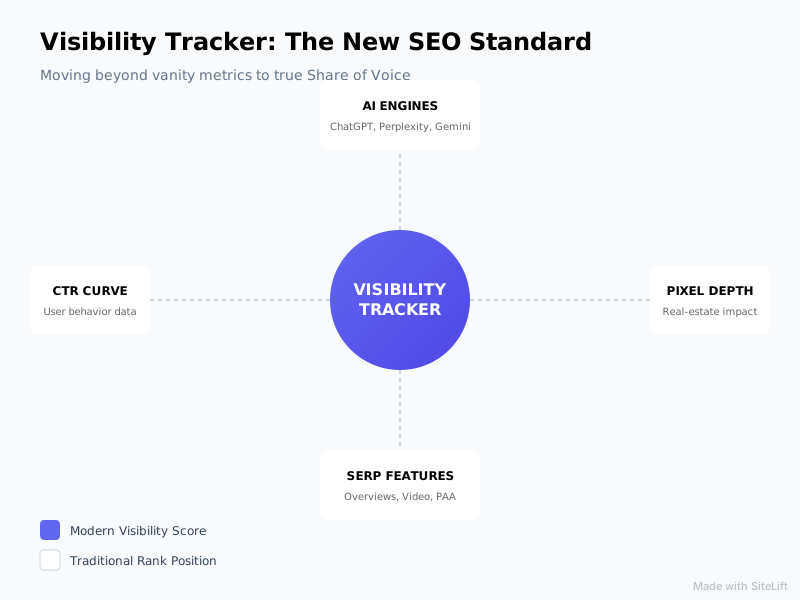
Infographic by SiteLift
What is share of voice SEO and how is it calculated?
Share of Voice (SOV) represents your slice of the total search demand pie.
                                Total Brand Organic Visibility Score
Share of Voice SEO (%) = --------------------------------------------------- x 100
                          Sum of Visibility Scores (Brand + All Competitors)
By benchmarking your domain against five to ten direct commercial competitors across the same target keyword set, you generate a true market-share metric. If the aggregate visibility points for a keyword universe equal 100,000, and your site commands 35,000 of those points, your organic share of voice is 35%. You can dive deeper into commercial market comparisons with our guide on Searchmetrics SEO visibility benchmarking.
How to track visibility in Google SERPs, AI Overviews, and featured snippets
According to research by BrightEdge, 68% of all trackable online experiences begin with a search engine. Because search remains the primary discovery engine, tracking Google requires monitoring multiple SERP components:
- AI Overview Inclusions: Recording whether an overview triggers on the query, whether your brand is hyperlinked inside the text card, and what position that link holds.
- Featured Snippet Displacement: Determining whether your content controls "Position Zero" or if a competing publisher has captured the definition box.
- Brand Sentiment within Generative Summaries: Documenting whether Google’s AI summary recommends your product, mentions it passively, or surfaces it in a negative context.
For an extensive analysis of how search systems process content for extraction, explore the official Google Search Central documentation.
How does AI visibility tracking work for ChatGPT, Gemini, and Perplexity?
AI discovery does not rely on a fixed keyword index or a static ranking order. If ten users prompt ChatGPT with the query: "What are the best enterprise visibility trackers for SaaS companies?", the platform does not deliver the exact same ten blue links every time.
Instead, it generates dynamic, non-deterministic language responses based on semantic entity associations, retrieval-augmented generation (RAG), and web citations.
Modern ai visibility tracking approaches this using structured prompt matrices:
- Prompt Archetypes: The tracking tool runs hundreds of structured prompts simulating buyer research across various stages of the funnel (e.g., direct comparisons, feature requirements, category definitions).
- Citation Extraction: The engine tracks whether the LLM citations reference your domain URL, link to external reviews praising your platform, or omit your domain entirely.
- Entity Association: Tracking how consistently the AI’s weights connect your brand entity to your target product category.
- Source Attribution: Identifying which third-party websites (e.g., software review portals, industry publications, digital PR sites) the model queries to validate its answers.
What Organic Visibility Metrics Should You Actually Track?
Data overload is an operational hazard in search marketing. To maintain strategic clarity, isolate your tracking architecture into three distinct operational buckets: traditional Google metrics, AI metrics, and competitive momentum.
Core organic visibility metrics for Google
- Keyword Footprint: The absolute volume of unique queries for which your domain appears anywhere in the top 100 results. A widening footprint demonstrates rising topical authority.
- SERP Feature Penetration Rate: The percentage of your ranking terms that capture rich snippets, site links, or image carousels relative to raw blue links.
- Impression Share by Intent: Segmenting your visibility score across informational, commercial, and transactional queries to verify whether you dominate high-intent keywords or purely top-of-funnel blog posts.
- Click-Through Rate Delta: Tracking deviations between expected CTR and realized CTR to spot queries where rich snippets or ads suppress user clicks.
Essential AI visibility tracking metrics
- Prompt Citation Share: The frequency with which an AI model links directly back to your domain across an entire matrix of industry-specific prompts.
- Brand Mention Frequency: The absolute count of times your brand or product name appears inside generated AI answers, even when no direct hyperlink is provided.
- Referral Authority Footprint: Mapping which digital PR properties, news outlets, and partner sites are cited by LLMs when discussing your category.
- Contextual Brand Sentiment: An NLP-driven metric scoring whether AI platforms describe your product favorably, accurately, or with outdated product limitations.
Competitive and momentum metrics that predict growth
- Keyword Momentum Velocity: Tracking whether a group of target keywords is systematically moving up in bands (e.g., from positions 21–50 into 11–20, then into 4–10) before that trajectory generates clicks.
- Competitor Visibility Delta: Monitoring sudden drops in a competitor’s visibility index to target their slipping pages with improved, freshly distributed content.
- Content Velocity Yield: Measuring how rapidly newly published URLs achieve organic impressions and citations across Google and AI search systems.
How to Choose and Use a Visibility Tracker for Autopilot Growth?
Most visibility tracking platforms are purely observational. They act as passive thermometers: they tell you that your organic temperature dropped two degrees, then leave you to run diagnostics, write new briefs, manually build backlinks, and fix indexing issues.
For modern growth teams, a monitoring tool that produces only static charts is a bottleneck.
+-----------------------------------------------------------------------------------------+
|                               AUTONOMOUS VISIBILITY PIPELINE                            |
|                                                                                         |
|   +-----------------------+      +------------------------+      +------------------+   |
|   |  VISIBILITY ENGINE    | ---> |  AUTONOMOUS REMEDIATION| ---> |  GROWTH LIFT     |   |
|   |                       |      |                        |      |                  |   |
|   |  - Tracks Gaps & Rank |      |  - Drafts Rich Content |      |  - Recovered SERP|   |
|   |  - Monitors LLM Citations    |  - Auto-Publishes CMS  |      |  - Compounding   |   |
|   |  - Real-Time Alerts   |      |  - Syndicates Authority|      |    Organic SOV   |   |
|   +-----------------------+      +------------------------+      +------------------+   |
+-----------------------------------------------------------------------------------------+
What features to look for in a modern visibility tracker?
When evaluating platforms to monitor search power and voice share, look for these baseline technical capabilities:
- Unified Dual-Index Tracking: The software must track traditional Google SERPs alongside generative platforms (AI Overviews, ChatGPT, Perplexity, Gemini).
- Real-Time Momentum Detection: Daily SERP tracking that spots algorithm movements, drops, and keyword velocity leaps in real-time, rather than delayed weekly updates.
- Automated Competitor Benchmarking: Direct side-by-side share of voice tracking against named rivals across segmented query categories.
- Native CMS Integrations: Direct API handshakes with WordPress, Webflow, Shopify, or Ghost that eliminate manual CSV exports and uploads.
- Actionable Gap Remediation: Features that translate visibility data directly into technical briefs or autonomous content deployment.
To review how modern systems stack up across these criteria, see our breakdown of the best rank tracking tools for SEO and AI search.
Why the "Measurement-Only" Model Is Broken
Here is an editorial opinion forged through years of watching enterprise marketing teams burn capital:
Tracking visibility without having an automated engine to act on the data is an expensive waste of time.
Traditional SEO departments assemble massive dashboards with 80-slide decks, highlighting that their visibility score fell by 3.2% across mid-funnel SaaS queries. Then what happens?
The SEO director assigns a brief to a content manager. The content manager assigns it to a freelance copywriter. Three weeks later, the draft is submitted, sits in editorial review for another fortnight, waits for design assets, and is finally published six weeks after the initial drop was detected. By then, competitors have consolidated the SERP, and the search engine has re-indexed the topic.
The winning organizations in 2026 are not simply those with the prettier charts. They are the teams that close the loop between detection and remediation.
When a visibility tracker identifies an emerging keyword cluster where your share of voice is hovering near zero, you should not spend a month talking about it in status meetings. You need an automated system that drafts target content, deploys it to your production CMS, enriches your digital PR footprint to seed LLMs, and begins compounding your organic authority immediately.
This is precisely why we built SiteLift.
SiteLift is an autonomous SEO and AI visibility growth platform designed to help modern businesses conquer search engines and conversational AI models on autopilot. Instead of forcing you to live inside a disconnected tracking tool, SiteLift runs an end-to-end publishing engine.
The software automatically generates targeted, publication-grade content to capture identified visibility gaps, distributes it across a curated premium authority network to secure LLM citations, integrates cleanly with your existing CMS, and tracks keyword momentum in real-time. It turns SEO from a reactive operational chore into a reliable, compounding growth asset.
How often should you monitor and report on visibility?
Establish a clear cadence for reviewing visibility data:
- Daily Alerts (Automated): Track critical keyword rank drops, lost AI Overview citations, and sudden technical 404 indexing spikes on core conversion pages.
- Weekly Momentum Audits: Review keyword velocity shifts. Look closely at clusters advancing from page two to page one to see where minor optimization or authority syndication can push them over the line.
- Monthly Strategic SOV Reporting: Review aggregate share of voice against your primary competitors. Evaluate changes in the breakdown between Google impressions and AI engine citations to adjust your long-term content strategy.
Pro Tip: Pay special attention to prompt visibility within conversational engines whenever you launch new product lines. AI search platforms often experience a multi-week lag before integrating new product entities into their models; monitoring citations early allows you to seed the necessary brand associations before competitors enter the space.
The brands that capture the next decade of organic search will not be those that obsess over static blue-link ranks. They will be the brands that monitor their unified share of voice across every search surface—and build the autonomous engines required to act on that intelligence instantly. — sitelift.io
FAQ
What is a visibility tracker?
A visibility tracker is an advanced search analytics platform that measures your brand's total presence across search engines and AI discovery tools. Unlike a standard rank tracker that monitors isolated keyword positions, a visibility tracker calculates an aggregate search visibility score and determines your true share of voice SEO. It accounts for search volume, position-based CTR curves, SERP features (such as featured snippets and local packs), and inclusions within AI answers.
How does a visibility tracker calculate search visibility score?
A visibility tracker calculates search visibility by multiplying each ranking keyword position by its dynamic click-through rate (CTR), factoring in search volume, pixel height on the screen, and the presence of competing SERP features. The system sums the expected organic clicks across all tracked queries and divides that total by the theoretical maximum clicks possible across that keyword universe. This outputs an intuitive visibility index scored from 0% to 100%.
What is share of voice in SEO and how do you measure it?
Share of Voice (SOV) in SEO measures the percentage of total search market attention your website commands relative to your competitors within a specific industry topic. You measure it by tracking a shared basket of target commercial keywords, calculating the individual visibility scores for your domain alongside your direct rivals, and determining what percentage of the total competitive visibility points your site owns.
How does AI visibility tracking work across ChatGPT, Gemini, and Google AI Overviews?
AI visibility tracking monitors how generative models cite and reference your brand within conversational answers. Because AI platforms do not show identical, static link lists, tracking tools execute broad matrices of simulated user prompts across various buyer stages. The software analyzes the synthesized text to identify brand mentions, direct website link citations, the sentiment of the recommendation, and the third-party reference domains queried by the model.
What is a good organic visibility score to aim for?
A "good" visibility score depends heavily on keyword universe size and competitor density. In broad, hyper-competitive software markets with thousands of tracked queries, holding a search visibility score between 25% and 40% often signals clear market leadership and commands the dominant share of voice. In narrower, long-tail niches with fewer competitors, industry leaders routinely capture visibility scores exceeding 60% to 70%.
Topics Covered:
- visibility tracker
- search visibility score
- share of voice seo
- ai visibility tracking
- organic visibility metrics
More from SiteLift

LLM Visibility Tool: How to Measure and Grow Your Brand in ChatGPT and Perplexity
Discover how to use an LLM visibility tool to monitor ChatGPT brand mentions, track Perplexity citations, and scale your AI share of voice.

Single Page Application Search Engine Optimization: The Complete Rendering and Indexing Guide
Master single page application search engine optimization: rendering, indexing, Core Web Vitals & audits. Fix your SPA SEO today.

Best Rank Tracking Tool: 7 Must-Have Features for SEO and AI Search in 2026
Discover the best rank tracking tool for modern search. Compare SiteLift, Semrush, Ahrefs, and more across AI visibility, speed, and automated reporting.