Decoding Searchmetrics SEO Visibility: How to Benchmark Your Brand's Real Search Power

If you've ever tried to explain to a board of directors why your brand ranks #1 for a handful of keywords but still lags behind a competitor in overall organic reach, you'll understand the frustration of traditional rank tracking. It tells you where you are, but not how much of the pie you actually hold. That's where Searchmetrics SEO Visibility comes in — a composite metric that paints a far more honest picture of your domain's presence in Google's results pages. For European brands juggling multiple country indexes, localised content strategies, and aggressive competitors, understanding this score isn't optional anymore. It's the difference between thinking you're winning and actually knowing you are.
In this guide, I'll break down how the Searchmetrics SEO Visibility score works, how to use it for competitor SEO analysis, where it falls short, and how to pair it with autonomous content platforms to turn benchmarks into real, compounding traffic.
What Exactly Is Searchmetrics SEO Visibility? {#what-is-searchmetrics-seo-visibility}
Breaking Down the SEO Visibility Score Formula
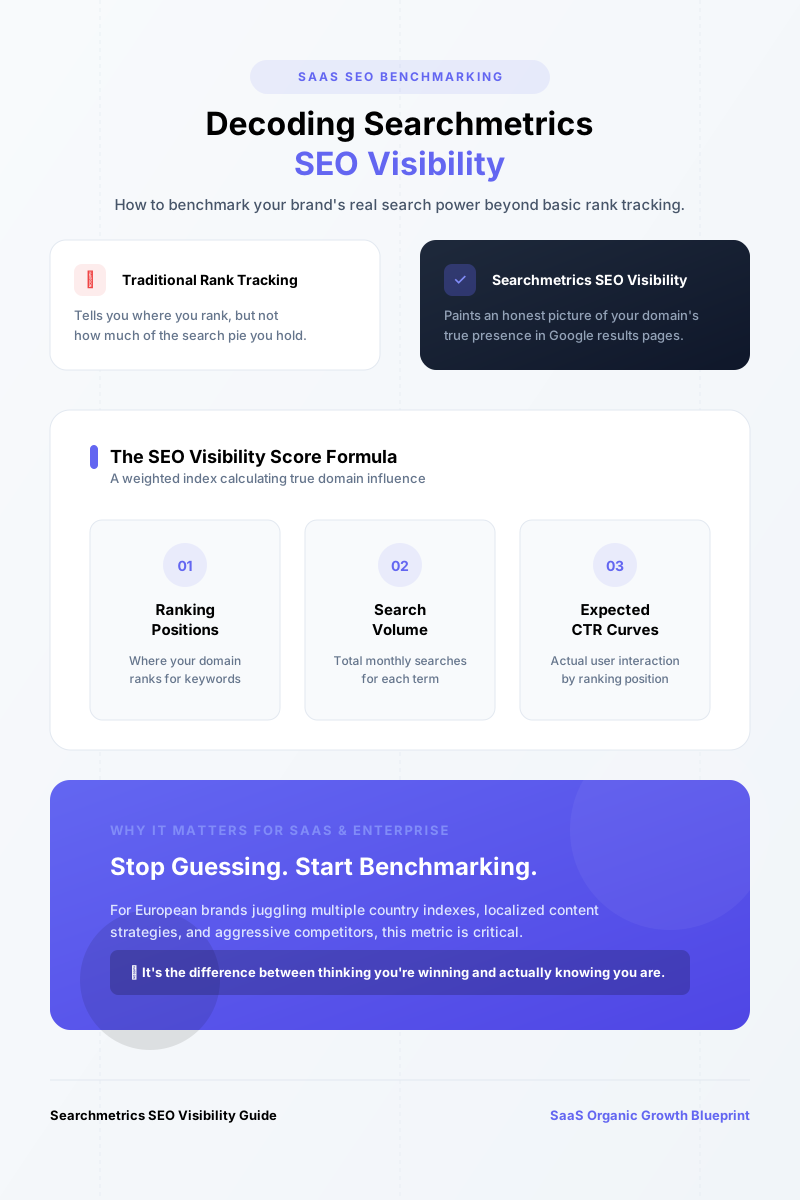
The SEO visibility score isn't a traffic estimate. It's a weighted index that reflects how prominently a domain appears across a defined set of keywords in Google's search results. According to Searchmetrics' official glossary, the score is calculated based on three core components:
- Ranking positions of a domain's tracked keywords
- Search volume for each of those keywords
- Expected click-through rate (CTR) based on the ranking position
The formula applies a multiplier to each position — so a #1 ranking for a high-volume term contributes significantly more than a #7 ranking for a low-volume long-tail term. This mirrors how real users interact with search results. A study by Ahrefs indicates that the top 3 Google search results receive over 75% of all organic clicks, which directly impacts how visibility is distributed across domains.
Pro Tip: Don't treat the visibility score as an absolute number. It's a relative index. What matters is the trend line — is your score climbing against competitors over weeks and months, not whether it's 10,000 or 50,000.
Searchmetrics Visibility vs. Searchmetrics SEO Visibility Score: Clearing Up the Names
If you searched for searchmetrics seo visibility, seo visibility searchmetrics, searchmetrics visibility, or searchmetrics seo visibility score — you are looking for the exact same metric.
Searchmetrics itself most often calls it simply SEO Visibility, while users add the brand in front or behind when they search. In the tool interface and in Searchmetrics reports you will also see it shortened to Visibility. There is no separate Searchmetrics Visibility vs. SEO Visibility Score to choose between. It is one proprietary index, calculated from rankings, search volume and expected CTR, and displayed as a single trend line per domain per country index.
When I talk to European teams, I tell them to think of it this way: Searchmetrics SEO Visibility = Searchmetrics Visibility = SEO visibility score from Searchmetrics. If you see a number like 125,430 for zalando.de in Germany and 18,210 for a niche competitor, that gap is your organic search market share gap in that country. Same name, same calculation, just shorthand.
SEO Visibility Search Metrics vs. the Searchmetrics Brand: What You Actually Meant
A lot of the searches for seo visibility search metrics and search metrics seo visibility come from the same confusion I see in briefings every month: are we talking about generic search metrics, or the Searchmetrics company product?
Here is the explicit distinction: generic SEO visibility as a concept exists in almost every platform — Sistrix has its Visibility Index, Semrush has Visibility %, Ahrefs has Share of Voice. They all try to answer how visible you are. Searchmetrics SEO Visibility is Searchmetrics' specific implementation of that idea, built on its own keyword set, its own European country indexes, and its own CTR model.
If you typed a generic phrase like search metrics seo visibility, what you almost certainly want is the Searchmetrics version if you operate in Europe, because its keyword universe is weighted toward European search behaviour and local Google indexes. Other tools will give you a different absolute number for the same domain because they track a different keyword set. That does not mean one is wrong — it means you should never compare a Searchmetrics visibility score directly to a Sistrix or Semrush visibility number. Pick Searchmetrics as your benchmark source of truth per market, then track the trend consistently in that same tool.
Why Searchmetrics is a Standard for European Markets
There are plenty of rank tracking tools on the market, but Searchmetrics has carved out a reputation as the go-to benchmarking platform for European brands. Why? Because its data integration across European country indexes is unusually deep. Whether you're tracking visibility in Germany, France, Spain, or the Nordics, Searchmetrics pulls from localised Google indexes with a granularity that many US-centric tools simply don't match.
According to Statista, over 75% of internet users in Europe rely on Google as their primary search engine. That makes rank tracking benchmarks crucial for regional visibility — and it makes Searchmetrics' country-specific data sets invaluable for brands operating across multiple EU markets.
If you're a UK brand expanding into the DACH region, or a French retailer targeting Iberia, Searchmetrics lets you benchmark visibility per country rather than relying on a blurred, pan-European average.

How Does Searchmetrics SEO Visibility Benchmark Your Brand's Search Power? {#how-searchmetrics-seo-visibility-benchmarks}
Tracking Organic Search Market Share Over Time
The real power of the Searchmetrics SEO Visibility score lies in longitudinal tracking. A single snapshot tells you very little. But when you plot your visibility score over 3, 6, or 12 months — and overlay it against competitors — you start to see who's actually capturing organic search market share in your space.
Research from BrightEdge shows that 68% of all online experiences begin with a search engine. That means the brand with the highest visibility score in your niche is effectively capturing the lion's share of that 68%. If your visibility score is flat while a competitor's is climbing, they're eating into your potential audience even if your individual keyword rankings haven't moved.
Here's a practical way to read the data:
| Scenario | What It Likely Means |
|---|---|
| Your score rises, competitors flat | Your content/technical SEO investments are paying off |
| Your score flat, competitors rising | Competitors are publishing faster or targeting new keyword clusters |
| Sudden drop across all domains | Likely a Google algorithm update or data refresh |
| Sudden spike for one domain | Competitor may have launched a major content campaign or acquired a domain |
Setting Realistic Rank Tracking Benchmarks
One of the biggest mistakes I see SEO teams make is setting benchmarks based on daily rank fluctuations. A keyword drops from position 4 to 6 on a Tuesday and panic ensues. But the Searchmetrics SEO Visibility score smooths out that noise by aggregating across hundreds or thousands of keywords.
Instead of asking "where do I rank for keyword X?", the visibility score forces you to ask "how much of the search landscape do I actually own?" That's a fundamentally healthier question for any brand serious about long-term organic growth.
Pro Tip: Set quarterly visibility benchmarks rather than weekly ones. Look at the delta between your score and your top three competitors. If you're closing the gap, you're winning — even if individual rankings bounce around.
How to Conduct Competitor SEO Analysis Using Visibility Scores? {#competitor-seo-analysis-with-visibility-scores}
Identifying Competitor Keyword Overlaps in the EU
This is where most articles on Searchmetrics stop. They explain the formula, show you a graph, and leave you to figure out the rest. Let's fix that.
Here's a step-by-step approach to using visibility scores for competitor SEO analysis in European markets:
- Map your competitive set per country. Don't assume your UK competitors are the same as your German ones. Local competitors often dominate localised indexes.
- Pull visibility trend lines for each competitor over the last 12 months. Look for inflection points — where did a competitor's score jump? That's usually a content or campaign launch.
- Identify keyword overlaps. Which keywords are you and your top competitor both ranking for? Where are they winning, and where are you?
- Spot keyword gaps. These are keywords your competitor ranks for that you don't even appear for. This is your content roadmap.
- Analyse SERP features. Are competitors capturing featured snippets, People Also Ask boxes, or local packs? These contribute to visibility even when traditional rankings are similar.
How to Find Searchmetrics Competitors Directly Inside Searchmetrics
When people search for searchmetrics competitors, they usually mean one of two things, so let me answer both explicitly.
First, if you mean organic competitors as identified by Searchmetrics for your domain: do not build that list manually. In Searchmetrics Suite, enter your domain, set the correct country index — for example, google.de, google.fr, google.co.uk, google.es — and open the Organic Competitors / Competitor Landscape module. Searchmetrics ranks other domains by keyword overlap and visibility proximity to you in that specific index. Export the top 10-15 by SEO Visibility, not just by overlapping keyword count.
My practical workflow for Europe: I pull that competitor list separately for each priority country, then keep only domains that appear in the top 10 in at least two markets or dominate one core market. That stops you chasing a pan-European average competitor that does not actually threaten you locally. Then I overlay their Searchmetrics SEO Visibility trend lines for 12 months against mine. The domains with a rising line and high overlap are your true SEO competitors, even if your sales team has never heard of them — often they are publishers, aggregators, or marketplaces eating your informational and commercial clicks.
Second, if you mean companies that compete with Searchmetrics as a tool — the main Searchmetrics competitors are Sistrix (very strong in Germany for its Visibility Index), Semrush and Ahrefs (stronger for backlinks and global keyword discovery), and Conductor / seoClarity at enterprise level. I still keep Searchmetrics as the benchmark for European organic search market share because of its historical depth per EU country, and use the others for complementary link or content gap work. Do not mix their visibility numbers together.
Spotting Market Shifts and Algorithm Updates
One of the most underrated uses of the Searchmetrics SEO Visibility score is algorithm update detection. When Google rolls out a core update, you'll often see simultaneous visibility shifts across multiple domains in a vertical. If your score drops alongside several competitors while one or two domains surge, that's a strong signal that Google has rewarded a specific type of content or site architecture.
In European markets, I've seen this play out repeatedly with localised content outperforming generic English domains. A brand that publishes properly localised, culturally relevant content in French or Spanish will often see visibility climb while English-language competitors with thin translations lose ground. Google's emphasis on helpful, locally relevant content has only intensified, and the visibility score makes these shifts visible.
How to Use the Searchmetrics Blog to Interpret Visibility Changes
If you landed here by searching searchmetrics blog, here is the explicit answer: the official Searchmetrics Blog and its Research / Winners & Losers reports are where Searchmetrics explains methodology tweaks, data updates, and what moved visibility across industries after each Google core update.
I use it as a second layer on top of my own graphs. When I see a sudden drop across all domains in my vertical, I check the Searchmetrics blog for that month's update analysis for my country index before I assume it is a site issue. They regularly publish visibility winners and losers per country — Germany, UK, France, Spain, Italy — which is gold for European competitor SEO analysis because you can see which content models Google just rewarded. Bookmark the blog by country and check it quarterly alongside your own rank tracking benchmarks. It turns a scary dip in your Searchmetrics SEO Visibility line from a panic moment into a diagnosable market shift.
What Are the Limitations of the Searchmetrics SEO Visibility Score? {#limitations-of-searchmetrics-seo-visibility}
Understanding the Difference Between Visibility and Actual Traffic
Here's the hard truth: a high SEO visibility score does not guarantee high converting traffic. I've seen brands with massive visibility scores that were built almost entirely on informational keywords — "what is X", "how does X work", "history of X" — while their commercial pages languished on page two.
Visibility measures presence. It doesn't measure intent.
If your visibility is driven by top-of-funnel blog posts that attract researchers but not buyers, your revenue won't reflect your score. Conversely, a niche B2B SaaS company might have a modest visibility score but rank for a handful of high-intent, high-value keywords that drive real pipeline.
This is why visibility should always be paired with actual traffic and conversion data from Google Analytics 4 or your CRM. The score tells you how much of the SERP you own. Your analytics tell you whether that ownership translates into business outcomes.
Complementing Searchmetrics with Autonomous SEO Platforms
The other limitation is more practical. Monitoring visibility scores is manual, time-consuming work. You pull reports, spot gaps, brief content, wait for writers, publish, and then wait weeks to see if the needle moves. In fast-moving European markets where competitors are publishing daily, that cycle is too slow.
This is where autonomous SEO platforms like SiteLift change the equation. Instead of manually acting on visibility insights, SiteLift takes your keyword and visibility data, automatically generates targeted content, distributes it across a curated premium network, and tracks keyword momentum in real-time. It turns the "I noticed a gap" moment into published, indexed content within hours rather than weeks.
The workflow becomes:
- Searchmetrics reveals a visibility gap or competitor keyword cluster
- SiteLift automatically generates content targeting those gaps
- Content is distributed and published through an integrated CMS pipeline
- Rank tracking and visibility scores update to reflect the impact
This closed-loop approach — benchmark, act, measure — is how modern SEO teams compound organic authority without scaling headcount.
Key Takeaways: Maximising Your Brand's Real Search Power {#key-takeaways}
Before we wrap up, here's a summary of the core principles for using Searchmetrics SEO Visibility effectively:
| Principle | What It Means | Action |
|---|---|---|
| Visibility ≠ Traffic | The score measures SERP presence, not conversions | Always pair with GA4 and CRM data |
| Track trends, not snapshots | Daily rank changes are noise; quarterly visibility deltas are signal | Set 3-month benchmarking cycles |
| Benchmark per country | European markets are fragmented; pan-European averages mislead | Track visibility per country index |
| Watch competitor inflections | Sudden competitor gains reveal content strategies | Reverse-engineer their content clusters |
| Act on gaps fast | Manual content production is too slow to capitalise | Use autonomous platforms to close gaps quickly |
Editorial: Why Visibility Benchmarking Is the Most Underrated Skill in European SEO {#editorial}
I've worked with enough SEO teams across Europe to know that most are still obsessed with individual keyword rankings. They pull weekly rank reports, celebrate when they hit #1 for a branded term, and ignore the fact that a competitor has quietly published 200 pages of content targeting their entire commercial keyword cluster.
Here's my honest take: rank tracking without visibility benchmarking is like checking your speedometer without looking at the road. You know how fast you're going, but you have no idea whether you're winning the race.
The teams that actually win in European search are the ones who treat organic search market share as a strategic KPI — something reported to leadership alongside revenue and pipeline. They use Searchmetrics to benchmark against competitors quarterly. They spot algorithm shifts before anyone else. And critically, they don't just observe — they act.
That last part is what separates good SEO teams from great ones. Observing a visibility gap is interesting. Closing it within days using automated content pipelines is transformative. If you're still briefing writers manually every time you spot a keyword gap, you're operating at 2018 speed in a 2025 landscape.
The brands that will dominate European search over the next two years aren't the ones with the biggest SEO teams. They're the ones who've connected visibility intelligence to autonomous publishing pipelines and let the system compound their authority while they sleep.
— The SiteLift Editorial Team
FAQ {#faq}
What is the Searchmetrics SEO Visibility score?
The Searchmetrics SEO Visibility score is a composite index that measures how visible a domain is in Google search results across a defined set of keywords. It aggregates ranking positions, search volumes, and expected click-through rates into a single score, allowing brands to benchmark their search presence against competitors over time.
How is the SEO visibility score calculated?
According to Searchmetrics' glossary, the score is calculated using three factors: the ranking positions of a domain's keywords, the search volume for each keyword, and the expected CTR based on position. Higher rankings for high-volume keywords contribute more to the score, reflecting real user click behaviour.
Does a high Searchmetrics SEO Visibility guarantee more website traffic?
No. A high visibility score indicates strong SERP presence, but it doesn't guarantee converting traffic. If your visibility is driven by informational keywords rather than commercial ones, you may attract visitors who don't convert. Always pair visibility data with actual traffic and conversion metrics from analytics tools.
How can I use Searchmetrics for competitor SEO analysis in Europe?
Use Searchmetrics to track competitor visibility scores per country index, identify keyword overlaps and gaps, and monitor inflection points where competitors gain visibility. Focus on localised competitors in each European market rather than assuming a single pan-European competitive set. Reverse-engineer their content strategies by analysing which keyword clusters drove their visibility gains.
What is a good SEO visibility score for my brand?
There's no universal "good" score — it's a relative metric. What matters is how your score compares to your direct competitors in the same market and whether your trend line is improving over time. A score of 5,000 might be dominant in a niche vertical or negligible in a broad e-commerce space. Benchmark against your competitive set, not against an absolute number.
Article generated by SiteLift
Topics Covered:
- searchmetrics seo visibility
- SEO visibility score
- organic search market share
- rank tracking benchmarks
- competitor SEO analysis
More from SiteLift

Visibility Tracker Explained: Measure True Share of Voice Across Google and AI Search
Discover how a visibility tracker measures search visibility scores and share of voice across Google and AI search engines to compound your organic reach.

LLM Visibility Tool: How to Measure and Grow Your Brand in ChatGPT and Perplexity
Discover how to use an LLM visibility tool to monitor ChatGPT brand mentions, track Perplexity citations, and scale your AI share of voice.

Single Page Application Search Engine Optimization: The Complete Rendering and Indexing Guide
Master single page application search engine optimization: rendering, indexing, Core Web Vitals & audits. Fix your SPA SEO today.