AI Search Optimization Services vs Autonomous Platforms: Which Scales Faster?

If you're shopping for ai search optimization services right now, you're facing a real fork in the road. Do you hire a done-for-you team to get you cited in Google AI Overviews, ChatGPT, and Perplexity? Or do you plug in an autonomous platform that publishes and distributes on autopilot?
I’ve tested both paths with SaaS, affiliate, and multi-site portfolios. The short answer: services win on bespoke strategy, platforms win on raw scaling speed. But the right choice depends on your budget, team size, and how fast you need topical coverage.
This head-to-head breaks down velocity, cost per asset, AI engine coverage, control, and measurement — so you can pick the model that actually compounds.
AI Search Optimization Services vs Autonomous Platforms at a Glance
Here’s the quick comparison if you don’t have time for the full breakdown:
| Criteria | AI Search Optimization Services | Autonomous Platforms (like SiteLift) |
|---|---|---|
| Key features | AI visibility audit, entity/schema optimization, prompt testing, digital PR for citations, content refreshes | Automated keyword clustering, AI drafting, internal linking, premium network distribution, CMS auto-publish, real-time momentum tracking |
| Pricing | $3k–$15k+/mo retainer, plus setup fees | Flat SaaS subscription, unlimited or high-volume publishing tiers |
| Time to first publish | 2–4 weeks (audit + strategy first) | Days (after CMS integration) |
| Assets per month | 4–20 articles + PR placements | 100–1,000+ pages + syndications |
| Pros | Senior strategy, editorial polish, high-authority PR, ideal for YMYL/enterprise | 10x–100x velocity, flat marginal cost, 24/7 execution, continuous testing |
| Cons | Linear cost to scale, revision bottlenecks, limited testing velocity | Needs brand voice setup, human fact-check process |
| Best for | Enterprise, regulated niches, complex rebrands | Startups, SMBs, agencies, SaaS, affiliates, multi-site owners |
Bottom line: If you need 10 perfect pages, hire services. If you need 500 good, interlinked, AI-readable pages across markets, you need automation.
How to Compare AI Search Optimization Services: 6 Criteria That Determine Scaling Speed
Scaling faster doesn’t just mean publishing more. It means compounding output without linearly increasing cost or headcount.
I score both options on the same six criteria:
1. Publishing velocity and topical coverage How many AI-search-ready assets can you ship per month? Can you cover full topic clusters for Google AI Overviews + ChatGPT + Perplexity + Copilot, not just head terms?
2. Cost structure and marginal cost to scale What does asset #101 cost compared to asset #1? Retainers scale linearly. Software scales flat.
3. AI visibility automation and measurement Can you track brand mentions, citations, and share of answer across LLMs automatically? Or is it manual screenshots and spreadsheets?
4. Control and brand governance Who controls voice, facts, and approvals? How do you enforce E-E-A-T at scale?
5. Authority building and citation acquisition Does the model earn third-party citations that LLMs trust? AI engines don’t just rank your site — they synthesize answers from sources they trust. Google’s documentation on AI experiences in Search makes clear that helpful content, structured data, and crawlability still determine eligibility.
6. Speed to learn and iterate How fast can you test titles, refresh stale content, expand winners, and prune losers?
Pro Tip: Define scaling as “compounding organic traffic without adding headcount.” If a solution requires a new hire for every 50 pages, it doesn’t scale.
How Do AI Search Optimization Services Scale?
Generative engine optimization services are the evolved version of the classic SEO agency. Instead of just blue links, they optimize for AI answers.
A typical engagement includes:
- AI visibility audit across Google AI Overviews, ChatGPT, Perplexity, Copilot
- Entity research, knowledge graph alignment, and schema markup
- Prompt testing: what questions trigger your brand vs. competitors?
- Content creation or rewriting for citability — clear definitions, stats, tables, FAQs
- Digital PR to earn mentions on sites LLMs already cite
- Technical fixes for crawlability, indexation, and structured data
Timelines are usually 4–12 weeks from audit to early impact, with ongoing retainers for content and PR.
Strengths of AI Search Optimization Services for Strategy and Authority
Where human-led ai search optimization services shine is judgment.
A good team will catch nuance automation misses: repositioning a YMYL health claim, navigating financial compliance, untangling a messy migration, or landing a feature in a publication that ChatGPT actually quotes. They bring senior editorial polish and relationships you can’t automate.
This matters because search behavior is shifting fast. According to Gartner, traditional search engine volume will drop 25% by 2026 as users shift to AI chatbots and virtual agents, a forecast detailed in Gartner research on generative AI and search disruption. At the same time, Pew Research Center data on ChatGPT adoption shows 34% of U.S. adults say they have ever used ChatGPT as of 2025, up from 23% in 2023. You need both visibility and credibility in those answers.
For enterprise governance, crisis management, or major rebrands, that human layer is worth paying for.
Where Manual Services Create Bottlenecks
The bottleneck is math.
Most retainers deliver 4–20 assets per month. Each piece goes through brief → draft → client review → revisions → publish → outreach. If you need 300 location pages, 500 comparison pages, or coverage in five languages, you’re looking at higher tiers, extra writers, and longer queues.
Other friction points I see constantly:
- Limited testing velocity — you can’t A/B test 200 introductions for AI citability
- Dependency on agency bandwidth during peak months
- Content decay — refreshes compete with new deliverables for hours
- Zero-click pressure — with 58.5% of U.S. Google searches ending without a click in 2024 according to SparkToro and Datos, you need far more at-bats to win the same traffic
Services scale with people. People scale linearly.
Pro Tip: If you hire generative engine optimization services, ask: “How many citable assets and third-party placements per month are guaranteed in writing?” Strategy decks don’t get cited. Published pages do.
How Do Autonomous Platforms Scale?
An llm optimization platform flips the model. Instead of renting hours, you run an always-on publishing pipeline.
Here’s how a system like SiteLift typically works end-to-end:
- Cluster and prioritize: Pulls keyword and conversational query data, groups by intent, maps to AI Overview and chatbot prompts
- Draft autonomously: Generates structured, schema-ready drafts with definitions, tables, pros/cons, and FAQs designed for extraction
- Interlink and optimize: Adds internal links, entities, and metadata automatically
- Distribute: Publishes to your CMS via integration and syndicates across a curated premium network for authority signals
- Track momentum: Monitors keyword movement, indexation, and AI visibility in real-time, then prioritizes refreshes and expansions
No brief ping-pong. No waiting for sprint capacity.
How AI Visibility Automation Compounds Output Without Headcount
The advantage is marginal cost.
Once setup is done, asset #200 costs essentially the same as asset #20 — just compute. That’s why startups and portfolio teams use an ai seo agency alternative to cover entire categories in weeks, not quarters.
Specific scaling wins:
- 24/7 execution: Research, draft, publish, and refresh while your team sleeps
- Worldwide coverage: Spin up programmatic templates for use cases, industries, or regions without hiring local writers for v1 drafts
- Continuous testing: Ship 50 title and structure variants, keep winners, rewrite losers
- Built-in distribution: Content plus network placements in one workflow, not two vendors
This aligns with broader automation trends. According to McKinsey’s 2025 State of AI report, 78% of organizations now use AI in at least one business function, a finding summarized in McKinsey State of AI reporting. SEO is following the same path — from manual crafts to supervised automation.
And automation doesn’t mean ignoring how LLMs source answers. OpenAI’s resources on ChatGPT search and citations show that browsing and linked sources heavily influence brand surfacing. Platforms that structure content for extraction and distribute it for citation cover both sides.
Where Automation Still Needs Human Oversight
Autonomy isn’t autopilot without a pilot.
You still need to set brand voice guidelines, approved claims, banned phrases, and review rules — especially in health, finance, and legal. I recommend a lightweight QA loop: auto-publish informational content, require human approval for YMYL, pricing, or competitive claims.
You’ll also need initial setup: CMS integration, analytics connection, and 1–2 hours to calibrate tone and topical boundaries. Competitive niches still benefit from quarterly human strategy on differentiators and link-worthy assets.
If you want to go deeper on that setup, this guide to AI for SEO to automate research, content creation, and distribution walks through the full automation workflow.
AI Search Optimization Services vs Autonomous Platforms: Total Cost of Ownership Over 6-12 Months
Let’s talk real numbers.
Most ai search optimization services retainers I see run $3,000–$8,000/mo for SMBs and $10,000–$15,000+/mo for enterprise with digital PR. That usually includes 8–15 pages and a handful of placements. Need 100 pages in a quarter? Expect overages or a second retainer.
An autonomous platform runs on flat SaaS pricing. Even at a mid-tier subscription, your cost per asset collapses as volume grows.
Simple breakeven math:
| Scenario | Services (est.) | Autonomous Platform (est.) |
|---|---|---|
| 15 assets/mo x 6 months = 90 assets | $30k–$60k ($333–$666/asset) | Flat subscription ($30–$80/asset equivalent) |
| 50 assets/mo x 6 months = 300 assets | $60k–$90k+ with overages | Same subscription ($10–$25/asset equivalent) |
| Refreshes + internal linking + distribution | Billed as extra hours | Included in pipeline |
| AI visibility tracking | Manual report, monthly | Real-time dashboard |
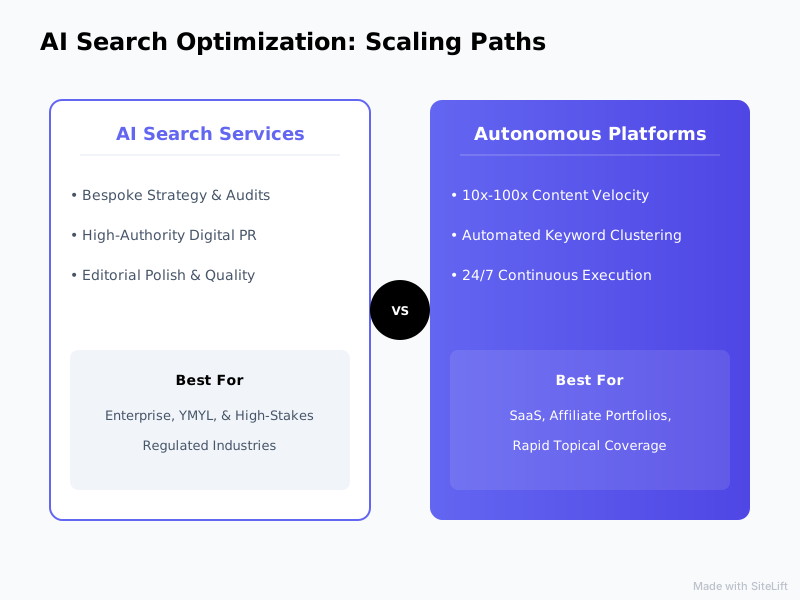
Infographic by SiteLift
Verdict on cost: services win if you need <20 bespoke assets with heavy PR. Platforms win decisively past 100 pages, multiple sites, or ongoing refreshes.
On control, services offer more hands-on editorial control per piece, but platforms offer better system control — rules, templates, and guardrails applied consistently across thousands of pages. For brand governance at scale, systems beat heroic editing.
For technical foundations like crawl budget, indexation, and schema, pair either path with modern standards. This breakdown of what modern technical SEO services must include to win in AI search is a useful checklist before you scale publishing.
Which Should You Choose for Your Team Size, Budget, and Goals?
Use this decision framework, not hype:
When to choose AI search optimization services:
- You’re an enterprise with complex governance, legal review, or YMYL risk
- You need high-authority digital PR and crisis management
- You’re doing a rebrand, migration, or multi-market consolidation
- You have budget for $5k+/mo and need white-glove strategy
When to choose an AI SEO agency alternative like SiteLift:
- You’re a startup or SMB that needs 100+ pages fast without hiring
- You run an agency or portfolio and need to scale across clients or domains
- You’re SaaS, affiliate, or lead-gen and live on long-tail and comparisons
- You need worldwide coverage and continuous refreshes for ai visibility automation
- You want flat costs and real-time keyword momentum tracking
If you’re evaluating vendors, don’t skip this ultimate checklist for choosing an SEO company in the AI era. It will save you from paying for outdated deliverables.
When to use a hybrid model (my favorite for most teams):
Run the platform for always-on execution — clustering, drafting, publishing, distribution, and refreshes. Bring in a consultant or services team quarterly for technical audits, entity strategy, and 2–3 link-worthy hero assets per quarter.
Checklist to decide in 10 minutes:
- Do you need >30 pages/mo? If yes → platform
- Do you need weekly PR placements in top-tier press? If yes → services
- Do you manage >2 sites or languages? If yes → platform
- Are you in regulated YMYL? If yes → services-led + platform for support content
- Is budget <$4k/mo? If yes → platform
Pro Tip: Start with search intent, not volume. This playbook on aligning AI content with real user needs shows how to map automated content to what AI answers actually pull.
My Take: Why I’d Bet on Automation for Pure Speed
I’ll be direct: I’ve watched too many smart teams stall with brilliant 20-page strategies while competitors ship 400 decent pages and own the category.
Services feel safer because there’s a person on Zoom. But safety doesn’t get cited. Coverage plus structure does.
In my experience, the teams winning AI Overviews and Perplexity right now aren’t writing the single perfect guide. They’re publishing clear, factual, well-structured answers across every variant of the question — then refreshing monthly as models shift. That’s a velocity game, and humans alone can’t win it.
That doesn’t mean fire your strategist. It means stop paying strategist rates for execution a machine can do 24/7. Let humans do positioning, original research, and authority plays. Let software do the compounding grind.
— sitelift.io
Get Compounding Without Adding Headcount
If your goal is to dominate search and AI engines on autopilot, this is exactly what sitelift.io was built for — automatically generate targeted content, distribute it across a curated premium network, sync with your CMS, and track keyword momentum in real time.
You set voice and boundaries once. The pipeline handles research to publishing to refreshes, so organic traffic and authority compound without manual intervention.
Still weighing traditional help? Read this honest take on whether you still need SEO consulting services in the age of AI content engines before you sign a 12-month retainer.
FAQs About AI Search Optimization and Autonomous SEO Platforms
What is the difference between AI search optimization services and an autonomous SEO platform?
Ai search optimization services are done-for-you teams offering audits, entity optimization, and PR for AI citations. An autonomous llm optimization platform is software that automatically researches, drafts, publishes, distributes, and tracks content at scale without added headcount.
How much do AI search optimization services cost compared to an autonomous platform?
Services typically cost $3k–$15k+/mo with limited pages included, so cost per asset stays high. Autonomous platforms use flat SaaS pricing, so cost per asset drops sharply past 50–100 pages, making them cheaper for high-volume scaling.
Can an autonomous LLM optimization platform replace an AI SEO agency?
For execution, yes — it can replace ongoing writing, publishing, and distribution. For high-level strategy, regulated YMYL content, and top-tier digital PR, many teams use a hybrid: platform for always-on velocity plus quarterly consultant input.
How long does it take to see results in AI Overviews and ChatGPT citations?
Expect 4–12 weeks for initial movement after publishing and indexation, with stronger AI citation lift in 3–6 months as authority and refreshes compound. Velocity, internal linking, and third-party mentions accelerate eligibility across engines.
How do you measure AI visibility automation and LLM mentions?
Track brand mentions and citations in ChatGPT, Perplexity, Copilot, and AI Overviews, plus share of answer for priority prompts, referral traffic from AI engines, and keyword momentum. Ai visibility automation dashboards monitor this continuously instead of manual checks.
Topics Covered:
- ai search optimization services
- generative engine optimization services
- ai seo agency alternative
- llm optimization platform
- ai visibility automation
More from SiteLift

Visibility Tracker Explained: Measure True Share of Voice Across Google and AI Search
Discover how a visibility tracker measures search visibility scores and share of voice across Google and AI search engines to compound your organic reach.

LLM Visibility Tool: How to Measure and Grow Your Brand in ChatGPT and Perplexity
Discover how to use an LLM visibility tool to monitor ChatGPT brand mentions, track Perplexity citations, and scale your AI share of voice.

Single Page Application Search Engine Optimization: The Complete Rendering and Indexing Guide
Master single page application search engine optimization: rendering, indexing, Core Web Vitals & audits. Fix your SPA SEO today.