What Modern Technical SEO Services Must Include to Win in AI Search

For years, ranking on Google meant playing by a fairly predictable set of rules. You built clean pages, secured your site, and waited for Googlebot to drop by. But the search landscape has fundamentally shifted. Today, we aren't just optimizing for traditional search engines; we are optimizing for Large Language Models (LLMs) like ChatGPT, Claude, Gemini, and Perplexity. This shift means that legacy technical seo services that focus solely on basic checklists are no longer enough to keep your brand visible.
If your technical foundation isn't optimized for both human-facing search engines and AI-driven scrapers, your content simply won't exist in the answers generated for users.
To win in this new era, you need to understand how technical optimization has evolved. Here is a comprehensive guide to what modern technical SEO must deliver today.
Key Takeaways: Legacy vs. Modern Technical SEO
| Feature | Legacy Technical SEO Services | Modern AI-Ready Technical SEO |
|---|---|---|
| Primary Target | Googlebot and Bingbot | LLM Scrapers, AI Agents, and Search Crawlers |
| Audit Frequency | Monthly or quarterly manual PDFs | Real-time, autonomous monitoring and deployment |
| Schema Depth | Basic Organization and Article markup | Deep semantic entity nesting and Knowledge Graph integration |
| Crawl Strategy | Simple XML sitemap updates | Strict crawl budget optimization and AI bot management |
| Content Structure | Optimized for keyword density | Structured for Retrieval-Augmented Generation (RAG) |
What Are Technical SEO Services in the Age of AI Search?
Historically, technical seo services were treated as a one-off cleanup project. An agency would hand you a 100-page audit filled with broken links, duplicate meta descriptions, and image alt text recommendations. You would pass it to your development team, where it would sit in a backlog for six months.
That approach is dead.
Today, technical SEO is an ongoing, dynamic discipline. It is the practice of ensuring that search engines and AI engines can find, parse, understand, and trust your content at scale.
The Evolution from Traditional Indexing to LLM Training Data
Traditional search engines use crawlers to build an index of web pages. When a user types a query, the search engine matches keywords to pages in its index.
AI search engines and answer engines do something different. They use LLMs that have been trained on massive datasets. When a user asks a question, the AI doesn't just return a list of links; it synthesizes an answer on the fly using Retrieval-Augmented Generation (RAG).
To be cited as a source in these generative answers, your website must maintain pristine technical site health. If an AI scraper cannot easily parse your page's semantic structure, the LLM will bypass your site entirely and cite a competitor who made their data easier to digest.
A study by BrightEdge reveals that Generative AI search experiences can alter organic visibility for up to 84% of informational queries. If you aren't optimized for these generative engines, you stand to lose the vast majority of your informational search traffic.
Why Standard Site Audits are No Longer Enough for Modern Brands
Standard site audits check for compliance with basic web standards. They tell you if your SSL certificate is working or if you have 404 errors. While these basics still matter, they are table stakes.
Modern brands need to optimize for how AI crawlers (like GPTBot, ClaudeBot, and OAI-SearchBot) interact with their sites. This requires a shift in focus toward semantic clarity, machine readability, and real-time data delivery.
If your technical provider is still sending you static PDFs once a month, they are living in 2018. You need continuous, automated optimization that adapts to search engine updates and LLM training cycles in real time.
Core Deliverables: What Modern Technical SEO Services Must Include
When evaluating modern technical seo services, look past the basic checklists. Your technical partner or platform must deliver on these three critical pillars:
Advanced Schema Markup and Entity Recognition
Structured data is the bridge between human language and machine comprehension. While search engines have gotten better at understanding natural language, schema markup provides explicit clues about the meaning of a page.
According to data from W3Techs, structured data (Schema.org) is used by over 40% of websites, yet deep entity-level schema remains highly underutilized by B2B brands. Most sites stop at basic Organization or Article schemas.
To win in AI search, your site must implement advanced, nested JSON-LD schema. This includes:
- Entity Nesting: Explicitly defining the relationships between your brand, your products, your founders, and your target industries.
- SameAs Properties: Linking your on-site entities to established external authority nodes like Wikidata or Wikipedia.
- Product and Pricing Schema: Giving AI engines real-time, structured access to your inventory, pricing models, and customer reviews.
By using precise markup from Schema.org, you help AI search engines build accurate knowledge graphs and entity associations for your brand. This makes it far more likely that your site will be recommended when users ask comparative questions like "What is the best alternative to [Competitor] for [Use Case]?"
Crawl Budget Optimization for Rapid Indexing
Search engine crawlers do not have infinite time or resources. They allocate a specific "crawl budget" to your site based on its authority, size, and technical performance.
Crawl budget optimization is the art of ensuring that search bots prioritize your high-value, high-converting pages over low-value utility pages. If your site has thousands of auto-generated tag pages, duplicate parameters, or broken redirects, crawlers will waste their budget on junk.
[Search Engine Bot]
       │
       ▼
[Robots.txt / Sitemap] ──► [High-Value Content Pages] (Prioritized Indexing)
       │
       └─► [Utility Pages / Parameters] ──► (Blocked/Ignored to Save Budget)
For enterprise websites and SaaS platforms, poor crawl budget management means new content can take weeks or even months to get indexed. In a fast-moving market, that delay is unacceptable. Modern technical services must actively manage your internal link architecture, clean up redirect chains, and use canonical tags strategically to guide crawlers directly to your money pages.
Site Speed Performance and Core Web Vitals
Site speed is no longer just a user experience metric; it is a critical ranking factor for both traditional search engines and AI scrapers.
According to official data from Google, a 1-second delay in mobile page load times can impact conversion rates by up to 20%. Furthermore, slow sites cost search engines more money to crawl, which naturally reduces your crawl frequency.
Your technical services must focus heavily on site speed performance by optimizing Google's Core Web Vitals:
- Largest Contentful Paint (LCP): How fast the main content of your page loads.
- Interaction to Next Paint (INP): How responsive your page is to user inputs.
- Cumulative Layout Shift (CLS): How visually stable your page layout is during loading.
To achieve top-tier performance, your technical stack should leverage modern image formats (like WebP and AVIF), implement aggressive edge caching, minimize main-thread JavaScript execution, and utilize global Content Delivery Networks (CDNs). You can monitor these metrics continuously using resources like Google's web.dev platform.

How Do You Optimize Technical Site Health for Generative Engines?
Optimizing for generative AI engines (Generative Engine Optimization, or GEO) requires a different technical mindset than optimizing for standard Google search. You must design your site's architecture to be easily ingested by LLM scrapers.
Managing AI Bot Access via Robots.txt and Protocols
The first step in managing your relationship with AI engines is controlling who has access to your data. Not all AI bots are created equal. Some, like OAI-SearchBot, are used to power real-time search results in ChatGPT. Others are simply scraping your proprietary data to train future models without sending any traffic back to your site.
A modern technical SEO strategy involves auditing your robots.txt file to selectively allow or disallow specific crawlers based on your business goals.
# Allow AI Search Bots that attribute sources and drive traffic
User-agent: OAI-SearchBot
Allow: /

# Block AI scrapers that train models without sending referral traffic
User-agent: GPTBot
Disallow: /
By strategically managing these permissions, you protect your intellectual property while ensuring you remain highly visible in conversational search results.
Structuring Content for Retrieval-Augmented Generation (RAG)
When an AI engine attempts to answer a user's query using your site's data, it relies on RAG. The engine's scraper pulls down your page, chunks the text into semantic vectors, and stores it temporarily to generate an answer.
If your page content is buried inside complex layouts, unsemantic HTML, or non-standard JavaScript accordions, the RAG process breaks down.
To make your content RAG-friendly, your site architecture should prioritize:
- Flat Semantic Hierarchies: Use clear
H1,H2, andH3heading tags that follow a logical outline. - Clean Markdown or HTML: Avoid cluttered, inline CSS and heavy JS frameworks that obscure the actual text.
- Clear Question-and-Answer Formatting: Frame key concepts as direct questions followed by concise, authoritative answers.
For a deeper dive into how to structure your content to meet these rigorous standards, refer to SiteLift's content quality guidelines.
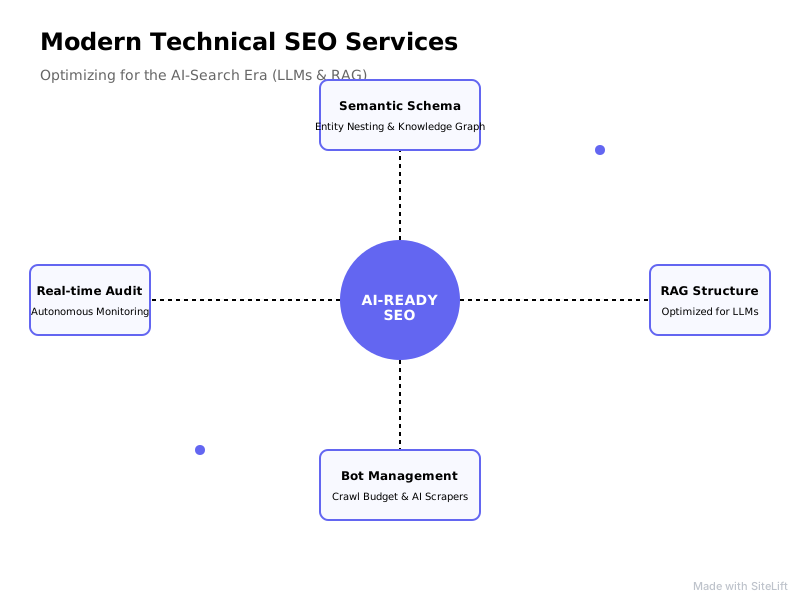
Infographic by SiteLift
The Role of Automation in Modern Technical SEO
The days of manual site maintenance are over. The modern web moves too fast, search algorithms change too frequently, and AI engines scrape too rapidly for humans to keep up using spreadsheets.
Real-Time Technical Monitoring vs. Periodic Audits
If your technical SEO provider only runs an audit once a month, you are operating in a reactive state. If a developer pushes a code change that accidentally adds a noindex tag to your primary product page, waiting 30 days to find out could destroy your quarterly revenue.
Modern technical seo services must include real-time, autonomous monitoring. You need platforms that continuously scan your site for changes in indexation status, schema errors, and performance drops, alerting you instantly when something goes wrong.
Automated CMS Integrations and Instant Publishing Pipelines
To scale your organic search presence, your technical optimizations must be deployed instantly. This requires tight, automated integrations with your Content Management System (CMS).
When you create or update content, your platform should automatically:
- Generate and nest the appropriate JSON-LD schema.
- Update your XML sitemaps and ping search engines for immediate crawling.
- Optimize and compress any newly uploaded media assets.
- Distribute the content across a fast CDN edge network.
By automating these technical workflows, you eliminate the development bottlenecks that traditionally hold SEO campaigns back. You can learn more about setting up these automated pipelines in the SiteLift documentation.
Pro Tip: Never rely on manual plugin updates to manage your site's schema and sitemaps. Use an autonomous platform that handles these technical deployments at the server or edge level to prevent plugin conflicts and performance degradation.
My Editorial Take: Why Legacy Technical SEO Checklists Are Dead
Let's be completely honest: most agencies selling technical seo services are running an expensive racket.
They charge thousands of dollars a month to run your site through a commercial crawler, export the issues into a branded PDF, and tell you that you have 45 missing alt tags and 12 duplicate meta descriptions. They call this "ongoing technical maintenance."
It isn't. It's busywork.
In the age of AI-driven search, those minor issues are trivial. Modern search engines are incredibly smart; Google can easily figure out what a page is about even if you forgot an alt tag. What they cannot do is navigate a bloated, slow website that lacks semantic structure and clear entity relationships.
If your technical SEO provider isn't talking to you about LLM scrapers, vector chunking, RAG-friendly content models, and automated edge deployment, they are stealing your budget. The future of technical SEO belongs to software-driven, autonomous platforms that monitor, optimize, and publish content on autopilot, leaving humans to focus on high-level strategy.
How to Evaluate and Choose the Right Technical SEO Provider
If you are looking to hire an agency or adopt a platform to manage your site's technical health, you need to ask the right questions to separate the modern innovators from the legacy dinosaurs.
Key Questions to Ask Prospective Agencies or Platforms
When vetting a provider, skip the generic questions about backlinks and keyword rankings. Instead, ask:
- How does your platform or service optimize our site specifically for AI search engines like ChatGPT Search, Google Gemini, and Perplexity?
- Do you manually write and implement JSON-LD schema, or does your platform dynamically generate and nest entity-level markup at scale?
- How do you handle crawl budget optimization for large-scale enterprise or SaaS sites?
- Is your technical monitoring continuous and real-time, or do you run periodic manual audits?
- How does your system integrate with our existing CMS to automate technical deployments and publishing?
Red Flags in Legacy Technical SEO Proposals
Be on the lookout for these warning signs in any technical SEO proposal:
- The "One-Time Audit" Trap: Technical SEO is treated as a static project rather than an ongoing, automated process.
- Over-Emphasis on Low-Impact Metrics: The proposal focuses heavily on minor issues like missing meta descriptions while ignoring Core Web Vitals and schema depth.
- No Mention of AI or LLMs: The provider has no roadmap or strategy for Generative Engine Optimization (GEO).
- Slow, Manual Workflows: Every minor technical fix requires writing a ticket for your development team rather than deploying changes programmatically.
Automating Your Path to Search and AI Dominance
If you want to win in both traditional search and the emerging AI search landscape, you cannot rely on slow, manual processes. You need an autonomous engine that keeps your site's technical health pristine without requiring constant developer intervention.
This is exactly why we built SiteLift.
As an autonomous SEO and AI visibility growth platform, SiteLift is designed to help businesses dominate search and AI engines on autopilot. Instead of dealing with clunky plugins, manual schema creation, and slow publishing cycles, our software:
- Automatically Generates Optimized Content: Built from the ground up to be RAG-friendly and semantically structured.
- Deploys Deep Schema Markup: Dynamically generates nested JSON-LD to feed search engine knowledge graphs.
- Optimizes Site Performance: Delivers lightning-fast page speeds and optimized Core Web Vitals.
- Integrates Seamlessly: Connects directly with your CMS to manage your publishing pipeline and track keyword momentum in real-time.
By automating the complex, technical heavy lifting, SiteLift ensures your site remains perfectly optimized for both Googlebot and the latest LLM scrapers, allowing you to compound your organic traffic and authority effortlessly.
— sitelift.io
FAQ
What is the difference between traditional technical SEO and AI search optimization?
Traditional technical SEO focuses on making a website easy for search engine crawlers (like Googlebot) to index and rank based on keywords. AI search optimization (or Generative Engine Optimization) focuses on structuring data so that Large Language Models (LLMs) can easily parse, synthesize, and cite your content in conversational, generative answers.
Do modern technical SEO services include schema markup implementation?
Yes, any modern technical service must include advanced, nested JSON-LD schema markup. This goes beyond basic article schemas to include entity nesting, product schemas, and organization schemas that help AI engines understand the relationships between your brand and other entities on the web.
How do AI search engines like ChatGPT and Google Gemini crawl and index websites?
AI search engines use specialized scrapers (such as GPTBot or OAI-SearchBot) to crawl web pages. This data is then chunked and converted into vector embeddings. When a user asks a query, the system uses Retrieval-Augmented Generation (RAG) to pull the most relevant chunks and generate a synthesized response with citations.
Why is crawl budget optimization critical for enterprise SaaS websites?
Enterprise SaaS websites often have thousands of pages, including product listings, documentation, and dynamic parameters. Without proper crawl budget optimization, search engine bots will waste resources crawling low-value utility pages, causing high-value, revenue-driving content to go unindexed or updated slowly.
How does site speed performance impact my visibility in AI-driven search results?
Fast site speed performance is essential because AI engines and traditional search crawlers operate with resource constraints. A slow website costs more to crawl and process. If your site is slow, crawlers will access it less frequently, and RAG systems may bypass your pages in favor of faster, more accessible sources.
Topics Covered:
- technical seo services
- technical site health
- crawl budget optimization
- schema markup
- site speed performance
More from SiteLift

International Organic Expansion: Scaling Global SEO Without Massive Agency Retainers
Execute international search expansion with proven technical steps, automated localization, and cross-border growth tactics. Start scaling today.

The Modern Guide to White Label SEO: Automating Client Success at Scale
Learn how to scale your agency with white label SEO. Discover automated fulfillment, content marketing, and reporting strategies that maximize profit.

Why B2B SaaS Brands Are Replacing Traditional B2B SEO Agencies with AI Workflows
Stop paying retainers for stale reports. See how AI workflows drive b2b lead generation, automate content pipelines, and outperform traditional b2b seo agency models.