Smart SEO Tech Explained: How Autonomous Platforms Replace Manual SEO Work

For over two decades, search engine optimization meant running manual spreadsheets, conducting tedious technical audits, writing single article briefs, and slowly publishing blog posts one by one. But the landscape has shifted fundamentally. Modern smart seo tech is transforming organic search strategy from a labor-intensive operational bottleneck into a continuous, self-executing growth engine.
Instead of treating SEO as a fragmented checklist of disconnected tasks, forward-thinking growth leaders are leveraging ai seo technology to handle end-to-end publishing pipelines. By automating everything from dynamic keyword discovery to content creation and headless CMS distribution, autonomous platforms are changing how brands build topical authority at scale.
In this guide, we will unpack how smart seo tech operates under the hood, compare traditional workflows with fully autonomous platforms, and explore why automated search systems are essential for the era of generative AI search.
Key Takeaways
| Metric / Dimension | Traditional Manual SEO | Autonomous Smart SEO Tech |
|---|---|---|
| Workflow Model | Task-based, manual execution | Closed-loop, continuous execution |
| Keyword Research | Static quarterly spreadsheets | Dynamic real-time intent discovery |
| Content Operations | Manual drafting & piecemeal editing | Context-aware automated generation |
| Publishing Pipeline | Manual CMS formatting & staging | Automated headless CMS integration |
| Internal Linking | Ad-hoc manual link insertions | Algorithmic full-site link graph management |
| Search Engine Target | Traditional SERP listings only | Dual-target: Google SERPs + Generative AI Engines |
What Is Smart SEO Tech? Defining the Autonomous Search Era
At its core, smart seo tech refers to closed-loop, algorithmic software systems that execute the complete organic search lifecycle without requiring constant manual intervention. Unlike traditional single-point utilities that only flag errors or generate raw text, autonomous seo automation software integrates analysis, creation, optimization, and distribution into a unified operational pipeline.
+-------------------+     +---------------------+     +-----------------------+
|  Real-Time Intent | --> | Contextual Content  | --> | Automated Publishing  |
|     Discovery     |     |    Generation       |     |     & Distribution    |
+-------------------+     +---------------------+     +-----------------------+
          ^                                                       |
          |__________________ Continuous Feedback ________________|
From Manual Spreadsheets to Autonomous Execution
Historically, organic growth required hiring specialized teams or agencies to manage separate workstreams: keyword researchers, technical auditors, copywriters, and content ops managers. This approach created inherent latency. By the time a keyword report was translated into a content brief, written, approved, and manually formatted in WordPress, search intent had often shifted or competitors had already captured the position.
According to HubSpot's State of Marketing report, 68% of marketing leaders report that automation and AI tools have significantly increased their overall team productivity. Autonomous search engines build on this efficiency gain by shifting teams away from administrative overhead toward high-leverage strategic oversight.
The Core Architecture of Modern AI SEO Technology
Modern ai seo technology relies on three interconnected layers working in sync:
- Data Ingestion Engine: Continuously tracks keyword momentum, search volume fluctuations, entity associations, and semantic gaps across your vertical.
- Generative & Semantic Core: Utilizes Natural Language Understanding (NLU) and Large Language Models (LLMs) to structure enterprise-grade, entity-rich content designed for both human readers and search crawlers.
- Automated Deployment Pipeline: Connects directly to CMS endpoints via APIs, managing formatting, metadata, internal link inserts, and publishing schedules automatically.
How Does Modern SEO Automation Software Work Under the Hood?
To understand why autonomous platforms outperform manual workflows, it helps to examine the mechanics driving modern seo automation software.

Dynamic Intent Discovery and Predictive Keyword Momentum
Static keyword research is reactive by nature. Autonomous smart seo tools monitor live search data streams to identify emerging search clusters and predictive keyword momentum before difficulty scores spike. By evaluating real-time changes in search behavior, these systems automatically prioritize topics that offer the highest potential conversion value and organic reach.
Context-Aware Content Generation and Semantic Structuring
Search engines evaluate content based on topical depth and entity relationships rather than simple keyword density. Modern ai seo technology constructs detailed semantic maps for every target query, analyzing top-ranking competitors to determine required entities, secondary topics, and structural standards.
When generating content, the platform automatically incorporates structured schema markup, optimized heading hierarchies, and natural keyword density, aligning with guidelines detailed in Google Search Central documentation.
Automated Headless CMS Integration and Distribution
The biggest friction point in traditional SEO is publishing operations. Formatting HTML elements, adding alt text, building internal links, and clicking "Publish" across dozens of articles takes hours of manual work.
Autonomous smart seo tech bypasses manual CMS entry entirely. Through direct API integrations with platforms like WordPress, Webflow, or custom headless systems, content is automatically formatted, categorized, tagged, and published according to your editorial schedule.
Pro Tip: When evaluating autonomous platforms, ensure they offer direct API-driven CMS publishing. True automation eliminates manual staging, copy-pasting, and manual draft approvals entirely.
Manual SEO vs. Smart SEO Tech: What Work Actually Gets Replaced?
Switching to an autonomous SEO workflow changes how time and resources are allocated across your marketing organization.
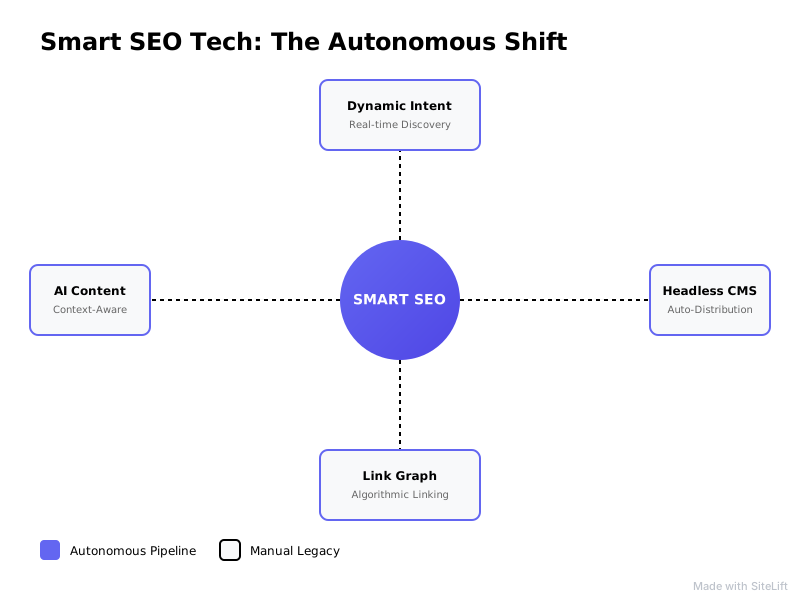
Infographic by SiteLift
Automating Labor-Intensive Content Pipelines and Drafting
Building topical authority requires consistent publishing volume. In a manual workflow, producing 30 high-quality articles per month requires a full team of writers, editors, and SEO specialists.
Autonomous smart seo tools handle the heavy lifting of initial research, outline generation, semantic optimization, and drafting. This reduces the time required to deploy comprehensive content clusters from weeks to minutes.
Continuous Internal Linking and On-Page Technical Fixes
Managing internal links manually across hundreds of published pages is practically impossible at scale. Autonomous systems use site-wide link graphs to dynamically insert contextual internal links whenever new content is published. This keeps crawl equity distributed efficiently across your domain and strengthens topical relevance.
Shifting SEO Talent from Mechanical Labor to High-Level Strategy
When mechanical tasks like keyword tracking, drafting, and CMS staging are handled by software, your team's role evolves. Marketers can focus on product positioning, conversion rate optimization (CRO), brand messaging, and broad distribution strategies rather than operational busywork.
Why Autonomous Platforms Are Critical for AI Search and Answer Engines
The search landscape is undergoing its biggest transformation in twenty years as search engines transition from blue links to generative answers.
Optimizing for Generative Engine Optimization (GEO) and LLM Citations
Generative AI answer engines like Perplexity, ChatGPT Search, and Google AI Overviews do not simply retrieve pages—they synthesize facts from authoritative sources. Industry reporting on search trends from Search Engine Land highlights that winning citations in generative responses requires clear entity structuring, direct answer passages, and strong semantic organization.
Autonomous platforms structure content specifically to meet these Generative Engine Optimization (GEO) standards. By publishing clear data points, structured tables, and well-organized responses, smart seo tech ensures your brand is selected as an authoritative source by LLM crawlers.
Scaling Velocity Without Linear Headcount Expansion
Research published by Gartner predicts that by 2026, traditional search engine volume will drop by 25% due to the rise of AI chatbots and generative response engines. To capture market share in this fragmented ecosystem, brands must cover target topics comprehensively without inflating operating costs.
Despite these shifts, traditional search results remain extremely valuable. According to Backlinko's search analysis, the #1 organic result in Google still has an average click-through rate of 27.6%, underscoring the enduring commercial value of compounding search positions. Autonomous platforms allow organizations to maintain high publishing velocity across both traditional search engines and AI discovery tools without scaling headcount linearly.
How to Choose and Implement Smart SEO Tech in Your Organization
Not all platforms labeled as "AI SEO" offer true autonomy. Many are simple text writers that still require manual management at every step.
+-------------------------------------------------------------------------+
|                  AUTONOMOUS PLATFORM EVALUATION CHECKLIST                |
+-------------------------------------------------------------------------+
| [ ] Closed-Loop Execution: Continuous keyword discovery to publishing   |
| [ ] Native CMS Integrations: Direct API connections (WordPress, Webflow) |
| [ ] Semantic Intelligence: Automatic entity mapping and schema markup    |
| [ ] Dynamic Internal Linking: Automatic link insertions across pages     |
| [ ] Real-Time Visibility Tracking: Integrated keyword & rank monitoring |
+-------------------------------------------------------------------------+
Key Criteria for Evaluating Full-Stack Autonomous Platforms
When selecting seo automation software, look for systems that deliver complete end-to-end publishing pipelines:
- Closed-Loop Operations: The platform should autonomously discover keywords, draft content, optimize on-page elements, and publish directly to your site.
- Semantic & GEO Optimization: It must go beyond simple keyword insertion to build comprehensive entity profiles tuned for both Google and LLMs.
- Integrated Analytics: Look for systems that track organic visibility and keyword momentum in real time to refine content output automatically, similar to modern Next-Gen SEO Reporting Software.
Maintaining Quality Control and Brand Safety on Autopilot
Deploying smart seo tech does not mean abandoning oversight. The most effective implementations combine automated execution with strategic human checkpoints.
Pro Tip: Establish clear brand parameters, required terminology, and tone-of-voice guidelines within your platform settings before launching automated publishing workflows.
Editorial: Why Set-and-Forget Growth Pipelines Are the Future of Search
The debate between manual content production and AI automation often misses the point. The issue isn't whether human content creation is valuable—it always will be for opinion pieces, original research, and brand storytelling. The issue is that relying on manual effort for routine search coverage is inefficient and hard to scale.
Search optimization is fundamentally a data engineering problem. Search engines analyze structure, entity connections, relevance signals, and technical architecture. Autonomous platforms execute these technical tasks faster and more accurately than manual workflows ever could.
By automating the repetitive technical work of SEO, brands can build compounding topical authority while freeing human teams to focus on strategy, creative vision, and conversion experience.
The true value of modern smart SEO tech isn't just saving time—it's building a self-sustaining organic acquisition engine that runs continuously in the background.
— sitelift.io
Turn Search Engine Growth Into an Autonomous Engine
If you are ready to move away from spreadsheets, manual drafts, and piecemeal SEO tools, it is time to upgrade your tech stack.
SiteLift provides an all-in-one autonomous SEO platform designed to grow organic traffic on autopilot. By combining real-time keyword intent discovery, semantic content generation, automated CMS integration, and premium network distribution, sitelift.io replaces complex manual operations with a streamlined, scalable system.
Discover how SiteLift can automate your search strategy, expand your reach across traditional and AI search engines, and drive compounding organic growth today.
Frequently Asked Questions
What is smart SEO tech and how does it differ from traditional SEO tools?
Smart SEO tech refers to autonomous platforms that execute the complete SEO workflow—including research, content creation, optimization, and publishing—without requiring manual input at every step. Traditional SEO tools are point solutions that require human operators to manually analyze data and execute tasks.
Will autonomous SEO automation software replace human SEO specialists completely?
No. Autonomous software replaces mechanical tasks like keyword tracking, drafting, and manual CMS posting. Human specialists shift their focus to higher-level strategy, creative direction, conversion rate optimization, and brand positioning.
Does content created by smart SEO tools violate Google search guidelines?
No. Google's Search Central documentation explicitly confirms that Google rewards helpful, high-quality content regardless of how it is produced. Smart SEO tech focuses on value, relevance, entity richness, and user intent, aligning fully with Google's search quality guidelines.
What is the difference between a standalone AI writer and an autonomous SEO platform?
A standalone AI writer simply generates text from a prompt, requiring you to manually research keywords, paste the text into a CMS, format headings, build internal links, and schedule the post. An autonomous SEO platform manages the entire end-to-end publishing pipeline automatically via direct CMS integration.
How fast can a business see results after deploying autonomous smart SEO technology?
While search engine indexing times vary, autonomous platforms accelerate growth by drastically increasing publishing velocity and optimizing topical coverage. Businesses often see increased indexing speed and early keyword momentum within weeks of deploying automated content clusters.
Topics Covered:
- smart seo tech
- smart seo tools
- ai seo technology
- seo automation software
More from SiteLift

SEO with Spa Brands: Local Search Playbook to Fill Your Booking Calendar
Dominate local search and fill your appointment calendar. Discover the ultimate local SEO playbook built specifically for day spas and med spa brands.

Single-Page Application SEO: How to Get React, Vue and Angular Apps Indexed and Ranking
Master single-page application SEO. Fix JavaScript rendering bottlenecks, solve SPA indexing issues, and optimize Core Web Vitals for React, Vue, and Angular.

7 Best Link Building Tools for SEO to Scale Authority on Autopilot
Compare the best link building tools for SEO. Learn how to automate link prospecting, analyze backlinks, and scale domain authority efficiently.