SEO with Spa Brands: Local Search Playbook to Fill Your Booking Calendar
Running a luxury wellness sanctuary or a high-end medical clinic is demanding enough without watching your treatment rooms sit empty during mid-week slumps. When clinic owners ask how to sustainably fill their appointment calendars, my answer always starts with search visibility. Executing targeted seo with spa brands requires shifting away from vanity metrics on social media and zeroing in on high-intent prospective clients who are actively looking to book treatments right now.
Whether someone is dealing with sudden hormonal acne, desperate for a tension-relieving deep tissue massage, or searching for preventative botulinum toxin treatments, their immediate reflex is to pull out a smartphone. If your spa does not show up in those critical local search moments, you are handing high-ticket clientele directly to your regional competitors.
Key Takeaways
| Pillar | Focus Area | Impact on Bookings |
|---|---|---|
| GBP Optimization | Primary/secondary categories & geo-reviews | Puts your clinic in the Local 3-Pack for high-intent searches |
| Site Architecture | Individual treatment pages with transactional booking links | Captures long-tail treatment queries and cuts bounce rates |
| Clinical E-E-A-T | Medical director profiles & protocol documentation | Protects med spas from YMYL penalties and builds user trust |
| Local Schema | Structured data (HealthAndBeautyBusiness) |
Feeds search engines clean operational and pricing metadata |
| Autonomous Content | Dynamic geo-targeted pages & automated indexing | Expands your geographic catchment radius on autopilot |
An Editorial Perspective: Why the "Instagram-First" Spa Strategy Is Broken
For the past decade, wellness marketers convinced spa owners that Instagram aesthetic grids and influencer gifted visits were the holy grail of bookings. I strongly disagree.
While a curated visual feed can reinforce your brand perception, it is fundamentally a passive discovery channel. A user scrolling past your hot stone massage reel at 11:30 PM is seeking visual relaxation or entertainment—not making a purchase. Conversely, a prospective client searching "emergency deep tissue massage lower back pain" or "best hydrafacial clinic near me" has an open wallet and immediate intent.
Relying exclusively on social media creates an unpredictable boom-and-bust cycle. Organic search builds a compounding, appreciating digital asset. When you own the local search results for your primary modalities, your rooms stay booked without having to churn out daily short-form videos or feed money into rising ad networks.
Why is SEO with Spa Brands Essential in Modern Wellness Marketing?
The High-Intent Shift: From Passive Social Browsing to Active Search Queries
Wellness and aesthetic clients search with immediate transactional intent when seeking treatments like facials, massages, or injectables. According to data from Think with Google, mobile searches containing "near me" with an intent to buy or book have grown by over 200% across lifestyle and service verticals.
When someone searches "hydrafacial near me," they are rarely researching the chemical background of salicylic acid; they are evaluating price, proximity, reviews, and how easily they can secure an appointment for Saturday afternoon. Converting these users is remarkably straightforward if your site loads quickly, demonstrates proof of work, and immediately presents an integrated reservation engine.
The Economics of Organic Discovery vs. Paid Spa Advertising
The commercial stakes in the wellness space are massive. According to the International SPA Association (ISPA), the spa industry generates over $20 billion annually in the US alone, driven heavily by digital discovery and online reservation systems.
Yet, many owners burn cash on Meta and Google Ads without having an organic baseline. In competitive metropolitan markets, pay-per-click (PPC) bids for terms like "lip fillers" or "laser skin resurfacing" often top $15 to $35 per click. If your landing page converts at a modest 3%, your customer acquisition cost (CAC) eats directly into treatment margins.
Developing a dependable organic search footprint provides a foundation of zero-marginal-cost client acquisition. Paid ads should supplement your operational capacity during seasonal pushes, not act as a perpetual life-support machine for your appointment ledger.
Understanding Day Spa vs. Med Spa Search Intent Differences
A fatal flaw in many generic agency playbooks is treating all wellness businesses identically. Search engines treat day spas and medical spas very differently:
- Day Spas: Search intent revolves around relaxation, sensory indulgence, couples packages, and gift certificates. The queries lean heavily on geographic proximity, ambiance, weekend packages, and pricing transparency.
- Medical Spas: These sites fall under Google's strict "Your Money or Your Life" (YMYL) guidelines. Search intent centers on safety, downtime, practitioner credentials, efficacy, and clinical results.
If you run a med spa and treat your service copy like an afternoon retreat menu without clinical citations, contraindications, and practitioner biographies, search engines will hesitate to surface your pages for competitive queries.
How Can Spas Dominate the Google Local 3-Pack and Map Rankings?
The Google Local 3-Pack drives the lion's share of immediate calls and appointments for aesthetic and relaxation businesses. According to BrightLocal, 87% of consumers used Google to evaluate local businesses in 2023, with beauty and wellness ranking among the top categories for local review dependency. Winning this real estate requires technical precision on your business listings.
Spa Google Business Profile Ranking Fundamentals and Category Selection
Your primary category selection is the heaviest single ranking signal in local search. You must choose the category that aligns exactly with your primary revenue driver:
Day SpaMedical SpaFacial SpaMassage SpaSkin Care Clinic
If you are a medical clinic performing laser treatments and injectables, setting your primary category as "Day Spa" because you offer an occasional relaxation massage will dilute your visibility for your highest-margin treatments. Set your primary category to Medical Spa, then select secondary categories like Skin Care Clinic and Laser Hair Removal Service to capture peripheral searches.
Ensure you adhere strictly to Google Business Profile official guidelines. Do not spam your business name field with keywords (e.g., "Radiance Spa - Botox, Facials, Massages NYC"). Search algorithms frequently suspend listings that manipulate the title field with keyword stuffing.
Pro Tip: Embed your direct booking engine URL (such as Boulevard, Mindbody, or Jane App) directly into the "Appointments" attribute on your Google Business Profile. Removing friction between discovery and booking directly lifts appointment volume.

Building Geo-Targeted Citations Across Health, Beauty, and Tourism Directories
Local citations confirm your business's existence, physical location, and legitimacy. Inconsistent Name, Address, and Phone (NAP) details across the web erode search engine confidence in your location data.
Beyond core platforms like Apple Maps, Bing Places, and Yelp, spas must claim profiles across niche-specific ecosystems:
- Beauty directories (StyleSeat, SpaFinder)
- Medical directories for med spas (RealSelf, Healthgrades)
- Local chamber of commerce and regional tourism portals
If your spa operates across multiple branches, managing this footprint manually can drain operational bandwidth. You can review our guide on automated local SEO to explore how multi-location brands handle citation syndication and local profile health at scale.
Proactive Review Acquisition and Sentiment Management
Review velocity, aggregate rating, and review text content directly dictate local rankings. An unoptimized five-star review that reads "Great service!" does little for your topical relevance.
Train your front-desk staff or configure your automated post-treatment SMS flow to encourage specific feedback:
"Thank you for visiting Radiance Medspa! Could you leave us a quick review mentioning the treatment you received from Sarah today and how your skin felt afterwards?"
When satisfied clients naturally include terms like "HydraFacial," "microneedling," or "deep tissue massage" alongside your neighborhood name, your profile builds topical depth inside Google's local search algorithm.
What Website Architecture Converts Search Visitors into Booked Appointments?
Ranking is only half the battle; your site architecture must guide search visitors smoothly toward an appointment. Many wellness websites commit the error of listing all their offerings on a single, endless menu page or—worse—uploading a downloadable PDF menu that search bots struggle to parse.
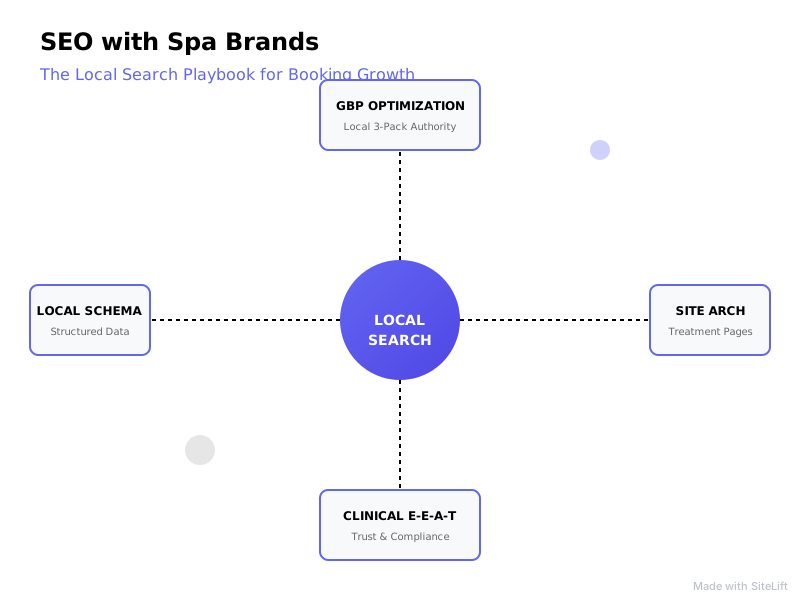
Infographic by SiteLift
Dedicated Treatment Landing Pages vs. One-Page Service Menus
Every treatment you offer deserves a dedicated, indexable URL. If you bundle chemical peels, microdermabrasion, and dermaplaning onto a single page titled /services, you force search engines to guess which term matters most.
Structuring individual service silos allows you to target specific intent:
yourspasite.com/
├── treatments/
│   ├── facials/
│   │   ├── hydrafacial/
│   │   └── dermaplaning/
│   ├── injectables/
│   │   ├── botox/
│   │   └── dermal-fillers/
│   └── body/
│       ├── deep-tissue-massage/
│       └── lymphatic-drainage/
Each page must address four essential elements:
- Immediate Booking Mechanism: An unmissable CTA above the fold linking directly to that specific service in your booking engine.
- Treatment Expectations: Step-by-step walkthrough of what happens during the appointment.
- Pricing & Duration: Clear, upfront pricing tiers or consultation guidelines. Hidden pricing drives high bounce rates.
- Local Context: Natural mentions of the local neighborhoods and communities you serve.
If you are unsure whether your current site structure slows down search crawlers or fails Core Web Vitals, run your URL through our free technical SEO audit to spot crawl traps, rendering bottlenecks, and missed metadata.
Med Spa Website Optimization: Addressing E-E-A-T and Clinical Credentials
Because medical aesthetics directly influence a patient's physical health, search evaluators prioritize Experience, Expertise, Authoritativeness, and Trustworthiness (E-E-A-T).
To satisfy these expectations:
- Feature Medical Directors Prominently: Med spas must host a detailed biography page for their Medical Director, Nurse Practitioners, and Licensed Estheticians, detailing board certifications, education, and years of clinical practice.
- Include Safety and Clinical Disclaimers: Every injectable and laser page must cover candid contraindications, potential side effects, and pre/post-care clinical requirements.
- Show Case Studies: Back claims with high-resolution, unedited before-and-after imagery coupled with thorough procedural notes.
Implementing HealthAndBeautyBusiness and Service Schema Markup
Structured data (schema markup) translates your site's content into machine-readable code that search engines digest instantly.
For spas, implementing schema types from Schema.org makes a substantial difference in how your brand is cataloged. Use HealthAndBeautyBusiness for day spas, or MedicalBusiness for aesthetic clinics.
Here is an example of an operational JSON-LD snippet you can adapt:
{
  "@context": "https://schema.org",
  "@type": "HealthAndBeautyBusiness",
  "name": "Lumina Wellness Sanctuary",
  "image": "https://lumina-spa.com/images/spa-front.jpg",
  "@id": "https://lumina-spa.com",
  "url": "https://lumina-spa.com",
  "telephone": "+1-555-839-2831",
  "priceRange": "$$$",
  "address": {
    "@type": "PostalAddress",
    "streetAddress": "452 Riverwalk Way",
    "addressLocality": "Austin",
    "addressRegion": "TX",
    "postalCode": "78701",
    "addressCountry": "US"
  },
  "geo": {
    "@type": "GeoCoordinates",
    "latitude": 30.2672,
    "longitude": -97.7431
  },
  "openingHoursSpecification": [
    {
      "@type": "OpeningHoursSpecification",
      "dayOfWeek": ["Monday", "Tuesday", "Wednesday", "Thursday", "Friday", "Saturday"],
      "opens": "09:00",
      "closes": "19:00"
    }
  ]
}
Deploying this code alongside nested hasOfferCatalog and Service schema ensures search crawlers clearly comprehend your specific modalities, service pricing, and operating schedule.
How to Build Content and SEO with Spa Treatments Across the Client Journey?
Publishing generic articles about "The Benefits of Drinking Water" does nothing for your bottom line. To win with content marketing, you must answer real questions prospective clients ask during every stage of their treatment consideration process.
Targeting Pre-Care, Post-Care, and Treatment Comparison Searches
Before booking a $600 laser session or a $300 chemical peel, clients experience hesitation. They search for practical details regarding pain thresholds, social downtime, and long-term results.
Create detailed informational resources that target comparison queries:
- HydraFacial vs. Traditional Facial: Which One Cleans Pores Better?
- Can You Work Out After Botox? Pre- and Post-Care Instructions
- What to Expect During Your First Deep Tissue Massage: A Beginner's Guide
By answering these queries directly, you capture search traffic at the research stage. When these readers decide they are ready for the procedure, your spa has already earned their trust.
Pro Tip: Embed short, 30-second video answers from your licensed estheticians or medical providers within these guides. Rich media increases on-page dwell time—a positive organic engagement signal—while establishing direct personal rapport before the client ever enters your clinic.
Hyper-Local Wellness Guides to Capture Surrounding Suburbs and Neighborhoods
Your immediate street address is not the only place your clients live. Spas typically pull clientele from a 5 to 15-mile radius depending on regional density.
To reach nearby communities without resorting to spammy doorway pages, publish authentic, value-driven neighborhood wellness guides:
- The Ultimate Self-Care Day in [Suburban Neighborhood]: Spas, Healthy Cafes, and Yoga Studios
- Bridal Prep Timelines: Skincare Regimens for Brides in [City/District]
These editorial pieces establish contextual geographic relevance, letting search engines know that your authority spans your entire metropolitan territory.
Leveraging Before-and-After Galleries with Search-Friendly Metadata
Aesthetic results drive conversions, but raw image files rarely rank without optimization. To make your before-and-after case galleries indexable:
- Use descriptive, hyphens-separated file names (e.g.,
microneedling-acne-scar-treatment-three-sessions.jpg). - Write thoughtful alt text detailing the technique, Fitzpatrick skin type, and treatment cadence without exposing private client identifiers.
- Accompany image pairs with an editorial breakdown: the patient's initial concern, the protocols applied, how many sessions were scheduled, and the post-care routine prescribed.
How Does Autonomous SEO and AI Visibility Future-Proof Spa Bookings?
Search is evolving beyond simple blue links on a page. The emergence of Google AI Overviews, Apple Intelligence, and conversational engines like Perplexity means potential clients now receive synthesized answers to queries like:
"Find a highly rated medical spa near downtown that specializes in hormonal acne treatments without heavy prescriptions."
If your brand lacks clear entity structure, validated citations, and comprehensive technical foundations, these conversational discovery engines will simply skip over your business.
Preparing Spa Brands for AI Overviews and Conversational Search Engines
AI search models rely on verified entities and cross-referenced consensus across the web. To ensure your spa features as an authoritative recommendation in AI-generated answers:
- Maintain Consistent Facts Across Data Sets: Ensure your operating hours, practitioner specialties, clinical certifications, and brand name match across all public platforms.
- Use Conversational Q&A Headers: Structure your treatment landing pages with question-based headings (e.g., "How many sessions of RF microneedling are necessary for jawline tightening?") followed by concise, definitive 2-3 sentence answers.
- Encourage Detailed Testimonials: AI tools parse user sentiment in reviews to understand real-world client experiences, using this data to populate natural-language recommendations.
Automating Content Cadence and Real-Time Local Keyword Momentum Tracking
For a busy spa director or practice manager, consistently writing technical treatment guides, maintaining schema, and monitoring local search momentum is a steep operational hurdle.
Traditional agency retainers often consume thousands of dollars a month for manual reporting and sluggish publication schedules. If you are assessing your marketing budget, take a look at our breakdown on evaluating an SEO agency in the AI era to see where conventional retainers frequently fall short.
This is precisely why forward-thinking wellness brands embrace automated organic growth platforms like sitelift.io. Rather than managing sprawling content spreadsheets or worrying about code updates, an autonomous publishing pipeline generates targeted treatment pages, updates internal linking profiles, and refines keyword targeting across your entire service catalog automatically.
By automating the mechanical and analytical aspects of organic search, your clinical team stays focused on delivering exceptional patient experiences while your digital infrastructure consistently captures high-value bookings in the background.
— sitelift.io
Frequently Asked Questions
How long does it take for a spa SEO strategy to generate new appointment bookings?
Most spas begin noticing increases in phone inquiries and Google Map directions within 60 to 90 days after fully optimizing their Google Business Profile, cleaning up local citations, and launching dedicated treatment landing pages. Competitive treatments like cosmetic injectables or advanced laser therapies in major urban hubs generally take 4 to 6 months of steady content publishing and authority building to achieve top-three organic rankings.
Should a day spa and a medical spa use different Google Business Profile categories?
Yes. Google differentiates the search intent between day spas (relaxation, leisure, bodywork) and medical spas (clinical aesthetics, medical procedures). If your core revenue stems from clinical treatments like Botox, laser therapies, and chemical peels, set your primary category to Medical Spa. If your primary offering is relaxation massage, body scrubs, and signature wellness facials, set your primary category to Day Spa to prevent confusing both search algorithms and prospective clients.
How do I prevent Google from treating my multi-location spa branches as duplicate content?
Multi-location brands must never use cloned landing pages where only the city name is swapped out. Every branch page should feature unique photography of the physical space, dedicated staff biographies, custom customer reviews from that specific location, a unique Google Map embed, and localized driving and parking instructions.
What schema markup should be implemented on a spa or aesthetic clinic website?
Spas should deploy HealthAndBeautyBusiness schema, while medical clinics and med spas should use MedicalBusiness or Dermatology schema. Each individual service page should also carry Service and Offer schema markup detailing the treatment description, practitioner credentials, and service pricing where appropriate.
Can a spa rank locally without running paid Google Ads?
Yes. Google Local 3-Pack and organic search rankings are governed by relevance, distance, and prominence—not ad spend. While running Local Services Ads (LSAs) or Google Ads can supplement your immediate traffic, a well-optimized organic strategy provides a self-sustaining pipeline of client bookings without recurring ad costs.
Topics Covered:
- seo with spa
- spa seo strategy
- local seo for day spa
- med spa website optimization
- spa google business profile ranking
More from SiteLift

Single-Page Application SEO: How to Get React, Vue and Angular Apps Indexed and Ranking
Master single-page application SEO. Fix JavaScript rendering bottlenecks, solve SPA indexing issues, and optimize Core Web Vitals for React, Vue, and Angular.

7 Best Link Building Tools for SEO to Scale Authority on Autopilot
Compare the best link building tools for SEO. Learn how to automate link prospecting, analyze backlinks, and scale domain authority efficiently.

Rank Tracker API: Automate Keyword Monitoring Across Google and AI Search
Master rank tracker API integration. Learn how to automate keyword monitoring across Google SERPs and generative AI search engines with structured data.