How Automated Local SEO Can Put Your European Multi-Location Business on the Map

If you manage marketing for a brand with dozens or hundreds of physical locations across Europe, you already know the operational headache of local marketing. Keeping addresses, opening hours, and regional offers consistent across multiple countries, languages, and directories is a monumental task. When done manually, it is a recipe for human error and lost revenue.
This is where automated local seo changes the game. By leveraging intelligent systems to handle directory syncing, multi-lingual updates, and review management, European enterprises can secure top rankings in local search results without draining their internal resources.
According to research published by BrightLocal, 76% of consumers search for local business information online at least once a week. If your European locations are not visible at the exact moment those searches occur, your competitors will win that foot traffic.
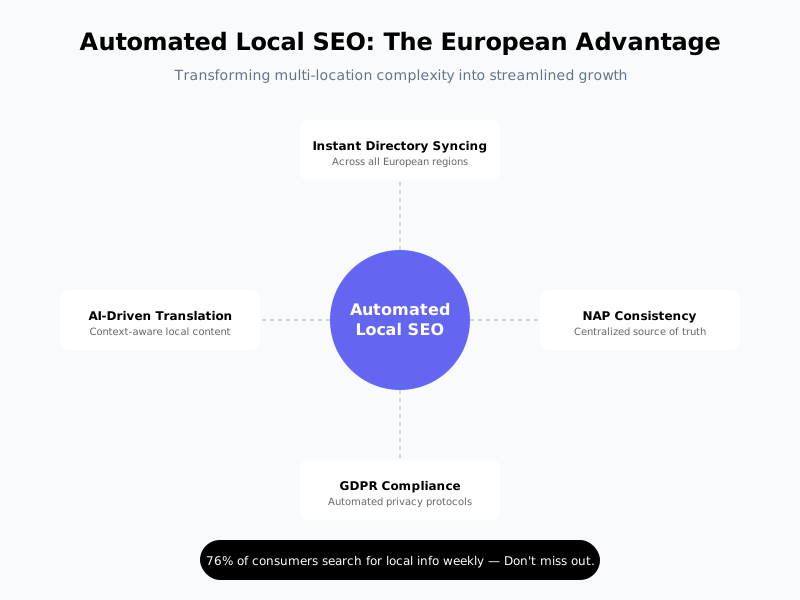
Below is a quick-reference summary of how automation transforms local search optimization for European multi-location brands:
| Challenge | Manual Approach | Automated Local SEO Approach |
|---|---|---|
| Directory Syncing | Manually updating Gelbe Seiten, Pages Jaunes, and Yell one by one. | Instant, one-click distribution across all regional European directories. |
| Language Barriers | Hiring translation agencies for localized city landing pages. | AI-driven, context-aware translation and local content generation. |
| NAP Consistency | Fragmented, outdated business listings across the web. | Centralised "source of truth" that automatically overrides incorrect data. |
| GDPR Compliance | Risk of improper handling of customer review data and IP tracking. | Built-in compliance protocols that protect user privacy automatically. |
What is Automated Local SEO and Why Does It Matter for European Multi-Location Brands?
At its core, automated local seo is the practice of using software, APIs, and machine learning to manage, optimise, and scale a business's online presence across geographical markets. Instead of manually updating individual listings, automated systems push accurate data, publish localized content, and monitor performance across hundreds of digital touchpoints simultaneously.
Scaling Visibility Across Diverse European Markets
Europe presents a unique challenge for multi-location enterprises. Unlike the relatively homogenous US market, a European expansion means navigating different cultures, languages, search behaviours, and local directories.
If your brand has branches in London, Paris, Berlin, and Madrid, a one-size-fits-all SEO strategy will fail. Managing these distinct profiles manually requires an enormous amount of time. Automation bridges this gap by allowing a lean marketing team to manage hundreds of locations from a single, unified dashboard.
From Manual Directory Updates to Autonomous Local Search Optimization
For years, local search optimization meant logging into individual platforms to change holiday hours or upload new photos. This tedious process is no longer viable.
Modern automation platforms sync directly with search engine APIs. When you update your store hours in a central database, those changes propagate across the web in real-time. This level of agility is critical; outdated information frustrates consumers and damages your brand's credibility.
Overcoming Multi-Lingual and Cross-Border Local SEO Hurdles
In Europe, cross-border commerce is a standard part of business. However, search engines expect high-quality, native-language signals to rank your locations.
A study by McKinsey reveals that European cross-border enterprise brands experience up to 35% higher customer acquisition efficiency when localized digital content is automated. Automation tools can generate culturally accurate, grammatically correct content in French, German, Spanish, and Italian, ensuring your brand feels local to every user.

How Does Automated Local SEO Work for Multi-Location Businesses?
To understand the power of automation, we need to look under the hood of a modern local SEO engine. It is not just about scheduling social media posts; it is about building a dynamic, self-correcting digital ecosystem.
Automated Google Business Profile Syncing and Management
Your Google Business Profile (GBP) is the cornerstone of your local search presence. For enterprise brands, managing these profiles at scale requires the Google Business Profile API.
An automated Google Business Profile management system allows you to push bulk updates, launch local posts, upload geo-tagged photos, and adjust holiday hours across all your locations instantly. This ensures that your business information is always accurate on Google Maps and search results, which is vital considering that official guidance from the Google Business Profile Help Center emphasises completeness and accuracy as primary ranking factors.
Programmatic Local Citation Automation Across European Platforms
While Google is dominant, European consumers rely on a fragmented network of regional directories. In Germany, it is Gelbe Seiten; in France, Pages Jaunes; in the UK, Yell.
[Central Data Source]
       │
       ├─► Google Business Profile API
       ├─► Apple Maps & Bing Places
       ├─► Gelbe Seiten (Germany)
       ├─► Pages Jaunes (France)
       └─► Yell (UK)
Local citation automation tools submit and synchronise your business’s Name, Address, and Phone number (NAP) across these regional directories. According to data cited by Search Engine Land, multi-location brands using automated local citation tools achieve a 43% average increase in Google Map Pack visibility within six months.
AI-Powered Geo-Targeted SEO Content Generation
Ranking in the "Map Pack" is only half the battle. To dominate local organic search, you need dedicated, high-quality landing pages for each city or region.
Creating hundreds of unique pages manually is incredibly expensive. Modern automated systems generate high-quality geo-targeted SEO content that includes local landmarks, regional terminology, and schema markup. This gives search engines the hyper-local context they need to rank your landing pages for localized queries.
What Are the Key Strategies to Implement Local Search Automation in Europe?
Transitioning from manual workflows to an automated model requires a strategic approach. Here is how European enterprises can successfully execute this transition.
Standardising NAP (Name, Address, Phone) Data at Scale
Before you turn on any automation tool, you must establish a single "source of truth" for your location data. Any inconsistencies in your NAP data will confuse search engine algorithms and hurt your rankings.
- Audit your existing listings: Identify duplicate profiles, incorrect phone numbers, and outdated addresses.
- Clean the data: Ensure formatting is identical (e.g., "Street" vs. "St.") across your internal database.
- Lock your listings: Use an automation platform to lock your profiles so third parties cannot suggest incorrect edits that auto-publish.
Pro Tip: Always use local phone numbers with regional area codes rather than a single national hotline. Search engines view local area codes as a strong signal of physical proximity.
Automating Hyper-Local Content and Review Management
Reviews are a major ranking factor in local search. Automating your review strategy involves setting up systems that trigger review requests via email or SMS immediately after a customer transaction.
Furthermore, AI-driven tools can draft personalized, context-aware responses to reviews in the customer's native language. This maintains high engagement metrics without requiring your local store managers to spend hours writing replies.
Ensuring Multi-Country GDPR and Local Data Compliance
When automating customer data collection for review generation or tracking local user behavior, European brands must remain strictly compliant with the General Data Protection Regulation (GDPR).
Ensure your automation software does not store sensitive personally identifiable information (PII) without explicit consent. For detailed compliance requirements, refer to the official European Union GDPR guidance.
My Editorial Take: Why "Near Me" is Dead, and What's Replacing It
Over the last decade, SEOs have been obsessed with "near me" search queries. We spent millions optimizing pages for terms like "bakery near me" or "car rental near me."
But here is my contrarian take: "Near me" is a legacy search pattern.
Consumers no longer need to type "near me" because search engines already know exactly where they are. Google, Apple, and emerging AI search engines assume local intent by default.
Instead of optimizing for explicit keywords, the future of local search is about implicit context.
This means your automated local SEO strategy must focus on building deep, semantic relevance. Your business needs to be mentioned in local news, referenced on regional blogs, and integrated into local event schemas.
If your automation tool only updates your NAP data on directory sites, you are playing a 2018 SEO game. True modern automation must generate local authority, not just local listings.
— Julian Thorne, Head of SEO Strategy at SiteLift
How Do You Measure the ROI of Automated Local SEO?
Investing in enterprise automation software requires clear proof of return. Fortunately, local search offers highly trackable, bottom-line metrics.
Tracking Geo-Specific Keyword Momentum and Local Pack Rankings
Standard rank tracking tools often fail in local SEO because search results vary from street to street. To measure real success, you need geofenced rank tracking.
These tools measure your visibility within a specific radius of your physical stores, tracking whether you land in the coveted Google "3-Pack" for high-intent searches.
Correlating Search Visibility to In-Store Foot Traffic and Conversions
Data from Google shows that 28% of local searches result in a purchase within 24 hours. To measure this impact, track the direct actions users take on your local listings:
- Clicks to call: Phone inquiries originating directly from Google Maps.
- Direction requests: Users actively navigating to your physical storefront.
- Local landing page conversions: Bookings, reservations, or click-and-collect orders placed on your local pages.
Measuring AI Engine Visibility (GEO) for Local Intent Queries
As search transitions toward conversational AI, we must measure our visibility in tools like ChatGPT, Gemini, and Google's AI Overviews. This is known as Generative Engine Optimization (GEO).
When a user asks an AI assistant, "Where is the best place to get a gluten-free pizza in Munich?", the AI synthesises data from local reviews, directory listings, and structured schema markup. Automated systems ensure your structured data is flawlessly formatted so these AI engines can easily recommend your locations.
Key Takeaways: Scaling Your European Footprint with Automation
Scaling a multi-location brand across Europe does not require an army of local marketers. By implementing an automated local SEO strategy, you can protect your brand's digital integrity, rank higher in local searches, and drive measurable in-store traffic.
Multi-Location Local SEO Action Plan for European Enterprises
To transition your brand from manual updates to an automated growth engine, follow this checklist:
- Consolidate your data: Create a master database of all location details, ensuring perfect NAP consistency.
- Connect your APIs: Integrate your location database with Google Business Profile, Apple Maps, and Bing Places.
- Map regional directories: Identify and sync with key European directories like Yell, Pages Jaunes, and Gelbe Seiten.
- Deploy local schema: Implement structured data on all local landing pages to feed search engines and AI models.
- Automate review loops: Set up automated triggers to ask for, monitor, and respond to customer reviews.
- Track geo-specific metrics: Use hyper-local rank tracking to monitor your visibility in the Google Map Pack.
If you want to take your organic visibility to the next level without the operational overhead, platforms like sitelift.io offer autonomous SEO and AI visibility growth. By automatically generating targeted content, distributing it across premium networks, and tracking keyword momentum in real-time, SiteLift helps multi-location enterprises dominate search engines on autopilot.
FAQ
What is automated local SEO and how does it differ from traditional SEO?
Automated local SEO focuses specifically on optimizing a business's online presence for location-based search queries. While traditional SEO targets broad, informational keywords globally, local SEO targets regional intent (e.g., "dentist in Berlin"). The automated aspect uses software and APIs to manage listings, content, and reviews across hundreds of locations simultaneously, eliminating manual updates.
How does local citation automation work across multiple European countries?
Local citation automation platforms connect via API to a vast network of global and regional directories. When you update your business details in a central dashboard, the software automatically translates and pushes those updates to country-specific directories like Pages Jaunes in France, Gelbe Seiten in Germany, and Yell in the UK, ensuring consistent NAP data everywhere.
Can automated local SEO generate localized content in multiple languages?
Yes. Modern automation platforms use advanced AI models to generate high-quality, contextually accurate content in multiple European languages. These systems do not just translate text literally; they adapt the content to reflect local idioms, regional landmarks, and specific search behaviours unique to each country.
Is automated Google Business Profile management compliant with search engine guidelines?
Absolutely. Legitimate automation platforms use Google’s official Business Profile APIs to publish updates, respond to reviews, and adjust store hours. Using official APIs is fully compliant with Google's guidelines and is the recommended method for enterprise brands managing multiple locations.
How quickly can a multi-location enterprise see ROI from local search optimization automation?
Many brands see a noticeable lift in local visibility and search impressions within 30 to 60 days of cleaning up their NAP data and launching automated citations. Because local searches have high commercial intent, this increased visibility typically translates into measurable increases in phone calls, direction requests, and foot traffic within the first quarter of implementation.
Article generated by SiteLift
Topics Covered:
- automated local seo
- local search optimization
- automated Google Business Profile
- local citation automation
- geo-targeted SEO content
More from SiteLift

SEO Tools in 2026: How to Build an Autonomous Stack That Grows Traffic on Autopilot
Discover how to build an autonomous stack with modern AI SEO tools, automated publishing workflows, and real-time rank tracking to grow organic traffic.

Repurposing Content for SEO: How to Multiply Organic Reach Across Channels
Learn how repurposing content for SEO multiplies organic reach. Discover step-by-step strategies for syndication, AI visibility, and automation.

Fresh Content SEO: How Publishing Frequency and Recency Drive Rankings
Discover how fresh content SEO, publishing velocity, and Google's QDF algorithm impact rankings and AI search visibility. Build a scalable freshness engine.