Mastering Search Intent Optimization: How to Align AI Content with Real User Needs
If you have spent any time looking at your analytics lately, you have likely noticed a frustrating trend: traffic is harder to win, and even harder to keep. The reality of modern SEO is that search engines no longer just match words on a page; they match the underlying motivation of the searcher. Achieving true search intent optimization is now the defining factor between a website that drives pipeline value and one that merely occupies server space.

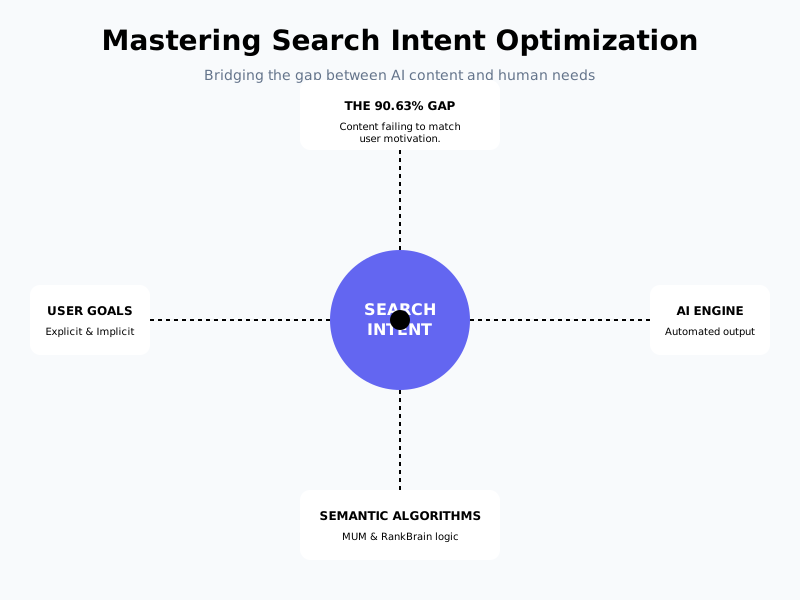
According to a study by Ahrefs, a staggering 90.63% of content gets no organic traffic from Google. In almost every case, this failure stems from a fundamental mismatch between what the user actually wanted and what the content delivered. When we introduce artificial intelligence into the publishing mix, this gap often widens into a chasm.
Let’s explore how to bridge this gap, ensuring your automated content engines produce material that aligns perfectly with real user expectations.
What Is Search Intent Optimization and Why Is It Critical for AI Content?
At its core, search intent optimization is the practice of structuring, designing, and writing your content to satisfy the explicit and implicit goals of a searcher. It is not merely about inserting the right keywords into your headings. Instead, it is about understanding why someone typed a specific phrase into a search box and delivering the most friction-free path to their answer.
The Evolution from Keyword Matching to Intent Alignment
In the early days of search, search engine optimization was a game of linguistic matching. If you repeated a keyword enough times, search engines assumed your page was highly relevant. Today, Google's semantic algorithms—powered by deep learning models like MUM and RankBrain—look at search queries through a conceptual lens.
Modern search engines analyze search history, user location, and real-time behaviour to decipher exactly what a searcher is trying to accomplish. For European B2B and SaaS brands, this means search engines can easily distinguish between a developer looking for a technical API documentation page and a procurement manager seeking a vendor comparison table. If your content does not immediately signal that it contains the exact resource the searcher needs, they will bounce back to the search results page within seconds.
The Hidden Cost of Unaligned AI-Generated Content
The rise of generative AI has made content creation incredibly accessible. However, raw, unguided AI content generation poses a significant risk to organic visibility. Large language models (LLMs) are trained to predict the next most logical word based on historical data. By default, they tend to write highly generalized, encyclopedic overviews.
When you ask a standard AI tool to write about a topic, it often produces a generic essay that tries to cover everything from history to basic definitions. This is the exact opposite of what a searcher wants when they have a highly specific query.
Google’s helpful content guidelines make it clear that search engines reward original, high-utility, people-first content. If your automated pipeline is simply churning out generic summaries, search engines will quickly deprioritize your domain, resulting in a severe loss of search momentum.
How Do You Conduct Effective User Intent Analysis for AI Content?
Before you write a single line of text or feed a prompt to an AI model, you must perform a thorough user intent analysis. This process ensures that your content strategy matches the actual expectations of your target audience.

Decoding SERP Features and Top-Ranking Content Patterns
The absolute best way to understand what searchers want is to look at the search engine results pages (SERPs) themselves. Google has spent billions of euros refining its algorithm to show exactly what users interact with most.
When analyzing the SERP for a target keyword, pay close attention to the following features:
- Featured Snippets: If a snippet is present, it indicates that users are looking for a direct, concise definition or a step-by-step list. Your content must provide a clear, bite-sized answer near the top of the page.
- People Also Ask (PAA) Blocks: These questions reveal the implicit sub-intents and secondary queries of your audience. They are a goldmine for structuring your subheadings.
- Video Carousels or Image Packs: If the SERP is highly visual, an text-only article will struggle to rank. You must integrate relevant media, diagrams, or interactive elements.
Categorising Informational Search Queries vs Transactional Search Intent
To scale your content production successfully, you must categorise your target keywords into distinct intent buckets.
According to research from Moz on understanding search intent, queries generally fall into four primary categories:
| Intent Category | Searcher Goal | Example Query (European B2B) | Optimal Content Format |
|---|---|---|---|
| Informational | Learn about a topic or solve a problem | "How to comply with GDPR data portability" | Comprehensive guides, checklists, calculators |
| Commercial | Research options, compare solutions | "Best automated invoicing software Germany" | Comparison tables, listicles, product reviews |
| Transactional | Complete a purchase or sign up | "SiteLift pricing plans" | High-converting landing pages, clear pricing grids |
| Navigational | Find a specific website or portal | "SiteLift login" | Clean site architecture, clear brand indexing |
Pro Tip: Never try to target informational search queries and transactional search intent with the same page. A user looking to understand a concept will immediately bounce if they are forced onto a hard-sell product landing page.
Identifying Implicit Sub-Intent and User Context
Beyond the broad categories, you must identify the implicit context of the searcher. For instance, a European user searching for "e-invoicing regulations 2025" has a highly localized, time-sensitive intent. They do not want a history of invoicing; they want to know exactly what compliance changes they need to implement in their business this year.
Analyzing the regional context, industry standards, and searcher maturity level allows you to build highly targeted briefs for your AI writing engines.
How Can AI SEO Copywriting Be Scaled Without Sacrificing Intent Satisfaction?
Scaling content production with AI does not mean you have to settle for low-quality, generic output. By implementing structured workflows, you can leverage AI SEO copywriting to produce highly targeted, intent-aligned content at scale.
Structuring Prompts for Intent-Driven AI Outputs
To get high-utility content from AI, you must move away from simple, one-line prompts. Your prompts should act as detailed creative briefs, defining the role, target audience, intent category, and structural rules.
Here is an example of a structured prompt framework for an informational query:
Role: You are an expert European B2B SaaS SEO copywriter.
Task: Write an in-depth section answering the query: "How to automate internal link building".
Target Audience: In-house SEO managers in European enterprise companies.
Search Intent: Informational. The reader wants highly practical, actionable steps, not high-level theory.
Requirements:
1. Provide a direct, 2-sentence answer in the first paragraph.
2. Create a numbered list of 4 actionable steps.
3. Avoid generic filler words or introductory clichés.
4. Include a "Pro Tip" callout box with an advanced strategy.
By constraining the AI's output parameters, you ensure the resulting copy directly addresses the user's immediate needs, preventing the fluff that typically triggers high bounce rates.
Integrating E-E-A-T and Unique Brand Value into Automated Drafts
Google's search quality evaluator guidelines place immense weight on Experience, Expertise, Authoritativeness, and Trustworthiness (E-E-A-T). Purely automated AI drafts often lack these qualities because they have no real-world experience.
To inject E-E-A-T into your automated pipelines, you must feed the AI your proprietary data, internal subject matter expert (SME) quotes, and specific case studies. Instead of letting the AI hallucinate examples, provide it with real-world scenarios to reference.
For instance, if you are writing about search experience optimization, have your AI tool integrate specific performance data or customer success stories from your own platform.
Optimising Information Density to Satisfy Informational Search Queries
According to Backlinko, 99% of search queries fall into four primary intent categories, with informational search queries making up over 80% of total web searches. Because informational queries dominate the search landscape, your content must be highly scannable and information-dense.
Research from SparkToro indicates that over 58% of Google searches result in zero clicks. This means users are increasingly looking for immediate answers on the SERP or within the first few paragraphs of a page.
To satisfy this behaviour, structure your articles using the "Inverted Pyramid" writing style: state the most important information or direct answer at the very beginning of the section, and then provide the supporting details and deep-dive analysis further down.
How Do You Bridge the Gap Between Informational Search and Transactional Conversion?
Winning organic traffic is only half the battle. To drive actual business growth, you must seamlessly guide users from high-volume informational queries down to high-value transactional actions.
Mapping AI Content Across the B2B Buyer Journey
To convert casual readers into customers, your content pipeline must be mapped to the entire buyer journey. A user might discover your brand through a top-of-funnel (ToFu) informational article, but you need a logical internal linking structure to guide them toward middle-of-funnel (MoFu) commercial comparison guides, and eventually to bottom-of-funnel (BoFu) transactional landing pages.
For example, if a user lands on an article discussing user experience optimization, you should naturally link to your guide on SEO User Experience and SXO to deepen their engagement.
If they are looking to solve immediate visibility issues, guiding them to an article on how to ensure instant search engine indexing helps build trust before you introduce your automated product solutions.
Crafting High-Converting CTAs for Transactional Search Intent
When a user displays transactional search intent, they are ready to act. Your call-to-action (CTA) elements must match this state of mind.
Instead of generic "Click Here" buttons, use context-aware CTAs that address the user's specific pain point. If they are reading about the complexities of scaling content, a CTA like "Automate Your SEO Pipeline with SiteLift" is infinitely more effective than a standard "Contact Us" form.
Measuring Intent Alignment via Search Momentum and Engagement
To validate whether your search intent optimization efforts are working, you must look beyond raw traffic numbers. Track these key metrics to measure true intent satisfaction:
- Average Engagement Time: If users spend several minutes on your long-form informational guides, they are actively consuming your content.
- Scroll Depth: High scroll depth indicates that the layout, structure, and readability of your content are keeping users engaged.
- Search Momentum: Monitor your keyword rankings and featured snippet acquisitions. A steady upward trend indicates that search engine algorithms recognize your content as highly helpful and aligned with user queries.
Key Takeaways: Mastering Search Intent Optimization in the AI Era
To help your team implement these strategies consistently, we have summarized the core components of intent-driven AI content creation in the comparison table below.
| Optimization Phase | Traditional Keyword Focus | Intent-Driven AI Focus | Expected Business Outcome |
|---|---|---|---|
| Research | Volume & Keyword Difficulty | SERP Layout & Sub-Intent Analysis | Higher relevance, lower bounce rates |
| Content Creation | High-volume keyword stuffing | High-density AI SEO copywriting | Featured snippet wins, improved E-E-A-T |
| User Experience | Text-heavy, generic layouts | Interactive, scannable, rich media | Increased time on site, better SXO metrics |
| Conversion | Hard-sell CTAs on all pages | Contextual, journey-mapped CTAs | Higher conversion rates, qualified pipeline |
The Search Intent Checklist for AI Publishers
Before publishing any automated content, ensure your editorial team runs through this quick checklist:
- Does the page directly answer the primary search query in the first 150 words?
- Have we analyzed the current SERP features and matched our content format to them?
- Is the content structured with clear headings that address People Also Ask queries?
- Have we integrated unique data, expert insights, or brand-specific case studies?
- Is there a logical, friction-free path for the reader to take the next step in their journey?
Continuous Intent Monitoring for Compound Growth
Search intent is not static. User expectations, search engine algorithms, and market dynamics change constantly. A query that had informational intent last year might shift toward transactional intent this year as new software solutions enter the market.
To maintain your organic visibility, you must continuously track keyword momentum and update your existing content to reflect these shifting SERP landscapes.
Why Intent-First Automation is the Most Underrated Growth Lever
Many marketing teams view AI content generation as a shortcut to volume. They focus on publishing hundreds of pages a week, hoping that sheer quantity will win the day. This is a fundamental misunderstanding of how modern search engines operate.
In my experience, the brands that dominate organic search are not those that publish the most content, but those that publish the most aligned content.
Scaling volume without scaling intent alignment is a recipe for algorithmic penalties and wasted resources. This is exactly why we built SiteLift.
Instead of just generating generic text, SiteLift acts as an autonomous SEO and visibility engine. It maps user intent, structures content to satisfy search engines and human readers alike, and publishes directly to your CMS on autopilot.
By automating the tedious analysis and optimization phases, you can focus on what truly matters: growing your business and building relationships with your audience.
— Lukas Vance, Head of Organic Growth at SiteLift
FAQ
What is search intent optimization?
Search intent optimization is the process of aligning your website’s content, structure, and design with the specific goals and expectations of the user searching for a given query. It focuses on satisfying user needs rather than just matching keywords.
How does user intent analysis improve search engine rankings?
User intent analysis helps you understand the exact format, depth, and context of content that search engines currently reward for a specific query. By creating content that matches these expectations, you reduce bounce rates, increase engagement, and signal to search engines that your page is highly valuable, leading to higher rankings.
How can AI SEO copywriting be adapted to meet transactional search intent?
To satisfy transactional intent, AI SEO copywriting must be highly focused on action, clarity, and value. Instead of long informational paragraphs, prompts should instruct the AI to generate clear value propositions, transparent pricing details, comparison tables, and highly contextual call-to-action (CTA) copy.
Why does standard AI content often fail to satisfy informational search queries?
Standard AI content often fails because LLMs default to writing broad, generalized overviews that lack specific, actionable insights. Informational searchers usually want direct, concise answers to highly specific questions, which raw AI drafts frequently bury under generic introductory fluff.
What are the main types of search intent in modern SEO?
The four primary types of search intent are informational (seeking knowledge), navigational (looking for a specific website), commercial (researching options before buying), and transactional (ready to make a purchase or complete an action).
Article generated by SiteLift
Topics Covered:
- search intent optimization
- user intent analysis
- informational search queries
- transactional search intent
- AI SEO copywriting
More from SiteLift

SEO Tools in 2026: How to Build an Autonomous Stack That Grows Traffic on Autopilot
Discover how to build an autonomous stack with modern AI SEO tools, automated publishing workflows, and real-time rank tracking to grow organic traffic.

Repurposing Content for SEO: How to Multiply Organic Reach Across Channels
Learn how repurposing content for SEO multiplies organic reach. Discover step-by-step strategies for syndication, AI visibility, and automation.

Fresh Content SEO: How Publishing Frequency and Recency Drive Rankings
Discover how fresh content SEO, publishing velocity, and Google's QDF algorithm impact rankings and AI search visibility. Build a scalable freshness engine.