High Intent Keywords: How to Find and Win Searches Ready to Convert

If you only chase traffic, you'll get visitors who never buy. I've seen sites with 100k monthly visits struggle to pay for hosting, while leaner sites with 5k visits print pipeline. The difference almost always comes down to high intent targeting.
High intent keywords are the searches people type when they're ready to act — to compare, to trial, to buy. This guide breaks down how to find those queries, validate them with SERP and CPC data, and build a bottom funnel seo strategy that turns organic search into revenue, not just pageviews.
Key Takeaways
| What You'll Learn | Why It Matters for Revenue |
|---|---|
| What high intent means across transactional and commercial queries | Focus budget on terms that convert at 3-10%, not <1% like informational posts |
| How to spot intent signals in modifiers, SERPs, and CPC data | Avoid wasting months ranking for curiosity clicks |
| Commercial intent keyword research from PPC, Search Console, and customer voice | Uncover high intent keywords competitors miss |
| Content blueprints for comparisons, alternatives, and pricing pages | Match buyer expectation and lift conversion rate |
| How to scale creation, distribution, and tracking | Compound wins across hundreds of long-tail variations |
What Are High Intent Keywords and Why Do They Drive Revenue?
High intent keywords signal a searcher is close to a decision. Instead of what is CRM software, they search best CRM for real estate under $50 or hubspot vs salesforce pricing.
That shift in wording is everything. It moves you from educator to closer.
Defining the Four Pillars of Search Intent
Google generally buckets intent into four types, a framework well explained in Search Engine Land's guide to search intent:
- Informational: how does email automation work — wants to learn
- Navigational: mailchimp login — wants a specific site
- Commercial: best email marketing tool for ecommerce — wants to compare before buying
- Transactional: buy klaviyo annual plan or klaviyo pricing — wants to act now
Transactional search intent and commercial intent are your money terms. Informational has its place for authority, but commercial and transactional queries sit at the bottom of the funnel where budget gets released.
For a deeper look at aligning pages to these motivations, see this breakdown of user intent analysis for AI content.
The ROI Advantage of Bottom Funnel SEO Strategy
Here's why I prioritize bottom-funnel first for every new site: math.
According to First Page Sage's B2B conversion benchmarks, bottom-of-funnel landing pages optimized for transactional keywords achieve average organic conversion rates between 3% and 10%, compared to less than 1% for top-of-funnel blog posts. You can explore their B2B SEO conversion research for the full breakdown by page type.
That 5-10x gap changes CAC dramatically. You need 10x less traffic to get the same number of demos if you rank for accounting software for freelancers instead of what is accounting.
Research from Google on mobile behavior adds urgency: searchers using commercial intent modifiers on mobile make purchase decisions within 24 hours in over 50% of cases, as detailed in Think with Google's micro-moments research. When intent is high, the window to win is short.
High Intent vs. High Volume: Quality Over Quantity
High-volume keywords look sexy in a dashboard. They rarely pay bills.
| Factor | High Intent (Low Volume) | High Volume (Low Intent) |
|---|---|---|
| Example | best project management tool for agencies (210 searches/mo) | what is productivity (18,000 searches/mo) |
| Searcher goal | Shortlist and buy | Browse and learn |
| Typical conversion | 3-10% | <1% |
| Sales cycle impact | Days to weeks | Months, if ever |
| Competition | Narrow, beatable with better UX | Broad, dominated by publishers |
According to Ahrefs' search traffic study, over 90% of web content gets no organic traffic from Google, often because it targets non-specific informational queries rather than focused, high-intent terms.
Pro Tip: Start your keyword map from the pricing page outward, not from the blog inward. If a keyword couldn't logically link to a demo, trial, or checkout, deprioritize it.
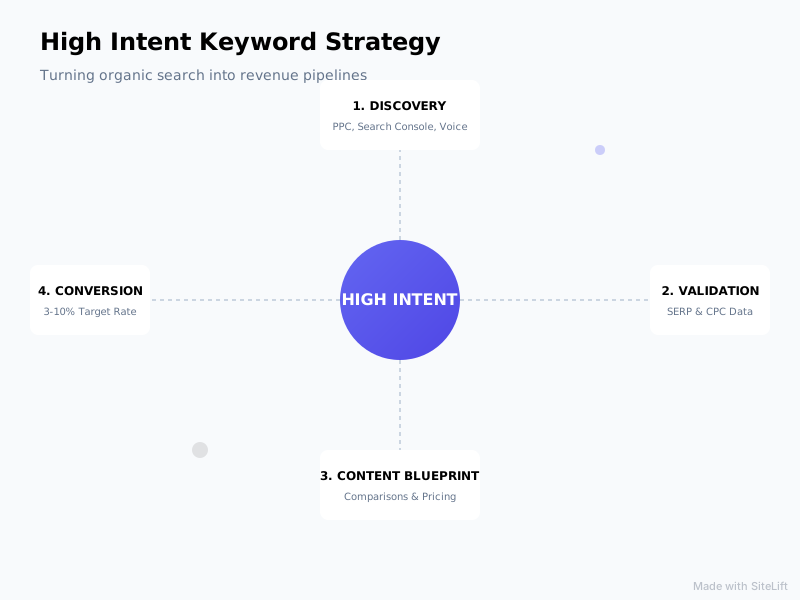
Infographic by SiteLift
How Do You Identify High Intent Search Queries?
You don't guess intent. You read the clues searchers and advertisers leave behind.
Spotting High-Intent Modifiers and Query Signals
Modifiers are adjectives and verbs that reveal buying stage. I group them into three buckets:
1. Transactional modifiers — ready to transact: buy, order, pricing, cost, quote, hire, book, demo, trial, coupon, discount, near me, same-day delivery
Example: order standing desk same day delivery, quickbooks pricing per user
2. Commercial modifiers — ready to compare: best, top, review, vs, versus, alternative, compare, pros and cons, for [use case], under [$]
Example: best standing desk for small apartment, notion vs asana for agencies, mailchimp alternative
3. Hyper-specific long-tail: These have no classic modifier but scream intent through detail: hipaa compliant telehealth platform with stripe integration.
Longer doesn't always mean lower value. In B2B and SaaS, 6-10 word phrases often convert best because only a real buyer knows those details.
Analyzing SERP Features for Commercial Context
Before I target any term, I Google it in incognito and read the SERP like a buyer.
High commercial intent SERPs show:
- Shopping ads and product carousels
- People Also Ask boxes like “How much does X cost?”
- Review stars, pricing tables, and comparison snippets
- Landing pages and product pages ranking, not Wikipedia or Reddit explainers
If the top 10 is all Ultimate Guide to... blog posts, Google thinks the intent is informational — even if you think it's transactional. Don't fight Google. Either pick a different keyword or build the page type Google rewards.
If the top 10 is G2, Capterra, vendor pricing pages, and YouTube reviews, you've found a commercial SERP worth chasing.
Evaluating Cost Per Click (CPC) as an Intent Metric
CPC is my favorite lie detector for commercial intent keyword research.
No one bids $28 per click for fun. When advertisers consistently pay high CPCs in Google Ads, that keyword drives pipeline. Use that data to prioritize organic:
- $0.50 - $2 CPC: Usually informational or early research
- $5 - $15 CPC: Solid commercial intent in most B2B niches
- $20+ CPC: Bottom-funnel gold — crm implementation services, business cyber insurance quote
Check CPC in Ahrefs, Semrush, or Google Keyword Planner. Filter your list for CPC > $5 and bottom-funnel SERP features, and you'll instantly cut 70% of vanity keywords.
Pro Tip: Export your competitors' paid keywords and sort by CPC descending. Those are the exact high intent searches they profit from — now go win them organically for free.
What Methods Work Best for Commercial Intent Keyword Research?
Forget brainstorming in a spreadsheet. The best high intent keywords come from real buyer language.
Mining Analytics and PPC Conversion Data
Your own data beats any tool:
- Google Search Console: Filter Queries containing best, vs, alternative, pricing, review, top, compare. Sort by impressions with position 8-20. Those are near-wins.
- Google Ads Search Terms Report: Sort by conversions, not clicks. A term with 40 clicks and 6 demos beats a term with 2,000 clicks and zero demos.
- GA4 Path Exploration: See which landing pages actually initiate checkout or demo booking. Reverse-engineer the queries that drive them.
If you run no ads yet, mine Search Console plus a tool like Ahrefs Keywords Explorer. Look for Keyword Difficulty under 30 with CPC above $5 — that's the sweet spot for new sites.
Learning to identify high-value organic search keywords automatically can speed this triage dramatically.
Customer Intelligence: Reviews, Forums, and Sales Calls
Buyers describe problems differently than marketers do. Steal their words.
- G2, Capterra, Trustpilot: Filter 3-star reviews. You'll find phrases like great but too expensive for small teams → target affordable [category] alternative.
- Reddit and Quora: Search site:reddit.com best [your category] for. Threads titled What do you actually use for X? are keyword goldmines.
- Sales calls and support tickets: Pull transcripts in Gong, Intercom, or HubSpot. Tag every How much..., Do you integrate with..., How are you different from... question. Each one is a bottom-funnel page idea.
I once turned 11 sales-call objections into 11 comparison pages. Three of them now drive 40% of demo requests.
Competitor Gap Analysis for Bottom-Funnel Phrases
Most competitors ignore granular comparisons. That's your opening.
In Ahrefs Site Explorer, enter a rival domain > Top Pages > filter URL containing vs, alternative, comparison, pricing, review. You'll often find their highest-converting pages have low traffic but rank for dozens of buyer terms.
Then run Content Gap for 3-4 competitors and filter for vs, best, alternative. Target the overlaps they all rank for but you don't. Those are proven converters.
To keep this loop running without spreadsheets, many teams now use automated keyword checking to validate and prioritize winners faster.

How Do You Create Content That Wins High Intent Searches?
Ranking is only half the battle. If your page doesn't feel like the obvious next step toward purchase, searchers bounce back to a competitor.
Matching Content Type to Buyer Expectation
Map transactional search intent to the right template:
| Intent | Search Example | Winning Page Type |
|---|---|---|
| Ready to buy | buy noise cancelling headphones sony | Product / landing page with price, stock, shipping |
| Ready to shortlist | best CRM for startups 2026 | Curated roundup with pros/cons, pricing tiers |
| Ready to switch | [competitor] alternative | Alternative page: why switch, migration, comparison table |
| Ready to validate | [tool A] vs [tool B] | Head-to-head comparison with verdict by use case |
| Ready to justify cost | [tool] pricing | Transparent pricing guide with ROI calculator, FAQs |
Don't publish a 3,000-word Ultimate Guide when the searcher wants a pricing table. Match the job, not your content calendar.
Designing High-Converting Product Comparison Pages
Comparison and alternative pages are the workhorses of any bottom funnel seo strategy. Here's my blueprint:
- H1 with clear verdict: Asana vs Monday: Which Is Better for Agencies in 2026?
- TL;DR box in first 100 words: Who should pick which, in 3 bullets.
- Side-by-side table: Pricing, key features, integrations, support, free trial — scannable in 30 seconds.
- Real screenshots, not stock: Show UI, not smiling teams.
- Pros / cons with nuance: Admit where competitor wins. It builds trust and actually lifts conversion.
- Migration section: Switching from Asana to [You] in 3 steps. This kills the #1 objection.
- FAQ schema: Answer Which is cheaper? Which integrates with Slack? to win rich results.
Keep it updated. Nothing kills trust faster than 2022 pricing in a 2026 search.
Optimizing On-Page CRO and Call-to-Actions (CTAs)
For high intent traffic, SEO and CRO are the same job.
- Place a primary CTA above the fold and after every major section — trial, demo, quote, or add-to-cart.
- Add trust signals near CTAs: 4.8 on G2 (2,300 reviews), SOC 2 certified, 30-day money-back.
- Use sticky comparison tables with a Try Free button that follows scroll on mobile.
- Replace generic Learn More with intent-matched copy: See Pricing, Compare Plans, Get Custom Quote.
- Add live chat or a pricing calculator. Interactive elements keep commercial visitors on-page longer, which correlates with higher rankings and conversions.
Test one thing at a time: headline promise, CTA wording, table order, or social proof placement. Small lifts on 8% converting pages compound fast.
How Can You Scale High Intent Content Generation and Distribution?
The problem with bottom-funnel SEO? There are hundreds of valuable variations — best X for Y, X vs Z, X alternative — and manual publishing can't keep up.
Automating Bottom-Funnel Page Creation
This is where programmatic workflows shine. Instead of writing one comparison page at a time, build templates for:
- {Competitor} Alternative pages
- {Use Case} + {Category} pages (best invoicing app for contractors)
- {Location} + {Service} pages (emergency plumber austin 24hr)
Feed them with structured data — pricing, features, reviews, FAQs — then add human editing for nuance and accuracy. You get coverage without cookie-cutter thin content.
If you want to align that automation with real buyer needs rather than just keywords, this guide to scaling AI SEO copywriting with intent analysis is worth bookmarking.
Building High-Authority Off-Page Signals
Transactional queries are competitive because they pay. You won't win on content alone.
- Earn links from roundups and best tools listicles — offer updated data, free screenshots, or affiliate partnerships.
- Turn every comparison page into a linkable asset with original pricing data or survey results. Learn how to turn every article into a passive backlink magnet to fuel this.
- Distribute pages beyond Google: repurpose comparisons into YouTube Shorts, LinkedIn carousels, and Reddit answers where buyers research.
- Get listed on G2, Capterra, and niche directories with consistent NAP and category messaging. Those listings often rank and send pre-qualified clicks.
Authority plus distribution is what pushes a great comparison page from position 9 to position 2.
Tracking Keyword Momentum and Conversion Attribution
Stop reporting only rankings. For high intent SEO, track money:
- Keyword momentum: How many bottom-funnel terms moved from >20 to top 3 in last 30/60/90 days?
- Organic conversion rate by intent: Segment landing pages into informational vs commercial vs transactional. Your commercial segment should trend toward that 3-10% benchmark.
- Pipeline value: Connect Search Console + CRM. Attribute demo value and closed-won revenue to first-touch organic pages.
- SERP share of voice: What % of your core best / vs / alternative set do you own vs competitors?
When you can say these 22 high intent pages drove $180k in pipeline last quarter, SEO stops being a cost center.
My Take: Why Most Marketers Get High Intent Backwards
I'll be honest: I wasted two years doing this backwards.
I chased informational traffic because it was easier to rank and looked great in monthly reports. We hit 80k visits and celebrated. Then sales asked where the demos were, and I had no good answer.
Flipping to high intent felt scary at first. Lower volume. Harder SERPs. Slower initial growth. But within six months, demos from organic tripled on one-third the traffic. That changed how I think about SEO forever.
In my experience, most teams don't need more content. They need braver content — pricing breakdowns competitors hide, honest comparisons where you don't always win, use-case pages so specific they feel like sales enablement.
That's also why I'm bullish on automation done right. Not spammy AI blogs, but systematic coverage of every vs, alternative, best for variation your buyers actually search, published consistently and kept fresh. Humans bring judgment and proof; machines bring speed and coverage. You need both to dominate bottom-funnel now.
If you're still measuring success by traffic alone, you're optimizing for applause, not revenue. Start from the checkout and work backwards.
How SiteLift Helps You Capture High Intent Demand on Autopilot
Manually building 100 comparison and alternative pages while keeping pricing fresh is brutal. That's exactly the grind sitelift.io was built to remove.
SiteLift is an autonomous SEO platform that finds high intent gaps, generates conversion-focused pages, distributes them across a premium network, and tracks keyword momentum in real time — all synced with your CMS. Instead of publishing one page a week, you cover entire clusters of transactional and commercial terms on autopilot.
If bottom-funnel is your priority, start with your 20 highest-CPC competitor terms and let automation build the moat while you focus on closing the leads.
FAQ
What is the difference between high intent and low intent keywords?
High intent keywords show readiness to buy or decide — buy, pricing, best, vs, alternative, near me. Low intent keywords show curiosity — what is, how does, history of, ideas for. High intent terms have lower volume but convert far better because the searcher already knows what they need and is choosing a provider.
How can you tell if a keyword has transactional search intent?
Check three signals: 1) Modifiers like buy, order, pricing, book, demo, quote. 2) SERP features like Shopping ads, product carousels, and vendor landing pages ranking. 3) High CPC — if advertisers pay $10+ per click, it almost certainly drives transactions. If all three align, treat it as transactional.
Why are high intent keywords important for SEO strategy?
They connect SEO directly to revenue. While informational posts often convert under 1%, bottom-funnel pages can convert at 3-10%. Targeting high intent reduces acquisition cost, shortens sales cycles, and proves SEO ROI to leadership in pipeline, not just traffic.
What are examples of high intent keyword modifiers?
Transactional: buy, pricing, cost, order, hire, book, demo, trial, coupon, near me. Commercial: best, top, review, vs, alternative, compare, pros and cons, for small business. Pair them with specifics: best email tool for Shopify under $50, hubspot alternative for startups.
How do you rank for competitive high intent keywords?
Match the expected page type exactly, build a better UX than the current top 3 (clear tables, real screenshots, updated pricing, strong CTAs), earn links from listicles and directories, and cover long-tail variations first to build topical authority. Then work up to head terms as momentum and conversions compound.
— sitelift.io
Topics Covered:
- high intent
- high intent keywords
- transactional search intent
- bottom funnel seo strategy
- commercial intent keyword research
More from SiteLift

Mastering Search Intent Optimization: How to Align AI Content with Real User Needs
Learn how to conduct user intent analysis and scale AI SEO copywriting to align automated content with real user needs.

Competitive Keyword Analysis: How to Find and Steal Rival Keywords That Convert
Master competitive keyword analysis with our step-by-step guide. Learn how to run a keyword gap analysis, prioritize high-value terms, and scale traffic.

SEO Content Planner: How to Plan 90 Days of Compounding Content on Autopilot
Learn how to use an SEO content planner to build a 90-day compounding strategy. Automate briefs, map topical authority, and scale traffic on autopilot.