SEO Content Planner: How to Plan 90 Days of Compounding Content on Autopilot

Most organic search strategies collapse after four weeks. A team launches an ambitious publishing schedule, burns out creating manual content briefs, and watches their published posts sit in indexing limbo without driving traffic.
According to Ahrefs, 90.63% of all web pages get zero search traffic from Google, largely because creators target isolated keywords rather than building systemic authority. If you want to rank consistently, you cannot treat content creation as a series of random blog posts. You need a dedicated SEO content planner system that maps topical clusters, automates brief generation, and sets up a high-velocity publishing pipeline.
In this guide, we will walk step-by-step through how to build a 90-day content plan that compounds traffic automatically—without burning out your editorial team.
Prerequisites: What Do You Need Before Building a 90-Day SEO Content Plan?
Before building your schedule, establish your strategic foundation. Running a high-output strategy without clear prerequisites yields fast production of pages that ultimately convert nobody.
Defining Your Core Business Pillars
Start by identifying the 3 to 5 core business pillars that drive revenue. If you sell enterprise software, your pillars are not vague ideas like "productivity"; they are explicit solution verticals like "workflow automation," "team permissioning," and "SaaS cost optimization." Every article you plan must tie directly back to one of these core pillars.
Audience Search Intent & Buyer Persona Mapping
Categorize target search terms across the full funnel:
- Informational Intent: High-volume, educational queries ("what is topical authority").
- Commercial Intent: Comparison and evaluation queries ("best content planning tools").
- Transactional Intent: High-intent product terms ("automated content pipeline platform").
Research from Content Marketing Institute shows that 73% of B2B marketers who document their content strategy achieve higher organic marketing success than those who operate ad-hoc. Documenting your persona search intent keeps your queue focused on business growth rather than vanity metrics.
Tools Required for Automated Execution
To run a compounding workflow on autopilot, assemble your tech stack:
- Keyword Research & Topic Discovery Tool: (e.g., Ahrefs, Semrush) to discover search volume and keyword difficulty.
- SEO Editorial Calendar: A central workspace to organize publish dates, pillar relationships, and assignment statuses.
- Automated Content Brief Workflow Tool: Software capable of scraping top-ranking SERPs, extracting NLP entities, and auto-generating structured outlines.
If you aren't sure which platforms fit your stack best, review our round-up of the best SEO project management tools to streamline your production engine.
Step 1: How Do You Conduct Topical Authority Planning with an SEO Content Planner?
Topical authority means proving to search engines that your site completely covers a subject. Rather than chasing single, disconnected keywords, topical authority planning focuses on owning entire knowledge domains.
                  +------------------------+
                  |  PILLAR PAGE (Hub)     |
                  |  "SEO Content Planner" |
                  +-----------+------------+
                              |
        +---------------------+---------------------+
        |                                           |
+-------v-------+                           +-------v-------+
| Cluster Node  |                           | Cluster Node  |
| "Topical      |                           | "Content      |
|  Authority"   |                           |  Briefs"      |
+---------------+                           +---------------+
Mapping Pillar Pages and Content Clusters
Begin by selecting a comprehensive broad keyword for your pillar (e.g., "SEO content planner"). This page serves as the authoritative central hub. Next, map out 8 to 15 supporting cluster pages that drill down into specific sub-topics, such as "topical authority planning," "keyword clustering tactics," or "automated content brief workflows."
To dive deeper into structuring these architectural hubs, check out our guide on building a strategic content map to see how entity clustering drives search velocity.
Keyword Clustering to Eliminate Keyword Cannibalization
Keyword cannibalization occurs when multiple pages on your site compete for the exact same search query, confusing Google and diluting your rankings.
Group keywords by SERP similarity. If Google displays nearly identical search results for two different terms, merge them into a single comprehensive article.
Assign one primary keyword and 3 to 5 secondary semantic terms to every planned URL.
Create explicit internal linking maps so supporting sub-pages link upward to the parent pillar using descriptive anchor text.
Actionable Step: Export your target keyword universe and run it through a semantic clustering tool to group related phrases into clear article units.
Expected Result: A structured site map of 20 to 30 clustered articles with zero target overlap.
Common Mistake to Avoid: Creating separate short articles for close synonyms (e.g., "content calendar tool" vs. "editorial calendar software"). Group them into a single, high-depth page.
Pro Tip: Always plan internal link paths before writing a single word. When a new supporting cluster article launches, it should immediately link back to its parent pillar page within the first two paragraphs.
Step 2: How Do You Build an Automated Content Brief Workflow?
Writing great content takes time, but manually pulling competitor outlines, target headers, and semantic entity lists can paralyze your team. An automated content brief workflow turns hours of manual research into a streamlined, repeatable process.
Standardizing Brief Requirements for AI and Human Writers
To scale publishing without dropping quality, every content brief must follow a strict, standardized structure:
- Primary & Secondary Target Keywords
- Search Intent Profile & Target Audience Level
- Required H2 and H3 Heading Framework
- Natural Language Processing (NLP) terms and Entity Checklist
- Target Word Count and Internal Link Directives
Integrating Search Intent, NLP Terms, and Competitor Gaps
Modern search engines evaluate content based on semantic coverage and entity relationships. Publications like Search Engine Land frequently emphasize that meeting Google's helpful content guidelines requires answering the searcher's query comprehensively without fluff.
Automate brief generation by configuring software to analyze the top 10 ranking pages for your target keyword. Extract their common subheadings, identify unanswered questions, and incorporate competitor content gaps. You can learn how to execute this systematically in our guide on content gap analysis SEO.
- Actionable Step: Build a master brief template inside your brief generation tool that auto-populates NLP terms and competitor SERP structures.
- Expected Result: Content briefs prepared in minutes rather than hours, giving writers an explicit roadmap to rank.
- Common Mistake to Avoid: Overloading briefs with 50+ forced NLP keywords. Focus on topically critical entities that match natural reading flow.

Step 3: How Do You Structure a 90-Day SEO Editorial Calendar Using an SEO Content Planner?
Consistency and publication velocity signal to search engine crawlers that your domain is an active, reliable authority. Setting up a dedicated seo editorial calendar keeps your production pipeline on track across the entire quarter.
Pacing Content Velocity for Maximum Search Indexing
Search engines adjust their crawling frequency based on how often your site updates. HubSpot reports that companies publishing 16 or more blog posts per month receive 3.5 times more traffic than those publishing fewer than 4 posts. High content velocity builds compounding indexing momentum.
| Publishing Frequency | Quarterly Output | Expected Crawl Rate | Time to Topical Authority |
|---|---|---|---|
| Low (1x / week) | 12 Articles | Standard / Periodic | 9 – 12 Months |
| Medium (3x / week) | 36 Articles | High / Frequent | 4 – 6 Months |
| High (Autopilot / Daily) | 90+ Articles | Real-Time / Continuous | 60 – 90 Days |
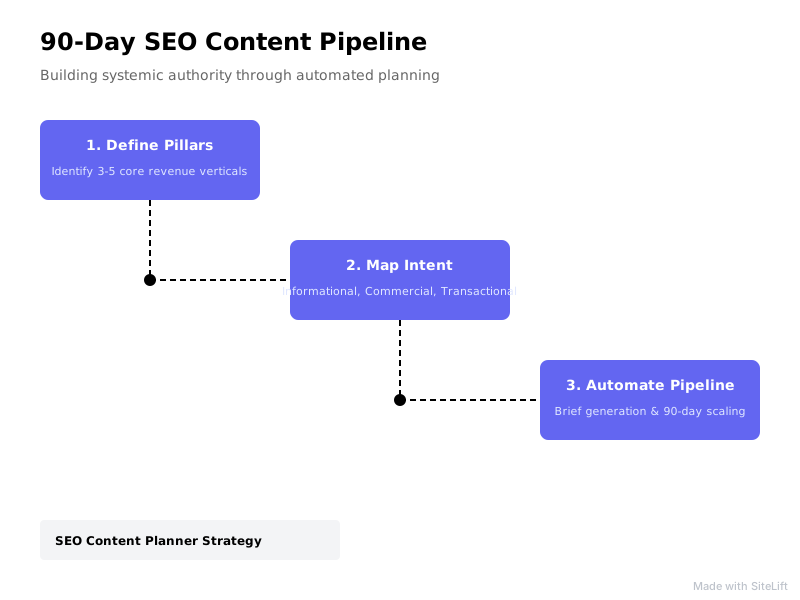
Infographic by SiteLift
Assigning Publishing Cadences and Ownership
Structure your 90-day calendar into three distinct 30-day phases:
- Month 1 (Pillar & Core Foundation): Publish core pillar pages and your primary high-intent commercial sub-nodes.
- Month 2 (Cluster Expansion): Roll out supporting informational articles to build depth across all primary hubs.
- Month 3 (Interlinking & Authority Reinforcement): Publish long-tail semantic extensions and close any remaining content gaps.
You can streamline this scheduling process directly using the SiteLift Content Planner documentation to manage titles, target dates, and generation directives in one unified interface.
Step 4: How Do You Automate Content Generation, Publishing, and Distribution?
Planning 90 days of content is only half the battle; executing it without manual bottlenecks requires automation. Modern workflows allow you to move from approved brief to live article on autopilot.
Setting Up Autonomous Publishing Workflows
Manual copy-pasting into CMS editors creates unnecessary operational friction. By connecting your content planning tool for seo directly to your CMS (like WordPress, Webflow, or Shopify), you can schedule content to publish automatically once generation standards are met.
Ensuring Seamless CMS Integration and Schema Injection
An automated pipeline must handle more than just body copy. It should automatically format:
Structured Data / Schema Markup: Injecting
Article,FAQPage, orHowToschema automatically.Internal Links: Contextually placing links to existing site nodes during publish time.
Meta Data & Open Graph Tags: Auto-filling high-CTR title tags and meta descriptions.
Actionable Step: Configure an end-to-end publishing pipeline that automatically formats, optimizes, and schedules posts straight to your CMS.
Expected Result: Zero time spent on manual CMS formatting or meta tag creation.
Common Mistake to Avoid: Publishing posts without structured schema markup, missing out on rich snippets in search results.
Step 5: How Do You Measure and Compound Keyword Momentum?
An effective SEO content strategy relies on feedback loops. Once your 90-day plan is live, track performance metrics to compound your organic gains.
Tracking Keyword Positions and Topic Density Real-Time
Do not track URLs in isolation. Monitor performance at the cluster level. Track how aggregate organic traffic and average rankings move for the entire topic hub as new supporting articles are indexed.
Week 1-4:  [Cluster Published] ---> Crawl Frequency Increases
Week 5-8:  [Internal Link Loop] ---> Secondary Terms Reach Top 20
Week 9-12: [Authority Compounds] ---> Pillar & Cluster Enter Top 5
Refreshing and Repurposing Underperforming Nodes
If a page sits on page 2 or 3 after 45 days, it usually lacks topical depth or internal link support.
- Run a fresh content gap analysis against newly ranking top-5 competitors.
- Inject updated statistics, structural headers, or missing semantic entities.
- Add 2 to 3 new internal links from higher-authority published pages on your domain to boost the struggling page.
Pro Tip: Set an automated alert for any article stuck between positions 11 and 20. Adding 3 target internal links with exact-match anchor text often pushes those pages straight onto page 1 within weeks.
Why Manual Content Spreadsheets Are Broken (And What to Do Instead)
We have managed organic growth across dozens of sites, and we have seen traditional Notion and Excel content calendars fail over and over again.
Manual spreadsheets are static. They don't warn you when keyword cannibalization occurs, they don't auto-update when search engine algorithms change, and they turn editorial management into a full-time job. Spending 20 hours a month copying briefs between docs and CMS platforms is operational waste.
Transitioning from a manual spreadsheet to an automated SEO content planner workflow transforms content production from a constant grind into an asset that compounds traffic automatically.
Troubleshooting: What Are Common Pitfalls in Content Planning?
Even with a detailed plan, common execution traps can stall your growth curve. Here is how to fix them:
Over-Relying on High-Volume Keywords Without Depth
Chasing broad, high-volume keywords without supporting cluster depth leads to high bounce rates and poor rankings. Always surround high-volume terms with hyper-specific long-tail sub-topics.
Failing to Maintain Internal Link Loops
Publishing articles that don't link anywhere—or never receive links from other pages—creates "orphan pages." Ensure your automated pipeline checks every draft for internal link assignments before going live.
Neglecting Engine/AI Visibility Updates
Modern searchers increasingly use AI answer engines alongside standard search. Ensure your content uses clean semantic headings (H2/H3), direct bulleted answers, and clear data tables so AI discovery models can easily ingest and summarize your content.
Expected Outcome: What Results Should You Anticipate After 90 Days?
When you execute a structured 90-day plan with high publishing velocity, your site experiences a compounding authority curve:
- Days 1–30: Faster search indexing rates as crawlers adapt to consistent publishing schedules.
- Days 31–60: Initial page-one impressions for long-tail, low-difficulty cluster terms.
- Days 61–90: Pillar pages move into top rankings as cluster internal links accumulate, resulting in exponential organic traffic growth.
Put Your SEO Growth on Autopilot with SiteLift
Executing a compounding 90-day strategy manually requires managing writers, building briefs, checking schemas, and scheduling posts.
SiteLift automates this entire pipeline. As an autonomous SEO and AI visibility growth platform, SiteLift generates targeted content, injects structured schema, handles CMS publishing, and tracks keyword momentum automatically.
Whether you want to scale output, capture AI engine visibility, or expand your topical authority, SiteLift handles the heavy lifting so your traffic compounds on autopilot.
FAQ
What is an SEO content planner?
An SEO content planner is a strategic framework or tool used to organize, map, schedule, and execute search-optimized content. Unlike a generic editorial calendar, an SEO content planner organizes content by keyword clusters, search intent, internal linking structures, and topical authority goals.
How does a 90-day compounding content strategy work?
A 90-day compounding strategy focuses on publishing interconnected clusters of content within a tight timeframe. As supporting sub-articles are indexed, they pass search relevance and internal link equity up to parent pillar pages, accelerating overall site rankings far faster than publishing isolated articles.
Why is topical authority more important than single-keyword ranking?
Search engines now evaluate whether a site demonstrates complete subject expertise rather than just checking single page keyword density. Establishing topical authority across a domain helps all related pages rank higher and stay resilient against search algorithm updates.
How can I automate my content brief workflow?
You can automate content briefs by using tools that pull top-ranking SERP data, analyze competitor heading structures, and extract NLP entity requirements automatically into a standardized template for your writers or AI systems.
How far in advance should you plan your SEO editorial calendar?
Planning 90 days (one quarter) in advance strikes the perfect balance between long-term strategic authority building and tactical flexibility. It gives search engines enough content volume to measure growth while allowing you to adapt to new industry trends quarterly.
— sitelift.io
Topics Covered:
- seo content planner
- content planning tool for seo
- seo editorial calendar
- topical authority planning
- automated content brief workflow
More from SiteLift

Platform SEO: How to Optimize Marketplaces, SaaS Platforms and Multi-Vendor Sites
Master platform SEO for marketplaces & SaaS. Learn taxonomy, programmatic SEO, UGC governance & scale organic traffic fast.

Keyword Ranking Explained: How Rankings Work and How to Improve Them
Discover how keyword ranking works on Google. Learn key ranking factors, how to manage position volatility, and practical steps to improve search visibility.

SEO for Single Page Website: How to Rank a One-Page Site on Google and AI Search
Master seo for single page website: sections, anchors, schema & AI search tactics to rank your one-pager. Start optimizing now.