Platform SEO: How to Optimize Marketplaces, SaaS Platforms and Multi-Vendor Sites

If you run a marketplace, SaaS directory, or multi-vendor store, platform SEO is a completely different game from optimizing a normal website. You're not optimizing 20 pages — you're governing thousands to millions of dynamic URLs generated by vendors, users, filters, and integrations.
I’ve seen brilliant platforms stall because they treated SEO page-by-page. According to BrightEdge, 53.3% of all website traffic comes from organic search, so when your template, taxonomy, or crawl logic is broken, you don’t lose one ranking — you lose thousands at once.
This guide breaks down a full marketplace seo strategy, saas platform seo, and ecommerce platform optimization system, including programmatic seo for platforms, UGC governance, and measurement at scale.
Key Takeaways: Platform SEO at a Glance
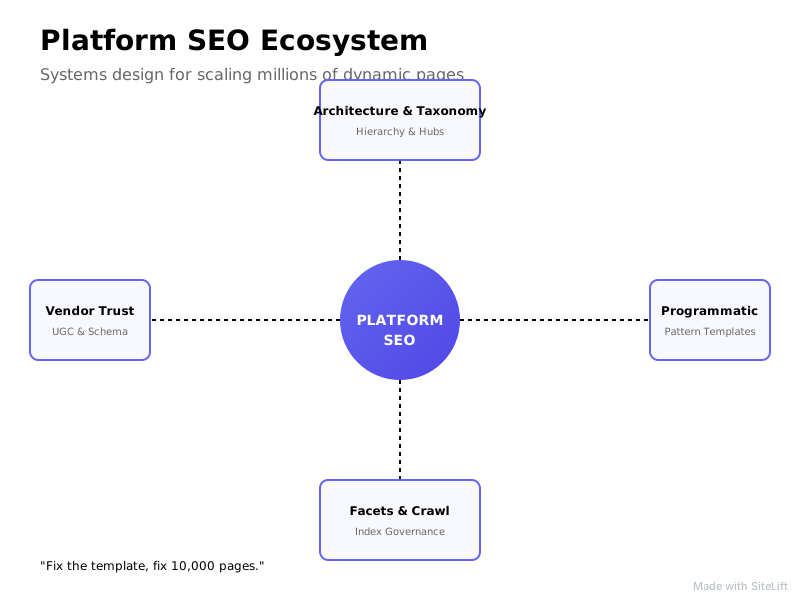
| Platform SEO Pillar | What to Get Right | Why It Moves Revenue |
|---|---|---|
| Architecture & Taxonomy | 3-4 level hierarchy, clean URLs, breadcrumbs, hub pages | Makes millions of listings crawlable and distributes authority |
| Programmatic SEO | Pattern-based templates like [service] + [city] | Captures long-tail demand without manual content |
| Facets & Crawl Budget | Canonicals, noindex, robots.txt for filters/search | Prevents index bloat and preserves crawl for money pages |
| Vendor Content & Trust | Canonicals, UGC standards, Product/Review schema | Solves duplicate content and wins rich results |
| Measurement & Expansion | Template-level CTR, indexed vs. valuable pages, localization | Compounds growth as new vendors create new optimized pages |
Bottom line: Platform SEO is systems design. Fix the template and you fix 10,000 pages. Get governance wrong and you scale problems just as fast.
What Is Platform SEO and How Is It Different from Traditional SEO?
Platform SEO is the scalable optimization of dynamic, multi-entity websites powered by listings, vendor pages, user-generated content (UGC), integrations, and app-generated inventory.
Think Etsy product grids, Airbnb location pages, Upwork freelancer profiles, Shopify app listings, G2 software categories, or Salesforce AppExchange. The platform owns the infrastructure, but vendors and users create most of the pages.
What counts as platform SEO: marketplaces, SaaS platforms and multi-vendor sites
Traditional SEO usually means 10-50 hand-crafted pages. Platform SEO means 10,000 to 10,000,000+ URLs built from databases.
Three models dominate:
- Marketplaces: Airbnb, Etsy, Upwork, Fiverr. Inventory = listings + sellers + locations.
- SaaS platforms & directories: G2, Capterra, Shopify App Store, HubSpot Marketplace. Inventory = tools, integrations, use-case pages, templates.
- Multi-vendor ecommerce: Amazon-style sellers, fashion aggregators, food delivery platforms. Inventory = overlapping SKUs from different vendors.
Each needs a distinct marketplace seo strategy vs saas platform seo playbook, but the core system is the same: templates + taxonomy + governance.
Why platform SEO is a systems problem, not a page-by-page problem
You can’t manually write title tags for 200,000 pages. You design rules that write them for you.
One bad pagination rule can create 500,000 thin URLs. One weak category template can cannibalize 2,000 long-tail rankings. According to Backlinko's analysis of 4 million Google search results, the #1 organic result captures approximately 27.6% of all clicks, which is why winning the template for a high-value pattern matters more than winning a single keyword.
Success comes from reusable components: URL logic, H1 formulas, internal linking modules, schema injection, and indexation rules.
Common platform models and their unique SEO risks
- Marketplaces: duplicate listings, thin location pages, keyword cannibalization between vendors selling the same service.
- SaaS platforms: thin integration pages (“Slack + Tool X” with no content), JavaScript rendering issues, and documentation bloat.
- Multi-vendor ecommerce: syndicated manufacturer descriptions, faceted navigation explosion, and competing sellers for the same product.
Pro Tip: Audit by template, not by URL. Pull 50 URLs per template type into a sheet and check indexation, CTR, and conversions. You’ll spot systemic issues in an hour.
How to Build a Scalable Site Architecture for Platform SEO?
Get architecture wrong and nothing else scales. Get it right and every new vendor makes you stronger.
How to design taxonomy for categories, vendors, products and locations?
Keep it to 3-4 levels max:
Homepage > Category > Subcategory / Location > Listing Detail
Example for a services marketplace:
upwork.com / hire / graphic-designers / logo-designers-in-austin / profile-url
Best practices I recommend:
- One clear H1 per hub page, with modifiers in URL:
/crm-for-real-estate/, not/cat?id=482 - Breadcrumbs on every level for users and crawlers
- Vendor storefronts nested under category, not orphaned:
/sellers/nike-store/linked from brand + category hubs - Location clustering:
/plumbers/chicago/as parent, neighborhoods as children to avoid cannibalization
For ecommerce platform optimization, resist creating a new category for every filter. Categories are for real demand with search volume. Filters are for refinement.
What is the best internal linking structure for large platforms?
Internal links are how you distribute authority across millions of pages without building backlinks to each one.
What works at scale:
- Crawlable hub pages: Top 20% categories linked from header, footer, and homepage modules
- Related listings: “Similar freelancers,” “Related apps,” “Customers also bought” — automated but contextual
- Vendor interlinking: Vendor storefront links to its listings, and listings link back to storefront + parent category
- Editorial bridges: Buying guides and comparison posts that link down to programmatic hubs
Avoid dumping 500 links on a hub. Prioritize 20-40 high-value child pages with descriptive anchors.
How to handle faceted navigation, filters, search pages and pagination?
Facets are the #1 killer of crawl budget on platforms.
Follow Google's guidance on managing crawl budget for large sites to control which parameter URLs get crawled and indexed:
- Index: Core category + 1-2 high-demand facets (e.g.,
/dresses/red-midi/if it has volume). Canonicalize to clean version. - Noindex + follow: Low-value combinations like sort, price slider,
?sessionid=, on-site search results. - Robots.txt disallow: Internal API endpoints,
?sort=,?filter=infinite combos you never want crawled. - AJAX / JavaScript: Load secondary filters client-side without creating new URLs.
For pagination, use clean ?page=2 with self-referencing canonicals, strong internal linking, and a “View All” where feasible. For infinite scroll, always provide paginated fallback links for crawlers.

How to Win with Programmatic SEO for Platforms?
Programmatic seo for platforms is how Airbnb owns “[vacation rental] + [city]” and G2 owns “[category] + software.” You find a repeatable keyword pattern, then build one excellent template deployed across your inventory.
How to find programmatic keyword patterns across inventory?
Start with inventory-first keyword research:
- Export your inventory: services, SKUs, integrations, cities, use cases.
- Pull Search Console queries by folder (
/hire/*,/apps/*) and find modifiers: near me, pricing, for Shopify, for small business. - Validate with Ahrefs and AlsoAsked for pattern volume: “[service] + [city]”, “[tool] + [integration]”, “[product] + [use case]”.
- Prioritize patterns where you have supply depth + intent + monetization.
For saas platform seo, goldmine patterns are often: /integrations/, /alternatives/, /templates/, and /use-cases/. For marketplaces, it’s location + attribute combos.
Learn more about scaling this without manual work in this breakdown of how autonomous platforms replace manual SEO work.
How to build high-converting page templates for scale?
A detailed breakdown from Search Engine Journal's programmatic SEO guides shows winning templates combine dynamic data with unique value. Don’t just swap the city name.
High-converting template must-haves:
- Unique H1 + 150-250 word intro that actually describes the local inventory or integration
- Dynamic listings grid (with ratings, price, availability)
- Comparison table: top 5 vendors/tools by rating, price, best for
- UGC: reviews, Q&A, photos
- FAQ block targeting People Also Ask
- Clear CTA above the fold: Book, Install, Contact Vendor
Example H1 formula: Best {Service} in {City} – {Count} Vetted Pros with Reviews [2026]
How to avoid thin content and doorway page penalties?
Google doesn’t penalize scale. It penalizes scale without value.
My quality guardrails:
- Minimum threshold: Don’t index a programmatic page until it has e.g., 5+ active listings, 3+ reviews, or 300+ words of unique data.
- Uniqueness score: At least 40-60% differentiated content per page via stats, FAQs, local data, images.
- Noindex by default: Launch new patterns as noindex, then auto-index when thresholds are met.
- Human review top 20%: Manually polish templates that drive 80% of revenue.
Pro Tip: Add one “unscalable” element to each template — original pricing data, expert verdict, or curated pros/cons. That’s what separates pSEO winners from doorway spam.
Infographic by SiteLift
How to Optimize Multi-Vendor Content, Trust and Technical Performance?
This is where most marketplace seo strategy efforts fail. You can have perfect architecture and still lose to duplicate content and slow templates.
How to manage duplicate content, UGC quality and vendor cannibalization?
Multi-vendor sites inherit duplicate manufacturer descriptions, copy-pasted vendor bios, and 15 sellers targeting “emergency plumber Austin.”
Fix it with governance:
- Set canonicals: syndicated product descriptions canonicalize to primary product or vendor; use Moz's guide to canonicalization to implement cross-domain canonicals correctly.
- Enforce vendor content standards: 200-word minimum unique description, 3+ original images, no keyword stuffing.
- Use AI-assisted rewriting + human moderation to enrich thin profiles.
- Solve cannibalization with clustering: one primary category page ranks for head term, vendor pages target long-tail differentiators (
affordable,24/7,luxury).
According to W3Techs, over 43% of all websites use WordPress, but most large platforms run on custom stacks — which means you must build these canonical and moderation rules into your CMS workflow, not rely on plugins.
How to use schema, reviews and E-E-A-T for marketplaces?
Trust is a ranking factor for platforms. Google wants to know who’s behind the listing.
Implement structured data using Schema.org Product and Review vocabulary:
Product+Review+AggregateRatingfor listingsFAQPagefor programmatic FAQsBreadcrumbListfor hierarchyOrganization+ seller verification for vendor pagesSoftwareApplicationfor SaaS directories (pricing, OS, ratings)
Then reinforce E-E-A-T: verified badges, vendor IDs, response times, refund policies, real reviewer profiles, and expert-moderated categories. Display review count, recency, and distribution — not just 5 stars.
What technical SEO foundations do SaaS and ecommerce platforms need?
For ecommerce platform optimization and SaaS at scale:
- Core Web Vitals: Optimize LCP by lazy-loading listing images, preloading hero, and limiting third-party scripts. Marketplaces live or die on mobile speed.
- JavaScript rendering: Server-side render critical listings and metadata. Test with URL Inspection, don’t assume.
- XML sitemaps by segment:
/sitemap-products-1.xml,/sitemap-vendors.xml,/sitemap-categories.xmlfor faster diagnostics. - Hreflang for global:
en-usvsen-gbvsde-defor localized inventory; don’t auto-translate without local supply. - Log file analysis: Check what Googlebot actually crawls. If 70% hits go to filters and search pages, your controls are failing.
Statista data shows global retail e-commerce sales have surpassed $5 trillion annually, with online marketplaces accounting for the majority of sales worldwide — which means technical edge on speed and crawl efficiency directly translates to market share.
How to Measure and Grow Platform SEO Over Time?
You can’t manage 500,000 pages in a spreadsheet. You manage cohorts and templates.
Which KPIs actually matter for marketplace and SaaS platform SEO?
Forget vanity rankings. Track:
- Indexed vs. valuable pages: % of indexed pages getting >1 click/month
- Share of voice by category: visibility for each hub vs competitors
- Template-level CTR and conversion: which pSEO pattern drives bookings/installs?
- Revenue per page cohort: new vendor pages, location pages, integration pages
- Vendor-level impact: rankings + leads per seller (great for retention)
Build dashboards sliced by template, category, and region — not just sitewide traffic.
What tools and workflows monitor thousands of pages?
My stack for platforms:
- Google Search Console + BigQuery for bulk query/page analysis by regex folder
- Screaming Frog or Sitebulb (crawl in segments, not full 2M crawl)
- Ahrefs Enterprise for share of voice and cannibalization alerts
- Custom Looker Studio dashboard: indexation, CTR decay, thin-page queue
Set alerts for index bloat spikes, template CTR drops, and sudden deindexing after deploys. Most platform SEO disasters come from a dev release, not an algorithm update.
How to expand with localization, new verticals and AI search visibility?
Compounding playbook:
- Launch new categories only when supply + demand thresholds met.
- Localize with real inventory, currency, and reviews — not just translation. See how an automated SEO platform scales organic growth across Europe for multi-market publishing workflows.
- Build integration/app directories — they’re link magnets for saas platform seo.
- Optimize for AI Overviews and ChatGPT/Perplexity: clear FAQs, comparison tables, stats, and brand mentions. Dive deeper with this comparison of AI search optimization services vs autonomous platforms.
The flywheel: new vendors → new optimized, interlinked pages → more long-tail traffic → more vendors.
My Honest Take: Why Most Platforms Get Platform SEO Backwards
I’ll be blunt: most marketplaces I audit obsess over backlinks while their own site is eating itself alive.
They’ll pay for digital PR to the homepage while 400,000 filter URLs drain crawl budget, 12 vendors cannibalize the same keyword, and their best category template has a 120-word generic intro from 2019. That’s backwards.
In my experience, platform SEO isn’t a marketing task — it’s product design. The winners like Etsy, Airbnb, and G2 treat SEO as infrastructure. Their product managers think about URL logic, indexation thresholds, and internal linking modules the same way they think about checkout flow.
If I were launching a platform today, I’d spend 70% of SEO effort on three things: taxonomy discipline, one killer programmatic template with real UGC, and ruthless index control. Everything else is polish.
Manual SEO can’t keep up once you pass 10,000 pages. You need systems that publish, interlink, and prune automatically — with humans steering strategy, not copy-pasting meta titles.
— sitelift.io
How to Scale Platform SEO Without Scaling Headcount
Here’s the uncomfortable math: your inventory grows daily, but your SEO team doesn’t. Every new vendor, integration, or location should automatically create an optimized, interlinked, fast page — not a backlog ticket.
That’s why teams are moving to autonomous execution. sitelift.io is built for this exact problem: it automatically generates targeted content, distributes it across a premium network, integrates with popular CMS platforms, and tracks keyword momentum in real time.
Instead of manually fixing 50,000 thin vendor pages, you set the system, templates, and guardrails once — then let publishing and authority compound while you focus on product and supply.

If you’re running a marketplace or SaaS directory past product-market fit, stop thinking in pages. Start thinking in pipelines.
FAQ: Platform SEO Questions Answered
What is platform SEO?
Platform SEO is the practice of optimizing large, dynamic platforms — marketplaces, SaaS directories, and multi-vendor sites — where thousands to millions of pages are generated from templates, listings, vendors, and UGC. It focuses on scalable architecture, programmatic templates, crawl budget, and governance rather than one-by-one page optimization.
How does marketplace SEO differ from traditional ecommerce SEO?
Traditional ecommerce SEO optimizes a fixed catalog you control. A marketplace seo strategy must govern inventory you don’t fully control: multiple sellers, duplicate products, thin profiles, location variations, and faceted filters. It requires vendor guidelines, canonicalization rules, index thresholds, and anti-cannibalization clustering at scale.
What is programmatic SEO for platforms and when should you use it?
Programmatic seo for platforms means creating hundreds or thousands of pages from a data-driven pattern like [service] + [city] or [software] + [integration] using one high-quality template. Use it when you have: proven search demand for the pattern, sufficient unique inventory per page, and a template that adds real value beyond swapped keywords.
How do you avoid duplicate content on multi-vendor and marketplace sites?
Use self-referencing and cross-domain canonicals for syndicated descriptions, enforce minimum unique content for vendors (original descriptions + images), noindex thin or duplicate combos, consolidate near-duplicate listings with clustering, and enrich pages with reviews, FAQs, and comparison data. Moderate UGC for quality, don’t just auto-index everything.
How long does platform SEO take to show results for SaaS and marketplaces?
Template fixes and index pruning can lift crawl and CTR in 4-8 weeks. New programmatic hubs typically need 3-6 months to mature, especially in competitive verticals. Platforms compound faster than small sites once systems are right, because each fix applies to thousands of pages and each new vendor adds new entry points.
Topics Covered:
- platform seo
- marketplace seo strategy
- saas platform seo
- ecommerce platform optimization
- programmatic seo for platforms
More from SiteLift

Keyword Ranking Explained: How Rankings Work and How to Improve Them
Discover how keyword ranking works on Google. Learn key ranking factors, how to manage position volatility, and practical steps to improve search visibility.

SEO for Single Page Website: How to Rank a One-Page Site on Google and AI Search
Master seo for single page website: sections, anchors, schema & AI search tactics to rank your one-pager. Start optimizing now.

Smart SEO Tech Explained: How Autonomous Platforms Replace Manual SEO Work
Learn how smart SEO tech and autonomous platforms eliminate manual workflows, automate CMS publishing, and scale organic search traffic on autopilot.