Why an Automated SEO Platform is the Secret to Scaling Organic Growth in Europe

Scaling organic growth in Europe isn't like scaling in a single domestic market. You're not just chasing rankings in one language — you're balancing German expectations for technical depth, French preferences for structured argumentation, Italian storytelling flair, and Nordic demands for digital transparency. Do that manually and you'll burn through budgets faster than a Berlin startup goes through cold brew.
That's why an automated SEO platform has quietly become the engine behind Europe's fastest-scaling SaaS brands. It's not another keyword tracker with a fresh coat of AI paint. It's an end-to-end system that handles research, content generation, publishing, and link distribution without constant human babysitting — turning organic search from a cost centre into a compounding revenue driver.
European market SEO is a multi-language, multi-culture chess game. The brands winning it aren't necessarily the ones with the biggest content teams. They're the ones using autonomous systems to out-publish, out-distribute, and out-optimise everyone else. Let's break down how it works, why it matters specifically for Europe, and why waiting is the riskiest move you can make.
Key Takeaways at a Glance
Before we dive deep, here's the short version for busy founders and growth leads:
| The Problem | Traditional SEO Approach | Automated SEO Platform |
|---|---|---|
| Producing content across 5+ European languages | Slow, inconsistent, agency-dependent | Continuous, programmatic, on-brand |
| Building authority and backlinks | Months of manual outreach | Automated distribution across premium networks |
| AI search visibility (ChatGPT, Perplexity, AI Overviews) | Rarely addressed | Built into the publishing workflow |
| Cost structure | High retainers, unpredictable ROI | Predictable SaaS pricing, compounding returns |
| Speed of iteration | Weekly or monthly reporting | Real-time keyword momentum tracking |
What Is an Automated SEO Platform and Why Is It Revolutionising Growth in Europe?
An automated SEO platform is a complete publishing pipeline. It doesn't just suggest keywords or rewrite blog posts. It takes a strategic brief, generates targeted content, publishes it directly to your CMS, distributes it across a curated network of authoritative sites, and tracks how your keyword portfolio responds — all without a human touching every step.
Think of it as the difference between hiring a kitchen full of chefs and buying a fully automated restaurant. Both produce meals. One scales without breaking a sweat.
Shifting from Manual Tasks to Autonomous SEO Software
Most European marketing teams are still running a 2015 playbook: brainstorm topics, brief a freelancer, wait three weeks for a draft, edit for two days, publish, then spend another month chasing backlinks. It's exhausting — and it's losing to companies that publish ten times more content with half the headcount.
Autonomous SEO software flips that model. It uses AI to identify content gaps, generate on-brand articles, and push them live through integrations with platforms like WordPress, Webflow, or headless CMS setups. The result is a content pipeline that never runs dry, even when your team is asleep — which, if you're operating across CET, GMT, and EET time zones, matters more than you'd think.
The shift isn't just about speed. It's about consistency. Google's algorithms reward sites that demonstrate sustained publishing activity and topical authority. A platform that publishes weekly, without fail, across all your target markets, builds trust signals that a sporadic manual workflow simply can't replicate.
Overcoming Multi-Market and Language Bottlenecks in Europe
Here's the reality check: Europe isn't one market. It's dozens. A keyword strategy that works in the Netherlands will flop in Spain. Search intent differs, competitor landscapes differ, and consumer trust signals differ.
According to Eurostat, over 75% of European consumers prefer interacting with digital content in their regional context. That means localisation isn't a nice-to-have — it's the price of entry. An automated SEO platform can generate and adapt content for multiple regional markets simultaneously, ensuring your brand speaks the right language, references the right local competitors, and targets the right search behaviour — without tripling your content team.
This is where generic AI writing tools fall apart. They translate words; they don't understand markets. A platform designed for European growth understands that "cloud storage" in Germany triggers different buying signals than in Poland, and that compliance concerns dominate in some regions while price sensitivity dominates in others.

How Does an Automated SEO Platform Drive Multi-Market European Growth?
This is where the magic happens. A truly autonomous platform doesn't just write articles. It operates a full publishing ecosystem designed to compound authority over time.
Hands-Off Content Publishing via Direct CMS Integration
The phrase "hands-off content publishing" sounds like a fantasy to anyone who's spent a Friday night manually uploading blog posts and fixing broken images. But modern platforms integrate directly with your CMS, meaning content moves from AI generation to live publication automatically.
This matters for European SaaS teams because organic growth is a volume game. You can't rank for "GDPR compliance software" in Germany, France, and the UK with one article per quarter. You need sustained publishing velocity — and automation delivers it without adding headcount.
Pro Tip: When evaluating platforms, check whether the CMS integration is bidirectional. You want the system to not only push content live but also pull performance data back so it can learn and adjust your publishing cadence.
Automated Content Distribution Across High-Authority Networks
Publishing on your own domain is only half the battle. Google's algorithm — and increasingly AI engines — reward brands that are cited and referenced across the web. Historically, that meant hiring link-building agencies and waiting months for results.
Autonomous platforms solve this by automatically distributing content across curated premium networks. Your articles, thought leadership pieces, and supporting assets get placed on high-authority sites that already have trust in your target markets. For European brands trying to break into competitive verticals like fintech, healthtech, or enterprise SaaS, this shortcut to authority is invaluable.
It also solves a uniquely European problem: fragmented domain authority. A brand might be well-known in its home market but completely unknown across the border. Automated distribution builds a pan-European digital footprint without the painstaking work of manual outreach to dozens of publishers in different languages.
Localised Nuance and Intent Optimisation for European Audiences
Here's the part most generic AI tools get wrong: they translate, but they don't localise. An automated SEO platform built for Europe understands that a German user searching for "Datenschutz Software" has different intent than a French user searching for "logiciel RGPD."
Modern platforms adapt messaging to local search behaviour across regions like the Nordics, DACH, and Southern Europe. They factor in cultural nuances, local competitor references, and regional regulations — so your content doesn't just rank; it resonates.
For example, a Scandinavian audience expects concise, transparent, and jargon-free copy. A German B2B buyer expects depth, data, and engineering precision. A Spanish audience responds better to warmer, relationship-driven messaging. Automation doesn't mean ignoring these nuances — it means encoding them into your content engine so they're applied consistently at scale.
Why Is AI Search Visibility Critical for the Future of European SEO?
If you're only optimising for Google, you're already behind. The search landscape is shifting under our feet.
Beyond Traditional Google Ranks: Optimising for AI Engines
According to Gartner, traditional search engine volume is projected to drop by 25% by 2026, driven by the rapid adoption of AI chatbots and search agents. European users are increasingly asking ChatGPT, Perplexity, and Google's AI Overviews for answers — and if your brand isn't cited there, you're invisible.
As Search Engine Land has documented, AI Overviews have already reshaped click-through behaviour for millions of queries. The days of "position one or bust" are evolving into "cited by the AI or bust."
This is where Generative Engine Optimisation (GEO) comes in. Automated platforms optimise content specifically to be referenced by large language models. They structure information in ways that AI engines can parse, cite, and recommend. In short, they ensure your brand becomes a trusted source in the AI answer layer, not just a blue link on page one.
Pro Tip: Start treating ChatGPT and Perplexity as part of your target SERP. Run your key product terms through them monthly and note which sources they cite — then reverse-engineer why those sources were chosen. Clear structure, cited statistics, and consistent brand mentions matter enormously.
Real-Time Keyword Momentum Tracking in Dynamic Markets
European markets move fast. A keyword that's trending in Amsterdam this week might be old news in Munich by Friday. Manual rank tracking tools give you a snapshot; autonomous platforms give you a live feed.
Real-time keyword momentum tracking lets you see which topics are gaining traction, which pieces are driving AI citations, and what your competitors are doing — then adjust your publishing cadence automatically. It's like having a market analyst watching every SERP and AI response 24/7.
This is especially valuable in Europe, where regulatory changes, funding announcements, and market shifts can create sudden demand spikes. A platform that detects momentum early and publishes relevant content within days — not months — gives you a decisive first-mover advantage.
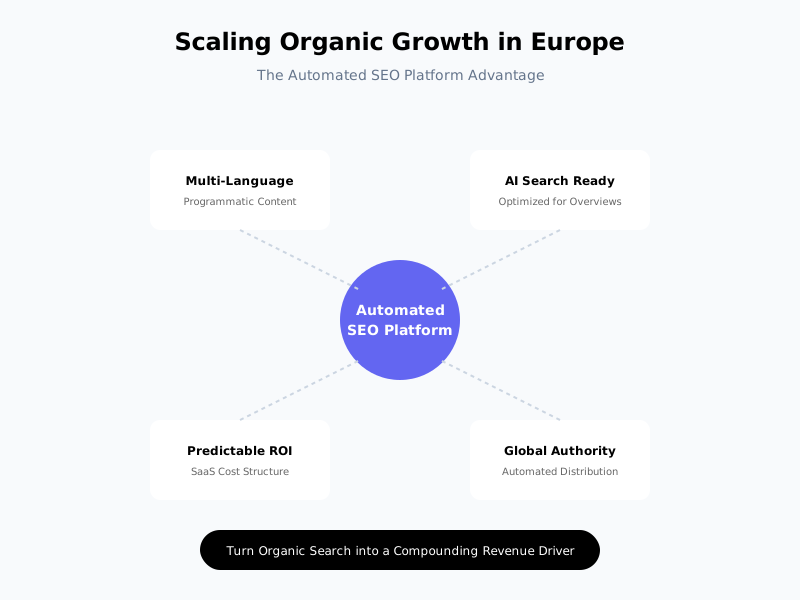
What Are the Key Business Benefits of Deploying an Automated SEO Platform in Europe?
Beyond the tactical advantages, there's a compelling business case. Let's talk money.
Scaling Organic Revenue While Reducing Customer Acquisition Costs (CAC)
European SaaS companies are feeling the squeeze. Paid acquisition costs have skyrocketed, and VC funding is no longer a blank cheque. Organic traffic — when done right — is the most sustainable growth channel because it compounds.
Research by McKinsey indicates that companies adopting AI-driven marketing tools experience a 10% to 20% increase in marketing efficiency and lead generation. For a European scale-up spending €50k per month on paid ads, shifting even a fraction of that into an automated SEO platform delivers compounding returns that paid channels simply can't match.
The math is simple: organic clicks are free. The cost is in producing and distributing content that ranks. Automation slashes that cost by an order of magnitude while increasing output. That's not incremental improvement — that's a structural advantage.
Compounding Authority Without Increasing Agency Headcount
Let's talk about the elephant in the room: agency retainers. A decent European SEO agency will set you back €5k to €20k per month — and that's before content production costs. You're paying for strategy meetings, reports, and a lot of waiting.
An automated SEO platform replaces the retainer model with predictable software pricing. It doesn't take holidays, doesn't churn, and doesn't need a 40-slide deck to tell you what's working. It just executes — consistently, at scale, and at a fraction of the cost.
| Cost Comparison (per month) | Traditional European SEO Agency | Automated SEO Platform |
|---|---|---|
| Retainer / subscription | €8,000 – €20,000 | €1,000 – €5,000 |
| Content production (10 articles) | €5,000 – €10,000 | Included |
| Link building / distribution | €3,000 – €8,000 | Included |
| Reporting & analytics | Weekly manual reports | Real-time dashboard |
| Time to first results | 3 – 6 months | 1 – 3 months |
European tech publication Sifted has repeatedly highlighted how lean growth teams are outperforming enterprise competitors by adopting AI-driven marketing stacks. The pattern is clear: the companies winning in European SaaS aren't the ones with the biggest marketing budgets — they're the ones with the smartest, most automated systems.
Why I Believe Autonomous SEO Is Europe's Most Underrated Growth Lever
Here's my honest take, as someone who has watched dozens of European startups try to hack their way to organic growth: most of them are overthinking it.
I've seen teams spend six months building a "content strategy" that amounts to a spreadsheet and a Notion doc. I've seen agencies string clients along with vanity metrics while organic revenue stays flat. And I've seen brilliant products lose the search battle to mediocre competitors who simply published more, more consistently, and with better distribution.
The truth is, the old agency model is broken for scale-stage companies. It was designed for a world where content was scarce and publishing was hard. That world is gone. AI has made content production cheap; automation has made distribution effortless. The winners in European search over the next three years won't be the brands with the biggest budgets — they'll be the ones who embrace the full publishing lifecycle.
Pro Tip: Don't treat automation as a replacement for strategy. Treat it as the execution engine that finally lets your strategy see the light of day. You still need a clear positioning and a target market — but you no longer need a small army to act on them.
That's why I'm bullish on autonomous platforms like SiteLift. They've built exactly what European growth teams need: a complete pipeline from research to published, distributed, and tracked content — with AI visibility built in from day one.
— The SiteLift Editorial Team
Key Takeaways: Scaling Organic Growth Automatically in Europe
If you take nothing else from this article, remember this:
- Manual SEO doesn't scale across Europe's fragmented markets. You need automation to match the speed and volume of the competition.
- AI search visibility is no longer optional. With Gartner projecting a 25% drop in traditional search volume by 2026, you must optimise for ChatGPT, Perplexity, and AI Overviews today.
- Distribution is the new differentiator. Publishing on your own domain isn't enough; automated distribution across premium networks builds the authority that drives rankings and AI citations.
- The ROI beats agency retainers. Autonomous software delivers predictable costs, faster iteration, and compounding organic growth.
The businesses that figure this out now will own European search — both traditional and AI-driven — for the next decade. The ones that wait will be playing catch-up in a landscape that's already moved on.
If you're ready to put your organic growth on autopilot, it's worth a look at what SiteLift offers. No retainer, no agency meetings, no waiting months for results — just a publishing pipeline that works while you focus on building your product.
FAQ
What is an automated SEO platform?
An automated SEO platform is an end-to-end system that handles keyword research, content generation, publishing, link distribution, and performance tracking automatically. Unlike traditional SEO tools that assist human workflows, it executes the entire publishing lifecycle without manual intervention.
How does autonomous SEO software handle content publishing without manual intervention?
It integrates directly with your CMS (WordPress, Webflow, headless setups, etc.), so generated content is formatted, optimised, and published automatically. The platform also distributes content across premium networks and tracks performance, meaning the entire loop — from idea to published asset to ranking data — runs on autopilot.
Why is AI search visibility important for European businesses?
European users are rapidly shifting to AI-powered search tools like ChatGPT, Perplexity, and Google's AI Overviews. If your brand isn't cited by these systems, you're missing a growing share of discovery traffic. Gartner projects traditional search volume will drop by 25% by 2026, making AI search visibility a critical component of any forward-looking SEO strategy.
Can an automated SEO platform replace a traditional SEO agency in Europe?
For most scale-stage companies, yes. An automated platform handles the execution — content production, publishing, distribution, and tracking — that agencies charge premium retainers for. You still need strategic direction internally, but the days of paying €10k+ per month for manual execution are ending.
How does an automated SEO workflow adapt to different European market languages and regions?
Modern platforms generate and localise content for multiple markets simultaneously, accounting for regional search intent, cultural nuance, and local competitor landscapes. Whether you're targeting the Nordics, DACH, France, or Southern Europe, the content is adapted to feel native — not translated.
Article generated by SiteLift
Topics Covered:
- automated seo platform
- AI search visibility
- autonomous SEO software
- hands-off content publishing
- European market SEO
More from SiteLift

Decoding SEO Agency Fees: Hourly Rates, Retainers, and Automated Alternatives
Uncover real SEO agency fees, from hourly rates and $3,000+ monthly retainers to cost-effective automated platforms. Maximize your organic ROI.

SEO Conversion Optimization: How to Turn Organic Search Readers into Paying Customers
Learn how to turn organic search visitors into paying customers with this step-by-step SEO conversion optimization guide. Optimize your CTAs and UX.

How to Choose SEO Audit Companies That Deliver Actionable Automation Roadmaps
Stop paying for static PDFs. Learn how to choose SEO audit companies that deliver developer-ready, automated roadmaps to scale your organic traffic.