Keyword Ranking Explained: How Rankings Work and How to Improve Them

Every organic growth campaign boils down to one fundamental metric: your keyword ranking. Put simply, a keyword ranking is the specific spot your web page occupies on a search engine results page (SERP) when someone types in an exact query. If a prospect searches for your core offering and your product page appears as the third link, your ranking for that term is position three.
Securing high rankings sounds straightforward on paper, but the reality is brutally competitive. According to an organic click-through rate (CTR) study published by Backlinko, the #1 organic result in Google captures an average of 27.6% of all clicks. Even more telling: the top three organic results together account for over 54% of all clicks. If your pages sit on page two or linger past position eight, you are essentially invisible.
Worse, research by Ahrefs analyzing over one billion web pages revealed that 90.63% of content gets zero organic traffic from Google, largely due to a lack of backlinks and misalignment with search demand.
If you want to pull your site out of that 90% void, you need to understand how search engines evaluate pages, why positions shift, and what concrete steps move the needle. Here is how modern search positioning actually works and how you can climb the SERPs systematically.
What Is a Keyword Ranking and How Does Search Positioning Work?
Search engines do not rank entire websites as single units; they rank individual URLs for distinct queries. When a user enters a search term, search engines parse an index of billions of pages, evaluate hundreds of contextual signals, and return an ordered list of URLs calculated to satisfy that searcher best.
Your ranking is your position in that specific evaluation. If you hold position #1, your URL is the premier organic recommendation. If you are at position #45, you are buried four pages deep, where virtually no human will ever discover you.
The Mechanics of the Modern Search Engine Results Page (SERP)
A decade ago, a ranking meant your spot among the ten blue links. Today, search layouts are vastly more complex.
A standard search results page now integrates dynamic SERP features that push traditional organic links further down the screen:
- Featured Snippets: Direct answers extracted from top-ranking pages that display above standard organic results (commonly called "Position 0").
- AI Overviews (SGE): Generative summaries synthesized across multiple web pages that provide immediate answers to complex questions right at the top of the viewport.
- People Also Ask (PAA): Expandable accordions answering related semantic queries.
- Local Map Packs: Geographically targeted clusters of business profiles displaying reviews, directions, and hours.
- Video Carousels and Image Grids: Visual media blocks triggered by informational and how-to queries.
Because of these features, being in "position #1" organically does not always guarantee your link appears above the fold. Understanding your actual pixel depth and visual real estate on the SERP is just as vital as knowing your numeric rank.
Search Visibility vs Keyword Ranking: Key Differences Explained
Tracking a single isolated keyword gives you an incomplete view of your organic health. This is where the distinction between search visibility vs keyword ranking becomes critical.
| Metric | Definition | Focus | Best Used For |
|---|---|---|---|
| Keyword Ranking | The absolute numerical position of an individual URL for an isolated query. | Tactical, single-query performance. | Spot-checking core commercial landing pages. |
| Search Visibility | The aggregate percentage of clicks and impressions a domain earns across an entire topic cluster or keyword group. | Strategic, overall organic footprint. | Evaluating overall domain growth and topical authority. |
Obsessing solely over whether you are position #2 or #3 for a single keyword blinds you to the broader landscape. A page ranking #4 for a primary high-volume head term might also rank across 400 long-tail variations, driving massive search visibility and consistent organic traffic. Conversely, ranking #1 for an obscure term with 10 monthly searches yields virtually nothing.
What Are the Primary Google Keyword Ranking Factors?
Google uses complex algorithms composed of numerous systems to assess web pages. While Google keeps its exact algorithmic weighting close to the vest, official guidance from Google Search Central and extensive industry testing make the core pillars clear.
Understanding primary google keyword ranking factors helps you focus on what genuinely drives algorithmic movement rather than wasting hours tweaking meta tags.
Search Intent Alignment and Semantic Relevance
Search engines no longer rely on primitive keyword repetition. Instead, they look for intent alignment and semantic depth.
Search intent breaks down into four main categories:
- Informational: The user wants to learn something ("how to improve keyword rankings").
- Commercial Investigation: The user is comparing solutions before buying ("best rank tracking tools").
- Transactional: The user is ready to purchase or sign up ("buy rank tracking software").
- Navigational: The user wants to reach a specific brand or destination ("Google Search Console login").
If your page serves up an aggressive sales page for a query where Google displays step-by-step editorial guides, your page will not rank. Search engines evaluate whether the format, depth, and angle of your URL match what users find most useful.
Furthermore, Google uses natural language processing models to index entities and topics, not just strings of text. If you write an article about keyword positioning, Google expects to see logically associated entities: search engine results pages, search intent, internal links, organic click-through rates, and algorithmic updates.
Topical Authority and Backlink Signals
PageRank remains one of the foundational building blocks of Google's ranking systems. Links act as third-party votes of confidence. When external, reputable domains link to your content, they transfer PageRank (or "link equity"), signaling to Google that your material is credible.
However, modern link equity is closely tied to topical authority. A backlink from a niche-relevant authority carries far more ranking weight than twenty links from generic, unrelated blogs.
Similarly, your site's internal link architecture distributes that earned equity. By linking strategically from high-authority pages to deeper, conversion-oriented pages, you signal to search engines which content deserves priority indexation and ranking weight.
Technical Health, Core Web Vitals, and Crawlability
Great content cannot rank if search engine bots cannot crawl, render, and index it efficiently. Foundational technical SEO sets the baseline:
- Crawlability and Indexability: Clear robots.txt instructions, XML sitemaps, and proper canonical tags ensure Google allocates its crawl budget to your most important URLs without hitting indexing bottlenecks.
- Core Web Vitals: Google's page experience signals—specifically Largest Contentful Paint (LCP), Interaction to Next Paint (INP), and Cumulative Layout Shift (CLS)—measure loading speed, visual stability, and responsiveness.
- Mobile Usability: With Google operating on mobile-first indexing, the mobile rendition of your site is the baseline for how your content is parsed and scored.
Pro Tip: Never assume a page is indexed simply because you published it. Use Google Search Console's URL Inspection tool immediately after publication to confirm that Google can retrieve your page without rendering errors or canonical conflicts.

Why Do Keyword Rankings Fluctuate? Understanding Volatility
One of the most common points of confusion for marketers is watching a page bounce from position #3 to position #7, then back to #4 within forty-eight hours. Keyword position volatility is a natural characteristic of modern search engines, not an immediate signal to rewrite your content.
Several distinct variables create this ongoing movement.
                  ┌─────────────────────────────────────────┐
                  │       Keyword Position Volatility       │
                  └────────────────────┬────────────────────┘
                                       │
         ┌─────────────────────────────┼─────────────────────────────┐
         ▼                             ▼                             ▼
┌──────────────────┐          ┌──────────────────┐          ┌──────────────────┐
│ Algorithmic Core │          │ Contextual &     │          │ Competitor Moves │
│ Updates & Tests  │          │ Geo Factors      │          │ & Content Decay  │
└──────────────────┘          └──────────────────┘          └──────────────────┘
Algorithmic Core Updates vs Normal Daily Position Drift
Google deploys multiple minor updates every day, alongside large broad core updates several times a year.
- Daily Drift: Google constantly runs small-scale experiments, temporarily promoting candidate pages to test user engagement metrics (such as click-through rates and dwell time). If your position shifts by one or two slots, it is usually regular SERP turbulence.
- Broad Core Updates: When Google overhauls primary ranking systems, massive shifts occur across entire categories. These updates reflect structural reassessments of quality, credibility, and intent satisfaction across the entire web.
Industry coverage from Search Engine Journal frequently highlights how tracking day-to-day macro volatility helps separate routine search fluctuations from systematic algorithmic hits.
Personalization, Geo-Targeting, and Device Variance
Google delivers search results tailored dynamically to the searcher. A user searching for "cloud backup solutions" in London will see a different SERP than someone entering the exact same phrase in Sydney.
Rankings also diverge based on:
- Physical Location: Even down to city or IP level for commercial and local intent queries.
- Device Type: Mobile SERPs prioritize mobile-friendly formats and local listings more aggressively than desktop layouts.
- Search History: Frequent interactions with a specific domain can cause Google to present that domain slightly higher in personalized sessions.
Because of this, there is no single, static universal ranking. Rankings exist across a spectrum of locations and devices.
Competitor Action and Content Decay
Your rankings do not exist in a vacuum. Even if you make no changes to your page, your position can slide because a competitor:
- Published a more thorough, up-to-date guide that answers the query better.
- Secured high-authority backlinks from major industry publications.
- Restructured their technical architecture to deliver blazing-fast page loads.
Simultaneously, content naturally suffers from content decay. Statistics become outdated, broken links accumulate, and new subtopics emerge within your niche. When your page stops representing the most current, comprehensive answer, search engines quietly swap it for something fresher.
How to Improve Keyword Rankings: A Practical Roadmap
Knowing why pages rank is only half the battle. If you have pages languishing on page two or three of Google, you need a repeatable framework to elevate them. Here is a battle-tested roadmap for how to improve keyword rankings systematically.
Conduct Content Gap Analysis and Refresh Stagnant Pages
The quickest path to ranking gains is not publishing net-new content; it is upgrading the pages you already have that sit in positions 8 through 20. These are "striking distance" keywords that Google already recognizes as relevant.
To refresh them effectively:
- Extract the Striking Distance Terms: Jump into Google Search Console or use a platform that supports keyword checking on autopilot to identify URLs earning impressions between positions 8 and 20.
- Evaluate Current Top-3 Results: Look at the pages currently winning the top spots. What angles do they take? What questions do they answer that you omitted? Do they include calculators, comparison tables, or downloadable templates?
- Fill the Semantic Gaps: Integrate missing subtopics, update obsolete data points, and rewrite headers to address long-tail queries directly.
- Strengthen Above-the-Fold Content: Answer the target search query immediately in your opening paragraphs. Do not bury the solution beneath 500 words of generic background text.
Optimize Internal Linking Architecture for Priority Pages
Internal links represent one of the few ranking mechanisms fully within your direct control. By linking strategically between related articles, you pass authority and establish clear topical hierarchies.
- Establish Topic Clusters: Group your content into core pillar topics supported by detailed cluster pages. Each cluster page should link back to the main pillar using descriptive, keyword-rich anchor text.
- Mine High-Authority Pages: Identify your pages with the highest number of external backlinks. Add contextual internal links from those high-equity pages directly to the struggling mid-tier pages you want to push into the top five.
- Fix Anchor Text Dilution: Avoid generic anchors like "click here" or "learn more." Use descriptive phrasing that informs search bots about the target page's core subject matter (e.g., "our comprehensive keyword research guide").
Pro Tip: Audit your internal links quarterly. If a priority landing page has fewer than five internal links pointing to it from relevant contextual content, it will struggle to hold top-tier rankings against competitors with cohesive cluster architecture.
Acquire Contextual Backlinks Through Authority Building
Backlinks remain a primary ranking driver. However, brute-force link acquisition will quickly trigger spam filters or burn your domain's credibility. Focus on sustainable, contextual link acquisition:
- Original Data and Research: Conduct surveys, analyze proprietary product data, or publish industry benchmarks. Writers and editors naturally cite and link back to original data sources.
- Definitive Resources and Frameworks: Create the definitive guide or tool that an industry refers to repeatedly. When your resource becomes the default reference point for a concept, passive backlinks compound over time.
- Digital PR and Thought Leadership: Contribute authoritative insights to industry trade journals, participate in relevant podcasts, and respond to journalistic requests via platforms like Connectively.
Gaining authority takes time. According to research by Ahrefs, only 5.7% of newly published web pages rank in Google's top 10 search results for at least one keyword within a year of publication. For competitive queries, authority building is a compounding marathon, not a sprint.
How to Track and Measure Keyword Ranking Performance Over Time
Tracking your positions prevents you from operating in the dark. But if you focus on the wrong metrics, you risk making rash decisions based on routine SERP shifts.
Choosing Meaningful Metrics Beyond Vanity Top-Rankings
Ranking #1 for an arbitrary keyword feels great, but vanity rankings do not pay the bills. When evaluating your search health, balance individual rankings against portfolio-level performance metrics:
- Organic Search Impressions: Often the earliest indicator of positive movement. When Google begins testing your refreshed content, impressions spike days or weeks before your average ranking climbs.
- Organic Click-Through Rate (CTR): High rankings are meaningless if users skip your listing. If you rank #3 but hold a sub-1% CTR, your meta title and description need immediate testing.
- Blended Conversion Value: Track which ranking URLs actually generate leads, signups, or revenue. Prioritize optimizing pages that convert at 3% over pages that generate massive traffic but zero pipeline value.
Leveraging Google Search Console vs Dedicated Rank Trackers
To monitor performance effectively, you need to combine first-party aggregated data with point-in-time rank tracking.
       ┌─────────────────────────────────────────────────────────┐
       │               Search Tracking Toolset                   │
       └────────────────────────────┬────────────────────────────┘
                                    │
           ┌────────────────────────┴────────────────────────┐
           ▼                                                 ▼
┌───────────────────────────────┐         ┌───────────────────────────────┐
│     Google Search Console     │         │    Dedicated Rank Trackers    │
├───────────────────────────────┤         ├───────────────────────────────┤
│ • Aggregated real-user data   │         │ • Point-in-time SERP scans    │
│ • Blended across all locations│         │ • Strict geo-targeted tests   │
│ • Delayed by 48-72 hours      │         │ • Tracks specific competitors │
│ • Shows long-tail discoveries │         │ • Near real-time visibility   │
└───────────────────────────────┘         └───────────────────────────────┘
Google Search Console (GSC) is essential because it displays actual user impressions and clicks from real searches. However, its "Average Position" metric is a blended average across every geography, device, and query variation. A page ranking #1 in Chicago and #10 in London will show an average position of roughly 5.5.
To catch micro-movements, evaluate localized results, and monitor competitors, pair GSC with specialized platforms. Teams tracking shifts across dynamic search engines often turn to daily rank tracking methods or integrate a programmatic rank tracker API to automate SERP snapshots without manual logging.
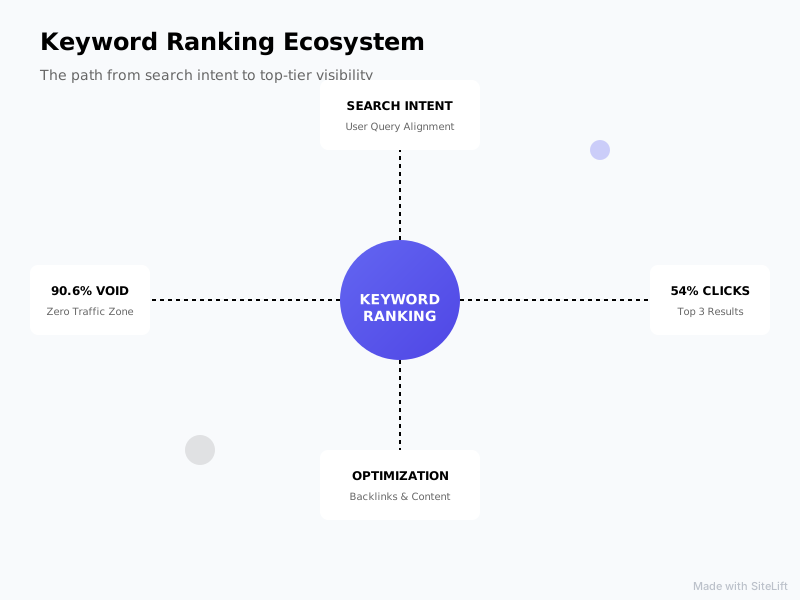
Infographic by SiteLift
Key Takeaways: Mastering Keyword Rankings
Before we look at the strategic leverage hidden in mid-tier rankings, here is a concise summary of the core principles:
| Core Concept | Strategic Reality | Actionable Best Practice |
|---|---|---|
| Rankings Are Granular | Google ranks URLs, not domains. Modern SERP features push organic results down. | Optimize for specific search intent; track both organic rank and SERP feature visibility. |
| Top Positions Take Clicks | The top three results capture over 54% of all clicks (Backlinko). | Focus optimization efforts on pushing striking distance terms (positions 4–15) into the top 3. |
| Content Requires Context | Keyword stuffing fails. Google relies on entities and topical clusters. | Cover topics comprehensively, answer related PAA queries, and maintain clean semantic structure. |
| Volatility Is Normal | Daily rank shifts are expected due to testing, geo-factors, and minor updates. | Track macro trends over 30 to 90 days rather than reacting to daily fluctuations. |
| SEO Compounds Over Time | Only ~5.7% of pages hit the top 10 within their first year (Ahrefs). | Build sustainable authority through strategic internal links, fresh updates, and original data assets. |
Why Position 4–10 Striking Distance Is the Most Underrated Growth Lever
In my experience running organic search campaigns, teams waste far too much energy on two extremes: obsessing over their existing #1 positions or trying to force brand-new URLs onto competitive page-one SERPs overnight.
The most undervalued goldmine in SEO sits squarely in positions 4 through 10.
When a URL ranks in position 6, Google has already resolved the hardest questions:
- It trusts the technical baseline of your page.
- It considers your content relevant to the core query.
- It has granted your domain baseline topical authority.
Moving a page from position 28 to position 4 takes immense effort, dozens of links, and months of waiting. But moving an existing URL from position 6 to position 2 can often be accomplished in a matter of weeks through targeted internal linking, refining search intent alignment, and pruning fluff from the copy.
Because organic CTR scales non-linearly—jumping from ~3% in position 7 to nearly 28% in position 1—lifting a handful of striking-distance pages into the top three will drive more pipeline revenue than publishing thirty generic articles that never escape page two. Stop treating all rankings equally. Double down on your near-winners.
— sitelift.io
Dominating Search Rankings with Autonomous Operations
Scaling keyword rankings across hundreds of queries manually is an exhausting uphill climb. Managing keyword research, identifying content decay, producing intent-matched drafts, and building contextual authority requires endless hours of coordination.
This is why modern growth teams rely on sitelift.io.
SiteLift functions as an autonomous SEO and AI visibility growth platform built to dominate search engines on autopilot. Instead of relying on manual editorial sprints, SiteLift:
- Automatically discovers high-value, striking-distance keyword opportunities.
- Generates deeply researched, semantically rich content designed to satisfy modern search intent.
- Distributes authoritative content across a curated premium network to build durable topical authority.
- Integrates directly with your existing CMS to maintain a self-compounding organic publishing pipeline.
- Monitors ranking momentum across traditional SERPs and emerging AI search engines in real time.
If you are ready to stop chasing algorithm updates and want an automated system that compounds organic traffic and visibility systematically, explore what sitelift.io can do for your business.
FAQ: Frequently Asked Questions About Keyword Rankings
What is considered a good keyword ranking on Google?
A "good" ranking depends on your specific goals, but generally, any position within the top three organic results is considered optimal. Positions 1 through 3 capture over half of all available search clicks. However, ranking on the first page (positions 1 through 10) for high-intent, competitive commercial queries is still valuable, as these pages sit within striking distance of the highest-converting traffic slots.
Why do my keyword rankings fluctuate from day to day?
Daily ranking fluctuations—often called SERP churn or volatility—are completely normal. Search engines continuously run small algorithmic tests, measure how real users engage with listings, and adjust results based on the searcher's physical location, browsing device, and regional search history. Unless your page suffers a catastrophic drop across an entire topic cluster simultaneously, minor day-to-day position shifts do not require panic or reactive changes.
How long does it take to improve a keyword ranking?
For established websites with existing topical authority, optimizing an existing page in striking distance (positions 4 through 20) can show measurable improvements within two to eight weeks after re-indexing. For brand-new domains or newly published URLs targeting competitive queries, achieving top-10 rankings often takes between six to twelve months of consistent content publication, internal linking, and authority building.
Does ranking in position #1 guarantee organic traffic and conversions?
No. Ranking #1 for a query with virtually no search volume will yield minimal traffic. Furthermore, modern SERPs frequently display Featured Snippets, AI Overviews, ads, and local packs above position #1, which can absorb user clicks before they ever reach standard organic links. Finally, traffic only converts if your landing page delivers an exceptional user experience, answers search intent instantly, and features a compelling call to action.
Topics Covered:
- keyword ranking
- google keyword ranking factors
- how to improve keyword rankings
- keyword position volatility
- search visibility vs keyword ranking
More from SiteLift
SEO for Single Page Website: How to Rank a One-Page Site on Google and AI Search
Master seo for single page website: sections, anchors, schema & AI search tactics to rank your one-pager. Start optimizing now.

Smart SEO Tech Explained: How Autonomous Platforms Replace Manual SEO Work
Learn how smart SEO tech and autonomous platforms eliminate manual workflows, automate CMS publishing, and scale organic search traffic on autopilot.
SEO with Spa Brands: Local Search Playbook to Fill Your Booking Calendar
Dominate local search and fill your appointment calendar. Discover the ultimate local SEO playbook built specifically for day spas and med spa brands.