How to Use Content Gap Analysis SEO to Steal Competitor Traffic on Autopilot
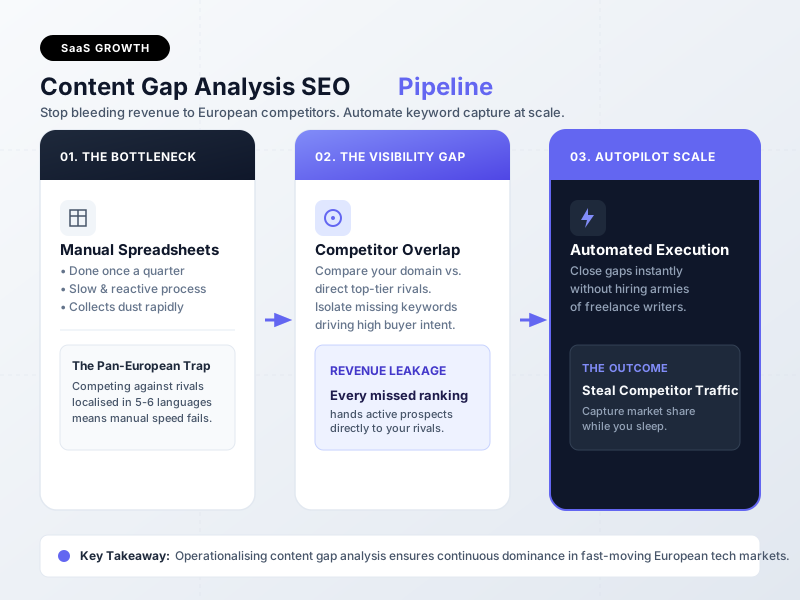
 If you're running a SaaS brand anywhere from Berlin to Barcelona, you already know the European market doesn't forgive slow movers. Someone else is ranking for the exact keywords your prospects are typing into Google right now, and every day you ignore that, you're handing them your revenue. Content gap analysis SEO is the practice of finding those missing keyword opportunities, but the old spreadsheet-and-guesswork method simply can't keep pace with how fast competitors publish today.
This article breaks down how to actually operationalise content gap analysis SEO — not just identify gaps, but close them automatically, at scale, without hiring a battalion of freelance writers.
What is Content Gap Analysis SEO and Why Does It Matter for European SaaS?
Content gap analysis SEO is the process of comparing your website's ranking keywords against your competitors' to find the terms they own and you don't. It sounds simple. In practice, most teams do it once a quarter, in a messy spreadsheet, and then let it collect dust.
Defining the organic visibility gap in competitive markets
The organic visibility gap is the space between what your audience is actively searching for and what your site currently ranks for. In fragmented, multilingual European markets, this gap is usually wider than founders think — because you're not just competing locally, you're competing against pan-European players who've already localised their content into five or six languages.
How missing target keywords quietly bleed revenue to rivals
Here's the uncomfortable stat: according to Ahrefs' guide on content gap analysis, most sites are missing dozens of high-intent keywords that their direct competitors already rank for on page one. Every one of those missed rankings is a prospect who never finds you and instead lands on a rival's pricing page.
Gartner research backs this up from the buyer's side too — B2B buyers now spend nearly 45% of their purchase journey independently researching solutions online before they ever talk to sales (Gartner). If your content isn't showing up during that research phase, you're invisible during the exact moment decisions get made.
The shift from manual spreadsheet tracking to automated discovery
Manual gap analysis worked fine when the web moved slower. It doesn't anymore. According to Search Engine Journal, over 90% of online content gets zero organic traffic from Google — which means the winners aren't the ones publishing the most, they're the ones publishing the right content, based on real gap data, consistently. That's where automation stops being a nice-to-have and becomes the only viable path forward.
How to Conduct a Comprehensive Competitor Keyword Research Workflow?
Competitor keyword research is the engine behind any solid gap analysis. Get this step wrong and everything downstream — your briefs, your content, your rankings — inherits the mistake.
Identifying top-performing market rivals in your niche
Start by mapping who's actually competing with you in the SERPs, not just who you consider a "competitor" internally. Often it's a mix of:
- Direct SaaS competitors selling the same core product
- Adjacent tools that solve the same problem differently
- Content-heavy publishers and review sites soaking up top-of-funnel searches
Extracting high-intent keyword overlap and blind spots
Once you have your rival list, pull their ranking keyword profiles and lay them next to yours. You're hunting for two things:
- Overlap keywords — terms you both rank for, where you're losing ground
- Blind spot keywords — terms they rank top 10 for and you don't rank at all
Backlinko's deep dive into keyword research is a great primer if you want to understand search intent segmentation before you start filtering data.
Filtering keyword data by search volume, intent, and difficulty
Not every gap is worth closing. Filter aggressively by:
- Search volume relevant to your market (don't chase vanity numbers from the US if you sell exclusively in the DACH region)
- Commercial intent — informational keywords are fine for awareness, but transactional ones convert
- Keyword difficulty relative to your domain's current authority
Pro Tip: Don't just filter by volume — weight keywords by estimated conversion value. A low-volume, high-intent term ("SaaS SEO automation pricing") often beats a broad, vague one with ten times the traffic.
This is exactly where traditional tools hit a wall. They'll show you the data, but someone still has to manually prioritise hundreds of rows and decide what to write next. That's a full-time job on its own.
 ## Can AI Keyword Mapping Accelerate Your Content Planning?
Once you've got your gap list, the next bottleneck is turning raw keywords into a coherent content structure. This is where AI keyword mapping genuinely changes the game.
Leveraging machine learning for semantic cluster analysis
Instead of treating every keyword as an isolated data point, AI keyword mapping groups semantically related terms into clusters automatically. "Content gap analysis SEO," "competitor keyword research," and "organic visibility gap" aren't three separate articles — they're facets of one topic cluster that should reinforce each other.
Eliminating keyword cannibalization with automated mapping
One of the sneakiest ways teams sabotage their own rankings is by unintentionally writing three articles targeting the same intent, splitting authority instead of building it. Automated mapping flags these overlaps before you publish, not after Google's already confused about which page to rank.
Structuring topical authority for search engines and AI answer engines
Search is no longer just about ten blue links. AI answer engines and generative search features now pull from sites that demonstrate deep, structured expertise on a subject — not just isolated blog posts. Building genuine topical authority means your content needs to cover a subject from multiple angles, interlinked logically, so both traditional crawlers and AI models can understand your depth of coverage.
Modern AI visibility platforms take this further by scoring each potential content brief on projected ROI — factoring in search volume, competitive difficulty, and how well it fills a cluster gap — before a single word gets written.
How to Automate Content Planning and Execution from Gap to Publish?
Finding the gap is half the battle. Automated content planning is what actually turns insight into published, indexed pages without a two-week internal approval cycle.
Turning raw gap data into production-ready content briefs
The transition from "here's a keyword" to "here's a publish-ready brief" is where most manual workflows collapse. An efficient pipeline should automatically generate briefs that include target keyword, search intent, recommended structure, and internal linking suggestions — all derived directly from the gap data itself.
Integrating autonomous generation with your existing CMS
European SaaS teams run everything from WordPress to Webflow to fully headless setups like Contentful or Sanity. Any automation layer worth using needs to plug into your existing CMS integration for SaaS stack without forcing a migration. That's the difference between a tool that fits your workflow and one that demands you rebuild your workflow around it.
Publishing across curated distribution networks for instant authority
Publishing on your own domain is step one. Distributing that content across a curated network of relevant, authoritative sites accelerates the trust-building process — giving fresh content the kind of early signal boost that used to take months of organic link building to achieve.
Industry studies indicate that companies using automated content operations reduce their time-to-publish by up to 70% while actually improving topical coverage, not sacrificing it for speed. That's the compounding effect autonomous publishing pipelines are built to create — each new piece reinforces the last, closing gaps faster than any single competitor can react.
This entire gap-to-publish loop is essentially what platforms like SiteLift are built to automate — from spotting the missing keyword to shipping the finished, optimised article straight into your CMS.
How to Measure Success and Track Keyword Momentum in Real-Time?
Automating content production means nothing if you're not watching the results. This is where real-time keyword momentum tracking earns its keep.
Key performance indicators for autonomous publishing pipelines
Focus on a tight set of metrics rather than vanity dashboards:
| Metric | Why It Matters |
|---|---|
| New keyword rankings (0→top 100) | Shows gaps actually being closed |
| Ranking velocity (top 100→top 10) | Signals content quality and relevance |
| Organic traffic per published piece | Ties production directly to results |
| Assisted conversions from organic | Connects SEO to actual pipeline revenue |
 ### Monitoring ranking velocity for newly closed content gaps
Newly published content targeting a gap keyword should show movement within weeks, not months, if the brief was well-targeted. Tracking velocity — not just final position — tells you early whether a piece is working or needs reinforcement (an extra internal link, an updated section, a distribution push).
Adapting your automated strategy based on shifting search trends
Search trends shift constantly, especially with AI-driven SERP features reshuffling what "ranking well" even means. Real-time tracking loops feed performance data back into your planning system, so the next batch of content briefs is informed by what's actually working right now — not what worked last quarter.
Pro Tip: Set a 30-day checkpoint for every new piece targeting a closed gap. If it hasn't cracked the top 50 by then, that's your signal to refresh or reinforce it, not abandon it.
Key Takeaways for Scaling SEO on Autopilot
Summary table
| Stage | Manual Approach | Automated Approach |
|---|---|---|
| Gap discovery | Quarterly spreadsheet audits | Continuous automated scanning |
| Keyword mapping | Manual clustering, prone to overlap | AI keyword mapping, cannibalization-free |
| Content planning | Ad hoc briefs, inconsistent quality | Automated content planning, ROI-scored briefs |
| Publishing | Manual CMS uploads, bottlenecked | Direct CMS integration, autonomous pipelines |
| Tracking | Monthly reports | Real-time keyword momentum tracking |
Future-proofing your organic visibility against algorithm updates
The core lesson here: content gap analysis SEO isn't a one-time audit, it's an ongoing loop. Gaps reopen constantly as competitors publish, algorithms shift, and search behaviour evolves. The businesses winning organic visibility in Europe right now aren't necessarily the ones with the biggest content teams — they're the ones with the tightest feedback loop between discovery, production, and measurement.
Editorial: Why Manual Gap Analysis Is Quietly Killing Your SEO Roadmap
I'll be blunt — I think most "content gap analysis" advice floating around is stuck in 2018. It still assumes you have a full-time analyst pulling competitor data into Google Sheets every month, manually eyeballing overlaps, and then briefing writers one article at a time. That process might have worked when the SERPs moved slowly and there were only a handful of serious competitors in your space.
That world doesn't exist anymore. Every SaaS niche in Europe now has dozens of well-funded competitors publishing aggressively, often supported by their own automation stacks. If your gap analysis takes three weeks to turn into a published article, the gap you identified has probably already been filled by someone faster.
What actually works is treating gap analysis as a live signal, not a quarterly report — and building (or adopting) a system where discovery, mapping, drafting, and publishing happen in one continuous pipeline. That's not a nice theoretical upgrade. It's the difference between compounding organic growth and permanently playing catch-up.
— Elena Marchetti, SEO Strategy Contributor
See It in Action
If you want a practical sense of what an automated gap-to-publish pipeline actually looks like day-to-day, it's worth exploring how platforms handle the full lifecycle end-to-end — from initial keyword discovery through to live, indexed content.
 Tools like sitelift.io are built specifically around this loop: scanning for organic visibility gaps, mapping them with AI, generating publish-ready content, and pushing it directly into your CMS with real-time performance tracking baked in. Worth a look if you're still stitching together five different tools to do what one pipeline should handle.
FAQ
What is content gap analysis SEO?
Content gap analysis SEO is the process of comparing your website's keyword rankings against competitors to identify high-value search terms you're missing. The goal is to find where rivals capture traffic you should be earning, then close that gap with targeted content.
How does competitor keyword research improve organic traffic?
Competitor keyword research reveals exactly which terms are driving traffic to rival sites, including ones you may have never considered. By targeting these validated, high-intent keywords, you reduce guesswork and focus content production on terms with proven demand.
What is AI keyword mapping and how does it save time?
AI keyword mapping uses machine learning to group semantically related keywords into topic clusters automatically, rather than treating each term in isolation. This eliminates hours of manual sorting, prevents keyword cannibalization, and speeds up brief creation significantly.
How can businesses automate content planning from gap discovery to publishing?
By using a platform that connects gap analysis directly to brief generation, content drafting, and CMS publishing in one pipeline. This removes the manual handoffs between research, writing, and uploading that typically slow teams down, cutting time-to-publish dramatically.
Why is an organic visibility gap critical for SaaS growth in Europe?
European SaaS markets are highly fragmented and multilingual, meaning visibility gaps compound quickly across regions. Since a significant share of the B2B buyer journey happens through independent online research, an unaddressed visibility gap directly translates into lost pipeline and revenue.
Article generated by SiteLift
Topics Covered:
- content gap analysis seo
- competitor keyword research
- organic visibility gap
- AI keyword mapping
- automated content planning
More from SiteLift

Decoding SEO Agency Fees: Hourly Rates, Retainers, and Automated Alternatives
Uncover real SEO agency fees, from hourly rates and $3,000+ monthly retainers to cost-effective automated platforms. Maximize your organic ROI.

SEO Conversion Optimization: How to Turn Organic Search Readers into Paying Customers
Learn how to turn organic search visitors into paying customers with this step-by-step SEO conversion optimization guide. Optimize your CTAs and UX.

How to Choose SEO Audit Companies That Deliver Actionable Automation Roadmaps
Stop paying for static PDFs. Learn how to choose SEO audit companies that deliver developer-ready, automated roadmaps to scale your organic traffic.