Competitive Keyword Analysis: How to Find and Steal Rival Keywords That Convert

Research from BrightEdge shows that organic search drives 53% of all website traffic across industries. Yet many growth teams still build their editorial calendars by brainstorming topics out of thin air, hoping something sticks. Executing a systematic competitive keyword analysis changes the game. Instead of taking shots in the dark, you analyze what is already driving real revenue for your market rivals, spot their content vulnerabilities, and pull their highest-converting search traffic directly to your domain.
In this guide, I will walk you through a proven step-by-step framework to identify your true search rivals, execute a deep gap analysis, prioritize bottom-of-funnel opportunities, and convert those stolen insights into a high-velocity publishing strategy.
Prerequisites: What Do You Need Before Starting Competitive Keyword Analysis?
Before diving into raw data, you need to set up the right foundation. Skipping this setup leads to bloated spreadsheets, vanity metrics, and targeting queries that bring zero actual business revenue.
Essential SEO Tools Required
To run a comprehensive competitor traffic analysis, you need specialized software capable of multi-domain comparisons and historical search engine results page (SERP) tracking. Industry standard platforms include:
- Domain Intelligence Tools: Platforms like Semrush or Ahrefs to pull domain-level rankings and traffic estimations.
- Search Console Data: Google Search Console access for your own site to compare real impression data against third-party estimates.
- Spreadsheet Management: Google Sheets or Excel with pivot table capabilities to categorize thousands of terms efficiently.
Establishing Your Organic Traffic Baseline
Document your current metrics before analyzing market rivals. Record your site's domain rating/authority, monthly organic sessions, non-branded search traffic, and current conversion rate for organic landing pages. Having a clear baseline allows you to set realistic acquisition goals when evaluating keyword difficulty across competitive landscapes.
Step 1: How Do You Identify Your Real Organic Search Competitors?
Your direct business competitors are not always your primary organic search rivals. A software company competing with you for enterprise deals might invest nothing in search engine optimization (SEO), while an industry blog or affiliate platform steals tens of thousands of prospective buyers on Google.
+-----------------------------------------------------------------------+
|                       ORGANIC COMPETITOR MATRIX                        |
+-----------------------------------------------------------------------+
| Market Category         | SERP Overlap Level | Priority in Analysis   |
+-------------------------+--------------------+------------------------+
| Direct Product Rivals   | High Overlap       | Core Target (Priority) |
| Indirect / Alternative  | Medium Overlap     | Secondary Target       |
| Media / Publisher Sites | High Overlap       | Content Frameworks     |
+-------------------------+--------------------+------------------------+
Direct Business Competitors vs. Search Competitors
Separating business rivals from organic rivals is critical:
- Direct Business Competitors: Companies that sell similar products or services to your exact audience.
- Organic Search Competitors: Sites that occupy ranking real estate on search engine results pages for the high-intent keywords your target buyer searches, regardless of their business model.
Using Domain Overlap Tools
To pinpoint your real organic search rivals, navigate to your primary SEO suite and execute a domain overlap report. Enter your root domain and inspect the top 10 domains sharing the highest percentage of ranking keywords.
Isolate 3 to 5 key domains that fit into two buckets: two established direct market competitors and two high-ranking industry publishing portals. Mapping out the domain authority, backlink velocity, and estimated organic search share for these four or five targets gives you an accurate blueprint of your real SERP competition.
- Actionable Steps: Enter your domain in your analytics suite, pull the top overlapping domains, and filter out mega-sites like Wikipedia or Amazon.
- Expected Result: A clean list of 3–5 core organic rivals sharing at least 15% keyword overlap with your domain.
- Common Mistake to Avoid: Tracking direct offline business competitors who have no active organic search footprint, wasting time on dead domains.

Step 2: How Do You Execute the Keyword Gap Analysis Process?
Once you have identified your true search competitors, the next step is running a systematic keyword gap analysis process. This isolates every search query where your competitors rank on Page 1 while your site is completely absent or stuck on lower pages.
According to Ahrefs, 90.63% of all web pages receive zero organic search traffic from Google. This staggering drop-off usually happens because publishers target terms without validating demand or building proper search engine alignment.
Exporting Uncaptured Keyword Opportunities
Input your root domain alongside your top three organic search competitors into a matrix tool. Filter the results to isolate terms where at least two competitors rank in the top 10 positions, but your domain ranks outside the top 50 (or does not rank at all). Export this dataset into a master research sheet.
+---------------------------------------------------------------------------------+
|                         KEYWORD GAP CATEGORIZATION MATRIX                       |
+---------------------------------------------------------------------------------+
| Keyword Status | Ranking Position            | Action Required                  |
+----------------+-----------------------------+----------------------------------+
| Missing        | Competitor: 1-10 | You: None | Build fresh targeted landing page|
| Weak           | Competitor: 1-5  | You: 11-30| Optimize & update existing page  |
| Shared         | Competitor: 1-5  | You: 1-5  | Monitor & protect backlink profile|
+----------------+-----------------------------+----------------------------------+
Categorizing Missing vs. Weak Keywords
To prioritize your workflow, split your export into two actionable categories:
- Missing Keywords: High-intent queries where your competitors hold front-page positions and your site has zero visibility. These require creating fresh, dedicated content assets.
- Weak Keywords: Terms where your site sits on positions 11 to 30 while competitors dominate top positions. These represent quick wins where on-page updates, internal linking, or structural adjustments can drive fast gains.
Applying refined content gap analysis SEO strategies lets you extract high-converting opportunities without spending weeks combing through raw spreadsheet data.
- Actionable Steps: Cross-reference competitor rankings against your domain in a gap matrix, export the dataset, and tag terms as "Missing" or "Weak".
- Expected Result: A curated repository of actionable search queries categorized by immediate optimization needs vs. new creation requirements.
- Common Mistake to Avoid: Treating missing and weak keywords identically; weak keywords require updates to existing assets, whereas missing terms demand brand-new pages.
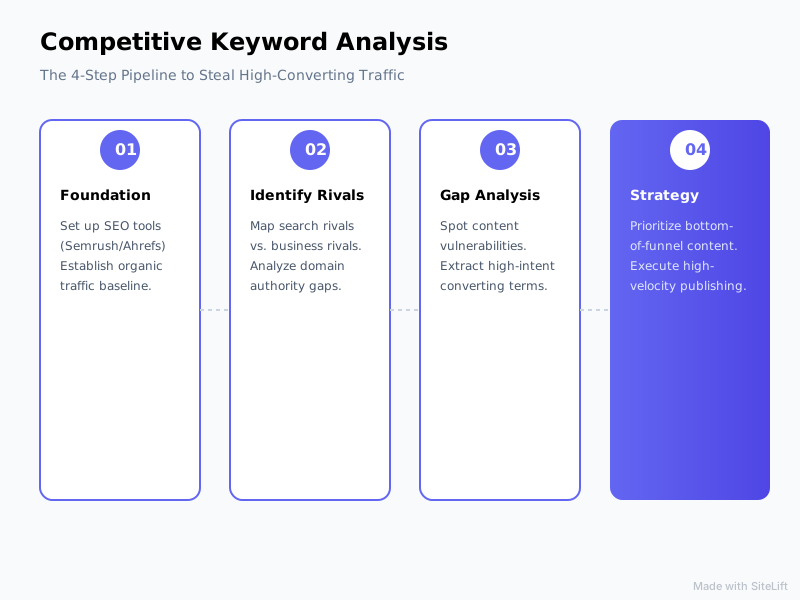
Infographic by SiteLift
Step 3: How Do You Master High-Value Keyword Prioritization in Competitive Keyword Analysis?
Not all traffic is created equal. A single query with 200 monthly searches that generates ten enterprise sales calls is infinitely more valuable than a 10,000-volume query that yields zero leads. Executing effective competitor keyword research requires strict filtering to elevate revenue drivers above simple traffic spikes.
According to Backlinko, the top organic result on Google receives an average click-through rate (CTR) of 27.6%. Dominating the first position for commercial, high-intent keywords captures a massive portion of ready-to-buy traffic.
Evaluating Search Intent (Informational vs. Commercial)
Classify your gap keywords by user intent:
- Informational (Top of Funnel): Broad queries like "what is SEO". Useful for top-of-funnel awareness, but low conversion intent.
- Investigative (Middle of Funnel): Queries like "best keyword research tools". High engagement potential as users evaluate options.
- Commercial / Transactional (Bottom of Funnel): High-intent queries such as "competitor keyword research tool pricing" or "buy automated SEO platform". These represent prospects with an immediate intention to purchase.
Balancing Keyword Difficulty, Volume, and Business Relevance
To achieve sustainable growth, adopt a balanced high-value keyword prioritization model. Score candidates using a simple index:
$$\text{Opportunity Score} = \frac{\text{Search Volume} \times \text{Business Value Score (1-5)}}{\text{Keyword Difficulty}}$$
+---------------------------------------------------------------------------------+
|                        SEARCH INTENT & VALUE TIER MATRIX                        |
+---------------------------------------------------------------------------------+
| Intent Category | Conversion Rate | Search Volume | Business Value Weight      |
+-----------------+-----------------+---------------+----------------------------+
| Transactional   | High (3% - 10%) | Low - Medium  | 5/5 (Highest Priority)     |
| Commercial      | Medium (1% - 3%)| Medium        | 4/5 (High Priority)        |
| Informational   | Low (< 1%)      | High          | 2/5 (Secondary Priority)   |
+-----------------+-----------------+---------------+----------------------------+
Focusing on mid-tail, high-intent terms allows smaller brands to capture fast market share. You can learn how to build an automated framework to target high-value organic search keywords and stream high-intent opportunities directly into your creation workflow.
Pro Tip: Ignore total search volume when evaluating bottom-of-funnel conversion keywords. A query with only 50 searches per month can easily drive thousands in ARR if it directly matches an enterprise buying decision.
- Actionable Steps: Sort candidate keywords by search intent, assign a business relevance score from 1 to 5, and filter out broad head terms with high difficulty scores.
- Expected Result: A prioritized backlog of high-converting keyword targets sorted by maximum revenue impact.
- Common Mistake to Avoid: Chasing high-volume informational keywords that inflate traffic reports without delivering measurable leads or revenue.
Step 4: How Do You Reverse-Engineer Competitor Content and On-Page Tactics?
Discovering a high-value keyword is only half the battle. To displace an entrenched rival on Page 1, you must analyze why search engines favor their content and build an asset that systematically outperforms it.
Analyzing Top-Performing SERP Content Structure
Analyze the top three ranking pages for your target keyword to understand the underlying framework:
- Content Depth and Coverage: What specific concepts, frameworks, and questions do they answer?
- Page Architecture: How do they structure their H2 and H3 subheadings?
- On-Page Technical Signals: Are they leveraging custom schema markup, interactive tables, or structured metadata? Refer directly to Google Search Central documentation to ensure your structural markup aligns with current webmaster standards.
Identifying Content Gaps and Search Intent Mismatches
Search engines favor pages that resolve user queries efficiently. Examine competitor pages for weaknesses:
- Are they using outdated metrics or obsolete industry examples?
- Is the design cluttered with disruptive popup ads that ruin mobile experience?
- Did they fail to offer a tangible resource, template, or step-by-step resolution?
Understanding how keyword ranking works allows you to diagnose competitors' on-page gaps and create structured assets designed to claim top positions.
Editorial Opinion: Why High Search Volume Is Overrated
In my experience leading organic search strategies, most marketing teams waste far too much time fighting over high-volume head terms. Industry guides routinely advise targeting broad queries with 50,000 monthly searches, promising game-changing traffic. In reality, these terms attract low-intent visitors who bounce within five seconds.
The most lucrative organic strategy involves aggressively capturing low-volume, high-intent long-tail keywords. Winning thirty distinct low-competition queries with 200 monthly searches each yields 6,000 highly qualified visits per month. These visitors convert at significantly higher rates because your content matches their specific commercial needs. Stop prioritizing vanity metrics over revenue potential.
- Actionable Steps: Audit top-ranking competitor pages for structural weaknesses, outline superior content sections, and integrate specific user assets like templates or calculators.
- Expected Result: A comprehensive content brief engineered to surpass top-ranking competitor assets on depth, usability, and intent matching.
- Common Mistake to Avoid: Simply copying competitor word counts without adding fresh data, unique media, or superior structural clarity.
Step 5: How Do You Build and Scale an Actionable Publishing Pipeline?
Conducting a competitive keyword analysis delivers value only when translated into active publishing. To convert static spreadsheet data into growing search visibility, you need an automated, repeatable publishing pipeline.
+---------------------------------------------------------------------------------+
|                       SCALABLE CONTENT PUBLISHING PIPELINE                      |
+---------------------------------------------------------------------------------+
|  [ Keyword Gap ]    [ Intent Brief ]    [ Automated Creation ]    [ Real-Time ] |
|  [ Discovery   ] -> [ Generation   ] -> [ & Distribution     ] -> [ Tracking  ] |
+---------------------------------------------------------------------------------+
Creating Targeted Content Briefs
Turn every prioritized keyword into a structured, production-ready content brief containing:
- Target Primary and Secondary Keywords: Clear density targets and semantic terminology requirements.
- Required Search Intent Angle: Instructions detailing whether the asset should be a how-to guide, product comparison, or strategic blueprint.
- Required Headings Matrix: Mandatory subheadings based on competitive gap analysis.
Automating Production and Keyword Tracking
Manual brief creation, content writing, CMS formatting, and rank tracking can create severe bottlenecks. High-growth teams leverage platform tools to streamline content pipelines and accelerate execution speed.
This is where sitelift.io shines. Instead of spending dozens of hours manually managing spreadsheets and publishing workflows, SiteLift automates organic visibility growth end-to-end. The software monitors keyword momentum in real-time, builds contextually aligned assets, and manages seamless publishing across your web ecosystem on autopilot.
Pro Tip: Set up automated position tracking immediately after publishing new target assets. Tracking rank momentum on a weekly basis helps you spot early indexing signals and make prompt on-page optimizations before competitors react.
- Actionable Steps: Standardize content briefs, schedule content outputs into a recurring content calendar, and implement automated rank tracking software.
- Expected Result: A steady, scalable publishing workflow that consistently covers high-value keyword gaps.
- Common Mistake to Avoid: Publishing high-value content sporadically without tracking initial performance signals or building supportive internal links.
Common Pitfalls: What Mistakes Should You Avoid in Competitor Keyword Research?
Even experienced growth leads run into predictable snags when executing competitor keyword strategies. Avoiding these common traps protects your resources:
Copying Low-Value or Irrelevant Keywords
Just because a key competitor ranks for a specific query does not mean that term generates business value. They may have published that content years ago as an experiment that never converted. Always evaluate search intent against your actual product offerings before adding terms to your production queue.
Ignoring Search Intent Changes
Google constantly refines SERP layouts based on real-time user behavior. A keyword that previously displayed standard blog articles might shift toward video carousels or local map packs. Re-evaluate live search engine results pages right before writing to ensure your content format aligns with active display preferences.
+---------------------------------------------------------------------------------+
|                     COMMON ANALYSIS PITFALLS & SOLUTIONS                        |
+---------------------------------------------------------------------------------+
| Common Mistake                   | Impact                    | Corrective Action |
+----------------------------------+---------------------------+-------------------+
| Chasing high-volume head terms   | Low conversion, slow rank | Pivot to long-tail|
| Copying competitor page outline  | Indexing duplicate intent | Add unique data   |
| Failing to monitor SERP shifts   | Traffic drop over time    | Conduct quarterly |
|                                  |                           | content audits    |
+----------------------------------+---------------------------+-------------------+
Expected Outcome: What Results Should You Expect from Competitive Keyword Analysis?
Executing a systematic competitor keyword strategy accelerates organic acquisition efficiency while drastically lowering customer acquisition costs (CAC).
Measuring Organic Traffic Growth and Conversions
When executed with high publishing consistency, you can expect:
- Accelerated SERP Indexing: High-intent long-tail assets routinely hit front-page rankings within weeks of indexation.
- Higher Conversion Rates: Capturing lower-funnel commercial keywords delivers qualified buyers with immediate purchasing intent.
- Compounding Organic Authority: Consistently closing keyword gaps relative to top market rivals builds authority across your broader topic ecosystem over time.
FAQ
What is competitive keyword analysis?
Competitive keyword analysis is the process of identifying, evaluating, and prioritizing the organic search terms that drive traffic and conversions for your market competitors. By analyzing competitor keyword gaps, growth teams uncover proven search opportunities to create targeted content that steals organic search market share.
What is the difference between business competitors and organic search competitors?
Direct business competitors sell identical products or services to your target market. Organic search competitors are any websites—including media outlets, affiliate platforms, or indirect service providers—that currently rank on Page 1 of Google for the search queries your prospective buyers write.
How often should you perform a keyword gap analysis?
You should execute a full competitive keyword analysis quarterly to track new market entrants, identify shifting content strategies, and catch emerging search trends. However, real-time rank tracking and ongoing content gap updates should be maintained continuously using automated SEO management platforms.
Which metrics matter most when prioritizing high-value keywords?
The most critical metrics for prioritizing keywords are Search Intent Alignment (commercial vs. informational value), Keyword Difficulty (ability to rank relative to domain authority), Business Value Weight (fit with your product offerings), and Search Volume. Prioritize terms with high commercial intent and manageable difficulty over pure search volume.
— sitelift.io
Topics Covered:
- competitive keyword analysis
- competitor keyword research
- keyword gap analysis process
- competitor traffic analysis
- high-value keyword prioritization
More from SiteLift

How to Use Content Gap Analysis SEO to Steal Competitor Traffic on Autopilot
Learn content gap analysis SEO strategies to find and close competitor keyword gaps, then automate content planning to grow organic traffic faster.

SEO Content Planner: How to Plan 90 Days of Compounding Content on Autopilot
Learn how to use an SEO content planner to build a 90-day compounding strategy. Automate briefs, map topical authority, and scale traffic on autopilot.

Platform SEO: How to Optimize Marketplaces, SaaS Platforms and Multi-Vendor Sites
Master platform SEO for marketplaces & SaaS. Learn taxonomy, programmatic SEO, UGC governance & scale organic traffic fast.