How to Choose SEO Audit Companies That Deliver Actionable Automation Roadmaps

If you’ve ever hired seo audit companies, you probably know the drill. You sign a contract, wait three to four weeks, and receive a massive, 150-page PDF filled with generic recommendations. There are colored pie charts, lists of missing meta descriptions from 2018, and a vague warning about your site speed. Then, the agency leaves you to figure out how to actually implement those recommendations.
This "deliver-and-disappear" model is dead. In an era where search engines evolve daily, relying on a static, slow-moving document is a recipe for falling behind. When evaluating seo audit companies, you shouldn't just look for a list of errors. You need a partner that provides an actionable, automation-friendly roadmap that integrates directly with your modern development pipeline.
Key Takeaways
| What to Look For | What to Avoid | The Modern Workflow |
|---|---|---|
| Continuous automated site analysis | One-off, static PDF reports | Real-time dashboards with API access |
| Deep technical error detection (Schema, CWV) | Basic "broken link" scans | Prioritized developer-ready tickets (Jira/GitHub) |
| Integration with modern website audit tools | Manual spreadsheets with no context | Automated workflows and CMS integration |
| Strategic focus on seo performance health | Vanity metrics and generic checklists | AI-readiness, SGE visibility, and ROI mapping |
Why We Believe the Traditional SEO Audit Model is Broken
Let’s be honest: most traditional SEO audits are designed to justify an agency's retainer, not to help your engineering team fix your site.
For years, agencies have charged five-figure fees to run your URL through off-the-shelf software, export the results, slap their logo on it, and call it a "strategic audit." This process creates a massive disconnect between marketing goals and engineering reality. SEOs throw a spreadsheet of 4,000 unprioritized errors over the fence. Developers look at it, see "low-priority alt text issues" mixed with "critical rendering bugs," and promptly dump the entire document into the backlog where it goes to die.
We believe that a modern technical audit must be an active, living engineering document. If an audit doesn't translate directly into a prioritized queue of developer tickets, it isn't an audit—it's homework.
With organic search driving over 53% of all trackable website traffic according to a comprehensive study by BrightEdge, your business cannot afford to let technical recommendations sit in limbo. The agencies worth hiring today are those that treat SEO as a continuous software engineering discipline, not a quarterly creative writing project.
What Should You Expect from Modern SEO Audit Companies?
The SEO landscape has shifted. If you are vetting partners, you must demand deliverables that reflect the current state of search technology.
Shifting from Static PDFs to Dynamic Roadmaps
A static PDF is outdated the moment it is generated. If your development team deploys a code change tomorrow, a PDF audit from last week becomes instantly obsolete. Modern seo audit companies have abandoned static documents in favor of dynamic, interactive roadmaps.
These roadmaps should categorize issues by impact (high, medium, low) and dev effort (easy, medium, hard). This allows your product managers to easily spot the "low-hanging fruit"—high-impact, low-effort fixes that move the needle immediately.
The Role of Automated Site Analysis in Modern Audits
Manual analysis will always have its place for deep strategic thinking, but relying on it for basic error detection is incredibly inefficient. Modern partners utilize continuous automated site analysis to monitor your site’s health 24/7.
Instead of waiting for a quarterly review to find out that a rogue canonical tag deindexed your high-value landing pages, automated systems flag these errors the moment they occur. This keeps your development loop tight and prevents costly organic traffic drops.
Aligning Audit Deliverables with Business Growth
An audit shouldn't just list what is broken; it must explain why fixing it matters to your bottom line. If an agency cannot estimate the organic traffic lift or conversion recovery of a technical fix, they are just guessing.
For example, research from Google indicates that a 1-second delay in mobile page load times can impact conversion rates by up to 20%. A sophisticated SEO partner will tie their recommendations directly to these performance metrics, proving the direct financial ROI of technical error resolution.
Key Capabilities to Look for in an SEO Audit Partner
When interviewing potential agencies, you need to look under the hood of their technical capabilities. Do not get blinded by fancy client lists; focus on their technical execution.
Advanced Technical Error Detection and Prioritization
Your partner must go far beyond basic crawl errors. They should specialize in deep technical error detection, which includes analyzing:
- JavaScript Rendering: Can search engines actually render and index your client-side JavaScript (e.g., React, Angular, Vue)?
- Structured Data & Schema: Are your schemas compliant with W3C standards and optimized for rich snippets?
- Core Web Vitals: Are they diagnosing real-user monitoring (RUM) data or just running a single Lighthouse scan?
Without this level of depth, you are only scratching the surface of your site's technical health.
Integration of Enterprise Website Audit Tools
Ask potential partners which website audit tools they use. A top-tier agency won't rely on a single platform. They should leverage a sophisticated stack of enterprise crawlers (like Botify, Screaming Frog, or Deepcrawl) alongside proprietary automation scripts.
More importantly, they should show you how they synthesize this data. If they just hand you raw exports from these tools, they aren't doing their job. They need to translate raw crawl data into clean, actionable insights.
Continuous Monitoring of SEO Performance Health
SEO is not a one-time project; it is a continuous state of optimization. Your partner should establish a baseline for your seo performance health and track it continuously.
[Continuous Crawl] ---> [Automated Error Detection] ---> [Prioritized Dev Tickets] ---> [Validation Scan]
This loop ensures that once an issue is fixed, it stays fixed. If a new deployment accidentally breaks your structured data, automated alerts should notify your team immediately, rather than months down the road.

How to Evaluate an Agency's Automation and AI Readiness?
The search landscape is undergoing its most significant disruption in a decade with the integration of AI-driven search engines (like Google's AI Overviews) and LLM-based web crawlers. The agency you hire must be prepared for this shift.
Do They Use Autonomous Execution or Just Manual Reporting?
The biggest differentiator between legacy agencies and modern partners is execution. Legacy agencies stop at reporting. Modern partners build automated workflows.
Ask them: “Once you find an issue, how do we fix it?”
If their answer is purely "your developers have to write the code," they are lagging behind. The best partners can provide pre-written code snippets, automated redirect maps, or even integrate with systems that programmatically deploy fixes. If you want to bypass manual agency bottlenecks entirely, you might want to look into how B2B SEO agency vs AI workflows compare in terms of speed and execution.
Vetting Their Tech Stack for AI Search Visibility
AI search engines crawl and process information differently than traditional search bots. Your audit partner must understand how to optimize your site for LLM crawlers (like GPTBot or ClaudeBot).
This includes auditing your site's llms.txt files, structuring data for semantic search, and ensuring your content is easily digestible by AI models. To see where your site stands right now, you can run an instant analysis using our suite of specialized SEO tools built for the AI era.
Assessing Their Speed to Implementation
In SEO, speed is a competitive advantage. If it takes three months for your agency to deliver an audit, and another six months for your dev team to implement it, you’ve lost nine months of organic growth.
Ask agencies how they accelerate the developer handoff. Do they write clean Markdown for GitHub? Do they create native Jira tickets with clear acceptance criteria? If they don't understand developer workflows, your audit will inevitably stall.
Pro Tip: Always ask a prospective SEO agency to show you a sample of a developer ticket they have written. If it doesn't include clear "Steps to Reproduce," "Expected Behavior," and "Acceptance Criteria," your developers will ignore it.
Critical Questions to Ask Before Hiring SEO Audit Companies
To filter out the low-value agencies that rely on generic templates, use this vetting checklist during your sales calls.
1. How Do You Translate Audit Findings into Developer Tickets?
If they say they send an Excel sheet, move on. A modern partner should ask for access to your project management tools (Jira, Trello, Asana, or GitHub). They should write the tickets themselves, complete with technical specifications, code examples, and validation steps.
2. What Balance of Manual Expertise and Automation Do You Provide?
Automation is excellent for scale and speed, but manual oversight is necessary for complex contextual issues. You want an agency that uses automation to handle the heavy lifting of technical error detection, freeing up their senior strategists to focus on competitive positioning and architecture design.
3. How Do You Measure the ROI of Your Technical Recommendations?
They should be able to map technical issues directly to business metrics. For instance, if they recommend fixing rendering issues on your product pages, they should estimate the traffic and revenue currently blocked by those indexing issues.
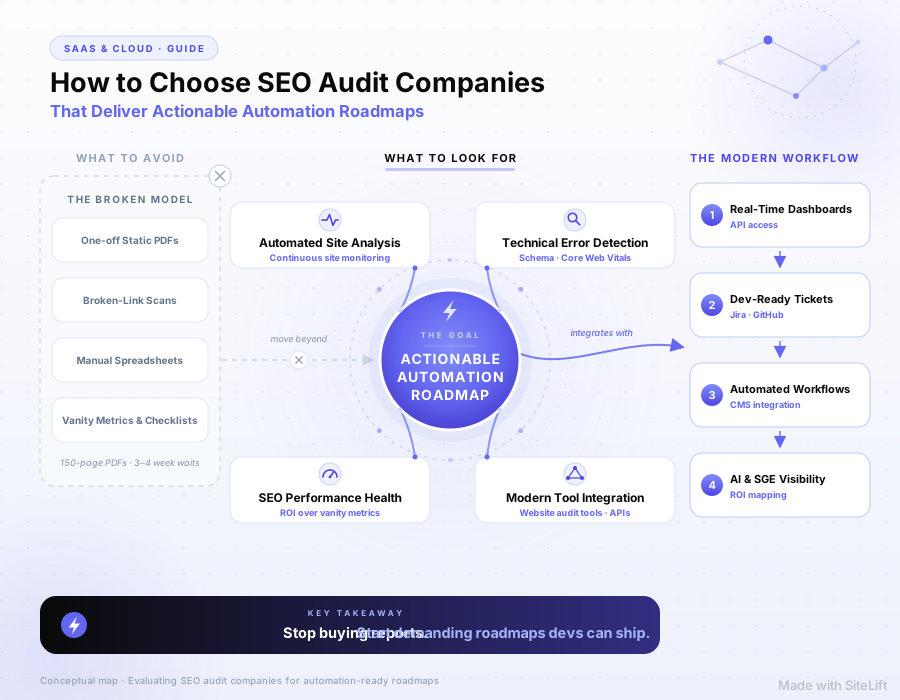
Infographic by SiteLift
To help you compare different agency models, we’ve broken down how traditional agencies compare to modern, automation-first partners:
| Feature | Traditional SEO Agencies | Modern Automation Partners |
|---|---|---|
| Deliverables | Static PDFs, generic spreadsheets | Dynamic dashboards, API feeds, Jira tickets |
| Turnaround Time | 4 to 6 weeks | Real-time or within days |
| Developer Handoff | Manual review meetings, zero code | Pre-written code, dev-ready specs |
| AI Search Readiness | Focuses only on traditional Google blue links | Optimizes for LLM crawlers, SGE, and AI engines |
| Pricing Model | High monthly retainers | Performance-based or software-enabled |
Red Flags: When to Walk Away from an SEO Audit Provider
Don't get burned by slick sales presentations. Watch out for these three major red flags when evaluating seo audit companies.
Over-Reliance on Generic Out-of-the-Box Software Reports
If an agency's sample audit looks identical to a free PDF export from a tool you can run yourself, run away. You are paying for their analysis, context, and prioritization, not their software subscription. If you want to see what a high-quality automated technical scan looks like without paying a dime, try our Free SEO Audit Tool to get an instant, weighted health score and a prioritized list of fixes.
Lack of Post-Audit Implementation Support
Many agencies make their money by delivering the audit and then washing their hands of the implementation. They will argue that "implementation is your team's responsibility." While they won't write your core codebase, they must be available to test fixes in staging environments, answer developer questions, and validate deployments.
Ignoring Modern Search Engine Realities
If an agency doesn't mention Core Web Vitals, schema markup, or AI Search Generative Experience (SGE) during their pitch, they are living in the past. According to technical documentation on Google Search Central, search engines prioritize page experience and structured data more than ever. An agency focusing solely on keyword density and manual link building is using a playbook from 2015.
How SiteLift Transforms the Technical Audit Workflow
If you are tired of paying high agency retainers for static reports that your team never implements, it’s time to rethink your approach. The traditional agency model is slow, expensive, and disconnected from modern development.
At SiteLift, we built an autonomous SEO and AI visibility platform that replaces manual agency bottlenecks with intelligent, continuous automation. Instead of waiting weeks for a manual audit, our platform provides real-time monitoring of your site's SEO health, automatically detects technical errors, and generates optimized content pipelines on autopilot.
Whether you want to completely replace your agency or simply supercharge your internal team's capabilities, shifting to automated workflows allows you to scale your organic traffic without the manual overhead. You can explore whether you still need traditional SEO consulting services or if an autonomous pipeline is the right fit for your growth goals.
FAQ
What is the difference between a manual SEO audit and automated site analysis?
A manual SEO audit is conducted by an analyst who manually reviews a site's architecture, content quality, and competitive landscape. It is excellent for high-level strategy but is slow and prone to human error. Automated site analysis uses software to continuously crawl a website, instantly detecting technical errors, broken links, and rendering issues at scale.
How much do professional SEO audit companies typically charge?
For a mid-market to enterprise website, professional seo audit companies typically charge between $5,000 and $20,000 for a one-time comprehensive technical audit. Retainer-based agencies often package these audits into their initial onboarding fees, which can range from $3,000 to over $10,000 per month.
How often should a business conduct a comprehensive technical SEO audit?
At a minimum, you should run a comprehensive technical audit quarterly. However, if your development team deploys code changes weekly or daily, you should implement continuous automated monitoring to catch technical errors immediately upon deployment rather than waiting for a scheduled audit.
Can website audit tools completely replace professional SEO audit companies?
While automated website audit tools are highly effective at identifying technical errors, they cannot replace the strategic context that human experts provide. A tool can tell you that a page is missing a canonical tag, but it cannot align your overall URL structure with your broader business objectives or prioritize fixes based on developer resources.
What deliverables should be included in an actionable SEO audit roadmap?
An actionable audit roadmap must include:
- A prioritized list of issues categorized by business impact and development effort.
- Clear developer specifications (Jira-ready markdown) with steps to reproduce and expected behavior.
- Pre-written code or schema snippets where applicable.
- A post-implementation validation plan to verify that fixes have been deployed correctly.
If your team also needs to clean up decaying or underperforming content alongside technical fixes, you can learn how to systematically run an SEO content audit to revive your organic search traffic.
— sitelift.io
Topics Covered:
- seo audit companies
- website audit tools
- technical error detection
- automated site analysis
- seo performance health
More from SiteLift

SEO Conversion Optimization: How to Turn Organic Search Readers into Paying Customers
Learn how to turn organic search visitors into paying customers with this step-by-step SEO conversion optimization guide. Optimize your CTAs and UX.

What Defines High-Quality Content SEO in Google’s AI-Driven Search Era?
Discover what defines high-quality content SEO today. Learn how to optimize for Google's AI Overviews, master E-E-A-T guidelines, and outrank generic copy.

The Truth About Guaranteed SEO Services: Red Flags and Real Ranking Predictability
Exposing guaranteed SEO services scams. Learn red flags, real ROI timelines, and how to drive predictable organic traffic safely.