How to Build an Autonomous SEO Content Strategy That Compounds Traffic

Building a modern seo content strategy shouldn't feel like running endlessly on a manual hamster wheel. For years, marketing teams have operated under a flawed assumption: hire a writer, publish two articles a week, wait six months, and pray to the search engine algorithms.
Yet search has fundamentally shifted. Search engines are no longer just looking at individual keywords; they evaluate comprehensive topic ecosystems, semantic context, and real-time freshness. If your content production model relies entirely on fragmented spreadsheets and manual drafting, you're competing with a typewriter in an era of high-speed compute.
An autonomous seo content strategy replaces fragile manual workflows with a programmatic, compounding system. By combining intelligent keyword cluster planning, algorithmic execution, and a continuous automated publishing schedule, businesses can establish true topical authority and turn search visibility into a self-sustaining asset. Here is how to architect an end-to-end organic content pipeline that compounds traffic month over month.
Key Takeaways
| Strategic Dimension | Traditional Manual Content Strategy | Autonomous SEO Content Pipeline |
|---|---|---|
| Output Cadence | 4–8 articles per month | 30–100+ high-depth articles per month |
| Topic Coverage | Single-keyword targeting; isolated posts | Comprehensive semantic keyword cluster planning |
| Internal Linking | Manual, inconsistent, prone to broken paths | Programmatic, entity-based context distribution |
| Publishing Workflow | Manual drafting, formatting, and CMS upload | Zero-touch sync directly to CMS platforms |
| Search Engine Target | Traditional blue links | Hybrid: Google Core, AI Overviews, & LLM engines |
| Traffic Trajectory | Linear growth with rapid plateauing | Compounding organic visibility across entire clusters |
What is an Autonomous SEO Content Strategy?
At its core, an autonomous seo content strategy is a self-governing growth engine. Instead of treating every blog post as a bespoke, artisanal craft project, an autonomous system views content as code: structured, scalable, interlinked, and continuously optimized based on performance data.
According to research from Ahrefs, an astonishing 90.63% of all indexed pages get zero organic search traffic from Google. The reason isn't always poor writing; it's structural irrelevance. Traditional publishing models fail to saturate topics deeply enough to register as authoritative in modern search algorithms.
+-------------------------------------------------------------+
|               AUTONOMOUS SEO CONTENT PIPELINE               |
+-------------------------------------------------------------+
|  1. Semantic Discovery  --> Dynamic Keyword Clustering      |
|  2. Structured Gen      --> Contextual Intent Mapping       |
|  3. Graph Linking       --> Automated Bi-Directional Links  |
|  4. Cadence Publishing  --> Headless / Native CMS Webhooks  |
|  5. Feedback Loop       --> Momentum Tracking & Auto-Pruning|
+-------------------------------------------------------------+
The Shift from Manual Execution to Algorithmic Scale
Traditional search engine optimization treats publishing like publishing a print magazine: editors brainstorm ideas, assign them to freelancers, wait two weeks for a draft, edit for style, and manually paste text into WordPress. This workflow creates an artificial bottleneck.
An autonomous system changes the unit economics of organic growth. By automating research, clustering, dynamic schema generation, and technical delivery, teams decouple content velocity from head count. The human role shifts from repetitive typing to high-level architecture and editorial direction.
Core Pillars of an Organic Content Pipeline
To build a truly resilient organic content pipeline, your system must be anchored on four structural pillars:
- Semantic Intelligence: Automated ingestion of search intent, competitive gaps, and entity graphs rather than isolated keyword search volume.
- Programmatic Content Generation: Systems capable of producing nuanced, comprehensive long-form content that answers primary, secondary, and latent user queries.
- Automated Interlinking Topology: An algorithm that calculates optimal context pathways between parent hub pages and child cluster nodes without manual intervention.
- Autonomous Distribution: Direct API webhooks into your CMS (like WordPress, Webflow, or Shopify) coupled with external distribution networks.
Why Traditional Content Calendars Fail to Compound Traffic
Traditional editorial calendars are designed around time intervals (e.g., "Post every Tuesday and Thursday") rather than information architecture. When you publish randomly across disparate subjects, search crawlers perceive your website as a generalist bulletin board rather than a definitive knowledge base.
To build sustainable momentum, your content cannot exist in silos. It must form an unbroken semantic web that satisfies user intent across every stage of the evaluation journey.
How Do You Execute Keyword Cluster Planning for Topical Authority?
Search engines have evolved past strict string matching. With algorithms powered by transformer models, Google evaluates whether your site comprehensively answers a topic's entire ontology.
If you want to rank for high-value transactional phrases, you must also dominate the informational, comparative, and technical sub-queries surrounding them. This is where topical authority becomes your moat.
Mapping Search Intent to Semantic Hubs
The cornerstone of keyword cluster planning is aggregating hundreds of search queries into discrete semantic groups. Instead of creating five thin pages targeting minor spelling variations, you build an interconnected cluster anchored by a core pillar page.
- Pillar Pages (Hubs): Broad, comprehensive resources addressing broad head terms (e.g., Customer Retention Software).
- Supporting Pages (Spokes): Detailed explorations of specific sub-topics, tactical workflows, and long-tail questions (e.g., How to Calculate Churn in SaaS, Cohort Analysis Templates, Exit Survey Strategies).
To ensure every piece performs, you must master search intent optimization so that automated outputs deliver the exact format—whether teardown, comparison matrix, or tutorial—that searchers and algorithms expect.

Building Topical Authority Through Automated Interlinking
Writing content without an explicit linking strategy is like building rooms in a house without hallways; neither visitors nor search bots can navigate between them.
Automated interlinking solves this by algorithmically weaving contextual anchors between related pieces:
- Every spoke links directly back to the parent hub with descriptive anchor text.
- Spokes within the exact same cluster link horizontally to sibling topics.
- Hub pages balance outgoing links across all underlying child nodes.
This structure creates clear semantic boundaries, distributes PageRank efficiently, and demonstrates to search engines that your domain provides an exhaustive, definitive knowledge graph on the topic.
Identifying and Exploiting Keyword Gaps at Scale
Most content strategists conduct gap analysis once a year, export a spreadsheet, and never look at it again. In an autonomous framework, gap identification runs continuously.
By systematically running content gap analysis SEO pipelines, your system identifies queries where competitors are ranking but your domain lacks coverage.
Platforms like Semrush demonstrate that modern keyword clustering methodologies require evaluating SERP overlap: if two distinct search queries display four or more identical URLs in the top 10 results, they belong to the same cluster and should be targeted on a single page. If the SERPs are completely distinct, the queries require separate, dedicated URLs.
Pro Tip: Never target a keyword cluster without validating SERP intent programmatically. If Google shows calculator tools in the top 3 spots, no 3,000-word informational article will crack the first page. Tailor the content architecture to the SERP's predominant entity type.
How to Power Your SEO Content Strategy with an Automated Publishing Schedule
Speed and volume matter in organic search. A common myth is that publishing "too fast" will somehow trigger search penalties. In reality, search engines reward authoritative sites that regularly update and expand their indexable inventory—provided the quality remains high.
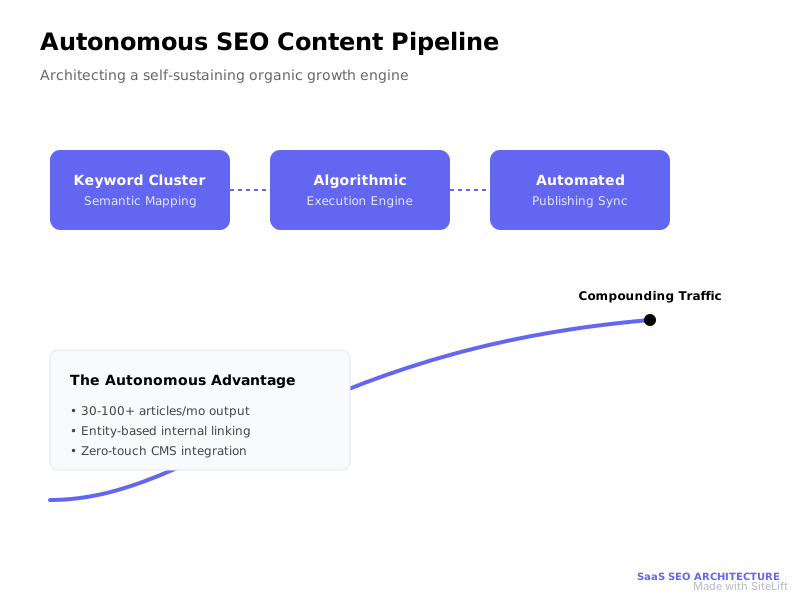
Infographic by SiteLift
According to benchmark research from HubSpot, companies that publish 16 or more blog posts per month generate nearly 3.5 times more traffic than those publishing 4 or fewer. Compounding returns do not accrue to the hesitant; they accrue to domains that build coverage quickly.
Determining Your Optimal Publishing Cadence
The relationship between publishing frequency, crawl budget, and index velocity is direct:
$$\text{Index Acceleration} \propto \frac{\text{Content Volume} \times \text{Cluster Density}}{\text{Crawl Interval}}$$
When you deploy an automated publishing schedule, search engine spiders alter their crawl schedules. The more frequently your domain yields fresh, logically connected pages that users engage with, the more frequently crawlers return to your XML sitemap.
| Cadence Strategy | Output (Monthly) | Indexation Lag | Strategic Impact |
|---|---|---|---|
| Traditional Boutique | 2–4 articles | 4–8 weeks | Slow; easily overtaken by faster competitors |
| Hybrid Team | 8–12 articles | 2–4 weeks | Moderate; establishes baseline authority |
| Autonomous Pipeline | 30–100+ articles | 24–72 hours | Rapid dominance across primary and long-tail clusters |
Automating Content Distribution Across Premium Networks
Publishing an article to your CMS is only step one. For search engines to discover and prioritize newly published content, it needs rapid indexation signals:
- Automated Ping & Indexing APIs: Immediate notification sent via Google Indexing API and Bing Webmaster API upon generation.
- Syndication and Repurposing: Automatically transmuting long-form articles into condensed summaries, social threads, and newsletter snippets to generate initial referral signals.
- Cross-Platform Syndication: Pushing canonicalized versions to partner publications and developer communities to seed high-trust contextual footprints.
Seamless CMS Integration for Zero-Touch Publishing
An autonomous pipeline eliminates the copy-paste nightmare. Using direct webhooks or native integrations with platforms like WordPress, Webflow, and Shopify, content assets—complete with formatted headers, auto-generated alt text, optimized meta descriptions, and schema markup—are staged and published hands-free.
This eliminates administrative friction and allows your marketing leaders to concentrate on high-level positioning and product alignment rather than fixing broken layout divs in a CMS back-end.
How Do You Monitor and Optimize an Autonomous Content Pipeline?
A truly autonomous seo content strategy isn't a "set-it-and-forget-it" mechanism. It functions as an adaptive control loop that monitors performance, identifies anomalies, and dynamically executes updates.
                    +--------------------------------+
                    | Monitor Real-Time Momentum     |
                    +---------------+----------------+
                                    |
                                    v
     +------------------------------+------------------------------+
     |                                                             |
     v                                                             v
+----+----------------------------+   +----------------------------+----+
|  Cluster Gaining Fast Traction  |   |  Cluster Stagnating / Decay   |
+----+----------------------------+   +----------------------------+----+
     |                                                             |
     v                                                             v
+----+----------------------------+   +----------------------------+----+
| Double Down: Generate Sub-Spokes|   | Trigger Automated Audit &   |
| and Bridge Adjacent Entities    |   | Historical Pruning Pipeline |
+---------------------------------+   +---------------------------------+
Tracking Real-Time Keyword Momentum
Static rank trackers that report updates once a week are obsolete. High-velocity publishing operations monitor keyword momentum—the velocity and acceleration of your URLs through search tiers:
- Tier 3 (Positions 51–100): Early algorithmic acknowledgment; validates indexation and basic entity relevance.
- Tier 2 (Positions 11–50): Growing relevance; signals that structural linking is working.
- Tier 1 (Positions 1–10): Dominant topical authority; indicates the cluster is driving meaningful organic traffic.
When an autonomous system detects that a specific cluster is climbing rapidly into Tier 2, it dynamically schedules child nodes to reinforce the rising URL, capitalizing on algorithmic momentum.
Programmatic Content Pruning and Historical Optimization
Content decay is inevitable. Industry statistics from the Content Marketing Institute highlight that 73% of B2B marketers use content marketing as a core pillar of their acquisition strategy, meaning the volume of competing content in the SERPs increases daily.
To maintain your rankings, you must run an automated SEO content audit to flag pages suffering from decay, missing search intent, or keyword cannibalization.
Autonomous platforms can programmatically update out-of-date statistics, add missing conversational queries, and adjust internal links to revive slipping rankings without human intervention.
Pro Tip: Set an automated alert for any top-performing URL that loses more than 15% of its weekly impressions. In 80% of cases, an algorithmic refresh of H2 headers and the insertion of direct answer schema will stabilize the page before traffic drops permanently.
Adapting Content for AI Search Engines and LLM Visibility
Search is no longer confined to ten blue links. Google AI Overviews, Perplexity, and conversational engines extract and synthesize content directly into generative answers.
To capture visibility across large language models (LLMs), your content must be structured for machine parseability:
- Extractable Answers: Clear definitions formatted in 40–60 word blocks immediately following question-based H2s and H3s.
- Structured Tables & Lists: LLMs favor tabular data and structured unordered lists when compiling direct answers.
- Entity Density: Inclusion of verified industry nomenclature, co-occurring terms, and citations that validate authoritative claims.
Why Manual Content Production is Underratedly Broken: An Editorial Perspective
I have watched dozens of ambitious SaaS companies and high-growth brands torch millions of dollars on traditional content agencies. They hire an army of freelance generalists, spend six weeks on strategy workshops, and produce twelve 1,200-word blog posts per quarter that fail to rank for anything beyond their own branded search terms.
The truth is simple: the traditional agency retainer model is fundamentally misaligned with how modern search engines operate.
Human writers are essential for proprietary research, original storytelling, and distinct brand opinions. But expecting a human being to manually write every informational sub-variant of your keyword universe is inefficient. It is too slow, too expensive, and mathematically incapable of achieving the topical density required to compete today.
If you are serious about winning organic search in an era governed by algorithmic scale and AI synthesis, you must stop treating SEO as a creative writing exercise. Treat it as data engineering. Build a system that models your market's entire search architecture, programmatically satisfies every user intent, and publishes at a speed that makes your competitors look like they are standing still.
— sitelift.io
Scale Your Organic Growth Autopilot with SiteLift
Executing an autonomous content strategy manually requires an extensive, custom-engineered stack: web scrapers, clustering models, LLM pipelines, schema generators, and custom CMS webhooks. Maintaining this infrastructure quickly turns your marketing team into a full-time software development shop.
This is why we built SiteLift. SiteLift is an end-to-end autonomous SEO and AI visibility growth platform engineered to take domains from keyword obscurity to category dominance on autopilot.
Instead of juggling fragmented subscriptions to legacy keyword tools and coordinating manual freelance queues, sitelift.io manages the entire lifecycle:
- Autonomous Semantic Clustering: Automatically discovers high-intent keyword gaps and groups them into authoritative topical clusters.
- High-Fidelity Automated Content: Produces comprehensive, long-form content crafted to rank both in traditional search results and AI-driven engines like Google AI Overviews.
- Automated Cross-Network Distribution: Distributes and indexes content across curated premium networks to build authority signals quickly.
- Direct CMS Synchronization: Pushes fully formatted, schema-rich content natively into WordPress, Webflow, Shopify, and custom headless environments without manual work.
If you are ready to stop chasing search traffic and start compounding it systematically, it is time to upgrade your infrastructure.
FAQ
What is an autonomous SEO content strategy?
An autonomous seo content strategy is an algorithmic, automated framework that manages keyword research, semantic cluster planning, content generation, internal linking, and publishing without requiring manual intervention for every step. It shifts the organic growth process from manual tasks to a scalable software-driven pipeline.
How does keyword cluster planning improve topical authority?
Search engines analyze the semantic depth of your entire website rather than individual pages in isolation. Keyword cluster planning organizes your content into core pillar hubs and interconnected sub-topic spokes. By comprehensively answering every related sub-query, query variation, and intent stage within a topic, you signal to search algorithms that your domain is a definitive source of truth, raising rankings across the entire cluster.
Can you fully automate an organic content pipeline without sacrificing quality?
Yes, provided the pipeline includes automated fact-checking, structured intent matching, and semantic schema generation. High-quality autonomous systems focus on programmatic depth, accurate technical parsing, and answering search queries directly, avoiding the vague generalities of poorly prompted consumer AI tools. Editorial teams can then focus on high-level product alignment and proprietary data rather than formatting text.
How does an automated publishing schedule impact search engine crawling?
Search engines allocate a finite crawl budget to every website based on its size, authority, and update frequency. Implementing a consistent, high-frequency automated publishing schedule signals to search engine spiders that your site is constantly adding value. Over time, search bots increase both crawl frequency and indexation speed, allowing newly deployed pages to rank in days rather than months.
Topics Covered:
- seo content strategy
- topical authority
- keyword cluster planning
- automated publishing schedule
- organic content pipeline
More from SiteLift

How to Choose SEO Audit Companies That Deliver Actionable Automation Roadmaps
Stop paying for static PDFs. Learn how to choose SEO audit companies that deliver developer-ready, automated roadmaps to scale your organic traffic.

What Defines High-Quality Content SEO in Google’s AI-Driven Search Era?
Discover what defines high-quality content SEO today. Learn how to optimize for Google's AI Overviews, master E-E-A-T guidelines, and outrank generic copy.

The Truth About Guaranteed SEO Services: Red Flags and Real Ranking Predictability
Exposing guaranteed SEO services scams. Learn red flags, real ROI timelines, and how to drive predictable organic traffic safely.