SEO Tools in 2026: How to Build an Autonomous Stack That Grows Traffic on Autopilot

For over two decades, enterprise marketing teams have relied on legacy seo tools that require hundreds of manual hours every month to perform keyword research, run site audits, and track search visibility. You open a dashboard, extract a list of keywords, draft content briefs, pass them to writers, format the text inside your CMS, build internal links manually, and then cross your fingers while checking rank trackers a week later.
That reactive model is officially dead.
According to data published by BrightEdge, over 68% of all online experiences begin with a search engine, underscoring why search presence remains the ultimate acquisition lever for digital brands. However, the nature of search has fundamentally shifted. Modern discovery spans traditional Google SERPs, AI overviews, SearchGPT, Perplexity, and conversational answer engines.
To win today, market leaders are replacing disconnected toolkits with integrated, autonomous systems. In this guide, we will explore how next-generation ai seo tools, real-time keyword rank tracking, and seo content automation allow you to deploy a hands-off publishing pipeline that scales your organic reach on autopilot.
Key Takeaways: Modern vs. Legacy SEO Tech Stacks
| Feature / Capability | Legacy SEO Toolkits (2015–2023) | Autonomous AI SEO Stacks (2026+) |
|---|---|---|
| Workflow Direction | Reactive: Manual research, exports, and manual implementation | Proactive: Autonomous detection, execution, and self-healing pipelines |
| Search Engine Scope | Traditional 10-blue-links on Google and Bing | SERPs + Generative Answer Engines (SearchGPT, Perplexity, Claude) |
| Content Execution | Manual drafting or static outline generators | Programmatic seo content automation with brand safeguards |
| Optimization Model | Keyword density and exact-match string matching | Semantic entity modeling, knowledge graphs, and intent coverage |
| Technical Maintenance | Manual internal linking, manual schema tags | Automatic dynamic internal linking and programmatic structured data |
| Performance Action | Periodic manual re-optimizations when traffic drops | Real-time keyword rank tracking linked to automated refresh rules |
What Are SEO Tools and How Is AI Transforming Them in 2026?
Legacy seo tools were essentially database viewports. Platforms like Ahrefs or Semrush gave marketers access to massive search indices, but the operational heavy lifting—the analysis, content production, distribution, and technical fixes—remained entirely human-dependent.
Today, modern systems have evolved from static lookup tables into active operational engines. Instead of presenting raw data for a human to interpret, autonomous software reads search signals, identifies revenue-generating opportunities, and executes technical and content tasks directly through connected platforms.
+-----------------------------------------------------------------------+
|                 AUTONOMOUS SEO STACK ARCHITECTURE                     |
+-----------------------------------------------------------------------+
|                                                                       |
|   1. REAL-TIME SIGNALS & INTENT DISCOVERY                             |
|      (Tracking SERPs, AI Answer Engines, Entity Gaps)                 |
|                                 │                                     |
|                                 ▼                                     |
|   2. PROGRAMMATIC CONTENT ENGINE                                      |
|      (Entity Optimization, Brand Voice Safeguards, Schema Generation) |
|                                 │                                     |
|                                 ▼                                     |
|   3. AUTOMATED CMS INTEGRATION & NETWORKING                           |
|      (Direct Publishing, Dynamic Internal Links, Multi-Channel)       |
|                                 │                                     |
|                                 ▼                                     |
|   4. REAL-TIME RANK TRACKING & CLOSED-LOOP UPDATES                    |
|      (Automated Refresh Triggers on Position Drops)                   |
|                                                                       |
+-----------------------------------------------------------------------+
The Shift from Manual Research to Autonomous SEO Systems
In traditional workflows, identifying a keyword gap was only 5% of the battle. The remaining 95% was consumed by manual briefing, writer management, content editing, CMS formatting, and link building.
An autonomous SEO engine collapses this process. The system constantly listens for shifts in buyer search intent, analyzes top-ranking pages across both Google SERPs and conversational AI engines, and automatically builds structured content targeting those gaps.
According to research from McKinsey, companies leveraging generative AI within their marketing workflows achieve a 15% to 20% increase in marketing efficiency and content ROI. By delegating administrative execution to automated infrastructure, growth teams can redirect their focus toward high-level strategy and positioning.
Why Traditional SEO Software Suites Are Falling Behind
Traditional SEO software suites were built for a search ecosystem dominated by desktop browsers and standard blue links. Their architecture relies on batch-processed crawler data that updates weekly or monthly—a cadence far too slow for contemporary algorithms.
Furthermore, traditional tools measure visibility almost exclusively through exact-match keyword rankings on Google desktop SERPs. They struggle to quantify how your brand performs inside generative response engines or AI search features.
When your competitors deploy ai seo tools that automatically adjust site architecture, generate content, and rebuild internal links in response to real-time algorithm updates, relying on manual software suites creates an unbeatable operational delay.
Core Capabilities of Modern AI SEO Tools
To succeed in 2026, an enterprise search stack must deliver four non-negotiable capabilities:
- Entity-Based Intelligence: Analyzing pages based on semantic knowledge graphs and entity relationships rather than simple keyword repetition.
- Generative Engine Optimization (GEO): Structuring content so large language models (LLMs) like ChatGPT, Claude, and Gemini synthesize and cite your brand in answer engine outputs.
- Closed-Loop Execution: Directly publishing content, inserting schema markup, and managing link networks without requiring developer resources.
- Programmatic Refresh Rules: Connecting keyword rank tracking to content pipelines so articles auto-update when position loss is detected.
How Do You Build an Autonomous SEO Stack for Exponential Traffic Growth?
Building an autonomous stack doesn't mean stitching together twenty different micro-SaaS tools with fragile Zapier zaps. It requires designing a unified architecture where keyword tracking, content generation, and publishing pipelines speak to one another seamlessly.
+-------------------------------------------------------------------------+
|                  DISCONNECTED VS. INTEGRATED STACKS                     |
+-------------------------------------------------------------------------+
|                                                                         |
|  DISCONNECTED (LEGACY):                                                 |
|  [ Keyword Tool ] ──> Manual Export ──> [ Google Docs ]                 |
|  ──> Copywriter ──> Manual Upload ──> [ CMS ] ──> Manual Rank Check    |
|                                                                         |
|  INTEGRATED (AUTONOMOUS):                                               |
|  [ Dynamic Intent Discovery ] ──────┐                                   |
|                                    ▼                                    |
|  [ Closed-Loop Pipeline ] ──> [ Automated CMS ] ──> [ Live Rank Engine ]|
|            ▲                                                │           |
|            └──────────────── Auto-Update Trigger ───────────┘           |
|                                                                         |
+-------------------------------------------------------------------------+
Automating Keyword Research and Cluster Identification
Keyword research should no longer begin with a human typing a head term into a query bar. Modern systems analyze your domain's content graph against live search results to uncover missing topic clusters automatically.
Instead of targeting isolated keywords, autonomous systems construct multi-tier topic clusters. They identify parent entities, calculate topical authority scores, and group long-tail search variations into strategic execution queues.
This ensures your publishing schedule systematically covers every angle of a topic, earning your domain topical authority faster than publishing disconnected pieces.
Streamlining Content Pipelines with SEO Content Automation
Content production has historically been the primary bottleneck in scaling organic acquisition. Data from HubSpot indicates that businesses blogging consistently with automated workflow tools generate 67% more leads per month than those relying solely on manual output.
Through seo content automation, search intent briefs are automatically transformed into publish-ready assets. The system analyzes the top 10 search results along with AI answer engine responses to identify mandatory semantic entities, ideal structural formatting, and intent nuances.

The platform then builds long-form, authoritative articles that match your target persona, injects structured JSON-LD data, and pre-formats elements like callout boxes and bulleted summaries for high readability.
Connecting Real-Time Keyword Rank Tracking to Publishing Rules
Most teams track search rankings purely as a reporting metric. They look at a monthly dashboard, notice a core keyword fell from position 3 to position 11, and schedule a manual content audit three weeks later.
An autonomous search stack treats keyword rank tracking as an actionable operational input.
When your rank-tracking engine registers a baseline ranking drop for a strategic keyword, it triggers an automated re-optimization protocol:
- The system re-crawls the current top-ranking SERP competitors.
- It identifies newly emerging semantic entities, secondary keywords, or intent shifts.
- It injects updated data, refreshes outdated statistics, and republishes the page via your CMS API without human delay.
Which AI SEO Tools Are Essential for Content Creation and Optimization?
Selecting the right software components determines whether your automated stack operates smoothly or breaks down under scale. Modern teams need platforms built specifically for autonomous workflows rather than point solutions designed for manual execution.
When managing complex multi-site setups or global publishing ops, you also need robust orchestration. Utilizing specialized SEO project management tools ensures that human-in-the-loop review steps blend seamlessly into automated publishing queues.
Intelligent Topic Modeling and Entity Optimization
Search engines no longer rely on string-matching to determine context. They parse content using Natural Language Processing (NLP) models to map relationships between named entities (people, places, concepts, technologies, and specifications).
Leading ai seo tools analyze top-ranking SERPs to construct a full semantic map of target topics. If you are targeting "supply chain software," modern topic models will identify that your content must cover related entities like warehouse management systems (WMS), third-party logistics (3PL), API integrations, and real-time telematics.
By programmatically covering these sub-entities, your content achieves maximum semantic coverage, sending strong relevance signals to both traditional crawlers and generative AI answer engines.
Automated Content Generation with Brand-Voice Safeguards
The biggest risk in automated content production is generic, low-quality output that sounds like every other LLM query. Modern enterprise tools eliminate this issue by employing custom brand-voice guardrails and retrieval-augmented generation (RAG).
+---------------------------------------------------------------------+
|                  BRAND-VOICE SAFEGUARD PIPELINE                     |
+---------------------------------------------------------------------+
|                                                                     |
|   Raw Search Intent Data                                            |
|              │                                                      |
|              ▼                                                      |
|   [ Topic & Entity Extraction Engine ]                              |
|              │                                                      |
|              ▼                                                      |
|   [ Brand Guidelines & Editorial Knowledge Base ]                   |
|              │                                                      |
|              ▼                                                      |
|   [ Style & Tone Parsing (Custom Voice Rules) ]                     |
|              │                                                      |
|              ▼                                                      |
|   [ Fact Validation & Source Attribution ]                          |
|              │                                                      |
|              ▼                                                      |
|   Publish-Ready, High-EEAT Content Asset                            |
|                                                                     |
+---------------------------------------------------------------------+
These platforms ingest your style guides, brand terminology, product documentation, and target audience profiles. When generating content assets, the system cross-references these rules to ensure:
- Correct usage of proprietary product and technical terminology.
- Accurate tone, perspective, and brand formatting preferences.
- Natural inclusion of real data sources and contextual citations.
- Automatic exclusion of generic AI overuses or unnatural phrasing.
Internal Link Automation and Schema Markup Engines
Internal links distribute link equity across your domain and help search crawlers map topic relationships. Yet, manually inserting internal links across hundreds or thousands of articles is almost impossible to maintain manually.
Autonomous platforms automatically evaluate your site's entire page index upon every new publish. The system identifies optimal anchor texts across historical content and updates those pages programmatically to point to the newly published asset.
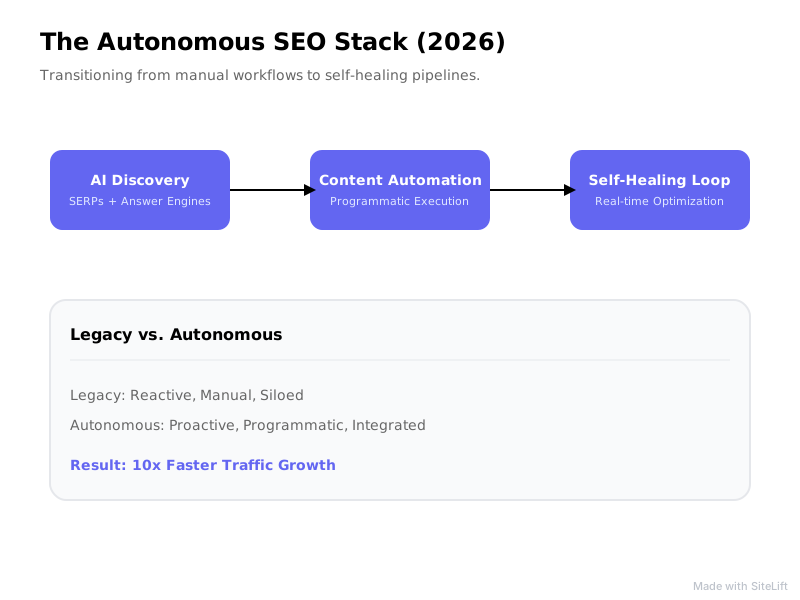
Infographic by SiteLift
Simultaneously, programmatic schema engines generate customized JSON-LD markup—including Article, FAQPage, HowTo, and Organization schemas—ensuring search engines understand your context immediately upon indexing. To verify that crawlers and LLM bots can seamlessly access your published assets, you can run quick diagnostic checks using a suite of free SEO tools to test crawler directives, review schema validity, and inspect SERP previews.
How Does Real-Time Keyword Rank Tracking Work Across Search and AI Engines?
Measuring organic performance used to be straightforward: you monitored daily ranking shifts across desktop and mobile SERPs for a fixed keyword list. In 2026, discovery happens across multiple surfaces, making real-time multi-channel rank tracking critical.
Tracking Rankings in Traditional SERPs vs. AI Answer Engines
Traditional search engines display organic search results alongside local packs, featured snippets, and video carousels. AI answer engines (such as SearchGPT, Perplexity, and Google Gemini) present conversational answers synthesized from multiple top web sources.
Modern keyword rank tracking platforms track both paradigms simultaneously:
| Measurement Dimension | Traditional SERP Tracking | AI Answer Engine Tracking (GEO) |
|---|---|---|
| Primary Metric | Numerical Rank Position (1-100) | Brand Citation & Share of Voice (%) |
| Output Format | Title, URL, and Meta Snippet | In-line Text Citation / Hyperlinked Footnote |
| Query Sensitivity | Keyword String Driven | Semantic Intent & Natural Conversation |
| Tracking Cadence | Hourly / Daily API Polling | Continuous Conversational Extraction |
Monitoring Share of Voice in SearchGPT and Perplexity
Measuring visibility in conversational engines requires tracking Share of Voice (SoV) across conversational query sets.
Rank tracking engines run hundreds of contextual queries through conversational APIs to record:
- Whether your brand or content URL is cited in the generated answer.
- The sentiment associated with your brand citation.
- Which specific competitors are cited alongside or above your domain.
- The specific anchor text and sources the engine used to derive its answer.
Pro Tip: Pay close attention to citation frequency inside Perplexity and SearchGPT for high-intent comparison queries (e.g., "Best X for Y"). Winning these citations often drives higher-converting referral traffic than sitting at position #3 on traditional desktop SERPs.
Using Performance Analytics to Trigger Automatic Content Updates
When rank tracking data is fully integrated into your content pipeline, it functions as an automated continuous feedback loop.
If an article drops from position 2 to position 8 on Google, or loses its featured citation in SearchGPT, the rank tracking engine flags the page as "Degraded."
                                    ┌────────────────────────┐
                                    │  Position Loss Detected │
                                    └───────────┬────────────┘
                                                │
                                                ▼
                                    ┌────────────────────────┐
                                    │ Auto-Crawl Competitors │
                                    └───────────┬────────────┘
                                                │
                                                ▼
                                    ┌────────────────────────┐
                                    │ Identify Missing Terms │
                                    └───────────┬────────────┘
                                                │
                                                ▼
                                    ┌────────────────────────┐
                                    │ Programmatic Re-Publish│
                                    └────────────────────────┘
The connected automation engine then systematically:
- Re-crawls the current top-ranking assets for that query string.
- Identifies newly added entity requirements, statistical updates, or structural changes.
- Injects updated sections into the article and deploys the refreshed content to your CMS.
- Pings search engines via IndexNow and site APIs to trigger immediate re-crawling.
What Best Practices Ensure Quality and Compliance in Automated SEO?
While automation offers massive efficiency advantages, running unmonitored script loops without governance can damage domain authority. To build a resilient organic growth engine, automation must align strictly with search quality guidelines.
Official documentation from Google Search Central states clearly that automated content generation is not inherently against their guidelines; rather, using automation to manipulate search rankings without adding genuine value violates search spam policies.
Maintaining EEAT and Human-in-the-Loop Review
Google evaluates content quality using its EEAT framework: Experience, Expertise, Authoritativeness, and Trustworthiness. Pure AI-generated text often lacks first-hand perspective and original testing.
To preserve high EEAT signals while taking advantage of seo content automation, top growth teams run a hybrid "Human-in-the-Loop" (HITL) framework:
- Automated Research & Drafting: AI platforms conduct keyword research, build structural briefs, and draft the core foundational body text.
- Human Review & Subject Matter Injection: An editor or subject-matter expert adds first-person observations, proprietary data, unique quotes, or custom media elements.
- Automated Formatting & Publishing: The system formats the finalized text, manages internal links, generates schema markup, and handles CMS publishing.
Navigating Search Engine Guidelines on AI Content
Search engines prioritize helpfulness regardless of whether a page was produced by a human, an AI, or a combination of both.
To ensure long-term compliance:
- Avoid Content Thinness: Ensure every automated asset delivers complete, direct answers to user intent without filler phrasing.
- Eliminate Hallucinations: Verify that stats, links, and technical facts generated by AI models are cross-referenced against confirmed data sources.
- Structure for Accessibility: Use clean headings, clear bulleted lists, and schema tags so both humans and automated bots can scan the page instantly.
If you are expanding across multiple geographic regions or strict regulatory markets, consult our comprehensive automated SEO software guide to understand how scaleups maintain localized quality control and regulatory compliance.
Scaling Content Velocity Without Sacrificing Domain Authority
Publishing thousands of generic pages overnight on a brand-new domain is a reliable way to trigger algorithmic spam filters. Scaling publishing velocity successfully requires a controlled, incremental approach.
+-------------------------------------------------------------------+
|               SUSTAINABLE CONTENT SCALING ROADMAP                 |
+-------------------------------------------------------------------+
|                                                                   |
|   PHASE 1: Core Topical Foundation                                |
|   • Target high-intent, low-difficulty clusters                   |
|   • Publish 5–10 authoritative assets per week                    |
|   • Establish baseline crawl habits & entity indexation           |
|                               │                                   |
|                               ▼                                   |
|   PHASE 2: Expansion & Automation Scaling                         |
|   • Scale publishing velocity to 20–50 assets per week            |
|   • Enable dynamic internal linking & automated schema            |
|   • Monitor indexing speeds and performance metrics               |
|                               │                                   |
|                               ▼                                   |
|   PHASE 3: Full Closed-Loop Autopilot                             |
|   • Continuous intent gap discovery                               |
|   • Automated programmatic refreshes on position drops            |
|   • Multi-channel optimization (SERPs + Generative AI)            |
|                                                                   |
+-------------------------------------------------------------------+
Pro Tip: Keep an eye on indexation velocity in Google Search Console as you scale publishing volume. If new pages take longer than 48 hours to get indexed, slow down publishing speed and focus on building stronger internal link structures to your new URLs.
The Untold Reality of Autonomous Search Infrastructure
For years, the digital marketing industry treated manual effort as a proxy for content quality. Marketers took pride in spending twenty hours writing a single article, assuming that manual effort guaranteed search success.
The industry has changed permanently. Search engines have evolved from basic keyword matchers into deep semantic engines powered by AI. Expecting human teams to manually track millions of entity variations, update thousands of static articles, and build complex link structures without software assistance is no longer feasible.
In my view, the debate over "human vs. AI content" misses the point entirely. The true distinction today is between reactive publishing and autonomous publishing pipelines.
Teams holding onto legacy toolkits and manual content production will find themselves outpaced by competitors who leverage autonomous systems. When an automated engine can discover an intent gap, publish a fully optimized piece of content, build relevant internal links, and continuously re-optimize that page based on real-time ranking data—all in a fraction of the time—manual approaches simply cannot keep up.
Building an autonomous SEO stack isn't about eliminating human oversight. It's about giving your team enterprise-grade infrastructure so your organic traffic compounds reliably in the background.
Scale Your Organic Growth on Autopilot with SiteLift
If you are ready to modernize your search operations beyond disconnected software suites, sitelift.io provides an end-to-end autonomous search platform designed for scalable organic growth.
SiteLift bridges the gap between intent discovery and automated distribution. Rather than handing you spreadsheets of raw metrics, SiteLift acts as your complete organic growth pipeline:
- Autonomous Content Generation: Continuously identifies topical gaps and drafts comprehensive, intent-focused articles customized to your brand voice.
- Premium Network Distribution: Automatically distributes your published assets across an exclusive media network to build authority and accelerate initial indexation.
- Seamless CMS Integration: Integrates directly with your CMS platform to handle publishing, updating, formatting, and schema management without developer effort.
- Closed-Loop Rank Tracking: Monitors search and generative AI answer engines in real-time, automatically triggering re-optimization protocols to protect your rankings.
Whether you manage an enterprise portfolio or scale a fast-growing business, SiteLift lets you turn organic search into a predictable, hands-off growth engine.
Frequently Asked Questions About SEO Tools
What are AI SEO tools and how do they differ from traditional SEO software?
Traditional seo tools act primarily as static databases, requiring human marketers to analyze research, write content, and execute site updates manually. Next-generation ai seo tools utilize generative models, Natural Language Processing, and direct API connections to automate intent discovery, content production, schema generation, and programmatic site optimization on autopilot.
Can an autonomous SEO stack completely replace manual SEO management?
An autonomous SEO stack automates repetitive administrative tasks like keyword clustering, baseline drafting, schema markup, internal link insertion, and routine re-optimizations. However, strategic oversight, human brand voice reviews, first-person insights, and custom product positioning still benefit from expert human guidance to maximize trust and brand alignment.
How does SEO content automation affect Google rankings and policy compliance?
Google evaluates content based on helpfulness, accuracy, structural clarity, and user satisfaction, rather than whether it was drafted by a human or generated by automated tools. As long as automated content offers accurate information, avoids manipulative spam techniques, and satisfies user intent, search engines index and rank it normally.
How do modern keyword rank tracking tools measure visibility in AI answer engines like SearchGPT?
Modern keyword rank tracking systems monitor conversational answer engines (such as SearchGPT, Perplexity, and Google Gemini) by executing natural-language prompts via conversational APIs. They track metrics like brand citation rates, inclusion in generated summary footers, contextual sentiment, and total Share of Voice (SoV) across target query sets.
— sitelift.io
Topics Covered:
- seo tools
- ai seo tools
- keyword rank tracking
- seo content automation
More from SiteLift

AI for SEO: How to Automate Research, Content Creation and Distribution
Learn how to use AI for SEO to automate keyword research, generative content creation, CMS publishing, and search engine visibility.

Repurposing Content for SEO: How to Multiply Organic Reach Across Channels
Learn how repurposing content for SEO multiplies organic reach. Discover step-by-step strategies for syndication, AI visibility, and automation.

Fresh Content SEO: How Publishing Frequency and Recency Drive Rankings
Discover how fresh content SEO, publishing velocity, and Google's QDF algorithm impact rankings and AI search visibility. Build a scalable freshness engine.