Finding the Best Automated SEO Tool: What European Scaleups Need to Look For

The search for the best automated SEO tool often ends with a list of the same familiar names — Ahrefs, Semrush, and a handful of AI copywriters like Jasper. But if you're leading growth at a European scaleup, those tools were built for a different era. They're manual toolkits, not autonomous systems. And in a market where speed, multilingual reach, and compliance matter more than raw features, that distinction is everything.
This guide breaks down exactly what European scaleups should evaluate when choosing an automated SEO platform — from CMS integration and AI content generation to GDPR compliance and real-time rank tracking. No fluff, just the criteria that actually move organic revenue.
Key Takeaways: The 30-Second Summary
| Evaluation Criteria | What to Look For | Why It Matters |
|---|---|---|
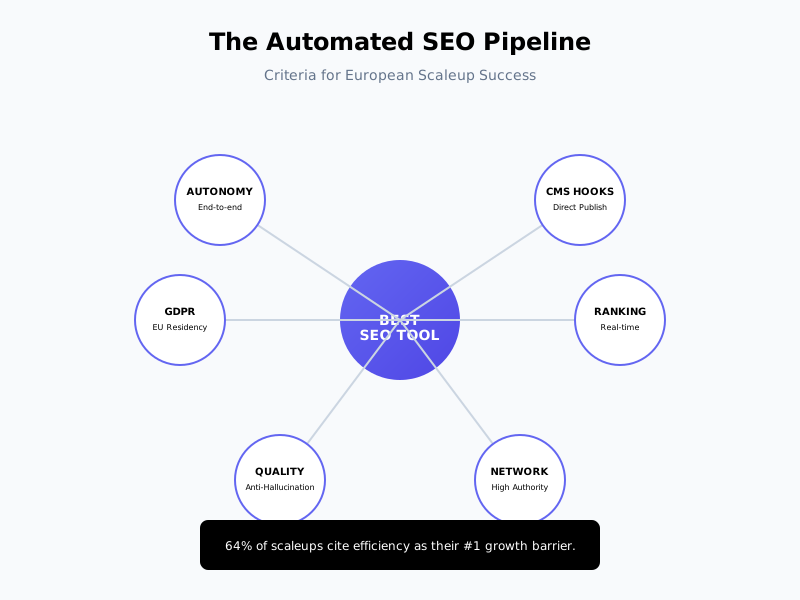
| Autonomy Level | End-to-end pipeline vs. single-feature tool | True automation compounds results without manual effort |
| CMS Integration | Native hooks for WordPress, Webflow, Shopify | Direct publishing eliminates workflow friction |
| Content Distribution | Premium network with high domain authority | Backlinks and visibility in one motion |
| Rank Tracking | Real-time keyword momentum + AI engine visibility | You can't optimize what you can't measure |
| GDPR Compliance | EU data residency, privacy-first infrastructure | Non-negotiable for European operations |
| Content Quality | Brand voice preservation, anti-hallucination controls | Protects your domain from algorithmic penalties |
Why Are European Scaleups Pivoting to Automated SEO Tools?
Here's a hard truth: manual SEO cannot keep pace with scaleup growth targets. According to the State of European Tech report, 64% of European scaleups cite operational efficiency and headcount constraints as their primary growth barriers. That's not a small number — it's a structural bottleneck.
When you're scaling from Series A to Series B, you can't hire five content marketers, three SEO specialists, and a dedicated link-building agency overnight. The talent pool is shallow, the cost is prohibitive, and the timeline is brutal. Automation isn't a luxury; it's the only viable path to consistent organic growth without ballooning headcount.
Overcoming Scaleup Growth Bottlenecks with AI Automation
Think about what a traditional SEO workflow looks like: keyword research, content briefs, drafting, editing, publishing, internal linking, outreach, rank tracking. Each step requires a human hand. Multiply that by dozens of articles per month across multiple languages, and you've built a content factory that requires a small army to operate.
Automated SEO platforms collapse that pipeline. They generate content, distribute it across a network, publish directly to your CMS, and track performance — all without manual intervention. The McKinsey research on AI in marketing confirms this shift: enterprise teams leveraging AI automation achieve a 10-20% increase in efficiency while dramatically accelerating time-to-market.
Pro Tip: When evaluating automation, ask about the "human hours saved per published article." The best tools should be saving you 80%+ of the time a traditional workflow demands.
Navigating Multilingual and Cross-Border Search Across Europe
Here's where European scaleups face a unique challenge that US companies rarely contemplate: you can't rank in Germany with English-only content, and you can't win in France with a one-size-fits-all strategy. The European digital market is fragmented across dozens of languages and cultural contexts.
The best automated SEO tools handle this natively. They generate localized content that respects linguistic nuances — not just translated text, but culturally appropriate messaging that resonates with local audiences. Combined with automated rank tracking across multiple regions, you get a complete picture of your search engine visibility from Lisbon to Helsinki.
What Key Features Define the Best Automated SEO Tool?
Not all "automated" tools are created equal. The market is flooded with AI writing assistants that promise automation but deliver little more than a chatbot with a thesaurus. Here's how to separate genuine autonomous platforms from glorified writing aids.
Autonomous AI Content Generation and Content Distribution Networks
A simple AI writer generates text. An autonomous platform generates content and places it where it can actually perform. The difference is distribution.
When I evaluate tools, I look for platforms that don't just create articles but also syndicate them across a curated network of high-authority sites. This dual approach — publishing on your domain and building contextual backlinks through distribution — is what drives real domain authority momentum.
According to BrightEdge research, organic search drives over 53% of all website traffic. That makes organic visibility the single most important acquisition channel for most scaleups. But visibility requires both content volume and authority, and authority requires backlinks. A tool that handles both is worth its weight in gold.
Real-Time Automated Rank Tracking and Search Engine Visibility
Here's a question that exposes most SEO tools: how fast does your rank tracking update?
Many platforms still operate on weekly or monthly data pulls. That's like checking your speedometer once a week. For a scaleup in hyper-growth mode, you need real-time visibility into keyword momentum. If a piece of content starts climbing the SERPs, you want to know immediately — not when the quarterly report lands.
The best automated SEO tools also track something newer: generative engine visibility. With AI engines like ChatGPT and Perplexity increasingly becoming the entry point for search, you need to know how your brand appears in AI-generated responses. This is the frontier of search engine visibility, and most traditional tools haven't caught up.

Seamless CMS Integration for Direct Publishing Pipeline
This is the feature that separates true automation from semi-automation. If you still have to manually copy-paste generated content into your CMS, you're not automated — you're just using a faster typist.
Look for platforms with native integrations for the CMS ecosystem you actually use. Whether that's WordPress, Webflow, or Shopify, the tool should publish directly to your site without requiring a developer to build custom API hooks. This CMS integration for SEO is what creates a true "set it and forget it" pipeline.
Pro Tip: Ask for a live demo of the publishing workflow before committing. If the tool can't publish a fully formatted article to your CMS in under 60 seconds, it's not autonomous enough.
How Do Automated SEO Platforms Handle Data Privacy and Regulatory Standards in Europe?
Let's address the elephant in the room: GDPR. If you're operating in Europe, compliance isn't optional — it's existential. The GDPR framework imposes strict requirements on how personal data is collected, processed, and stored. Any automated tool you deploy must be built on infrastructure that respects these standards.
Ensuring Full GDPR Compliance in Automated Software Stacks
When evaluating automated SEO platforms, dig into their data architecture. Where is your data stored? Is it processed within the EU? What data does the tool collect about your users, and how is it protected?
European scaleups in tech hubs like London, Berlin, and Amsterdam need platforms that treat GDPR compliance as a foundational principle, not an afterthought. This includes everything from data residency options to transparent privacy policies. If a tool can't clearly articulate its compliance posture, that's a red flag.
Maintaining High Content Quality Control and Brand Safety
Automation doesn't mean abdicating quality control. One of the biggest fears with AI content generation is brand dilution — content that sounds generic, spammy, or worse, hallucinated.
The best automated SEO tools maintain strict quality guardrails. They preserve your brand voice across all generated content, implement anti-hallucination controls, and ensure that everything published meets editorial standards. This isn't just about brand aesthetics; it's about algorithmic safety. Low-quality AI content can trigger penalties from Google, and Search Engine Land has extensively documented how thin, automated content gets deindexed.
The synergy between high domain authority distribution networks and local compliance requirements is the sweet spot. You want content that's both algorithmically safe and locally relevant.
How to Calculate the ROI of an Automated SEO Tool for Your Business?
ROI conversations with automated SEO tools often get stuck on subscription pricing. But the real calculation isn't the monthly fee — it's the cost of not automating.
Comparing In-House Agency Costs vs. Autonomous Platforms
Let's do some rough math. A mid-level content marketer in Europe costs €50,000-€70,000 annually. An SEO specialist adds another €60,000-€80,000. A freelance writer charges €100-€300 per article. An agency retainer for content and link building runs €5,000-€15,000 per month.
Now compare that to an automated platform that handles content generation, distribution, publishing, and tracking for a fraction of that cost. The savings aren't marginal — they're transformative. You're not just saving money; you're reallocating your best talent toward strategy and product, not repetitive execution.
Measuring Compounding Traffic Growth and Domain Authority Momentum
Here's where automated SEO gets genuinely exciting: the compounding effect. Unlike paid ads, which stop the moment you stop paying, organic traffic compounds. Every article you publish builds on the last, increasing your domain authority and keyword coverage.
The best way to measure this is through domain authority momentum and organic keyword growth over time. A good automated platform will show you not just where you are, but the trajectory of where you're heading. That compounding curve is the real ROI story.
What Are the Key Takeaways for European Scaleup Growth Leaders?
If you're still reading, you understand the stakes. Let's distill everything into a clear action plan.
Summary Checklist for Selecting the Best Automated SEO Tool
- Autonomy: Does it handle the full pipeline, or just parts?
- CMS Integration: Can it publish directly to your stack (WordPress, Webflow, Shopify)?
- Distribution: Does it include a premium content distribution network for backlinks?
- Rank Tracking: Is tracking real-time and does it cover AI engines?
- GDPR: Is the infrastructure EU-compliant with clear data residency?
- Quality: Does it preserve brand voice and prevent hallucinated content?
- ROI: Can it demonstrate compounding traffic and authority growth?
Future-Proofing Your Visibility Strategy for AI Search
The search landscape is shifting beneath our feet. Traditional Google rankings still matter, but AI engines are becoming the new discovery layer. The best automated SEO tools are already optimizing for both worlds — traditional SERPs and generative engine responses.
If you're a scaleup leader in Europe, the question isn't whether to automate your SEO. It's how quickly you can deploy a system that handles the complexity of multilingual, cross-border, AI-optimized organic growth.
Why the "Best Automated SEO Tool" Conversation Is Missing the Point
Here's my editorial take, and I'll be direct about it: the entire "best tool" framing is backwards for scaleups.
When you search for the "best automated SEO tool," you get listicles comparing feature sets. Ahrefs has great backlink data. Semrush has excellent keyword research. Jasper writes decent copy. But none of them are autonomous. They're all instruments that require a skilled operator. And the operator is your bottleneck.
What European scaleups need isn't a better instrument — it's a better system. An autonomous pipeline that takes a strategic input (your target keywords, your brand voice, your CMS) and produces a complete output (published, distributed, tracked content) without human intervention at every step.
That's the difference between a tool and a platform. And it's why I believe platforms like SiteLift represent the future of this category. They've built an end-to-end publishing pipeline that handles AI content generation, distribution across a premium network, native CMS integration, and real-time rank tracking — all in one autonomous system.
Is it the "best automated SEO tool"? I'd argue the question is outdated. The real question is: which platform can operate your organic growth engine on autopilot? That's a different conversation entirely.
— The SiteLift Editorial Team
FAQ
What is the difference between a traditional SEO tool and an automated SEO tool?
A traditional SEO tool (like Ahrefs or Semrush) provides data and analytics that you must act on. You research keywords, write content, build links, and track results manually. An automated SEO tool is an end-to-end system that generates content, publishes it to your CMS, distributes it across a network, and tracks keyword momentum — all without requiring manual intervention at each step.
How does an automated SEO platform integrate with my existing CMS?
The best platforms offer native integrations with popular CMS systems like WordPress, Webflow, and Shopify. This means the tool can publish fully formatted articles directly to your site through API connections — no copy-pasting, no developer involvement. Look for platforms that demonstrate a live publishing workflow during your evaluation.
Are automated SEO tools safe from Google AI content penalties?
Yes, if the tool prioritizes quality. Google's algorithms penalize thin, spammy, or mass-produced content regardless of whether it's AI-generated. The safest automated tools maintain strict editorial standards, preserve brand voice, implement anti-hallucination controls, and produce genuinely useful content. Always verify the platform's approach to content quality before committing.
How do automated SEO platforms ensure GDPR compliance for European scaleups?
Reputable platforms build their infrastructure with GDPR compliance as a foundational principle. This includes EU data residency options, transparent data processing policies, and clear privacy documentation. Before choosing a platform, review its privacy policy and ask about data storage locations and processing standards. For a deeper dive into GDPR requirements, consult gdpr.eu as your reference.
Article generated by SiteLift
Topics Covered:
- best automated seo tool
- AI content generation
- automated rank tracking
- CMS integration for SEO
- search engine visibility
More from SiteLift

Decoding SEO Agency Fees: Hourly Rates, Retainers, and Automated Alternatives
Uncover real SEO agency fees, from hourly rates and $3,000+ monthly retainers to cost-effective automated platforms. Maximize your organic ROI.

SEO Conversion Optimization: How to Turn Organic Search Readers into Paying Customers
Learn how to turn organic search visitors into paying customers with this step-by-step SEO conversion optimization guide. Optimize your CTAs and UX.

How to Choose SEO Audit Companies That Deliver Actionable Automation Roadmaps
Stop paying for static PDFs. Learn how to choose SEO audit companies that deliver developer-ready, automated roadmaps to scale your organic traffic.