Modern Search Engine Optimisation Solutions: Embracing Autonomous SEO for Fast-Growing Brands

Fast-moving European tech scale-ups—from fintech hubs in London and Amsterdam to SaaS leaders in Berlin and Stockholm—face a common operational ceiling: traditional organic acquisition takes too long, demands massive headcount, and costs far too much. When evaluating modern search engine optimisation solutions, forward-thinking digital directors quickly realize that yesterday's manual workflows cannot keep pace with today's real-time web.
The industry is undergoing a structural shift. The combination of generative AI search engines, multi-market expansion demands, and complex web architectures has rendered the classic monthly agency retainer obsolete. To capture market share in this environment, enterprise brands are moving away from passive keyword recommendations and adopting software-driven, autonomous SEO engines.
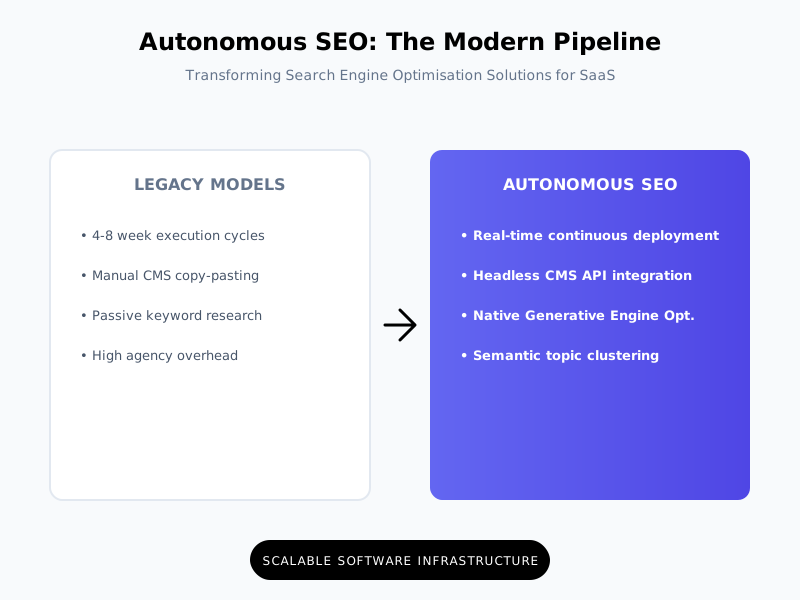
Here is a quick snapshot of how next-generation autonomous pipelines compare to traditional models:
Key Takeaways: Legacy vs. Autonomous SEO Architecture
| Strategic Metric | Legacy Agency & Consulting Models | Next-Gen Autonomous SEO Platforms |
|---|---|---|
| Execution Cycle Time | 4 to 8 weeks per content batch | Real-time, continuous deployment |
| Technical Integration | Manual briefs, copy-pasting into CMS | Direct headless CMS SEO automated API sync |
| Generative Search Readiness | Limited manual schema and content edits | Native Generative Engine Optimisation (GEO) |
| Internal Linking | Periodic manual audits | Automated, real-time semantic topic clustering |
| Resource Efficiency | High agency retainers & project management overhead | Scalable software infrastructure with automated pipelines |
Why Are Traditional Search Engine Optimisation Solutions Failing Fast-Growing European Brands?
For over two decades, enterprise organic search strategy followed a predictable playbook: hire an agency, conduct technical audits, receive a backlog of recommendations, and queue up copywriters to draft articles months in advance. In a digital economy moving at breakneck speed, this manual approach creates friction at every turn.
+-----------------------------------------------------------------------+
|                       LEGACY SEO BOTTLENECK                           |
| Manual Audits --> Freelance Copywriting --> Content Reviews --> CMS   |
| (Cycle Time: 4-8 Weeks)                                 Manual Uploads|
+-----------------------------------------------------------------------+
                                  VS
+-----------------------------------------------------------------------+
|                    AUTONOMOUS PUBLISHING PIPELINE                     |
| Intent Analysis --> Algorithmic Content --> Semantic Linking --> CMS  |
| (Cycle Time: Continuous / Direct API Integration)               Auto  |
+-----------------------------------------------------------------------+
The Manual Content Bottleneck in Modern Scale-Ups
The primary failure point in traditional organic acquisition is execution velocity. A fast-growing brand targeting three distinct European regions often requires dozens of deeply researched, technically precise articles every single month. Relying on human project managers, freelance writer networks, and multi-tier sign-off flows inevitably leads to missed search opportunities.
According to research from Gartner, 60% of CMOs plan to shift budget from traditional agency retainers to automated software platforms by 2026. The reason is clear: legacy agency models spend up to 70% of their billable hours on project management, client calls, and static PDF reporting rather than driving actual keyword momentum.
The Shift from Legacy Agencies to Autonomous Engines
Leading digital teams no longer view search as a quarterly consultancy project. Instead, they treat search engine optimization as a continuous engineering discipline.
Rather than paying for advice on what to fix, enterprises now invest in enterprise SEO software that executes technical fixes, drafts contextually accurate content, and publishes it automatically. According to operational studies published by McKinsey, companies leveraging AI in marketing and organic acquisition reduce overall execution cycles by up to 40%, allowing them to out-index slower competitors.
Core Components of Next-Generation Enterprise SEO Software
Modern search engine optimisation solutions must move beyond surface-level rank tracking. To deliver true organic leverage, next-generation platforms rely on three core pillars:
- Autonomous Execution: Systems that do not merely generate text, but natively format, link, and publish directly to production web stacks without manual intervention.
- Contextual Intelligence: Deep analysis of search intent, competitive gaps, and semantic relationships to ensure content answers explicit buyer queries.
- Multi-Platform Distribution: Automated syndication across curated networks to build domain authority alongside on-site content updates.
Pro Tip: When evaluating modern software platforms, never settle for systems that only produce downloadable copy. True efficiency requires an automated publishing pipeline that pushes production-ready code directly into your CMS schema.
How Does Autonomous SEO Drive Scalable AI Organic Growth?
The mechanics of search discovery are changing fundamentally. Traditional search engines like Google share the stage with generative search experiences—such as Google Search Generative Experience (SGE), OpenAI SearchGPT, and Perplexity. Capturing market share today requires a strategy designed for both traditional algorithms and generative engines.
Algorithmic Content Production at Enterprise Scale
Achieving AI organic growth is not about flooding the web with low-quality, programmatic text. Modern search engine algorithms penalize repetitive, thin content. Instead, modern software uses advanced linguistic engines and semantic entity mapping to build authoritative, comprehensive resources.
By analyzing thousands of top-performing search result pages (SERPs) in real time, autonomous engines uncover exact topic coverage gaps, user intent patterns, and technical schema requirements. They then draft, format, and structure articles that mirror the top 1% of web content in a given industry vertical.
Preparing Content for Generative Search and AI Engines
To rank within AI-driven search answer engines, brands must execute Generative Engine Optimisation (GEO). Industry coverage from Search Engine Land notes that over 68% of all online experiences begin with a search query, with generative AI engines directly influencing 40% of preliminary customer research.
               +---------------------------------------+
               |  Generative Engine Optimisation (GEO) |
               +---------------------------------------+
                                   |
         +-------------------------+-------------------------+
         |                                                   |
         v                                                   v
+-----------------------------+             +-----------------------------+
|    Direct Entity Citations  |             | Clear Data Tables & Schema  |
|  Explicit semantic answers  |             | Structured for LLM parsing  |
+-----------------------------+             +-----------------------------+
         |                                                   |
         +-------------------------+-------------------------+
                                   |
                                   v
               +---------------------------------------+
               | Primary Source in AI Search Answers   |
               +---------------------------------------+
To secure recommendations in AI-generated answers, content must satisfy specific criteria:
- Direct Entity-Attribute Mapping: Clearly linking terms, definitions, and product capabilities.
- Structured Information Blocks: Utilizing bulleted summaries, comparative tables, and concise answer blocks that LLM crawlers can easily digest.
- High Citation Quality: Supporting claims with external data points and primary research, following the official guidelines set out in Google Search Central documentation.
Automated Semantic Linking and Topic Clustering
Internal linking remains one of the most powerful—yet frequently neglected—ranking signals in enterprise search. Manual internal linking breaks down quickly as site architecture scales into hundreds or thousands of pages.
Autonomous SEO software solves this by dynamically calculating vector embeddings for every published page. When a new article goes live, the system automatically inserts contextually relevant internal links across your existing content catalogue without requiring a developer or editor to update old posts manually.

How Can an Automated Publishing Pipeline Bridge Modern Headless CMS Platforms?
Engineering teams across European enterprise brands have spent years moving away from traditional monolithic systems (like legacy WordPress setups) toward modern, API-driven architectures. While platforms like Contentful, Sanity, Strapi, and Hygraph offer incredible performance and developer flexibility, they often introduce major hurdles for marketing teams needing to publish at scale.
+-------------------+       +-----------------------+       +---------------------+
| Autonomous Engine | ----> | API Integration Layer | ----> |  Headless CMS Setup |
| (SiteLift Engine) |       | (JSON / Webhooks)     |       | (Contentful/Sanity) |
+-------------------+       +-----------------------+       +---------------------+
                                                                       |
                                                                       v
                                                            +---------------------+
                                                            | Production Frontend |
                                                            | (Next.js / Nuxt)    |
                                                            +---------------------+
Streamlining Headless CMS SEO Workflows
Deploying headless CMS SEO strategies manually can be a slow, cumbersome process. Copywriters must format raw Markdown or JSON fields, select assets, manually structure open-graph tags, define custom URL slugs, and coordinate with developers to ensure modern schema components render correctly on the frontend.
An automated publishing pipeline removes this operational friction completely. By connecting directly to your headless CMS via secure webhooks and GraphQL or REST APIs, autonomous platforms push fully formatted, semantically structured content into your content engine automatically.
Zero-Touch Content Distribution Across Curated Networks
Creating great content on your primary domain is only half the battle. To gain authority fast, enterprise scale-ups must build backlink profiles and entity references across recognized media networks.
Advanced search engine optimisation solutions automate content syndication and contextual partner distribution. Rather than conducting cold email outreach or negotiating guest post terms manually, modern systems distribute content updates across trusted distribution networks automatically, establishing domain authority on autopilot.
Real-Time Keyword Momentum and Indexation Tracking
Publishing content is useless if search engines take weeks to discover and index your pages. Autonomous platforms track keyword velocity and request instant indexing through official search engine API integrations as soon as new content goes live.
+-----------------------------------------------------------------------+
|                 AUTOMATED INDEXATION & TRACKING CYCLE                 |
|                                                                       |
|  [ Content Published ]                                                |
|            |                                                          |
|            v                                                          |
|  [ API Ping to Search Engines ] (Instant Indexation Request)          |
|            |                                                          |
|            v                                                          |
|  [ Real-Time SERP Monitoring ] (Rank Velocity & Impressions)           |
|            |                                                          |
|            v                                                          |
|  [ Dynamic Re-Optimization ]   (Algorithmic Content Updates)         |
+-----------------------------------------------------------------------+
Instead of waiting for monthly position reports, modern dashboards give performance updates in real time, displaying position movements, search impression trends, and algorithmic indexing health on a daily basis.
What Should European Enterprises Consider When Evaluating Enterprise SEO Software?
European brands face distinct challenges compared to their North American counterparts. Expanding an enterprise across Europe means managing multiple language verticals, navigating complex regional search habits, and complying with stringent local data protection laws.
Multi-Market Scaling and Localised Content Precision
A common mistake among European scale-ups is taking English enterprise content and running it through basic translation software for French, German, Spanish, or Nordics target markets. Search behavior varies widely across different regions; direct translations often miss high-volume local search intent entirely.
Next-generation enterprise SEO software builds native search models for each localized region. The system analyzes actual search queries used in Germany, France, or the Netherlands, generating tailored, native-sounding content that speaks directly to local nuances rather than sounding like an automated translation.
Data Compliance and Local Search Dynamics Across Europe
European digital leaders must operate with strict adherence to local compliance standards, particularly GDPR. Legacy search platforms often store user interaction data on unsecured servers or gather audience telemetry without consent.
Modern, European-focused solutions keep privacy front and center:
- Fully compliant server hosting architectures based inside the EU.
- Zero collection of personal identifiable information (PII) during rank tracking operations.
- Transparent AI generation standards that comply with emerging EU AI Act governance frameworks.
Calculating ROI: Agency Retainers vs. Autonomous Software Infrastructure
To build a compelling business case for board approval, executive teams need clear cost and execution velocity benchmarks. Here is a typical comparison for a mid-market European scale-up publishing 20 enterprise-grade articles per month across two language regions:
| Operational Dimension | Traditional Agency Retainer Model | Autonomous SEO Pipeline Software |
|---|---|---|
| Direct Annual Investment | €90,000 – €150,000 | €12,000 – €30,000 |
| In-House Management Time | 15–20 hours / week (Content reviews, calls) | < 2 hours / week (Strategy configuration) |
| Average Time to Index | 14 to 30 days post-approval | < 24 hours via direct API signals |
| Multi-Language Expansion | Linear cost increase per language | Algorithmic scaling at negligible added marginal cost |
| Data Ownership & Infrastructure | External agency asset retainers | Owned directly in modern headless CMS |
My Editorial View: Why Manual SEO Strategy Is Becoming Obsolete
Over the past decade consulting for high-growth tech companies across Europe, I’ve seen the same scene play out dozens of times: a brand raises a Series A or B round, hires a high-end agency, and sits back expecting organic pipeline growth. Eight months and €80,000 later, they are left with a 50-page PDF audit document, a handful of published articles, and flatlining organic traffic graphs.
The reality is that human-only execution cannot win in modern search.
The volume of high-quality web content required to establish topical authority today is too vast for human writing teams alone. Trying to conquer modern search using legacy manual processes is like taking a horse-drawn carriage to a Formula 1 race.
The brands that will dominate search over the next decade are not those with the largest manual content teams. They are the brands that build the most efficient automated publishing engines—allowing AI to handle research, draft generation, dynamic internal linking, and distribution, while human leadership focuses purely on brand narrative and high-level strategy.
— Marcus Lindqvist, Head of Organic Strategy
Key Takeaways for Implementing Next-Gen Search Engine Optimisation Solutions
If you are leading organic growth, marketing, or digital transformation at an enterprise scale-up, transitioning to an autonomous SEO setup requires a deliberate execution strategy:
Prioritise Autonomous Infrastructure Over Manual Overhead
Shift your budget focus away from billable agency hours and invest directly in automated software pipelines. Free up your internal team to focus on conversion rate optimization, brand positioning, and core product positioning, leaving the mechanics of content publishing and technical indexing to an automated pipeline.
Unify Headless Architectures with AI Search Capabilities
If your engineering team has migrated to modern headless platforms like Contentful or Sanity, do not let your SEO operations remain stuck in manual copy-pasting. Connect your web stack directly to autonomous tools via webhooks to build a fast, scalable publishing pipeline.
Track Visibility Momentum Beyond Traditional Ranks
Do not judge performance solely by desktop rank tracking for five high-volume seed keywords. Track overall organic search impressions, answer-engine citations across Generative Engine Optimisation metrics, and velocity of indexation across your entire long-tail topic footprint.
Scale Your Organic Growth Engine with SiteLift
If you are ready to stop managing sluggish copy pipelines and start building a compounding organic traffic asset, SiteLift provides the end-to-end platform you need.
Designed specifically for modern tech brands and ambitious scale-ups, SiteLift serves as an autonomous SEO engine that automatically researches target terms, generates deeply informed enterprise articles, injects contextual internal links, syncs directly into your headless CMS, and builds domain authority through distribution networks—all on autopilot.
Instead of waiting months for agency deliverables, you can turn organic search into a scalable software system. Learn how you can automate your organic growth at sitelift.io.
FAQ
How do modern search engine optimisation solutions differ from legacy SEO software?
Legacy SEO software (such as Semrush or Ahrefs) functions primarily as an analytics dashboard—providing raw keyword data, backlink reports, and technical site audit alerts that require human teams to interpret and manually execute. Modern autonomous search engine optimisation solutions handle the entire execution loop. They analyze search intent, generate high-quality content, update internal link structures, publish directly to your CMS via API, and track indexing in real time without heavy manual work.
Can an automated publishing pipeline integrate safely with our existing headless CMS?
Yes. Modern autonomous platforms connect to headless CMS setups (such as Contentful, Sanity, Strapi, or Hygraph) using secure, official API endpoints and webhooks. Content is pushed cleanly using structured JSON or Markdown schema, matching your exact custom page types and data structures. This zero-touch integration ensures zero operational risk to your core frontend application code (e.g., Next.js or Nuxt).
Is AI-generated content indexed effectively by major search engines?
Yes. Official Google Search Central documentation explicitly states that search engines focus on content quality and relevance rather than how content is produced. High-quality, AI-assisted content that offers real value, cites authoritative sources, answers search intent, and maintains expert contextual accuracy indexes just as effectively as human-written copy—often faster due to optimized technical formatting and automated indexing APIs.
What is Generative Engine Optimisation (GEO) and why is it vital for European scale-ups?
Generative Engine Optimisation (GEO) is the discipline of structuring web content so that AI-driven search answer platforms—such as Google SGE, OpenAI SearchGPT, and Perplexity—can easily parse, cite, and reference your brand as a primary source. For fast-growing European scale-ups, GEO is critical because modern buyers increasingly rely on AI search summaries for preliminary research before ever clicking through to a classic website SERP link.
How quickly can fast-growing brands expect ROI from autonomous SEO tools?
Unlike legacy agency retainers—which often take six to nine months to yield initial organic traffic changes due to slow publication cycles—autonomous SEO tools deliver accelerated results. Because automated pipelines can publish and index optimized, topic-clustered content within days, brands routinely see noticeable keyword impression momentum and domain authority gains within 30 to 60 days of launch.
Article generated by SiteLift
Topics Covered:
- search engine optimisation solutions
- automated publishing pipeline
- AI organic growth
- headless CMS SEO
- enterprise SEO software
More from SiteLift

AI Generated Contents That Rank: Scaling Quality, Originality and Distribution
Learn how to scale AI generated contents that rank on Google. Master quality control, automated pipelines, E-E-A-T, and multi-channel distribution.

Visibility Tracker Explained: Measure True Share of Voice Across Google and AI Search
Discover how a visibility tracker measures search visibility scores and share of voice across Google and AI search engines to compound your organic reach.

LLM Visibility Tool: How to Measure and Grow Your Brand in ChatGPT and Perplexity
Discover how to use an LLM visibility tool to monitor ChatGPT brand mentions, track Perplexity citations, and scale your AI share of voice.