Building a Scalable Backlinks SEO Strategy Through Premium Content Distribution

If you’re still chasing links one cold email at a time, you don’t have a backlinks seo strategy — you have a part-time job. I’ve run both sides of this game, and the difference between brands that stall on page three and brands that compound authority year after year almost always comes down to systems, not hustle.
Here’s the reality: a scalable approach built on premium distribution lets you earn organic link building momentum without begging for guest posts. You publish once, distribute intelligently, and let high-quality publications, niche blogs, and journalists create the citation footprint for you.
Key Takeaways
| Core Concept | What It Means for You |
|---|---|
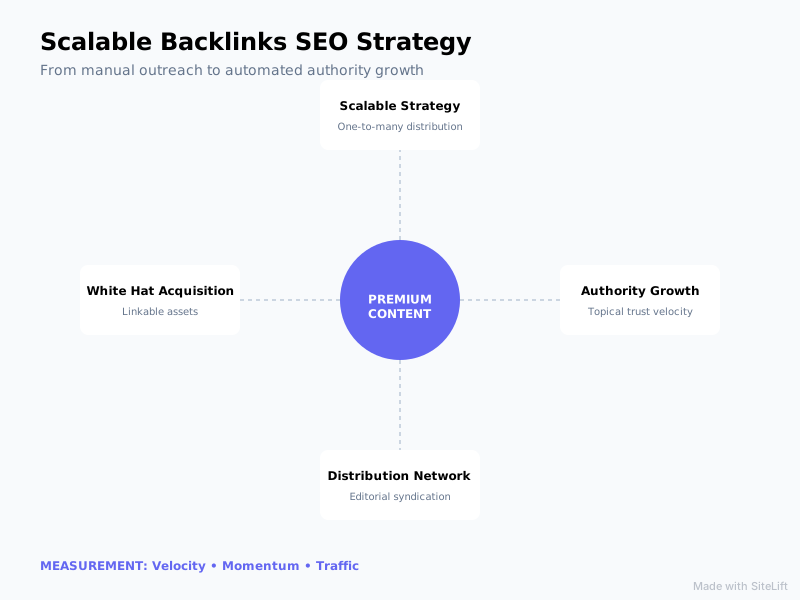
| Scalable backlinks seo strategy | Shift from one-to-one outreach to one-to-many distribution that earns links continuously |
| Premium content distribution network | Curated syndication across relevant, editorial-quality sites amplifies reach and link potential |
| White hat backlink acquisition | Earn links with linkable assets and disclosure-friendly syndication, not paid schemes or PBNs |
| Domain authority growth | Steady velocity of relevant referring domains builds topical trust and ranking stability |
| Measurement focus | Track referring domain velocity, keyword momentum, and referral traffic — not just raw link count |
What Is a Scalable Backlinks SEO Strategy in Modern Search?
A modern backlinks seo strategy isn’t a spreadsheet of prospects and follow-up templates. It’s a repeatable publishing and distribution system that earns relevant, editorial links at a consistent pace while you focus on running the business.
Google doesn’t rank pages in a vacuum. It looks at how the web talks about you — who cites you, in what context, and whether those citations keep coming from trustworthy places. That’s why link building and domain authority still carry real weight. According to FirstPageSage’s Google algorithm weight research, links and authority account for approximately 16% of Google’s core ranking weight.
A scalable system does three things manual outreach can’t:
- Maintains publishing velocity without adding headcount
- Gets every asset in front of link-capable audiences (writers, founders, analysts)
- Builds topical authority across clusters, not just one money page
The Evolution of Link Building from Manual Outreach to Syndication
Old-school link building was pure grind: scrape prospects, send 200 emails, get 2 replies, negotiate a guest post, repeat. It worked in 2014. Now inboxes are burned out, site owners charge “editorial fees” that violate guidelines, and the ROI collapses as soon as you stop emailing.
Distribution flips the model. Instead of pitching one site for one link, you publish a research-backed asset and syndicate it through a content distribution network of curated industry sites, newsletters, and partner publications. Each placement increases discovery surface. Journalists find your data. Bloggers reference your framework. Niche newsletters link back to the source.
The result is passive acquisition. You’re not asking for links; you’re making your content unavoidable for people who already link out.
Pro Tip: Stop measuring outreach by emails sent. Measure distribution by link-capable impressions — how many writers and publishers actually saw the asset in the first 14 days.
Why Domain Authority Growth Requires Quality Over Quantity
Not all links move the needle. A single editorial link from a relevant publication in your niche can outperform 50 directory or forum links, and it won’t put you at risk.
This matters because most of the web is invisible. According to Ahrefs’ search traffic study, 90.63% of all pages get zero traffic from Google, largely due to a lack of quality backlinks and topical relevance. Thin content with no citations simply doesn’t get picked up.
For sustainable domain authority growth, prioritize:
- Relevance over raw authority: A DR 60 SaaS blog linking to your SaaS tool beats a DR 80 recipe site.
- Editorial context: Links inside the main content, surrounded by topical copy, pass more equity than footers or author bios.
- Velocity stability: Ten great referring domains per month for six months beats 60 in one week followed by silence.
If you want a refresher on how third-party authority scores work, start with Moz’s guide to Domain Authority. It’s a comparative metric, not a Google score, but it’s useful for benchmarking progress against competitors.
Infographic by SiteLift
How Does Premium Content Distribution Drive Organic Link Building?
Premium distribution is the missing middle between “publish and pray” and “spray and pray outreach.” You create something worth citing, then you put it where citers already hang out.
Think of it like this: great content without distribution is a billboard in the desert. Distribution without great content is spam. The combination is what drives organic link building at scale.
Leveraging Content Distribution Networks for Maximum Reach
A true content distribution network for SEO isn’t a link farm or an article spinner. It’s a curated set of real sites with actual audiences, editorial standards, and topical alignment.
Here’s how I see high-performing teams use it:
- Core asset lives on your domain. That’s the canonical source — full study, guide, or tool.
- Adapted versions go to network partners. Think condensed insights, expert commentary, use-case breakdowns, each canonicalized or properly attributed back to the source.
- Discovery triggers secondary links. Once the idea circulates, independent writers cover it and link to the original.
That second wave is where scale happens. You control the first 10-20 placements through distribution. The next 30-50 come from people who discovered you through those placements.
This is also where AI search visibility compounds. When multiple trusted sources echo your data and frameworks with attribution, both classic search and AI answer engines are more likely to treat you as the source of truth.
Transforming Syndicated Assets into Permanent Editorial Backlinks
Syndication gets a bad rap because people confuse smart syndication with duplicate-content blasting. Done right, syndicated assets become backlink magnets.
What converts a syndicated view into a permanent editorial link?
- Original data: Benchmarks, survey results, pricing studies. No one can copy the finding without citing you.
- Clear frameworks: Named processes, checklists, and calculators are easy to reference.
- Quotable visuals: One sharp chart often earns more links than 2,000 words of text.
Backlinko’s analysis of 11.8 million Google search results found that the #1 result in Google has an average of 3.8x more backlinks than positions #2 through #10. You don’t get that gap with one viral post. You get it by turning every major asset into a long-tail citation source.
Pro Tip: Add an “embed this chart” or “cite this study” box with pre-formatted HTML and attribution. You’ll be shocked how many writers link simply because you removed friction.
What Are the Core Pillars of White Hat Backlink Acquisition?
White hat backlink acquisition is simple in principle: earn links you’d be proud to show Google. The execution is where most teams fall apart, because white hat is often misread as “slow and manual.” It doesn’t have to be.
A scalable white-hat system rests on three pillars: linkable assets, programmatic distribution, and automation that respects guidelines.
Creating Linkable Assets Designed for Natural Citation
Some content ranks. Other content gets referenced. You need both, but only the second type scales links.
Formats I’ve seen consistently earn natural citations:
- Data studies and benchmarks: “We analyzed 1,200 SaaS pricing pages” will always beat “10 pricing tips.”
- Original frameworks and SOPs: Step-by-step systems other operators can implement and credit.
- Free tools and templates: Calculators, audit sheets, and analyzers earn links for years.
- Contrarian teardowns: Respectful, evidence-based takes on popular advice attract debate links.
If you’re refining what “quality” means in an AI-overviews world, this breakdown of what defines high-quality content SEO in Google’s AI era is a useful gut-check before you invest in distribution. Thin AI rewrites don’t earn links; useful, experience-led assets do.
Programmatic Content Distribution vs. Traditional Manual Pitching
Let’s compare honestly:
| Factor | Manual Pitching | Programmatic Distribution |
|---|---|---|
| Effort per link | High — custom emails, follow-ups, negotiation | Low after setup — publish once, syndicate to network |
| Scalability | Linear, breaks with team bandwidth | Compounds, each asset adds to citation footprint |
| Link quality control | Hit-or-miss, depends on prospect list | High if network is curated and topical |
| Risk profile | Rises when teams pay for placements to hit quotas | Low when placements are editorial and attributed |
| Consistency | Feast-or-famine | Steady velocity that search engines trust |
Manual tactics like skyscraper outreach and broken link building still have a place for hero pages. But they can’t be your entire backlinks seo strategy if you want to grow from 50 to 500 referring domains. For a deeper look at how automation changes the math without crossing into spam, read about the evolution of SEO backlinks software and safely automating authority.
Integrating AI and Automation into Your Publishing Pipeline
Automation isn’t the enemy of white hat — manipulation is. Google is clear about this distinction in Google’s spam policies on link spam, which prohibit buying, selling, or excessively exchanging links to manipulate rankings. Automating research, drafting, internal linking, publishing, and distribution is not a link scheme. Paying for followed links at scale is.
A clean autonomous pipeline looks like this:
- Keyword clustering: Group topics by intent so every asset supports a pillar.
- Brief-driven drafting: AI-assisted drafts grounded in first-party data and expert review.
- On-page + internal links: Automatic schema, anchors, and hub connections.
- One-click publish to CMS: No copy-paste chaos across WordPress, Webflow, or Shopify.
- Network distribution: Push adapted versions to relevant partner outlets with canonicals.
- Momentum tracking: Monitor rankings, referring domains, and referral traffic in real time.
That’s the exact loop detailed in this guide to building an autonomous SEO content strategy that compounds traffic. When publishing never stalls, link velocity never stalls either.

How Do You Measure and Optimize Your Backlinks SEO Strategy?
You can’t optimize what you don’t track. And with links, vanity metrics will lie to you. Total backlink count includes a lot of noise — what matters is referring domain quality, relevance, and whether rankings and traffic actually move.
A strong backlinks seo strategy review happens monthly, not yearly. Here’s the dashboard I recommend.
Tracking Domain Authority Growth and Keyword Momentum
Forget obsessing over a single DA number week to week. Track the trendline and its drivers:
- Referring domains (unique): Are you adding new domains steadily? Aim for consistent growth, not spikes.
- Domain Rating / Domain Authority trend: 3-month direction matters more than absolute score.
- Keyword momentum: How many keywords moved from page 3-2 to page 1, and how fast after new links land?
- Share of branded vs. non-branded movement: Authority should lift non-branded discovery terms, not just your brand name.
- Topical coverage: Are you gaining links to an entire cluster, or just the homepage?
| Metric | What Good Looks Like | Red Flag |
|---|---|---|
| New referring domains / month | Steady +5-15% growth in competitive niches | 0 for 60 days, then +200 overnight |
| Anchor text mix | 70%+ branded, URL, and natural phrases | 40%+ exact-match money keywords |
| Link relevance | Same niche or adjacent vertical | Random languages, casinos, unrelated directories |
| Indexation | Linking pages indexed and getting traffic | Links only from orphaned, non-indexed pages |
| Keyword velocity | Cluster rankings climb within 4-12 weeks | Links grow, rankings flat for 6+ months |
Anchor diversity deserves special attention. Natural profiles are messy — brand names, raw URLs, “this study,” “according to research.” If every new link says “best CRM software,” that’s a footprint, not a strategy.
Evaluating Referral Traffic and PageRank Equity Pass-Through
SEOs talk about PageRank equity like it’s abstract. It’s not. A link passes value when:
- The linking page is crawled and indexed
- It has its own authority and topical relevance
- Your link is visible in the main content with descriptive anchor context
- The link is followed (or at least drives qualified humans who later search and link)
That last point is underrated. Even nofollow links from high-traffic newsletters or communities can trigger followed editorial links downstream. Track referral sessions, assisted conversions, and secondary mentions — not just link attributes.
Run a quarterly link audit:
- Export new links, flag irrelevant or toxic patterns
- Check that key placements are still live and followed where expected
- Disavow only clear spam at scale — don’t nuke imperfect but real links
- Reclaim lost links with a quick outreach when high-value mentions break
- Double down on formats and outlets that drove both rankings and referral traffic
What Common Pitfalls Subvert Scalable Link Building Campaigns?
Scale amplifies everything — including mistakes. These two pitfalls kill more campaigns than any algorithm update.
Over-Reliance on Low-Quality Networks and Private Blog Networks (PBNs)
If a network promises “500 DA 50+ backlinks for $99,” run. Those are either PBNs, hacked sites, or spun content farms. They might spike third-party metrics for a month, then trigger a slow bleed as Google devalues the source domains — or worse, a manual action.
Signs you’re dealing with a toxic provider:
- No transparency about where content will appear
- Guaranteed exact-match anchors at scale
- Every site looks the same, with thin “write for us” pages and no real traffic
- No option for nofollow/sponsored disclosure on paid placements
- Overnight link spikes from unrelated countries and languages
Premium distribution is the opposite: real sites, real audiences, relevant topics, proper attribution. It’s slower than buying links and infinitely faster than recovering from a penalty.
Neglecting Content Velocity and Publishing Consistency
The second killer is inconsistency. Brands publish six posts in January, nothing until June, then buy a link package in panic. Search engines read that erratic pattern as untrustworthy, and writers forget you exist.
Consistency wins because:
- Each new asset is a new reason for someone to cite you
- Fresh internal links redistribute equity to older linkable assets
- Steady output keeps your brand in journalists’ source lists
- Compounding works — month 9 builds on months 1-8
For early-stage teams with limited budget, consistency matters even more than volume. This playbook for how startups can outrank established giants on a budget shows how focused clusters and steady shipping beat sporadic heroics.
Build Authority on Autopilot Without the Outreach Grind
This is exactly why platforms like sitelift.io exist. Instead of juggling writers, CMS uploads, syndication partners, and rank trackers, you get one autonomous pipeline: targeted content generated for your niche, distributed across a curated premium network, published directly to your CMS, with keyword momentum tracked in real time.
It’s not about gaming the algorithm. It’s about removing the bottleneck that keeps good businesses invisible — inconsistent publishing and zero distribution. When every week adds relevant content and relevant exposure, domain authority growth stops being a quarterly hope and starts being a compounding curve.
If you’re already publishing, start by auditing which assets have original data or frameworks and push those through distribution first. If you’re starting from zero, build one tight cluster, ship weekly, and let the network do the heavy lifting while you refine based on what earns links.
Why I Stopped Pitching for Links (And What I Do Instead)
I’ll be honest: I used to love manual outreach. There’s a dopamine hit when a big editor says yes. But after running enough campaigns, I realized I was building a treadmill, not an asset.
The moment I switched to distribution-first thinking, everything got calmer. I spend my time making one asset genuinely citable — better data, sharper charts, a clearer opinion — then I make sure it’s seen in the right rooms. No begging. No awkward “just bumping this” follow-ups.
In my experience, most teams don’t have a link quality problem. They have a discovery problem. Their content is fine; it’s just never placed where link-capable people will trip over it. A curated content distribution network solves that unglamorous problem better than any clever email subject line I’ve ever tested.
My bias is this: outreach should be the seasoning, not the meal. Use it for 5-10 dream placements a quarter. Let premium distribution handle the baseline velocity that keeps your entire backlinks seo strategy compounding while you sleep.
— sitelift.io
FAQ
What is the difference between manual outreach and content distribution networks for link building?
Manual outreach is one-to-one: you pitch individual sites for guest posts, link inserts, or coverage. A content distribution network is one-to-many: you publish a canonical asset on your site and syndicate adapted versions across curated, topical publications. Outreach can land high-value hero links but scales linearly with effort. Distribution scales organic link building by increasing discovery — more writers see the work, which drives both direct syndicated links and secondary editorial citations you never pitched for.
How long does it take to see domain authority growth from a new backlinks seo strategy?
Expect leading indicators in 4-6 weeks (new referring domains, improved crawl frequency) and meaningful movement in rankings and third-party authority scores in 3-6 months. Competitive niches often take 6-9 months of steady velocity. What matters most is consistency: a steady cadence of relevant placements beats a short spike. Track referring domain velocity and keyword momentum monthly rather than checking DA daily.
Are syndicated content links considered white hat backlink acquisition?
Yes — when done transparently. White hat backlink acquisition via syndication means original, useful content placed on relevant, real publications with proper canonical tags or attribution links back to the source, without paying for followed links to manipulate rankings. What crosses the line is mass article spinning, hidden links, or paying for followed links at scale without disclosure, which conflicts with Google’s guidelines on link spam.
How many backlinks are required to rank on the first page of Google?
There’s no magic number. In low-competition niches, a handful of relevant editorial links plus strong content can win. In competitive SaaS, finance, or health queries, page-one results often have dozens to hundreds of quality referring domains. Remember that the #1 result averages 3.8x more backlinks than positions #2-10, per Backlinko’s large-scale study — but relevance, content depth, intent match, and site authority matter as much as raw count. Audit the top 10 for your specific keyword and aim to beat their relevant referring domains, not just their total links.
Topics Covered:
- backlinks seo strategy
- organic link building
- content distribution network
- domain authority growth
- white hat backlink acquisition
More from SiteLift

SEO Tools in 2026: How to Build an Autonomous Stack That Grows Traffic on Autopilot
Discover how to build an autonomous stack with modern AI SEO tools, automated publishing workflows, and real-time rank tracking to grow organic traffic.

Repurposing Content for SEO: How to Multiply Organic Reach Across Channels
Learn how repurposing content for SEO multiplies organic reach. Discover step-by-step strategies for syndication, AI visibility, and automation.

Fresh Content SEO: How Publishing Frequency and Recency Drive Rankings
Discover how fresh content SEO, publishing velocity, and Google's QDF algorithm impact rankings and AI search visibility. Build a scalable freshness engine.