Repurposing Content for SEO: How to Multiply Organic Reach Across Channels

If you are relying solely on writing fresh articles from scratch to expand your organic footprint, you are fighting an uphill battle. Modern search engines and AI answer engines reward topical depth and broad, multi-channel search visibility. Repurposing content for SEO is the single most efficient way to compound your organic traffic, maximize content ROI, and dominate search engine results pages (SERPs) without burning out your editorial team.
Instead of letting high-performing assets collect dust on page two or three, you can transform a single long-form guide into video scripts, structured AI summaries, syndicated publications, and interactive lead magnets. According to data from DemandGen Report, 64% of B2B marketers prioritize content repurposing to expand audience reach without exponentially increasing their creation budgets.
In this step-by-step guide, I will show you how to build a scalable repurposing workflow—from technical canonical setup to AI search optimization and automated distribution.
Prerequisites: What Do You Need Before Repurposing Content for SEO?
Before converting your text assets into multi-channel campaigns, you need a solid foundational strategy and technical setup. Repurposing poor or thin content only amplifies bad signal; you must start with validated, high-authority assets.
Prerequisites Checklist
| Requirement | Description | Purpose |
|---|---|---|
| Google Search Console (GSC) | Active search console account connected to your domain. | Spot high-impression, medium-ranking candidate URLs. |
| Content Audit Baseline | A catalog of top-performing evergreen blog posts. | Focus effort on proven organic winners. |
| Technical CMS Access | Ability to edit <head> tags or manage canonical URLs. |
Prevent duplicate content issues during syndication. |
| Distribution Endpoints | Accounts on Medium, LinkedIn, YouTube, or niche networks. | Serve as publishing targets for derivative assets. |
Auditing Your High-Performing Assets
Not every blog post deserves to be repurposed. Focus your resources on evergreen content that has already demonstrated search intent fit. Look for articles that solve core industry pain points, possess strong backlink profiles, and continue to attract consistent organic impressions.
If you haven't recently evaluated your content library, review our detailed guide on how to run an SEO content audit to identify decaying pages and rank opportunities before building out new formats.
Setting Up Canonicalization and Syndication Rules
Before distributing content to third-party platforms like Medium or LinkedIn, establish technical protocols to protect your core domain's search rankings. When search crawlers encounter identical text across multiple domains, they attempt to consolidate signals to a primary source.
If external platforms index your syndicated text before your own site establishes ranking authority—or if cross-domain tags are missing—your primary site risks losing keyword ranking credit to higher-authority third-party hosts.
Step 1: Audit and Select High-Potential Blog Articles for Repurposing
The secret to high-ROI content repurposing is choosing pages that are sitting right on the cusp of significant organic breakthroughs.
Using Search Console Data to Spot Hidden Gems
Open Google Search Console, set the date range to the last 3–6 months, and navigate to the Performance report. Filter your pages using these specific criteria:
- Positions 6 through 20: Pages ranking on the bottom of page one or top of page two are prime candidates. They already have ranking relevance; they just need content freshness and multi-channel signals to push into top-three positions.
- High Impressions, Low CTR: Pages drawing massive impression volume but low click-through rates usually indicate intent mismatches or inadequate search snippet presentation.
Research published by HubSpot shows that optimizing and updating historical blog posts can increase organic page traffic by over 100%. Repurposing these specific pages into new formats sends fresh signals back to Google while expanding your brand touchpoints.
GSC Filter Formula:
Impressions > Average Industry Baseline
AND
Average Position >= 6.0 AND <= 20.0
Evaluating Content Decay vs. Content Maturity
Avoid repurposing hyper-time-sensitive news or short-lived industry updates. Instead, select foundational, pillar-level topic clusters. Evaluate candidate URLs against three core criteria:
- Topical Longevity: Will this concepts remain relevant over the next 12 to 24 months?
- Format Flexibility: Can the core data points easily transition into visual infographics, slide decks, or video scripts?
- Search Intent Depth: Does the article satisfy informational, commercial, or navigational queries across multiple stages of the buyer journey?
Step 2: Map Core Concepts to Multi-Channel Formats and AI Engines
Once you select your primary blog articles, break them down into modular elements. Rather than copying and pasting entire articles, extract key arguments, statistics, step-by-step processes, and custom definitions.
Formatting for Visual and Audio Search (YouTube, Podcasts)
Visual and audio search engines operate on unique intent models. YouTube, for example, is the second-largest search engine globally and prioritizes retention and direct answer delivery.
To convert a blog article into a video or audio script:
- Transform H2 subheadings into individual script scenes or chapters.
- Convert abstract text explanations into spoken visual cues or diagrammatic slides.
- Repurpose article intro hooks into concise visual hooks within the first 10 seconds of video playback.
- Extract key transcript quotes and re-upload them alongside video uploads to capture native video search rankings on Google SERPs.

Structuring Modular Data for AI Engine Citation
Search visibility is no longer restricted to blue links on traditional SERPs. Large Language Models (LLMs) and AI answer engines—including Perplexity, ChatGPT, and Google Gemini—derive answers from well-structured web sources.
Understanding SEO in the era of AI and SGE requires optimizing your repurposed text for machine readability.
To optimize your repurposed content for AI extraction:
- Adopt "Trigger-Answer" Subheadings: Use clear H2 and H3 questions (e.g., "What is cross-domain canonicalization?") followed immediately by a direct 2-3 sentence answer.
- Implement Schema Markup: Wrap key content sections in
Article,FAQPage, orHowTostructured data schema. - Maintain High Entity Density: Include clear noun entities, technical definitions, and industry standards within your modular summaries.
Step 3: Implement a Content Syndication Strategy Without Duplicate Content Penalties
Executing a proper content syndication strategy allows you to leverage the domain authority of external media platforms while directing algorithmic equity back to your owned domain.
Cross-Domain Canonical Link Implementation
When syndicating full or partial articles on third-party platforms like Medium, Dev.to, or specialized industry blogs, ensure the platform supports cross-domain canonical URLs.
A cross-domain canonical tag tells search engines that the third-party version is merely a copy, and all search indexing credit belongs to your original blog post URL:
<link rel="canonical" href="https://yourwebsite.com/original-blog-post-url/" />
Refer directly to Google Official Documentation on Consolidating Duplicate URLs to verify how search crawlers treat rel=canonical statements across distinct domain properties.
Platform Syndication Comparison
| Platform | Canonical Support | Indexing Speed | SEO Value Strategy |
|---|---|---|---|
| Medium | Full Cross-Domain Support | Fast | Import feature applies rel=canonical automatically. Excellent for referral traffic. |
| LinkedIn Articles | No Canonical Support | Immediate | Re-write summaries with contextual backlink attribution to root source. |
| Substack | Partial / Custom Domains | Medium | Best for direct audience nurture; rephrase core takeaways rather than direct copy. |
| Niche Outlets | Negotiated | Varies | Require native cross-domain header tags in publishing contract. |
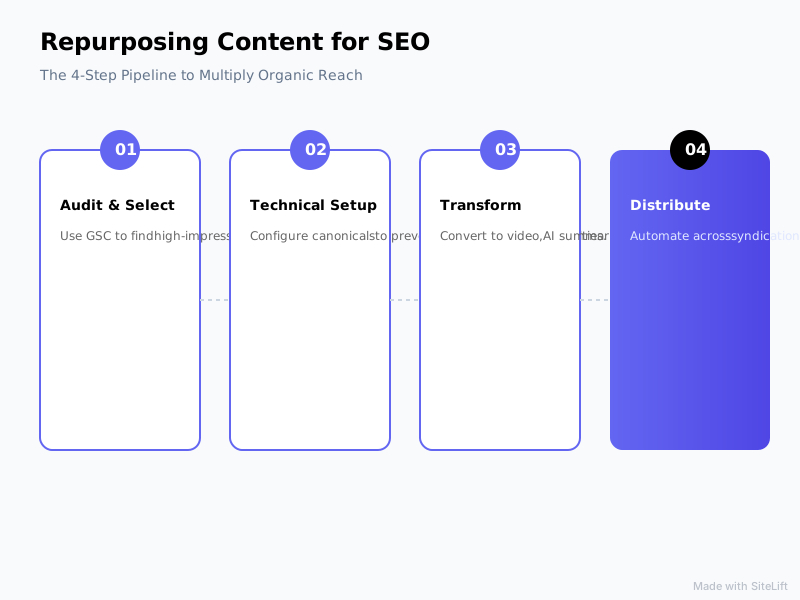
Infographic by SiteLift
Pro Tip: Always wait 5 to 7 days after publishing a fresh article on your main website before syndicating it externally. This indexation buffer ensures Google crawls, indexes, and attributes primary authorship to your site first.
Step 4: Scale Distribution with Automated Content Pipelines
Manual content repurposing across dozens of channels quickly becomes a bottleneck. To build true operational leverage, top-performing growth teams utilize automated content distribution workflows.
Automating Cross-Channel Content Publishing
Instead of manually reformatting articles every time you publish, connect your Content Management System (CMS) to distribution engines that automatically transform blog articles into channel-ready derivative assets.
A fully streamlined content pipeline executes the following sequence automatically upon blog publication:
[Primary Blog Article Published]
             │
             ├──> Webhook triggers AI pipeline
             │
             ├──> Generate 5 LinkedIn long-form posts
             ├──> Format 1 X (Twitter) thread with main key takeaways
             ├──> Generate structured JSON-LD FAQ schema
             └──> Schedule syndicated draft with cross-domain canonical tag
Setting up an autonomous SEO content strategy allows you to turn your editorial calendar into an automated publishing loop, ensuring consistent multi-channel distribution without requiring extra headcount.
According to research from Semrush, 42% of companies report that updating and repurposing existing content directly leads to an increase in overall organic search performance.
Troubleshooting: Why Does Repurposed Content Fail to Rank (And How to Fix It)?
Even with a detailed strategy, repurposed assets can hit performance ceilings. Here are the most common technical failure points and how to resolve them quickly.
Fixing Keyword Cannibalization Issues
Keyword cannibalization occurs when multiple assets on your domain (or across your controlled distribution endpoints) target the exact same primary keyword with identical search intent. This confuses search engines and splits page authority.
- Symptoms: Ranking URLs rapidly swap places in GSC, or both the original post and derivative pieces sit stuck on pages 3–5.
- The Fix: Differentiate target keyword intents. The primary long-form guide should target high-volume seed keywords (e.g., "repurposing content for seo"), while derivative assets target long-tail variations, contextual questions, or platform-native queries (e.g., "how to syndicate blog posts on linkedin without duplicate penalties").
Overcoming Low Engagement on Syndicated Assets
If your syndicated articles on Medium or LinkedIn generate zero organic traffic or click-throughs, the cause is usually raw text copy-pasting without platform-native adaptation.
- The Fix: Rewrite lead hooks and introduce platform-native formats. On LinkedIn, format content into visual PDF carousels or short, single-sentence paragraphs. On Medium, add custom callouts, executive summaries, and native embedded links pointing back to key resources on your root site.
Pro Tip: Periodically perform a site-wide scan using backlink and crawler audit tools to verify that syndication partners have not stripped your cross-domain rel="canonical" tags during site redesigns or platform migrations.
Why Manual Content Repurposing Is Obsolete (An Editorial Perspective)
Most marketers view content repurposing as a tedious manual task: open a published blog post, manually reword three paragraphs, paste them into a social scheduling tool, and repeat.
In my experience, this manual approach is why most repurposing initiatives crumble after three weeks. It is inefficient, difficult to scale, and lacks technical precision.
The real power of repurposing content for SEO isn't just getting extra social media posts out of an article. It is systematically establishing topical authority across multi-channel indexation points. When search engine bots crawl Google, visual indices on YouTube, structured data pipelines in AI engines, and authoritative third-party networks, they should find your core brand messages perfectly interlinked everywhere.
Building scalable infrastructure around automated distribution turns content creation from a linear, repetitive expense into a compounding growth asset.
Marketers who manually copy-paste content across platforms are wasting time on tasks that software can execute in seconds. Real SEO leverage comes from building automated systems that enforce canonical rules, structure data for AI discovery, and amplify organic reach on autopilot. — sitelift.io
Streamline Your SEO Growth Engine with SiteLift
Executing a multi-channel content strategy manually requires constant oversight—from tracking keyword positions across channels to enforcing technical canonical rules and maintaining consistent publishing schedules.

SiteLift provides an end-to-end autonomous SEO platform designed to multiply your multi-channel search visibility on autopilot:
- Autonomous Content Generation: Create high-quality, fully optimized articles tailored to high-intent keyword targets.
- Automated Content Distribution: Automatically syndicate and publish derivative content across curated high-authority networks with built-in canonical safety.
- Seamless CMS Integrations: Connect directly to platforms like WordPress, Webflow, or custom stacks to streamline publishing workflows.
- Real-Time Keyword Tracking: Monitor keyword momentum across both traditional search engines and AI engines in real time.
By automating content creation and distribution, SiteLift allows you to build an organic traffic pipeline that compounds growth continuously.
FAQ
Does repurposing content create duplicate content penalties from Google?
No, Google does not explicitly penalize sites for duplicate content. However, if identical content exists on multiple URLs without proper canonicalization, search engines will choose one version to index and filter out the rest. To ensure your primary domain receives ranking equity, always implement cross-domain rel="canonical" tags pointing back to your original source post when syndicating content externally.
What is the difference between content repurposing and a content syndication strategy?
Content repurposing involves altering the format or structure of an existing piece of content—such as converting a written blog article into an infographic, video script, or social thread. A content syndication strategy refers to republishing the exact same piece of content (or modified excerpts) on third-party websites or external platforms (like Medium or LinkedIn) to leverage their existing audience and domain authority.
How does automated content distribution help with multi-channel search visibility?
Automated content distribution streamlines the cross-platform publishing workflow by systematically converting blog posts into platform-native formats and distributing them across social networks, syndication partners, and CMS endpoints automatically. This ensures consistent brand presence and keyword coverage across traditional SERPs, social search channels, and AI answer engines without requiring heavy manual work.
Which blog posts are best suited for content repurposing?
The best posts for repurposing are evergreen, high-impression articles that rank on positions 6 through 20 in Google Search Console. Focus on comprehensive guides, data-driven reports, and foundational industry tutorials that can easily be broken down into modular summaries, visual slides, audio scripts, or quick social media threads.
Topics Covered:
- repurposing content for seo
- content syndication strategy
- automated content distribution
- repurposing blog articles
- multi-channel search visibility
More from SiteLift

AI for SEO: How to Automate Research, Content Creation and Distribution
Learn how to use AI for SEO to automate keyword research, generative content creation, CMS publishing, and search engine visibility.

SEO Tools in 2026: How to Build an Autonomous Stack That Grows Traffic on Autopilot
Discover how to build an autonomous stack with modern AI SEO tools, automated publishing workflows, and real-time rank tracking to grow organic traffic.

Fresh Content SEO: How Publishing Frequency and Recency Drive Rankings
Discover how fresh content SEO, publishing velocity, and Google's QDF algorithm impact rankings and AI search visibility. Build a scalable freshness engine.