SaaS Link Building: How to Scale Authority, Trials and ARR with Automation

Most software founders treat search engine optimization like an unpredictable lottery. You publish dozens of keyword-focused blog posts, send hundreds of cold pitch emails from a secondary Google Workspace inbox, and wait months hoping the algorithm notices. Yet, the pipeline barely moves.
Effective SaaS link building is not about blasting generic pitches or collecting arbitrary authority metrics on a spreadsheet. In software, backlinks serve a singular, ruthless commercial function: to establish enough topical trust with search engines so your high-intent feature pages outrank multi-million-dollar review aggregators, converting high-intent searches into product trials and pipeline Annual Recurring Revenue (ARR).
Research by Ahrefs analyzing over one billion web pages revealed that 90.63% of content receives zero organic traffic from Google, with a lack of backlinks being one of the primary drivers. If you want your software platform to avoid that digital graveyard, you must transition from fragile manual outreach to engineered, automated authority systems.
What Is SaaS Link Building and Why Is It Critical for Growth?
SaaS link building is the deliberate process of acquiring high-quality inbound references (hyperlinks) from relevant software, technology, and industry websites to your domain. Unlike traditional eCommerce or lifestyle affiliate sites, software companies operate under fundamentally different unit economics and user journeys.
Traditional Link Building vs. B2B SaaS Link Building
┌─────────────────────────┬───────────────────────────────────────────┐
│ Traditional Focus       │ SaaS & ARR Focus                          │
├─────────────────────────┼───────────────────────────────────────────┤
│ Raw DR/DA scores        │ Domain topical relevance & ICP context    │
│ Generic homepage links  │ Bottom-of-funnel solution & feature pages │
│ Passive ad impressions  │ Qualified self-serve trials & sales demos │
│ Volume over precision   │ Velocity on high-intent commercial SERPs   │
└─────────────────────────┴───────────────────────────────────────────┘
The Fundamental Disconnect Between B2C and B2B SaaS SEO
In consumer commerce, a backlink often supports an impulse purchase with a short conversion path. In b2b saas seo, the target audience consists of internal champions, buying committees, and technical decision-makers evaluating long-term operational infrastructure.
A backlink from an irrelevant mommy blog or a syndicated lifestyle magazine might marginally inflate a third-party metric like Domain Rating (DR), but it tells search algorithms nothing about your authority in workflow orchestration, enterprise data pipelines, or fintech compliance. SaaS links must reflect contextually aligned software ecosystems to pass algorithmic relevance.
How High-Intent Backlinks Drive Product Trials and Pipeline ARR
The SaaS revenue engine hinges on customer lifetime value (LTV). When an enterprise subscription delivers thousands of dollars in net annual revenue, the monetary value of ranking on page one for high-intent search terms is astronomical.
A study by Backlinko found that the number one organic search result in Google has an average of 3.8 times more backlinks than positions two through ten. In software search results, those top positions represent potential buyers actively searching for terms like:
- "churn reduction software"
- "developer analytics platform"
- "HIPAA-compliant document management"
When you channel authority into these bottom-of-funnel landing pages, organic search stops acting as an educational library and turns into an autonomous customer acquisition channel.
Understanding Search Engine Trust in Software Verticals
Look at the search results for nearly any commercial software query. The first page is almost always dominated by review aggregators like G2, Capterra, and TrustRadius. These platform aggregators dominate because they possess massive site architectures supported by millions of natural editorial mentions.
Search engines look for strong signals of platform legitimacy before they allow a standalone software vendor to outrank an established aggregator. Earning authoritative backlinks from peer software companies, integration partners, and technical publications proves to search crawlers that your product is a vetted alternative worth surfacing to users.
What Are the Most Effective SaaS Link Building Strategies Today?
Software companies have an inherent structural advantage over media sites: they build software. Instead of relying purely on written opinions, modern teams use code, product features, and unique usage data to naturally earn high-authority placements.
            Engineering Natural SaaS Link Magnets
                       ┌────────────────┐
                       │  Proprietary   │
                       │  Product Data  │
                       └───────┬────────┘
                               │
            ┌──────────────────┴──────────────────┐
            ▼                                     ▼
   ┌─────────────────┐                   ┌─────────────────┐
   │ Interactive Web │                   │ SaaS Digital PR │
   │ Tools & Calcs   │                   │ Industry Bench- │
   │ (Passive Links) │                   │  marks (Media)  │
   └─────────────────┘                   └─────────────────┘
Product-Led Link Building: Engineering Free Tools, Calculators, and Templates
Product-led link building is the practice of turning lightweight product functionality into free, indexable web assets. Instead of begging a webmaster to link to a generic blog post, you offer an interactive tool that solves an immediate workflow problem for their readers.
Examples include:
- Micro-calculators (e.g., ROI calculators, burn rate estimators)
- Interactive testing suites (e.g., code validators, site speed testers)
- Free design templates or open-source boilerplates
These assets naturally collect references from university resource lists, vendor toolkits, and software roundups without requiring constant outreach. Once published, an interactive engineering asset functions as a permanent, passive backlink engine.
Pro Tip: Never gate link-generating tools behind an email paywall. Keep the tool completely frictionless to maximize organic citations, then place a subtle, high-converting banner pointing back to your core paid platform inside the output results.
SaaS Digital PR: Turning Proprietary Telemetry into Industry Benchmark Reports
The venture capital firm OpenView consistently highlights how data-driven insights separate modern market leaders from copycats. Every SaaS platform generates thousands of proprietary data points: aggregated user behaviors, feature usage benchmarks, latency improvements, or seasonal productivity shifts.
When you anonymize, clean, and visualize this internal telemetry into an annual industry benchmark report, you unlock saas digital pr. Tech journalists, newsletter authors, and enterprise analysts routinely seek primary-source figures to contextualize their articles. When they cite your telemetry, you secure contextual editorial links from top-tier publications that money cannot buy.
Competitor Comparison and Alternative Pages as Natural Citation Magnets
Buyers in the evaluation stage love comparison grids, and industry analysts love citing them. When building out comparison pages (e.g., YourBrand vs. CompetitorA or Top 10 Alternatives to CompetitorB), prioritize balance, objective feature lists, and verified pricing models.
When your comparison asset is fair and accurate, other tech writers cite your side-by-side matrices as an authoritative reference point when publishing market landscape overviews.

How Can SaaS Teams Scale Authority with Automation and Content Distribution?
The traditional link-building agency playbook—hiring virtual assistants to scour LinkedIn, verify emails in Hunter, and blast mail-merged pitch templates—is fundamentally broken. It consumes immense resources, burns through domain reputations, and yields minimal results.
Scaling organic authority requires systemic automation across prospecting, content creation, and publishing networks.
Automated Prospecting and Data-Driven Relationship Management
Modern growth teams do not manually scrape SERPs into spreadsheets. Modern pipelines use automated web monitors, API connections to backlink databases, and intent triggers to identify real-time link opportunities.
When a partner directory updates, an industry blog covers an ecosystem trend, or a competitor updates their software integration page, automated triggers should add those targets to your outreach and partnership workflows immediately.
Programmatic Content Distribution Across Verified Partner Networks
Publishing a brilliant post on your internal blog and crossing your fingers is not a distribution plan. According to data from HubSpot, businesses that actively prioritize blogging and consistent content distribution generate 97% more inbound links to their websites.
To turn this into a scalable operation, companies build multi-channel saas content distribution engines. Rather than managing manual syndication on an ad-hoc basis, teams lean on curated syndication frameworks that automatically distribute executive thought leadership, case studies, and engineering assets across validated technical networks. For a deeper breakdown of this approach, read our guide on building a scalable backlinks SEO strategy.
Streamlining Internal CMS Workflows to Accelerate Content Publishing
Link acquisition relies heavily on indexation velocity. If your marketing engineers require two weeks to push an SEO landing page to staging, your content production cannot build momentum.
By integrating autonomous publication pipelines with modern CMS platforms (like Webflow, WordPress, or headless Ghost setups), your organic search engine updates continuously. Continuous publishing sends crawl signals to search bots, ensuring fresh backlinks are indexed and factored into ranking algorithms within days instead of months.
Key Takeaways: Manual Tactics vs. Automated Authority Pipelines
Before diving into our editorial perspective on modern link velocity, here is how legacy manual outreach compares to engineered, automated authority generation:
| Link Acquisition Vector | Traditional Manual Outreach | Automated Authority & Distribution Pipelines |
|---|---|---|
| Primary Mechanism | Cold email blasts, spreadsheet prospecting | Programmatic syndication, digital PR assets, free tools |
| Labor Requirement | High (Virtual assistants, SDR-style outreach) | Low (Engineered once, scaled programmatically) |
| Link Placement Quality | Often forced guest posts or pay-to-play directories | Natural, contextual citations from verified industry sites |
| Direct ARR Impact | Negligible; links often route to generic blog posts | Direct; links funnel authority into commercial solutions |
| Risk of Penalties | High; susceptible to Google link spam algorithms | Extremely low; mirrors natural editorial ecosystem behavior |
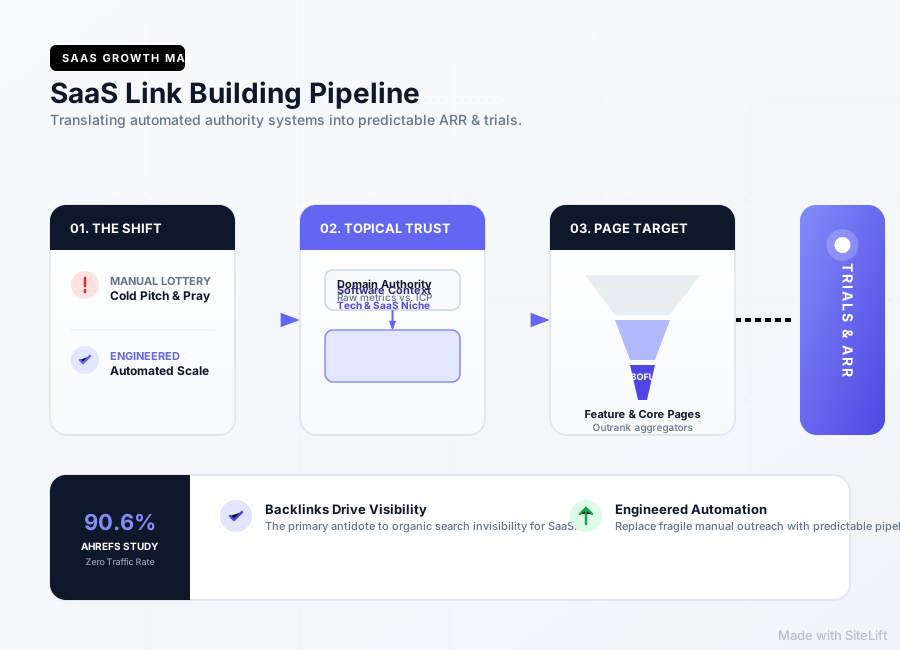
Infographic by SiteLift
Why Manual Email Outreach Is Overrated for Fast-Growing Software Companies
I have spent years watching B2B marketing teams burn valuable capital on the standard "outreach agency" playbook. You know the drill: an agency charges an $8,000 monthly retainer, spins up 15 fake persona domains, and spams every editor on Substack with broken templates asking for a link swap.
It is inefficient, it irritates your industry peers, and it consistently damages your brand.
The reality of modern search is that algorithms have grown exceptionally capable of deciphering natural editorial consensus from manufactured outreach. When twenty different websites suddenly drop identical anchor text into unrelated articles, machine learning filters detect the footprint. The search engine simply nullifies the link equity—or worse, marks your domain for an algorithmic penalty.
True leverage comes from systems that compound without manual labor. When you invest engineering resources into an interactive tool, or deploy an automated distribution network that broadcasts your product's technical content directly to interested publishers, authority takes care of itself. Stop hiring people to send cold emails that everyone deletes. Build engines that make your platform impossible to ignore.
— sitelift.io
How Do You Measure the Direct ROI of SaaS Link Building on Trials and ARR?
Vanity metrics like DR and DA are fine for high-level monitoring, but they do not pay for server costs or engineering salaries. Tracking SaaS authority requires direct attribution to commercial performance.
          The Full-Funnel SaaS Link Attribution Chain
┌─────────────────┐       ┌─────────────────┐       ┌─────────────────┐
│ Backlink from   │ ----> │ Authority Lifts │ ----> │ High-Intent     │
│ Authority Site  │       │ Target URL SERP │       │ Organic Traffic │
└─────────────────┘       └─────────────────┘       └────────┬────────┘
                                                             │
                                                             ▼
┌─────────────────┐       ┌─────────────────┐       ┌─────────────────┐
│ Net New ARR &   │ <---- │ Product Trial / │ <---- │ Direct Click-   │
│ Lower CAC       │       │ Demo Conversion │       │ Through Traffic │
└─────────────────┘       └─────────────────┘       └─────────────────┘
Keyword Velocity and SERP Visibility for Bottom-of-Funnel Queries
Track the movement of your core commercial keywords weekly. When an authoritative backlink goes live, monitor how quickly your target landing page climbs from position 18 to position 4 for bottom-of-funnel searches.
Tracking keyword velocity shows the direct cause-and-effect relationship between specific referring domains and SERP shifts. To learn more about modern automation tools that handle this monitoring, see how modern SEO backlinks software operates without spam tactics.
Multi-Touch Attribution: Connecting Referring Domains to Trial Conversions
A high-tier backlink produces two revenue streams:
- Indirect Search Lift: Increasing organic rankings and search engine traffic to the target URL.
- Direct Referral Pipeline: Potential customers reading an industry article, clicking the citation, and registering for an account.
By setting up multi-touch attribution models inside your analytics stack, you can track users from their initial referral session through product activation to paid conversion. If a single partner link brings in 15 qualified enterprise trials over twelve months, the real-world value of that backlink can easily clear six figures in contract value.
Link Quality Auditing: Assessing Relevance, Traffic, and Anchor Text Balance
Not all links are an asset. Maintain a clean backlink portfolio by evaluating these three criteria:
- Topical Proximity: Does the referring domain publish content relevant to your software category?
- Organic Search Health: Does the referring site have healthy search traffic of its own, according to search indexes?
- Anchor Text Diversity: Does your anchor text balance look natural, or is it stuffed with unnatural commercial keywords?
Pro Tip: Keep exact-match commercial anchors (e.g., "best billing software") under 5% of your total backlink profile. Aim for branded terms, clean URLs, and organic editorial phrases (e.g., "this breakdown from YourBrand") to protect your site against search engine link spam algorithms.
What Are the Common Pitfalls to Avoid in SaaS Link Building?
Scaling authority quickly often tempts marketing teams into high-risk shortcuts. Avoiding these structural mistakes will keep your domain out of algorithmic crosshairs.
Over-Relying on Low-Quality Guest Post Networks and PBNs
The internet is flooded with private blog networks (PBNs) disguised as "tech news blogs." These domains produce no real value, attract no actual human readers, and exist solely to sell sponsored links for $100 a pop.
As industry publications like Search Engine Land routinely emphasize during core algorithm updates, search engines consistently devalue commoditized guest post directories. Sponsoring content on these domains is a waste of capital that exposes your domain to future manual actions.
Neglecting Bottom-of-Funnel Feature and Landing Pages in Outreach
A classic failure in SaaS SEO is sending 95% of incoming backlinks to either the homepage or surface-level educational guides.
While top-of-funnel guides naturally attract links more easily, they do not directly drive product conversions. You must balance your link distribution. Funnel authority into core platform features, product integrations, and workflow solution pages if you want organic traffic to convert into paying accounts.
                  Healthy SaaS Link Distribution Model
┌─────────────────────────────────┬──────────────────────────────────────┐
│ Page Type                       │ Recommended Target Allocation        │
├─────────────────────────────────┼──────────────────────────────────────┤
│ Core Homepage & Brand Identity  │ 30% (Builds foundational trust)      │
│ Bottom-of-Funnel Solution Pages │ 40% (Directly drives trials and ARR) │
│ High-Value Tools & Telemetry    │ 30% (Passive link-attraction assets) │
└─────────────────────────────────┴──────────────────────────────────────┘
Treating Link Building in Isolation from Product Experience
Backlinks can bring search engines and potential buyers to your door, but they cannot fix poor conversion rate optimization (CRO) or an uninspired product experience.
If an authoritative link sends thousands of qualified visitors to a slow-loading, confusing landing page with a convoluted signup flow, your trial conversion rates will plummet. Ensure your product messaging, onboarding simplicity, and page speed match the authority of the domains recommending you.
Scaling SaaS Authority on Autopilot with SiteLift
Building organic authority should not pull your core team away from building great software. The manual path—managing agencies, screening outreach lists, and debugging fragmented publishing pipelines—eats up cycles that belong on product development.
This operational drag is precisely why companies choose SiteLift.
SiteLift acts as an autonomous growth engine, managing your organic optimization end to end. By automatically generating targeted content, distributing it across a curated network of authoritative platforms, and integrating cleanly with your CMS, SiteLift scales backlink velocity and domain trust on autopilot.
Instead of burning engineering and marketing hours tracking down references, you can let an intelligent publishing pipeline compound your organic visibility, trials, and pipeline ARR in the background. If you're weighing agency costs against automated platforms, explore why modern teams rely on AI workflows over traditional B2B SEO agencies.
FAQ
How does SaaS link building differ from traditional link building?
SaaS link building focuses on enterprise context, pipeline ARR, and bottom-of-funnel software queries rather than raw volume or basic Domain Authority metrics. Backlinks must come from relevant technical platforms, integration partners, and software publications to move the needle on competitive commercial search terms.
How long does it typically take for SaaS link building to impact organic trials and ARR?
Most software platforms begin seeing noticeable keyword movement and visibility shifts within 60 to 90 days of consistent backlink acquisition. However, substantial trial generation and closed-won ARR typically compound around month six, when authority gains help bottom-of-funnel solution pages outrank major review aggregators.
Can link building workflows and content distribution be safely automated?
Yes, provided the automation prioritizes editorial relevance and quality. Modern automation focuses on programmatic distribution across verified partner networks, dynamic internal linking, and telemetry reports. This avoids the penalties associated with legacy spam techniques like scraping forums or running automated cold-email scripts.
What is product-led link building, and how do SaaS companies implement it?
Product-led link building is the strategy of creating free, interactive web-based tools, calculators, or templates using your team's engineering skills. Because these assets solve immediate workflow problems without friction, third-party sites naturally cite and link to them as resources, earning you high-tier backlinks without manual pitches.
How many backlinks does a B2B SaaS startup need to start ranking?
There is no fixed universal threshold. Ranking for long-tail, low-competition keywords may require only 5 to 10 referring domains from topical sources. Conversely, outranking aggregators like G2 or Capterra for high-intent, head-term commercial queries often demands dozens of high-authority citations pointing directly to your commercial feature pages.
Topics Covered:
- saas link building
- b2b saas seo
- saas digital pr
- product-led link building
- saas content distribution
More from SiteLift

Site Architecture for SEO and AI Search: Structure for Crawlers, Users and LLMs
Master site architecture for SEO, web crawlers, and AI engines. Discover how to build topic clusters, reduce click depth, and optimize crawl budget.

AI Search Optimization Services vs Autonomous Platforms: Which Scales Faster?
Compare ai search optimization services vs autonomous platforms on speed, cost & AI citations. See which scales faster and start compounding.

Visibility Tracker Explained: Measure True Share of Voice Across Google and AI Search
Discover how a visibility tracker measures search visibility scores and share of voice across Google and AI search engines to compound your organic reach.