Auto Link Building: How Automation Earns Authority Without Spam
If you’ve heard the phrase auto link building and immediately thought of spam bots, forum blasts, and Google penalties, you’re not alone. I did too.
But that version is dead. Modern automated link building has nothing to do with blasting 10,000 directory links overnight. When done right, it’s programmatic syndication of genuinely useful content across a vetted premium distribution network — no cold email begging, no PBNs, no sketchy Fiverr gigs.
In this guide, I’ll break down how automation earns real authority without spam, what Google actually allows, and how to plug it into your SEO strategy for both classic search and AI search.
Key Takeaways
| What You Need to Know | The Short Answer |
|---|---|
| What is auto link building today? | Programmatic creation + distribution of useful content across vetted publishers, matched by AI for contextual relevance |
| Is it white hat? | Yes, if links are editorial, topically relevant, on real-traffic sites, with natural anchors — no manipulation |
| Why automate? | Manual outreach now costs $500+ per link and scales poorly; automation fixes velocity and cost |
| What to vet? | Real organic traffic, clean link profiles, anchor diversity, indexation, and AI-engine citations |
| How to start? | Build topic clusters, set sustainable velocity, monitor keyword momentum and referrals |
What Is Auto Link Building and How Has It Evolved?
Let’s clear up the confusion, because Google’s definition and most old blog posts don’t match reality anymore.
Old-school auto link building meant software like GSA Search Engine Ranker, ScrapeBox, and forum profile bots. You fed them a URL and anchor text, they scraped the web and dropped links everywhere — blog comments, wikis, directories, trackbacks. It worked briefly in 2012. Then Google’s Penguin updates and its guidelines on link spam schemes crushed it.
The new model is completely different. Think content syndication on autopilot, not link blasting.
The Legacy Dilemma: Black-Hat Scrapers vs. Manual Outreach
For a decade, SEOs had two bad choices:
Use black-hat scrapers: Fast, cheap, and guaranteed to burn your domain. These tools created patterns Google can spot in seconds — same anchor text 500 times, links from zero-traffic pages, foreign-language forums linking to a SaaS site in Texas.
Do manual outreach: Safe, but painfully slow. Find prospects, verify emails, personalize pitches, follow up three times, negotiate placement, send content, chase the live link. Repeat 100 times for 3 links.
Neither scales for a modern growth team.
The Shift Toward Programmatic Syndication and Workflow Automation
What changed is the infrastructure. Instead of scraping random sites, a modern backlink automation platform owns or partners with a pre-vetted network of real publishers.
The workflow looks like this:
- AI analyzes your cornerstone pages and target topics
- It generates helpful, original supporting articles — not spun gibberish
- Semantic matching pairs each article with the most contextually relevant publishers in the network
- Content is published with natural, editorial links back to your site
- Indexation, traffic, and keyword movement are tracked automatically
You’re not tricking an editor. You’re publishing useful content at scale where editors have already agreed to accept it, provided it meets quality bars.
Pro Tip: Think of auto link building like podcast syndication. You create one strong story once, then distribute tailored versions to 20 relevant shows. No one calls that spam because the audience fit is real.
Understanding White Hat Backlinks at Scale
So what makes automation white hat? Google doesn’t ban automation itself. Its Search Essentials ban manipulative intent — buying links to manipulate PageRank, excessive exact-match anchors, large-scale article spinning, and links from irrelevant, low-quality sites.
White hat backlinks at scale check three boxes:
- Editorial relevance: The link makes sense in context and helps the reader learn more
- User value: The linking page would exist and rank even without your link
- Genuine platform authority: The publisher has real traffic, real readers, and its own rankings
If your automated system can guarantee those three, you’re doing digital PR programmatically, not building a link scheme.
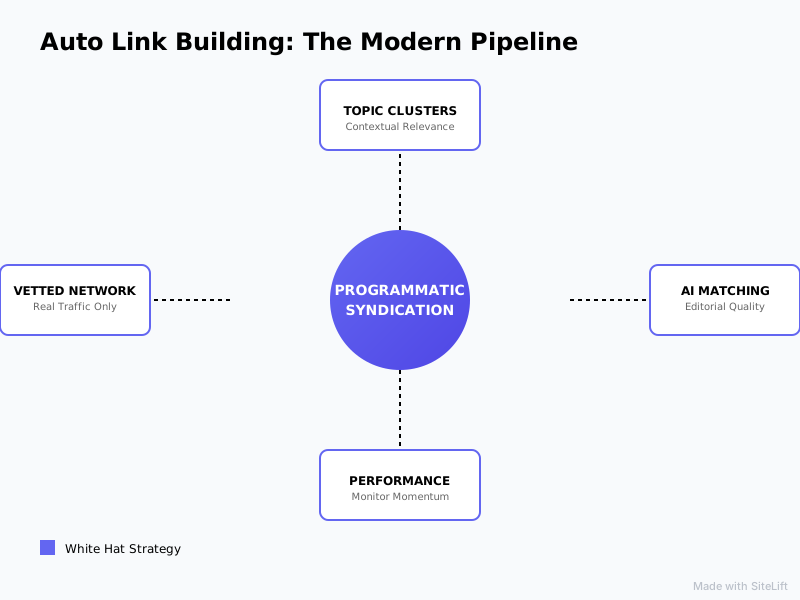
Infographic by SiteLift
| Legacy Spam Automation | Modern Compliant Automation |
|---|---|
| Scrapes random forums, comments, directories | Publishes on pre-vetted publishers with real traffic |
| Spun content, exact-match anchors repeated | Original helpful content, diverse natural anchors |
| 500 links overnight, then nothing | Steady, throttled velocity matched to brand size |
| Zero editorial control | Topic-matched, human quality checks + AI relevance |
| Triggers Penguin / spam systems | Aligns with helpful content and spam policies |
Why Does Traditional Manual Link Building Fail Modern Growth Teams?
I still do manual digital PR for hero campaigns. It has its place. But as your primary link engine? The math breaks.
If you want to understand the full upside of getting this right, read through these 7 link building benefits that compound traffic and AI visibility — authority compounds, but only if velocity is consistent.
The Unsustainable Cost and Labor of Cold Email Outreach
Manual links are expensive. A survey by Siege Media found the average cost of a single high-quality link via outreach exceeds $500 when you factor in strategist time, prospecting, content creation, and placement fees.
My experience matches that. For SaaS and legal and finance, I’ve seen $400-$800 per placement all-in. Need 50 quality referring domains to compete in a mid-difficulty SERP? That’s $25,000-$40,000 in labor before you’ve written a single product page.
For a deeper breakdown of retainers vs. pay-per-link vs. automation, see this 2026 guide to what quality backlinks really cost.
And cost is only half the problem. Your team burns out chasing replies instead of building strategy.
Plummeting Response Rates in Saturated Inboxes
Editors get 50-100 pitches a day. Most are AI-generated templates pretending to be personal: “Loved your recent piece on [TOPIC]!”
Response rates under 3-5% are now normal, even with great targeting. Follow-ups help, but they also annoy the exact people you want relationships with.
The Ahrefs team documented this traffic-link gap well in their study of over one billion pages showing 90.63% get zero organic traffic — and their consistent finding is that pages without backlinks almost never break through. You can’t fix that with three outreach emails a month.
Unpredictable Publishing Velocity and Authority Bottlenecks
Manual outreach creates feast-or-famine link profiles. Three links one month, zero the next two, then a sudden guest post spike. Google’s spam prevention systems are excellent at spotting unnatural patterns, but they also reward consistent authority growth.
Growth teams need predictable velocity. If you publish four cornerstone guides this quarter, you need supporting authority for all four — not just the one that happened to get a journalist reply.
That’s especially painful for SaaS teams running product-led content. My breakdown of how SaaS brands scale trials with automation instead of cold email shows why manual outreach can’t keep up with weekly feature launches and comparison pages.
Pro Tip: Audit your last 6 months: links earned per month, cost per link, and time-to-live. If velocity is flat while competitors add 15-20 new referring domains monthly, you don’t have a content problem — you have a distribution problem.
How Does Auto Link Building via a Backlink Automation Platform Work Without Spam?
This is where most old “auto link building = black hat” articles miss the plot. They review mail-merge tools like Hunter or Pitchbox and call that automation. Real automation isn’t faster email. It’s an end-to-end publishing pipeline.
Curated Premium Distribution Networks vs. Web Scraping
A premium distribution network is the opposite of a PBN or link farm.
Link farms exist only to sell links. They have no traffic, thin content, and outbound links to casinos, CBD, and essay mills on the same page. Google deindexes them in waves.
A premium network is a group of real niche sites, blogs, and media properties with:
- Actual organic traffic and keyword rankings
- Human readership and newsletters / social distribution
- Editorial standards and topical focus
- Diverse backlink profiles of their own
Brands like SiteLift plug into this kind of ecosystem. Content isn’t forced onto a site — it’s matched to sites where it belongs. A fintech guide goes to finance and SaaS operations publishers, not to a recipe blog that also links to plumbers.
Analyses from Search Engine Journal on scalable link acquisition and link spam risks consistently make the same distinction: relevance and editorial standards separate PR from schemes.
Semantic AI Matching for High-Context Editorial Placements
Old tools matched on keywords: insert “best CRM” 20 times, drop link. Modern systems match on meaning.
Semantic AI looks at entities, intent, and topical depth. For example, if your cornerstone is “SOC 2 compliance checklist,” it won’t just find pages containing “SOC 2.” It finds articles about cloud security audits, vendor risk reviews, and startup fundraising diligence — where a link to your checklist genuinely helps.
That contextual fit does two things:
- Readers actually click, which creates referral signals
- Google sees natural co-occurrence — surrounding words like audit, evidence, auditor, access control — instead of over-optimized exact anchors
Research from Backlinko on why top results have 3.8x more backlinks than positions 2-10 shows authority still correlates heavily with rankings. But it’s not raw count that matters now. It’s relevant authority from topically aligned pages.
Autonomous End-to-End Publishing Pipelines
The real unlock is CMS integration. A proper platform connects to WordPress, Webflow, Shopify, or via API, then runs continuously:
- Detects new or updated cornerstone content
- Generates supporting cluster articles briefed around search intent
- Distributes to matched publishers on a throttled schedule
- Verifies live links, indexation, and anchor distribution
- Feeds keyword momentum back to prioritize next topics
No CSV exports. No “hey, just bumping this to the top of your inbox.” Your site earns links while you ship product.

What Core Criteria Distinguish Safe Backlink Automation From Risky Schemes?
If you’re vetting any automated solution, run it through this checklist. If a vendor can’t answer clearly, walk away.
Publisher Domain Quality and Real Organic Traffic Signals
Forget DA and DR as headline metrics. They’re third-party guesses and easily gamed. Look for:
- Real organic traffic: Consistent traffic in Ahrefs / Semrush from its home country, not just 50k spammy keywords
- Diversified referring domains: Hundreds of natural inbound links, not 90% from one network
- Traffic-to-link ratio: Pages that rank and get visits, not orphan pages created only for your link
- No farm footprints: No “write for us + casino + CBD + crypto” sell-everything pages, no sitewide footer links
Ask for sample publishers and check them yourself. Can you find them in Google for non-brand queries? Would you be proud to show a customer that placement?
Anchor Text Diversity and Natural Semantic Co-occurrence
Over-optimization is the fastest way to turn good automation bad. Safe profiles look boring — in a good way:
- 50-60% branded / URL / naked anchors (your brand, sitelift.io, “here”)
- 20-30% topical / partial-match (“autonomous SEO pipeline,” “distribution network guide”)
- 5-10% exact-match max, only where it reads naturally
- Plenty of semantic co-occurrence around the link, not just in the anchor
A good backlink automation platform enforces this automatically. It rotates anchors, varies surrounding copy, and avoids pointing 30 links at one page with the same money keyword.
Visibility Beyond Google: AI Engines and Generative Search
Here’s what legacy link guides ignore: links now fuel AI visibility.
ChatGPT, Perplexity, Gemini, and AI Overviews don’t just count links. They extract brand mentions, citations, and consensus across trusted sources. If your brand is cited consistently across relevant publishers with clear, factual descriptions, LLMs are far more likely to mention you.
That’s why white hat backlinks scale matters doubly now. One guest post won’t move an LLM. Twenty consistent, topically aligned mentions across a premium network will. Automated distribution creates the breadth of evidence generative engines need to trust you.
If you’re in a trust-heavy vertical, this effect is even stronger. I’ve seen it with legal — see this playbook on earning local legal backlinks and AI search trust on autopilot — where consistent citations directly impact both map packs and AI answers.
How Can Brands Implement Auto Link Building into Their SEO Strategy?
Automation isn’t set-and-forget chaos. The best programs I’ve seen are disciplined and boring. Here’s a simple rollout that works worldwide, from startups to enterprises.
Establishing an Autonomous Topic Cluster Framework
Don’t automate links to a messy site. Start with structure:
- Pick 3-5 cornerstone money pages you must rank (e.g., pricing, use case, main category)
- Build 8-12 supporting guides per cornerstone that answer pre-purchase questions
- Internally link clusters tightly so authority flows upward
- Assign each cluster a target publisher set (e.g., SaaS ops blogs for workflow content)
Automation then amplifies what’s already logical. Each syndicated article points to the most relevant cluster page, not always the homepage.
Setting Sustainable Link Velocity and Monitoring Indexation
Velocity should match your footprint:
- New sites (<6 months, <50 referring domains): 5-10 new referring domains / month, mostly branded
- Growing sites (50-300 RD): 15-30 / month, mixed anchors, focus on clusters
- Established brands (300+ RD): 30-60+ / month is normal if content output supports it
More important than speed is indexation. Monitor what percent of new links are crawled and indexed within 14-30 days. If indexation drops below 60-70%, you’re pushing too fast, targeting weak publishers, or publishing thin content.
Pro Tip: Stagger cornerstone pushes. Promote Cluster A in weeks 1-2, Cluster B in weeks 3-4. This mimics natural PR cycles and prevents every new link pointing to the same URL.
Tracking Keyword Momentum and Referral Impact
Forget vanity link counts. Track:
- Keyword momentum: Number of keywords in positions 4-20 moving up within 30-60 days of distribution
- Share of intent: Impressions for core commercial terms, not just long-tail blog traffic
- Referral quality: Clicks from publisher articles — even 20-50 highly qualified visits beats 1,000 bot hits
- AI citations: Are you appearing in Perplexity, ChatGPT browsing, or AI Overviews for target queries? Track mentions monthly
When those move together — rankings, referrals, and AI mentions — your automation is building real authority, not just link graph noise.
My Take: Manual Grind Isn’t More Virtuous, It’s Just Slower
I’ll be honest: I romanticized manual outreach for years. Landing a DR 78 editorial link after six follow-ups felt like craft. And sometimes it is.
But most manual link building isn’t craft. It’s spreadsheet drudgery, template personalization theater, and paying $600 for a link on a site that will sell the same slot to your competitor next week.
I’ve run both models. Manual wins for one-off hero stories. Automation wins for everything else — the compounding middle that actually moves revenue: comparison pages, use-case hubs, integration docs, location pages. That’s 80% of organic pipeline, and it starves without consistent distribution.
The anti-automation crowd also misses how search has changed. We’re not just optimizing for ten blue links anymore. We’re optimizing for AI answers that synthesize 20 sources. No human team can manually earn 20 high-fit mentions per cornerstone without burning out. A vetted network with semantic matching can, and it does it without spam because the content is actually useful.
If you care about craft, put it where it counts: original research, strong opinions, better product content. Then let machines do the repetitive distribution work they’re better at.
That’s not cheating Google. That’s operating like a modern media company.
— sitelift.io
Build Authority on Autopilot with SiteLift
If manual outreach is bottlenecking your growth, you don’t need more cold email tools. You need a system that creates, publishes, and distributes authority-building content for you.
sitelift.io is an autonomous SEO and AI visibility platform built for exactly that. It generates targeted content, distributes it across a curated premium network, integrates with your CMS, and tracks keyword momentum in real time — so organic traffic and AI citations compound without manual intervention.
Start with one topic cluster, set your velocity, and watch consistent, white-hat placements stack up week after week.
FAQ
Is auto link building safe according to Google's Search Essentials?
Yes, when it avoids manipulation. Google’s Search Essentials prohibit link schemes intended to manipulate rankings — like buying links, large-scale spun articles, and irrelevant directory blasts. Editorial syndication of helpful content on relevant, real-traffic publishers with natural anchors is not a scheme. Risk comes from intent and patterns, not automation itself.
What is the difference between automated link building and link farms?
Link farms are networks of low-quality sites built solely to sell links. They have little to no organic traffic, publish anything for a fee, and link out to unrelated niches. Automated link building via a premium network uses real publishers with traffic and editorial standards, matched topically to your content. One manufactures links; the other distributes content that earns links.
How does a backlink automation platform earn links without manual outreach?
It replaces cold pitching with pre-approved distribution. The platform maintains relationships with vetted publishers, uses AI to match your cornerstone topics to the right outlets, creates tailored supporting articles, and publishes them with contextual backlinks. Because placement paths already exist, there’s no need for one-to-one email negotiation for every link.
Can auto link building improve my brand's visibility in AI search engines?
Yes. Generative engines like ChatGPT, Perplexity, and Gemini rely on consistent brand mentions and citations across trusted sources to decide who to recommend. Scaling relevant mentions across a premium distribution network increases your chances of being cited in AI answers, especially when messaging is consistent and factual.
How fast should I build automated backlinks to avoid search penalties?
Match velocity to your size and content output. New sites should aim for 5-10 new referring domains per month, growing sites 15-30, and established brands 30+. Prioritize steady pacing, anchor diversity, and indexation rates over raw speed. A sudden spike of exact-match links to one page is far riskier than consistent branded and topical links spread across clusters.
Topics Covered:
- auto link building
- automated link building
- backlink automation platform
- premium distribution network
- white hat backlinks scale
More from SiteLift

The Evolution of SEO Backlinks Software: Automating Authority Without Spamming
Discover how modern seo backlinks software scales organic authority safely. Learn how to avoid Google penalties and build white-hat links on autopilot.

White Hat Link Building Techniques That Still Work for Google and AI Search
Discover 5 proven white hat link building techniques that earn top Google rankings and AI search citations. Master ethical link building today.

Ecommerce Link Building: Scale Product Authority and Revenue on Autopilot
Master ecommerce link building. Learn how to secure product page backlinks, execute digital PR, fix redirect leaks, and automate your store authority.